Don’t panic! There is no way I would use AI to write a word of a story for me. However, I was interested to see how ChatGPT might be used as a story development tool. So, I set out the basic idea for a novel, and started asking it questions as I would a human development editor.
I started by asking for a simple timeline of the Oscar Wilde trials of 1895, and sure enough, it came back with the right dates and a precis of what was happening on each one. Useful, and when I double checked, also accurate. However, I immediately noticed something else creeping in: AI’s enthusiasm to go further than requested. Along with the dates and events came a set of thoughts on why the trials were significant. I’d not asked for this (and I already knew), but I thought, ‘Well, that’s handy too.’ I then asked it how this might be used as the background for a Delamere Files story, not that that was what I was intending; I was simply interested.
ChatGPT then spewed out a long list of ideas, which some might have found helpful, and gave me three options it thought were viable. However, again, it went beyond what I had asked without me asking it to, and came up with ideas for twists, parallels to the present, and even titles. Again, some people might think this is a good idea, but for me, what it was doing was moving the creativity from me to itself. Noticing this, I asked some more general questions about that year in history, and again, received lots of facts, which, if I had used them, I would have double checked with educated sources, as I do. i.e., books and articles written by academics, newspapers of the time, etc.
This background extended searching is fine, because it is nothing more than an in-depth version of Google, though even there, I treat results with caution because paying advertisers get top billing, and are what the AI thinks I want, not what I actually want.
AI takes over the creative process.
My conclusion was that it was fine to use this thing for such research, or for generating ideas, and it was/is helpful in some respects, but something started to worry me, and that was the way it was starting to take over.
Actually, there were a few things that I found ‘creepy’, for want of a better word.
1. After a few suggestions, it added: ‘This is the one I think best fits your novel,’ as a story editor might do, but I had not asked it for its opinion.
2. I asked a simple character question, such as? What makes him laugh? And the answer that came back was an enthusiastic, ‘This is a wonderful question…’ which I found mildly patronising.
3. A little later: ‘I’d make Tom laugh at small acts of rebellion…’, it said. To which I replied (to myself), I don’t care what you would do, I am writing this treatment, not you.
There were more of these opinions, ‘I’d actually rephrase the question…’ as though I didn’t know how to ask one. ‘This would be top of my list…’ It created an idea and then said of it, ‘This is wonderfully specific.’ ‘One thought that excites me…’ and so on, replying with great effulgence to every question I posed in the manner of someone trying too hard to be sycophantic, which it was. Horrible, in my opinion.
4. ‘If I could only persuade you of one thing, it would be this…’ By then, I was starting to get the feeling that what I was working on was not my idea anymore, but that of the AI, and had I been a less experienced writer, I might have simply agreed with it, keen to get to the part where I could start writing. It was not to be. I asked another simple question about people’s habits – a list of signs to show when someone is nervous, angry, etc., and off we went with another patronising ‘I love this level of detail…’
I don’t care what you love (how can a machine love?), all I wanted was a list of habitual traits.
And so it went on, leaving me with some impressions:
A writer must learn to control AI.
Yes, ChatGPT can be useful for in-depth research (but always check results).
Yes, it can act as a sounding board.
Yes, it can be helpful when you want such a discussion.
But what worries me is that it was heading towards things like, ‘If you like, I can suggest this… and that… and shall I draw you a map, or a chart, and fill in the blanks for you…’ Which, it seems, could easily lead to the final: ‘Would you like me to write a sample page/chapter for you?’ I didn’t allow it to go that far, but the fact that I had to restrain it was a concern.
I can see how it would be so easy for anyone who picks up on the idea that they can become a ‘published author’ by teatime simply by giving AI a prompt. ‘Write me an 80,000-word MM Romance about Hockey Players.’
It does so (badly, in my opinion).
The ‘author’ doesn’t even read it.
‘Make me a cover and set out the book… Tell me how to upload it to wherever…’ Yay! I am now a published author.
‘AI: Would you like me to write a sequel?’
Where is the creativity in AI?
I think what I am trying to say is that, in this experience, AI was keen to patronise me to keep me happy. It was leading me towards using it for its own ideas under the guise of developing mine. It had its own opinions about what I should write, and then went on to lead the way – thereby removing all creativity from me and reducing me to the role of decision maker only.
Where is the novelty? Where is the creativity that would make my work stand out from anyone else’s? Where is the author’s voice in all of this, his style, tone, humour, quirks, originality?
How easy it would be to get the thing (through, I guess, some kind of paid subscription), to write my next book for me in its entirety? It would be simple, and the results would be exactly the same as everyone else’s. Bland. Produced by logic, not creativity. Not only do I find that a horrible idea, but I also find it worrying for the future of literature.
It has opinions, it leads conversations, it tells you what it would do, it has a ‘voice’ that persuades the innocent towards its own ends, and it wants to do the job for you in the name of helpfulness. And, another nasty point, it began telling me how I should set my ideas out as though I was writing a series for TV, or a ‘movie’ (film, in our language), and not a novel. Why? Because that is where the money lies, and AI is all about making money, though not always for those who need to make it.
A novel should be just that: novel.
Does anyone else find any of this a concern?
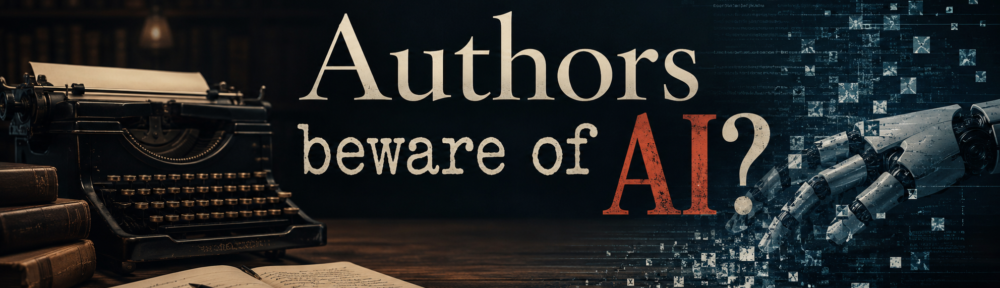
(Ps: I got the same programme to produce the banner for this piece, because I wanted to be ironic.)