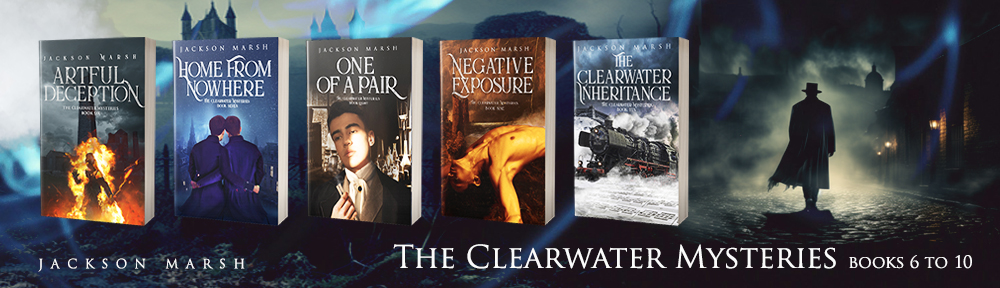
Now that the last in the Larkspur series is almost ready to be published, and I have sent it away to be proofed, what next?
I’ve still to complete the blurb and author’s notes which will also need to be proofread, and I will be working on them later today. As for the next book, I have a few ideas, and I’d like to ask you for more.
The Clearwater Companion
My next job is to put together a companion to go with the Clearwater and Larkspur series. For now, I am calling it ‘The Clearwater Companion’, but I also have an idea I might call it:
Barbary Fleet & Other Matters A Guide to the Clearwater and Larkspur Series
When I set about writing the Larkspur series, the first book was to be titled ‘Barbary Fleet,’ and I wrote the first couple of chapters to see how it would go. It didn’t go very far. Not because I didn’t have a good idea, but because I was keen to get the Larkspur Academy up and running, and this book was to be about Fleet, his past, and how he came to be in charge of the academy. It was to be a prequel, I suppose, and like ‘Banyak & Fecks’, would lead to the first of the new series. However, I soon realised I didn’t know enough of what was to happen in the Larkspur world, to give it a prequel, and the time wasn’t right for Barbary Fleet’s past. As Fleet would have said, ‘My past must remain in the future.’
I even had an idea for the cover:
That’s actually my husband photoshoped into a picture and created by Andjela, my cover designer. It was a Birthday present for Neil.
Instead, as I wrote the Larkspur series, I kept trying to find a place where I could put Fleet’s past, how he came to Larkspur and what his story was, but I never found the chance. There’s a large twist in his story, but it never fitted comfortably into any of the others.
I’m saving it for the Companion, and it is one of the unpublished sections and stories from the Clearwater and Larkspur worlds that will appear in the finished book.
The book, by the way, will contain a spoiler alert and I will suggest that people only treat themselves to it once they have finished reading both series.
As for ideas, so far I have:
Cut sections from some of the books.
Anecdotes and backstories, such as the one mentioned above.
Drawings of some of the characters like I have in the Larkspur series, but didn’t put in the Clearwater ones.
Maps.
Some of the author’s notes / information that, again, I didn’t put in the Clearwater books.
Quotes from some of the characters.
An explanation of titles.
Threads through the books that readers may not have noticed.
That list is the result of a quick brainstorm, and there may be more ideas to come. I started a folder for this project over two years ago, but there is little in it. I started writing character biographies, but frankly, that became dull. So, I don’t think we’ll have ‘fact pages’ about each of the main characters. It’s a companion, a bit of fun and an extra, not a Haynes manual.
So, my shout out to you is this:
If you have any ideas, or if you want to suggest what you would like to see in the book, please send them to me either via email or through my Facebook page. Perhaps you have unanswered questions, or want to know something about one/some of the characters that’s not been explained, let me know and I will see what I can do.
Currently, my first-in-series novel, Deviant Desire, is enjoying a book funnel promotion in their M/M Series Starters listing. There are many series-starters on the list, which you can explore from here. This gives me an excellent opportunity to talk about the first story in the Clearwater Mysteries, and to address the title of today’s blog: How To Start an M/M Romance Series.
First, have a deviant desire to write.
I’ve often been asked,
‘How did you start writing the Clearwater series?’
My answer?
By accident.
Back in 2018, I’d written a novel called ‘The Stoker Connection,’ and by doing so, unleashed within myself the deviant desire to write more mysteries based on fact, but ones that also included romance and adventure.
I’ve been a fan of ‘Dracula’ since I was 11 and begged for a copy for Christmas. (I was mad on the Hammer Horror films of the 70s and had a thing for creepy castles and what I now know as Gothic.) Dracula is written in the form of diaries and articles, journals and messages, and that makes it all the more real. So, when I set about ‘The Stoker Connection’, I wrote it in diary form, and based the story on a great big What If?
“What if you could prove that the greatest Gothic horror novel of all time was a true story?”
That was my starting point, and if you want to read how it all turned out, you can find The Stoker Connection here.
The Clearwater Mysteries
What ‘Stoker’ did was open up another What If? In this case,
‘What if Jack the Ripper had killed rent boys?’
That led to a
‘Why not?’
and then came the,
‘I can, and I will.’
Why not write a story where the villain is the famous Ripper of history? It’s an unsolved crime(s) that continues to grab the imagination of everyone, from conspiracy theorists to famous novelists, filmmakers to composers, so why not have a go? I’d read just about every book on the subject, seen the documentaries and films, and had gathered an amount of knowledge of the times and places. I’d even lived not far from Whitechapel and often walked its streets.
But… Yes, it had been done before, so I needed a different approach.
Make it a gay love story?
I’d written some classic MM Romance with ‘The Mentor of Lonemarsh House’ and other ‘Mentor’ books, and I’d dabbled with gay-to-straight mystery/romance/lore in my James Collins series, ‘The Saddling Series.’ What, then, would happen if I wrote a gay romance set in October 1888, the time the Ripper was stalking the streets of Whitechapel? The only way to answer a question like that is to set about writing one, so I did.
But…?How to make it faction?
Faction being a word for a novel where fact and fiction mix. How to make it realistic without descending into blood and gore, and how to make it dramatic? As if the original events weren’t dramatic enough. First, I thought, because it’s not going to be fact-fact, I will change Whitechapel to Greychurch, so I can create my own world. Greychurch is simply my name of the area of London, and now, eighteen books later, I rather wish I’d just called it Whitechapel, because the series has gone on to be accurate in historic detail apart from the names of a few places. Once they had appeared in ‘Deviant Desire’, it was too late to change them, so I still have Limedock for Limehouse, Westerpool for the Wirral, and St Matthew’s Park instead of Hyde Park. Hey ho! You write and learn.
But… Eighteen books by accident?
Well, yes and no. ‘Deviant Desire’ was meant to be a standalone novel, one that went into detail of the living conditions in the East End in 1888, and one that used facts as well as fiction, told a love story, and that was it. While writing it, I made references and gave nods to some of the facts from the original horrors. Astute Ripperologists may note that I have a double murder on one night, that some of the murder sites bear similarities to the originals (Mitre Square became Bishop’s Square, for example), and there are other hidden references which the avid reader might notice.
Yes, but… Eighteen books?
I’m getting there. The background to ‘Deviant Desire’ was London 1888, but what was the love story? Let’s call on another popular trend, I thought, one that some critics call cliché, and it is, a bit. Rich and poor, across-the-divide, Prince and Pauper, except, not a Prince but a viscount. In the British nobility, a viscount is less than an earl, more than a baron, but still an ancient title that often comes with much responsibility, and as much inherited wealth as debt. Of course, the other character had to be a rent boy, a ‘renter’ as he calls himself, and that’s how we ended up with the two main character’s you see on the cover. Archer Riddington, aka, the Viscount Clearwater, and Silas Hawkins, aka Billy O’Hara, the renter.
Their story starts with the line,
‘Silas Hawkins was searching for coins in an East End gutter when a man four miles distant and ten years older sealed his fate.‘
We don’t know who this man is yet, but within that line, we know Silas is poor, where we are, and that there’s going to be an age-gap element. The story continues… Silas has a best friend, a straight man with a big, er, talent, who works as a rent boy out of necessity, and who is an immigrant from Ukraine. Clearwater, meanwhile, sets his crotchety butler and his gorgeous, sexy footman the task of acquiring a renter for an interview. There are already enough ‘standards’ in the story, and I didn’t want another, i.e. the one where a rich man hires a poor man for a shag. Archer is more noble than that, and is using his new-found wealth to finance a shelter for homeless young men in the East End; rent boys, mainly. Thus, he wants to know what life is like for them and what they would want in such a shelter, and sends his staff to find someone who looks a little like a picture he drew. (There is an element of Archer wanting a fantasy to come true, and boy, does he get it.)
Yes, but…? I’m still getting there.
The story unfolds. Silas and his mate, Andrej, meet Archer. Silas immediately falls for him, and vice versa, at which point, the over-arching theme of the book begins: being gay in Victorian Britain was illegal, so everything that follows must happen away from the public eye.
So, now we have: rich and poor, nobility and renters, the East End and Knightsbridge, gay and straight, friendship and love, a 19 year old and a 29 year old, and our main cast can only love illegally. Oh, and there’s a series of murders taking place too, let’s not forget the villain of the piece. Let’s also not forget that the footman is in love with the viscount, the viscount is in love with the footman, but nothing has ever happened because, even within a nobleman’s house, relationships must not cross the threshold of the green baize door. (Upstairs and downstairs mustn’t mix.)
All these elements continue as the mystery unfolds, reaches a climax, and ends with an ending I was not entirely happy with. I was happy with it as a writer, but it left me feeling that there was something more. A longer story to tell. Characters have arced and changed, but where do they go next? What happens to the footman? Did the Ripper escape? Will he be back? Is he dead? And what am I going to do with this main cast of characters.
They’d already become so real, I knew Deviant Desire had to lead to something else.
It did, it led to 17 more novels.
At last! Yes, you see, I got there in the end.
What started as a one-off became a series, by accident, as I said. I hadn’t planned the series, so my ‘How To’ tip remains:
just get on and write it and see what happens.
It’s easy to base future stories on elements of those in the already-published earlier books, you don’t need to plan ahead. Having said that, as I worked through the series, I made notes of what I might like to see happen when the time was right, what other characters I could bring in, and what historical events I could use as fact in my fiction. Had I done all that before writing, Silas Hawkins was searching for coins… I would have found the prospect too daunting, so I am glad I just said, What if? and got on with it.
How Many Novels make up the Clearwater Series?
I mentioned 18, but that includes the follow-on series, the Larkspur Mysteries. The Larkspur novels include characters from right back in book one of Clearwater, Deviant Desire, and they even include threads that began in the prequel (which I wrote after Clearwater eight, ‘One of a Pair’, but which happens before Deviant Desire and leads into it). The two series are connected, and the five main characters, the ‘canonical five’ (you will note the Jack the Ripper reference) can be found playing parts in just about all eleven Clearwater and seven Larkspur books.
So, to answer the question, How To Start an M/M Romance Series, I’d have to answer:
Plan it, write book two before you publish book one, be passionate from the start, keep notes and a ‘bible’ for details, and keep going.
Or
Do what I did, and start one by accident.
Either way, I now have my own best seller, ‘Deviant Desire.’ Two actually, because the first in the Larkspur Series, ‘Guardians of the Poor’ is also doing well. People like a good ongoing series with characters who develop, and, I am pleased to say, that’s what you get with both the Clearwater and Larkspur mysteries.
Note: The last book of both series, ‘The Larkspur Legacy’ is due to be released around March 26th. You don’t have to have read all of the Clearwater books to enjoy the Larkspur series, it can be read separately, but you’ll get more from Larkspur if you’ve read Clearwater. You’re advised to read both series from the start and in order. You can find them all here:
Well, I wanted to give my readers an epic adventure, and that’s exactly what you’re going to get. Eventually. I am now fine editing the MS, and am on chapter 39 of 49 with a deadline of sending at least half the MS to be proofread on March 1st. Once this read-and-edit has been done, I want to start again with a read from the top before I send the MS to Ann, which only leaves me seven days including today.
Then, when that is done, I need to attend to the author’s notes, which have become a popular end to each of the Larkspur books, and then write a blurb.
Everything else is done; the cover, the map, and an illustration for the end of the book, so now, it’s just down to me and my beta reader (Neil), my proofreader, and my layout guys whom I shall contact nearer the time.
I am still heading for March 26th to release (and have a promo of the first in the series), but it’s got to be right. As I always say,
‘Don’t get it right, get it written, and then get it right,’
…and I am battling on getting it right by taking out words such as ‘get’, and I’ll let you know how it’s going in next week’s WIP Wednesday blog.
This week I am delighted to have fellow MM author, Ellie Thomas, over as a guest blogger. She is here to celebrate her new book, A Touch of Spice and to talk a little about the research behind her writing. I wish you a great release Ellie, the blog is all yours…..
A Touch of Spice
By Ellie Thomas
Thank you so much, Jackson, for having me as a guest on your blog today. I’m Ellie, and I write MM Historical Romance novellas. This week I have a release day for my new story, A Touch of Spice, set in Elizabethan London. It’s great to celebrate that here!
As I write historical stories, research takes up a big part of my writing preparation. Of course, websites are invaluable for fact and date checking and an online map for a sense of place, but there’s nothing like picking up a book to get solidly into a historical period. Or maybe that’s just my excuse for buying yet more reference books!
A Touch of Spice is the follow-up story to my last year’s Valentine’s story, The Spice of Life. In my new tale, I continue Gregory and Jehan’s ongoing love story and their everyday lives. Gregory is emerging from being trained as a servant in his relatives’ household, and Jehan has transitioned from a spice merchant’s apprentice to a shopkeeper. My intention in this new story was to give an impression of the colour, vibrancy and occasional danger of the crowded streets of Elizabethan London while depicting Gregory and Jehan’s loving relationship. So I had to grab my reference books.
I have two go-to authors for all things Tudor. The first is the fabulous method historian Ruth Goodman whose knowledge of day-to-day life in the 1500s is encyclopaedic. I find her books as lively and entertaining as they are informative (and I have most of them!)
For A Touch of Spice, I consulted How To Be A Tudor: A Dawn-to-Dusk Guide to Everyday Life. This is a brilliant resource for daily customs (clothes, food, mealtimes and so on) and also gives a fascinating insight into the Tudor mindset, which is pure gold for any author writing historical stories. For a little extra colour, I also had to browse How to Behave Badly in Renaissance Britain (worth buying for the title alone) giving further insight into what offended Tudor folk, including some choice insults. I mean who could resist calling someone a ‘prating fool,’ or a ‘ninnyhammer’?
The second author I turn to for Elizabethan mores is Judith Cook, the author of one of my favourite books, Roaring Boys: Shakespeare’s Rat Pack. This wonderful volume firmly puts Shakespeare and his contemporaries within the context of the bustling streets of overcrowded London. The introduction gives a wonderfully vivid description of the playwright and man about town Robert Greene, wearing a “wine stained doublet is in his favourite colour, ‘goose turd’ a virulent yellowy-green.” Irresistible!
In writing about Gregory and Jehan’s continuing love, I wanted to give a historically rich backdrop to their sweet love story to place the reader as firmly as possible in my chosen place and time. The fact I relished revisiting my invaluable sourcebooks was a bonus!
In the spring of 1573, twenty-one-year-old Gregory Fletcher is a happy man, set to move into the spice shop on London’s Ludgate Hill with his true love Jehan Zanini, who he spared from being condemned as a thief the year before.
But Gregory’s kind inclinations to help others in need tend to thwart the couple from fulfilling their dreams as Gregory delays living with Jehan to assist his adoptive family in a crisis.
Then William Anstell, their friend and the cause and saviour of Jehan’s previous problems, gets amorously involved with an unscrupulous tavern server and relies on Gregory and Jehan to resolve his embarrassing mess.
Can the lovers finally put aside distractions and other people’s problems to find lasting happiness?
Excerpt:
Mistress Cecily looked up from her stitching with a smile as Gregory entered her sewing room. Gregory felt a sting of nostalgia, that increasing sensation of being caught between two worlds. The safe patterns of boyhood grated against the exciting challenges of impending adult independence as he passed the age of a serving lad, only tied to this place by family loyalty.
As a courtesy, Gregory reported the purchase of the nutmeg and delivered his lady’s remaining money. Mistress Cecily nodded her head absently without bothering to count the change.
“And how is young Master Zanini today?” Mistress Cecily inquired.
“Both he and his trade are doing well, and he sends his compliments,” Gregory replied, the courtesy causing Mistress Cecily to smile more widely.
The Master and Mistress, Gregory’s de facto parents, had been delighted when he broached the notion of entering into merchandising. Jehan’s skill and knowledge of the goods he sold were never in question but Master Crossley had previously dealt with the business side of running the shop where Jehan was apprenticed. So the newly established merchant had scant experience of running a business and little certainty in his ability to notate letters and numbers.
Here, Gregory held the advantage. Growing up in a considerable household and being involved in its daily management proved invaluable, and Master Robert had guided him through the rest, poring for hours over the business ledgers and discussing how best to invest Jehan’s store of sovereigns.
If Master Robert had gladly imparted his knowledge of bookkeeping, Mistress Cecily had immediately bestowed her patronage on the Ludgate shop. Gregory reckoned that Master Crossley would not be dismayed at losing such a prestigious customer since he owned both premises, but Mistress Cecily’s friendly support to Jehan was a boon, as well as her recommendation of his services.
A few months after Jehan started trading from the narrow shop, Gregory was set to join him, openly as a partner in the business and privately, to conduct their burgeoning love affair. In overcrowded London, it was usual for men to share a room or even a bed without inciting gossip or moral outrage. Additionally, there was a small upstairs front room in direct proportion to the shop below, ideal for keeping the shop’s records. This chamber had a decent-sized window overlooking the street, garnering enough natural daylight for scribing.
Gregory had been preparing to decamp to Ludgate permanently in the depths of winter, when Master Robert’s elderly father had fallen down from the icy front steps of the Bishopsgate house. The doctor declared that Master Edward was lucky to get away with shock and bruising and a clean break of the bone in one arm. Gregory was a particular favourite of the old gentleman and had attended him in recent years more from fondness than duty. After the accident, not only did Master Edward require more practical assistance until his limb was mended, but the shock of the injury suddenly aged and confused him. For some months, it seemed that only Gregory’s presence could restore his good humour.
Neither Master Robert nor Mistress Cecily expected Gregory to remain to tend to their kinsman, but he could not bear to leave under the circumstances. After all, he reasoned, they had unhesitatingly opened their home and hearts to an orphaned boy. It would be unthinkable to repay those long years of kindness with desertion, especially when the old master needed him.
When he tried to explain his decision to Jehan, he feared outright rejection, even the end of their dreams of forging a life together, but although Jehan’s expressive face was sombre at the disappointing tidings, his dark eyes were full of compassion. “Family comes first,” He said. “You can’t desert Master Edward now. I sympathise, and I would expect no less of you. After all, if you hadn’t stuck by me when I was in trouble, where would I be now? You’re not the kind of man to abandon loved ones to follow your own desires, and I cherish you all the more for that quality. Never fear, I can wait a while longer.”
Ellie Thomas lives by the sea. She comes from a teaching background and goes for long seaside walks where she daydreams about history. She is a voracious reader especially about anything historical. She mainly writes historical gay romance.
Ellie also writes historical erotic romance as L. E. Thomas.
This week’s update on The Larkspur Legacy is encouraging. I am now about to start trawling through each chapter to check for better ways of writing things, obvious errors, grammar, characters’ speech patterns, and inconsistencies.
Because the story takes place over a period of ten weeks or so, and because there are various threads, with characters reporting back to a central place, I need to make sure I have all the dates and locations correct and feasible.
I have two weeks before I must send at least the first half to be proofread if I am to make the March 26th deadline for release, so any free time I now have has to be spent on the book.
Meanwhile, other elements are coming together:
The cover is 80% ready for approval.
I have had a map created.
I have an illustration I may/may not use.
Proofreader’s time is booked.
I’m also working on the blurb and author’s notes, though they come last on my list.
And so, to work…
If you are new to The Clearwater World then now is a good time to start binge reading the series. You have a month until the two interconnecting series are completely finished. Download Deviant Desire today, happy reading!
It’s a sad fact that many first-time writers will say, ‘I finished writing my book last night,’ when what they mean is, they finished writing a first draft. I’ve seen it myself, when someone has sought me out, and asked me to look at their publication, proudly showing it off, cover and all, printed and bound, and in their hand, and they’ve asked for my opinion. I used to tell them what they wanted to hear, but now I say, ‘Do you want my honest opinion, or do you want me just to say, it’s lovely?’
Most of the time, when someone asks you what you think of their work, they are asking for approval. They don’t want you to say how you think it could be improved, because they think it’s already perfect.
This happened last year: I was sitting outside our local bar as I often do in the summer afternoons, and someone I vaguely know bounded up with the first copy of his book under his arm. Knowing I make a living out of writing, he asked me to tell him what I thought. Honestly? Yes, please. He was one of the genuine ones. He wanted me to pull it apart so he could take it back to the people he’d paid to publish it and get them to make changes, so I knew I could be direct. I didn’t read all of it, only had a glance through, and seeing it had been printed in a sans serif font was enough for me. But, based on what I saw, here is a list of some of the things to avoid, look out for, be wary of and do when self-publishing. As usual, these are my opinions, and other writers will have a different view.
What happens after you’ve written your first draft?
Answer: You write a second, and third, and fourth, and as many as it takes to make it perfect.
Never pay to have your book published
You don’t need to. There’s no guarantee the people you pay thousands to will keep their end of the bargain. It’s vanity publishing, and often, they only put out what you put in. If you present an unfinished manuscript, or one that needs editing, they might say they will edit, but often, they don’t. It comes out with typos and all. If someone other than you wants to publish your work, they should be paying you. It’s as simple as that.
There’s a draft in here
‘I finished writing my book!’ Translates as, ‘I’ve written a first draft, and it’s perfect. It says everything I want it to say. I’ve reread it twice and not had to change a thing…’
Alarm bells.
Nothing is ever finished the first time around. Or as Hemmingway said,
‘The first draft of anything is shit.’
Here’s my list of drafts:
1st Don’t get it right, get it written. Bash it out, put the words down, tell yourself the story, make notes on the side as you go. Scribble reminders to include XYZ, number your files in order but give them POC titles. I.e., the Larkspur Legacy currently has 49 chapter files with file names such as: 20 Meanwhile, Silas at Larkspur, and 44 In house Dalston on way. This makes it easier to nip back and make changes or check facts.
2nd Read it through chapter file by chapter file. A POC, in my terminology, is a Point Of Chapter. Each chapter should do something otherwise it’s shoe leather, a term borrowed from screenwriting, where you write a scene just to fill in time. (You and the reader wander around aimlessly.) I’m not talking descriptions and atmosphere, they are essential, but someone having a conversation for the sake of it, or a scene that doesn’t advance plot or character, or in my case, mystery, that’s shoe leather.
Also, while in what I call draft two, the first readthrough, I cut out repetition. I have this thing where I get characters to tell each other or the reader their backstory or something they know, so that when I get to those parts in draft two, I can say ‘We know this.’ I make sure it’s been covered or mentioned, and then cut it out. It’s like dropping ‘remembrals’ along the path and then kicking them out of the way when you take the same route again.
Draft 2a. At this stage, I give what I have to my beta reader (husband) to read for story consistency. Does it make sense? Anything leap out as wrong? Any repetition? Anything that made you say, What the…? That kind of thing. It’s a structure read, if you like. I’m always pleased if I overhear him sniffing back tears, or laughing aloud, or calling me names when he gets a surprise, always so encouraging.
3rd This is when, having gone from 100,000 words to 95,000 words of your draft, you know you need to cut another 5,000. Why? My story is perfect as it is. No, it’s probably not. We’re very good at defending our own work, some authors call their books their babies (eek!), but that’s not the relationship you should be having with them. You command them, not the other way around. So, “If in doubt, cut it out,” as our family doctor used to say.
Also, at this time, I perform an in-depth edit for grammar, punctuation, passive Vs active sentences, sentence length, word repetition… the technical side of the craft. To assist me, I use Pro Writing Aid, and Grammarly plug-ins, but ultimately, the style is up to you, so you can ignore their advice if you want. (I never use Microsoft’s grammar checker, and I’ve not explored their ‘editor’ yet, because I use those other tools.)
You may repeat the draft-three surgery as many times as you see fit, but let’s say you’re happy with your MS after draft three. What next?
4th Draft four, of course. Some people say you should rewrite the entire thing from scratch, and yes, if you are a masochist, you can do that. If I’m not happy with a chapter or part of, I will take it out, discard the whole 4,000 words or whatever, and completely rewrite them. If I feel one of my novels needs completely rewriting, then I will probably throw the whole lot away and write something else. Clearly, the idea I’d had didn’t work, so why flog the proverbial?
Draft four can be a rewrite or a reread, but it’s usually the time when I put all files together and read the entire MS as one. While I am doing that, I check for typos.
TIP: Put the MS into one word doc, and as soon as you see a typo, run a search and find for that typo to ensure you haven’t done it again. Repeat this process before you send it to your proof reader, to cover anything you may have added in while editing.
Bonus TIP: I have a sheet of paper on which I wrote my most common typos. Some of them look like this: Wrote/write. Mr Lord/My Lord. Form/from. Sails/Silas. Desert/Dessert?
Time to let it go
By which I mean, let it go to a professional proof reader and/or editor if you work with an editor and we all should. If only we could afford it.
While you are paying to have the MS checked for typos, incontinences, spelling errors etc., there are other things to be doing. Hiring a professional artist to produce the perfect cover. Paying for illustrations or maps, if necessary. Working on the blurb and publicity releases. Starting the publicity ball rolling. Beginning the next novel…
Then, when the MS comes back, you need to read it again to approve the proofing, and that’s your last chance to make any changes. If you do, be careful not to add back in any other errors.
Then, it’s a case of having the MS laid out, uploading it to where you’re going to sell it, getting it publicised, and sitting back waiting for the money to come rolling in. It’s unlikely it will, so start the process again with a better story, and learn from any mistakes you made while writing book one.
Then, when you present your published book to people, you can do so knowing you have at least done your best to make it as perfect as perfect can be. Hopefully, the person you show it to won’t do what I did when that chap I was talking about showed me his ‘baby.’ Scream at the sans serif font, gasp at the overuse of exclamation marks, point out the various ways he’d spelt the same word, put double line breaks between paragraphs, and used “ ” instead of ‘ ’ (Apparently, double quotes for speech is American, and single is a British thing.)
But most importantly:
Don’t be put off by honest and constructive criticism, even when it feels like someone isn’t being positive. If all you want to hear is, ‘Darling, that was wonderful,’ then you should be working in the theatre.
Welcome to the world a new first draft, and what an epic it is. I finished it last Friday at 179,000 words (without the author’s notes). I immediately sent Andjela a message about cover ideas, and she is working on them. I also asked for a new pencil drawing to go at the start of the book, only to later realise that it will probably give the game away. Or one of the games (twists) in the story. I am now wondering if I can afford to have a map made, as I did for the end of the Clearwater series, ‘The Clearwater Inheritance.’ I’ll have to think about that. Book sales have been down so far this year; the post-Christmas pinch no doubt.
We are having a discussion over on my readers’ group about this so come and add your thoughts at Jackson’s Deviant Desires
I have started on my read through to check facts, consistency, the plot and timeline, and when that is done, will start on the deeper edits. Still, I am happy with what I have, and will be happier once I’ve been through this current read. I have already taken out a fair number of reminders. These are paragraphs I put in to explain what happened in previous books, and they are mainly there so that when I go back over the 1st draft I can say, ‘we know this’ and take them out. As long as we do know ‘this.’ If not, I leave them in. Some of these reminders relate to the earlier books in the series, and I assume the reader will remember. Others are from the Clearwater series, and the reader may not have read all of that.
Here’s the opening line as it stands right now, just to whet your appetite.
Four horses thundered across the desert; their riders determined to reach safety before their pursuers had them in range.
The Larkspur Legacy, opening line
Battling 5-degree temperatures here on Symi (if I am lucky, I can get the office up to eight degrees by lunchtime), I will carry on and report back to you next week. Meanwhile, there will be a blog on Saturday.
Something that serves as conclusive evidence or proof (as of a crime or scientific theory). In legal terms, the smoking gun is the term is most often used to describe a piece of circumstantial evidence that will lead to a person’s conviction.
Looking at other sources, we also discover that the term refers to the strongest piece of circumstantial evidence, as opposed to direct evidence, and the phrase, or one very like it, was coined by Sir Arthur Connan Doyle in the Sherlock Holmes story, The Adventure of Gloria Scott. In 1893, he used the words, smoking pistol, which was much more in keeping with his time and characters than ‘gun.’ The gun version seems to have come about in the 1970s, and may first have been used during the Watergate affair, because reports referred to one of Nixon’s tapes (June 23rd, 1972) as ‘the Smoking Gun’ tape, perhaps borrowing from Connan Doyle.
Examples of the Smoking Gun
Watch any of today’s action thriller films, and you will see examples of the smoking gun. The best ones are those which turn out to be something that’s been staring us in the face all this time, and when you realise, you say, ‘Oh, of course!’ At least, those are my favourite times, and I’m now trying to think of a classic one… The trouble is, they are also plot spoilers, so I can’t even give you an example from any of my books, in case you’ve not read them all. (And if not, why not? Lol.)
An example which is not a plot spoiler, might be: You walk into a room to find the last chocolate biscuit has been snaffled away, and your young child protesting his innocence… with chocolate all over his face. (That’s circumstantial evidence. ‘Real’ evidence would be him holding the last piece of the biscuit.)
How to use a Smoking Gun
I like to use the device as a twist, a revelation, or a key to unlock a mystery, but you have to be careful how you go about it. In one of my stories, I was aware from the start that I was going to rely on the smoking gun as the final ‘Ah ah!’ moment towards the end of the book. I had that in mind before I even began writing. Therefore, I was able to write the novel with that moment in mind, and made sure I laid the path to the smoking gun revelation with care.
Why? Because, when writing a smoking gun scene, you can’t reveal something that has never been there.
It’s like the classic error in dodgy thrillers and mystery plays, particularly those written by children to present to weary parents on a Saturday afternoon. Our hero battles the evil villain but is trapped, so he whips a magic potion from his pocket, throws it in the villain’s face, makes his escape and, ‘Curtain!’ Or, as happened in a play I once saw: The final showdown was taking place, the leading lady was about to be slaughtered in Act Two. The drawing room one afternoon in late spring, when our hero said, ‘There has to be a revolver here somewhere…’, dived into a bathroom cabinet, pulled out a gun and shot the baddie.
The message there being, always foreshadow your twists, handy escape implements and smoking guns. By the way, why were drawing room thrillers always set among chintz covered furniture in late spring? I worked on several back in the 80s, and never thought to ask. Nor did I think to ask how the character knew that particular cabinet would contain a gun, because a gun had never been mentioned. I also never found out why there was a bathroom cabinet in a drawing room.
Of course, where you want to avoid falling into the trap of ‘handy ways out of a crisis’ and ‘smoking guns that have not been foreshadowed,’ the opposite is true. There’s an old writers’ maxim that says,
‘If you’re going to show the reader a gun, you’d better damn well use it.’
Imagine if the hero, or detective, or both in one character, is halfway through an interview when he says, ‘That’s a very interesting sketch, Mr Snoot. Not everyone owns an original Da Vinci.’ How disappointed or bewildered (or both) are you going to feel when, after ploughing through the rest of the novel, you’re left wondering what the Da Vinci reference was all about?
A writer must make sure to justify prominent props, characters, and any suspicions put in the reader’s mind. Unless, that is, you are purposely intending to mislead your reader.
Some great murder mysteries to watch – look out for the ‘smoking gun’!
Something About Fish
Yes, you can mislead the reader, that’s allowed, and it’s called a red herring. However, my advice would be to make sure you don’t leave your red herrings to go off. Always tie them up, and hang them in the smokehouse, but don’t leave them there to rot. By which I mean, make sure your characters and readers know that was a red herring.
An aside. The term, red herring, may date from the late 17th century, when a publication suggested ways to train hounds to follow a scent trail. Herrings, when smoked and reddened, are particularly whiffy, and irresistible to hunting dogs. (More successful than other fish and dead cats, apparently.) The expression, as it relates to crime novels, became a widely used idiom in the 19th century, but if you try and look up exactly when, you will find many different theories. Most of them, I suspect, will be red herrings.
Back to the Smoking Gun
Apart from to offer my thoughts on this plot device, the reason I am posting this day, is because I am at the part in my current mystery where the smoking gun has just made its appearance. Actually, it’s been there since the book before, and throughout this one, as I peppered in references to it, but now, it’s just taken centre stage in the first draft. I’m not going to tell you what it is or even give you a clue, because that would spoil ‘The Larkspur Legacy’ for you. All I will say is, if you can wait until the end of March, and read the longest novel I have yet written, you will find out.
There will be an update on ‘Legacy’ in my Wednesday work in progress blog, by when, I hope, I shall be announcing that the first draft is finished.
This week, I have been researching all manner of facts for ‘The Larkspur Legacy’, while writing a few draft chapters. We’ve also had a major storm and a mild earthquake, neither of which are uncommon in Greece at this time of year. However, nothing stops Jackson Marsh when he is in full flow, and apart from the occasional internet outage, nothing stops the research. Actually, when the internet is out, I turn to my books and read, if necessary, by torchlight.
‘The Larkspur Legacy’ is turning into something of an epic; an end of season double episode, if you like, as it will bring the Clearwater and Larkspur mysteries together and to an end. It’s also a book with diverse points of view, because the main characters get flung far and wide as they struggle to solve the clues and treasure hunt begun in ‘Starting with Secrets.’ So, for that reason, my research has been wide-ranging, and while researching, I came across a few sites that might be of interest to other writers and readers.
Here are some of the subjects I found online while delving into the past this past week. Where I found a decent site, I’ve added the link in case you are interested.
Ships’ bells explained. Did you know eight bells happens six times per day? Once during each of the eight watches, save the first dog watch.
Sea routes and port distances. Ever wondered how long it would take to sail from Alexandria in Egypt to Falmouth in Cornwall? Assuming good weather and a constant speed of 10 knots, this online calculator puts it at 13.7 days.
A (free) dictionary of Cornish dialect. Me’ansome, me-lover, me-duck, and other colloquialisms to give your character’s authenticity.
Cook’s tourists’ handbook for Egypt, the Nile, and the Desert. [Electronic Edition] Just what I was looking for as it gives routes, timetables, details of sites to visit and much more.
View of the Temple at Luxor, 1880s. Antonio Beato (English, born Italy, about 1835, 1906). Albumen silver print.
Those are but a few of the places I have been this week online. I’ve also looked up the causes of death during pregnancy (1890), names of various piece of Egyptian costume, the distance between Mounts Bay and Bodmin, and Greece and Calais, steamships operating across the English Channel in 1891, how to distil oil from garlic and fish, extinct titles of the nobility, and how to sail a barquentine.
Because ‘Legacy’ sees the culmination of both series, I’ve also had to do a lot of back-checking, because the Clearwater cast are in the book along with the Larkspur Academy Men. In particular, one character’s story begun in 1884, comes to a conclusion in 1891. That character has been in every book through the series, if not on stage then off stage and mentioned, and I thought it high time we rounded him off – as it were.
You will see what I mean in due course.
Catch up with my Work In Progress blog next Wednesday and I’ll let you know how close I am to finishing the first draft.
“Today I am serving up a steaming bowl of this is how it is.“
I was sitting here at five this morning trying to decide what to put on the blog today, and not coming up with any ideas. I am currently heading towards the crisis/climax of ‘The Larkspur Legacy’ (first draft), and my head is full of times, dates, relationships, twists, clues and explainers. I don’t have much room for anything else. So, for inspiration, I turned to my collection of folders and files where I sometimes jot ideas, and there, I came across a folder titled ‘The Castle’. Having no idea what this could be, I opened it and found the file:
Cast of characters
The cast of characters also contained a brief synopsis, and here it is:
Fleet saves Alder from a beating. Inventor sees, gives him the chance to escape with him to the distant castle.
Fleet has no choice
Fleet will only go if the mute comes too – Mute wants to, neither have homes/families (at this stage)
Journey at night
Arrive at castle not knowing what’s in store.
Believe it or not, those notes are what led to The Larkspur Mysteries, and in particular, the characters of Fleet and Joe Tanner. It’s always interesting to see how one idea can lead to another. I wrote one chapter of this thing, decided it wasn’t right for this idea, and set it aside.
In the absence of anything else to entertain you with today, I thought I would post some of that first chapter, as a bonus read while you wait for something more interesting to come along. For some reason, I can’t get these pages to layout the text as you’d see it in a book, so apologies for that, and also for the state of this rough draft extract of a chapter that never was – or hasn’t yet been. (It might appear in ‘Barbary Fleet and Other Matters; The Clearwater & Larkspur Companion’ later in the year.)
The eviction of poor Irish families from Leather Lane, London Illustrated News, 1892
The year is 1889, the place is London
A penny bought most things in Leather Lane market. A glass of sherbet, a live mackerel, a comb, a crab, or four windfall oranges with skin as discoloured as the winter-bitten cheeks of the hawkers who lined the crowded path between the stalls. Hard-bake morsels and gown pieces, an inch of braid or a soft potato, finest dates from the Arabs with stones to break teeth, and spices from the Indies laced with bean flour and alum. Everything was sought and anything was available.
‘A posey for your lady, Sir?’ Fading aconites offered in a gloved fist across a tray of crumbling heather; a purple gift of poison in flowering form.
‘Enamel buttons for your coat, young man?’ Drilled and ready. ‘Three-a-penny,’ and recently clipped from the jaw of a corpse.
Onions and old iron, scraps and scabbards, lucky tickets to win a slaughtered lamb, or a brace of pigeons hooked by the feet, necks swinging. Kentish turnips and hops, Suffolk fabrics in stash, stack and bundle, Norfolk eels contorting in the melting ice, and Whitstable oysters whistling their asphyxiation on dry, wooden trays.
Hands that grabbed with, ‘Good fortune for you when you buy a bunch, Sir,’ and toothless mouths that spat, ‘Then the devil will take ye, rantallion,’ when answered with ‘No, thank you.’
Barbary Fleet didn’t need heather, whether charmed or cursed, and he was not a rantallion, not that he was able to prove it without exposing himself. He had no need of Arabic dates or doctored anise, twisted twine or dead men’s teeth to fasten his darktail coat, he had come to the market for a purchase of vital importance, and he knew where it was to be found.
So intent was he on his mission, he failed to notice he was being followed.
Edging between the canvas stalls and clouds of smoke wafted from the chestnut braziers, he ducked the awnings of skinned hares and alley cats, left the polluted stream of bargain hunters, and took the pavement. If the market were a cobbled canal of hucksters and tricksters, the pavement behind the stalls was its towpath, quieter and lined by semi-respectable woodcarvers and tailors. Suited men and women in aprons who didn’t need to sing their wares like desperate chanteurs de rue, and grab at every passing farthing as though it were their last chance, but who stood behind tinkling doors folding cloth and blowing dust from chisels with smiles prepared and welcoming.
Fleet didn’t need them either, nor did he need the annoying drips of gutter rain that tapped his hair, or the wind that leapt from alley openings to slap his already pounding head. The piles of rotting offcuts and steaming dog stools were other inconveniences he could have done without as he picked his way towards his destination at Drift Corner, and the pocket-dipping urchins who swarmed at his tails like flies at the midden were as aggravating as his foolishness.
Who wagers their last five shillings on a bait dog? Who, but a romantic dolt would risk home and hunger on a lone pup because he couldn’t resist the lure of the underdog and believed its handler when told the money would save the hound from a fight? Who but Barbary Fleet would cry when the fight was over, not because he had lost everything bar one shilling, but because the pup lay twitching in its own blood, its sad eyes fading? Who, but a lonesome, straggle of a man like Fleet would spend ten of his last pennies on Shadwell gin with no thought for bread or board because he believed everything would come right in the morning?
‘But you saved tuppence,’ he told himself, swiping away the investigations of a pocket-dipper. ‘You won’t find anything in there, young Sir,’ he said, lifting the child by its collar and turning it away. ‘I should try someone whose pockets jangle like sleigh bells, rather than gasp for sustenance.’
Nearing Drift Corner, he reminded himself that, somehow through his drunken stupor, he had saved tuppence for an exceptionally good reason, and that reason was now upon him.
It came in the form of one of the prettiest girls he’d seen in this part of town. A girl not yet twenty but edging towards it with the hope that youth would remain while experience blossomed, and yet, unlike himself, she was short, demur and employed. She stood at the junction with her tray suspended from her waist but just above his knees, rearranging her wares while singing a tuneless air about a variety of knots and the usefulness of brass-tipped laces. Her ochre eyes were fixed nowhere but in her imagination, and her hair was crammed beneath a straw bonnet.
She returned from her daydreaming, and her song ended abruptly when Fleet announced, ‘Your meal ticket for the day has arrived, Miss. Are you eager to attend it with care and quiet, for its head rages like the storm that sunk the Hesperus taking with it the skipper’s pride in the way a dog’s death has wrecked mine?’
The girl blinked at him, and said, ‘What?’ in the same flat, disinterested tone with which most people greeted Fleet.
‘I need two of your penny laces.’
She tutted, and lifted a pair from her tray as a washerwoman might lift a stranger’s soiled underclothes.
‘Tuppence.’
‘I thought as much,’ Fleet bowed his head. ‘The clue is in your signage, Miss. There, where it states, “Tuppence a pair.” May I suggest — purely for the entertainment of your clientele — you consider something more akin to a challenge in your advertising?’
‘What?’ That time, it was more of a grunt than a question.
‘For a man whose head is as close to combustion as his stomach, the distraction of a conundrum is more soothing than an apothecary’s powder. Perhaps, if your board simply stated, “Laces” or even, for the uncertain, “Boot laces”, your customers might have cause to enter into an absorbing dialogue, and your trade would entertain as well as serve.’
‘D’you want the bloody things or not?’
The bustle of the market was of more interest to her than conversation, as she swayed the laces and yawned. However, when Fleet opened his coat to retrieve his wallet, her gaze slid back into place. He was tall and slender, but not willowy, and he didn’t dangle like her wares, but held himself erect as if self-assured, which, beneath his well-fitting suit, he was not. The girl’s eyes strayed to and fastened upon, the landscape between the bottom of his waistcoat and the rise of his trousers. It rested there an impolite second before travelling to his face and greeting it with an indecent grin.
‘Or would you rather have me for a shilling?’ She winked, and Fleet sighed.
‘I fear your conversation is as unalluring to me as your sex, Miss.’ He dropped two pennies into her tray, took the laces and twirled them around an agile finger until they were coiled like a ring. ‘And there we have it. I would doff my hat, but it has gone the way of most everything else once in my possession. Should you require a Broadway Topper — an American import, I fear — you will find one at leisure in Cohen’s pawnbrokers just off Drury Lane. Thus, Miss, I can only wish you a good day.’
His laces bought, he looked for a place to raise his feet and insert them into his boots, wondering whether he shouldn’t have used the last of his money on something more practical like a meal, but decided that the appearance of tied boots would be more beneficial to a prospective employer than flapping footwear, and approached a step. Glancing at the engraved glass door, he read, “Mouthgot’s Intricate Plasterwork” and thought it a good a place as any, but wondered, ‘Whose mouth has plasterwork and why so intricate?’
As you can see, Fleet started out as a swaggering, slim youth, which is not how he is portrayed in the Larkspur series. As for the mute, and the Joe Tanner character, he enters this scene as Fleet is tying his new laces. Perhaps I will post that section of the chapter another time. For now, Joe is currently engaged in a treasure hunt along with the other Larkspur Academy men, and as I have left them on pause, I need to get back to them and see what they do next. I’ll let you know more about the progress of ‘The Larkspur Legacy’ on my work-in-progress blog on Wednesday. Have a great weekend.
Oh, and if you don’t know what a rantallion is, Google the word. It’s a fun one to use as a counter-insult.