December Book Promo

Queer Reads Book Promo

Hello, everyone

This is just a quick newsletter update to let you know of another book promo I’m taking part in all through December. This time, it’s a ‘Queer Reads’ promo with loads of titles on special offer and up for some attention, and all titles are, in some way, a ‘gay’ story.

I’m more than delighted to be in the company of some author friends, including some who have appeared on my blog. Check out the titles from Rebecca Cohen, Beck Grey, K.C. Carmine, and Glenn Quigley, among others. Head to the Queer Reads Promo page, and you’ll find plenty of titles to choose from, some reduced in price. It looks like there are some Christmas stories, MM Romance, Sci-Fi, thrillers, and general gay lit, as well as some historical mysteries.

Mind you, three of the historical mysteries are from me, with Deviant Desire, Guardians of the Poor, and Finding a Way on the list. These are the series starters for my three series of Victorian mysteries.

And while we’re on that subject, this is your last chance to get a free copy of my Christmas feel-good volume of shorts, ‘1892.’  Join my Facebook Group, Jackson’s Deviant Desires and in the next couple of weeks, everyone there will be able to take a free e-copy of this new set of short stories set in the Clearwater world of 1892.

‘1892’ will be on sale before Christmas and makes for a warm aside from the usual struggles of the Clearwater, Larkspur and Delamere books as five characters from those stories share a train journey from London to Cornwall on Christmas Eve 1892.

What with that, and with the Queer Reads promo taking place, you’re well positioned to stock up on Christmas reading, so I’ll take this opportunity to wish you an early Season’s Greetings, and leave you with the link to the book promo, which you can find here:

https://books.bookfunnel.com/queerreads/a46ac0114v

Jackson Marsh

1892: Cover Reveal

The other day, I dropped off the blurb for the new book, and in the meantime, I had a friend read the MS, because she’s a writer of short stories, whereas, I usually prefer to write novels. ‘1892, The Clearwater Tales, Volume One,’ is my first foray into short stories apart from those I have written for adult sites and magazines. As they tend to be 20% story and 80% nookie, I don’t really count them. I don’t talk about them much, other than to say, I do them as a means to a financial end, and would much rather write my historical mysteries and some romance/adventure novels.

Anyway, my friend used to work as a reader for a large London publishing house. One of those poor souls who have to deal with manuscripts from hopeful authors looking for publication. She has told me about the job, and what it entailed, and it’s not all about reading a few chapters and saying yes or no, she also worked in editing and entertaining potential authors, and she did the job for long enough to know good writing from bad. So, I was cheered to receive her thoughts on ‘1892.’ Her message included this:

Have read the short stories. A nice warm Christmas read, particularly for your loyal readers but you have managed to make it perfectly understandable for anyone new. It’s a lovely picture of that luxurious but cosy first-class carriage puffing down to snowy Cornwall with all mod cons and lashings of food.

That was good to read from a professional reader, and she summed up the overarching story of the book perfectly. Seven characters on a train heading for Cornwall for Christmas Eve. Within that are six stories, five told by the characters you see on the cover, and the other being the wrap-around story from the point of view of the stranger who is travelling with them.

To view the cover, click on the picture below and it should open separately. You will see who the cast is. From left to right you have: Joe Tanner, the antiquarian, Mrs Norwood, the housekeeper (here modelled by my friend, Jenine), Professor Fleet (as depicted by my husband, Neil), Andrej (Fecker), the baron, and Will Merrit, the detective.

I’ll have more news about the release and how you can get a free e-copy in a future post and on my Facebook page and group. The freebie is for group members only, so check out and join Jackson’s Deviant Desires to know when and how you can have a free e-copy. Meanwhile, here’s the full cover. Click the pic.

What’s in a Name? How to Find the Perfect Book Title.

I’m struggling… Well, I’m not struggling, I’m just undecided what to call my Clearwater short story collection that I am planning to bring out before Christmas. I’ve contacted Andjela with ideas about the cover, and she has begun work on the image. I was able to give her my visual ideas, and a subtitle, but not the actual title, and she’ll need it soon. So far, I have:

Untitled

The Clearwater Tales Volume One

Jackson Marsh

Obviously, we need more than that, so I thought it was time I reminded myself of what makes a good title for a book, and for that purpose, I turned to the New York Book Editor’s checklist of tips for creating a good book title.

Remember, your book title is one of the most important marketing tools and can draw in a reader or send them away. Therefore, a good book title needs to have key elements. One of my favourite titles is ‘Deviant Desire’, so I’ve taken the NYBE’s list of recommendations and compared them to that book, the first in the Clearwater Mysteries series. These notes are my observations of my own work, and I might be overblowing my own trumpet, but here goes…

Attention grabbing.

Deviant is a ‘power word’ as they call attention-grabbing words. Mind you, Desire is also pretty provocative because it suggests sex, while Deviant suggests naughty or illicit sex, so ears are already pricking up.

Easy to understand
It’s only two words, and sums up what might have been a book title in the days the story is set (1888). ‘Men with Unnatural Desires who are Considered Deviants Battle with another Deviant Intent on Killing Them.’ (Victorian writers were known for being over-wordy, and that extended to titles in some cases.)

Easy to remember
I suggest Deviant Desire is easier to remember than ‘Men with Unnatural Desires who…’ It’s also alliterative, a trick which aids memory.

Unique
I always run a check through Amazon and Google to see if my book title already exists. Sometimes it does, but the other book is completely off my topic, even so, I might think about changing it. Sometimes, my title is also the name of a music album or something else, but as long as I am not aping the brand or product, it’s acceptable.

For the current work in progress, I wanted to call the book, ‘My Old Man,’ because the story concerns the Victorian music halls and that is a famous line from a famous music-hall song which just happens to relate to much of the story. However, it’s also the title of an autobiography by the British former Prime Miniter, John Major, so I changed my title to ‘Follow the Van.’ That’s from the same song, ‘My old man said follow the van…’ and it’s also appropriate to the story. Phew!

Fits genre

Deviant Desire fits the genre of MM romance with a little light steam (Desire), and Victorian mystery (Deviant). My problem has always been staying in one niche, which is why I write mashups. Actually, I did it because they are more novel (get it?) and more original than traditional MM romances. ‘My Favourite Boy,’ ‘Hid Daddy’s Best Friend’, and ‘College Jock After-Game Love-In’ might be suitable for trad MM romance; Deviant Desire, though, does not suggest a budding romance between a shy teenager and the high school gym coach. I hope.

More appropriate to my story, the word ‘Deviant’ was one used in the past to describe gay men and gay sex. Homosexuals were deviants, and that theme continues in the following books which also use words for gay men in their titles. ‘Twisted’ Tracks, ‘Unspeakable’ Acts. (The phrase was often used in newspapers when reporting court cases of gross indecency.) ‘Fallen’ Splendour, as the word Fallen referred to prostitutes.

Simple

Yes, well, it’s only two words. Deviant Desire. Yet they refer to the (then) deviant behaviour of one man loving another, as well as the villain’s deviancy in murdering people, and the couple’s desire to love, plus the villain’s desire to kill.

Series and sequels

As mentioned, I used similar word combinations in the following three books, all of which have an adjective followed by a noun. Twisted Tracks, Unspeakable Acts, Fallen Splendour. I was going to end things there, but (luckily) carried on, and the titles then changed.

When it came to the second series, The Larkspur Mysteries, I was more aware of my titling and went for similar wordplay combinations.

Guardians of the Poor. That’s what those who ran the workhouses were called, and it is what the two main characters are doing; they are paupers guarding the welfare of themselves and other paupers.
Keepers of the Past. The ‘keepers’ are antiquarians (archaeologists), and that is what Joe is becoming, while the villain is keeping to the rites and killings of his tradition’s past.

Agents of the Truth. This refers to the investigators, archaeologists (who uncover the truth), and those who deliver the facts to solve a case.

I could go on, and I usually do, but I think the point is made.

Provocative
Hopefully, the words Deviant and Desire work together to provoke a sense of illegality mixed with longing.

The original cover for Deviant Desire. Note the original title.

Also…

This short post wasn’t intended as a way for me to say how perfect my titles are, because like all things in writing, a title can always be improved; at least until you get to the point where fiddling any longer will ruin it.

Just to prove I’ve not always been good at titles, the original title for Deviant Desire was going to be Deviant Lamplight. Say what? What does the lamp light do to make it deviant? Creep unseen from its carriage-lantern casing, and, entwined with the mist of East London, find its way into people’s homes and steal their candles?

Now there’s an idea for a fantasy novel…

For more chat about book titles, try my two previous posts:

What’s in a Title?

Making Your Book Titles Count

Non-strangers on a Train

Last week, I came up with the idea of producing a collection of short stories as a freebie for my readers. I asked for suggestions via my FB page, my group, and my blog, and I’ve now had several replies. I’ve also worked out the premise, and have gathered my five characters together on the 11.45 train from London to Cornwall, on Christmas Eve 1892.

I chose that date to fit in with the current Delamere series (which is so far set in 1892) and to follow on from the Larkspur series, which finished on Christmas Eve, 1891. We will get an update on what’s happening at Larkspur Hall, because that is where the five characters are heading, and they are heading there for the famous Larkspur Christmas Ball. This event was featured in ‘Fallen Splendour’ and then again at the end of ‘The Larkspur Legacy,’ and it’s the occasion when Lord Clearwater treats all his staff, tenants and their families to a lavish party in the great hall at Larkspur.

Here’s a rather obvious clue to one of the characters.

On the journey, each of the five characters will tell a story from their past, and so far, I have decided on one of these stories, but I still need to invent the other four. However, there will be another, a sixth in total, because although my characters are travelling in a private carriage, they are not alone. Someone else has gained a seat, but as he is sitting quietly at the back and is asleep, they decide to let him stay. Being Clearwater characters, they also suggest he might like to share in the supplies they have brought with them for the eight-hour journey if he wakes up.

Who this character is, and what he is doing there will be explained at the end of the book, which I intend to be reasonably short. I am guessing at around 50,000 words, but knowing me…

So far, I have an outline for the various chapters, and I’ve put it here so you can see who is on this journey. You’ll also see that I’ve modelled the index at least on Chaucer’s The Canterbury Tales, but the text will definitely not be made up of long poems in Olde English!

May 1892

Here’s who will be appearing in the index, and I’ll keep you posted on the progress of this project and ‘Follow the Van’ (Delamere part three) as the weeks roll on towards Christmas, when anyone subscribed to my newsletter and any members of my group Jackson’s Deviant Desires will get a Pdf copy for free. The book will later be on sale via the usual channels. (Anyone can subscribe to my occasional newsletters, and to my group, just follow the links.)

The Christmas Journey (not the eventual title)

The Prologue – In which five characters meet and a stranger takes note.
The Detective’s Tale*
The Baron’s Tale
The Housekeeper’s Tale
The Antiquarian’s Tale
The Professor’s Tale
The Stranger’s Tale – In which all is revealed and yet nothing is completely ended.
The Epilogue

As you can see, each chapter will also have a sub-heading in the style of Victorian serialisations. I’ve always wanted to do this, ‘In which we discover…’ kind of chapter heading, but it’s so outdated, that it’s never yet fit with anything I’ve written. Now’s my chance!

* Btw, although James Wright was a popular suggestion, he is not the detective in this case. I have gone for Will Merrit so that we have two Clearwater characters, two Larkspur characters, and one from the new series. You can probably guess who the others are.

There were many suggestions and my aim is to include some or all of the other suggestions within the stories, though they are not the ones telling them. So, you should get a Christmas dose of your favourite characters one way or the other.

As for the stranger… You will have to wait and see.

Finding a Way is on its Way

I was planning to upload and release ‘Finding a Way’ yesterday, but discovered a couple of last-minute typos, so had the guys fix them. I’m going to upload it as soon as I have posted this blog, and the link will be on the Saturday blog, no doubt, and on my Facebook pages.

A Fall from Grace

The second book in the new series, which continues the events two weeks after book one, is now at 65,000 words (out of an estimated 100,000), and after a week of finalising book one and rereading the draft so far of book two to remind myself where I was, I am, today, getting back to the job of typing.

Before I do that, I wanted to draw your attention to another homegrown product.

Symi Dream Calendar 2024

Excuse this step away from my books. Every year, my husband puts together a calendar of shots from Symi, the Greek island where we live. He’s been doing this for years, ever since he had his photography business and shop. Next year’s calendar has just gone live, and I thought I would let you know in case you were interested.

There’s one large image per month, a grid-style layout for each month with boxes large enough for quick notes and reminders, and there are no pre-marked special days cluttering up your pages. If you want a calendar with large images of where we live, then this is for you.

You can only buy this online from this one outlet. We’ve managed to keep the price to under €20.00 (which is what they were available for back in the days of the shop), though postage isn’t included, and prices vary slightly according to your country.

Click this link to get to the Symi Dream Calendar 2024, or click the image.

WIP: At Sixes and Sevens

I’m not, actually. Not at sixes and sevens, that is, but I am working on book two of the new series, which would be work in progress seven since I started the WIP blog, and I am also working on the first in the series, which would be WIP six. The first is almost complete, I am doing my ‘last edit before proofing’ but haven’t set a date for proofing yet, because I need to be further into book two first. So, unusually for me, I have two major works on the go at the same time. We also have family visiting, which means fewer working hours, but I’m still up at 3.00 each morning to get started and make the most of the time I have.

Where did the expression ‘at sixes and sevens’ come from?

Here’s an aside. First of all, this is an idiom, a group of words established by usage as having a meaning not deducible from those of the individual words. (Deducible: possible to discover based on the information or evidence that is available.)

Grammarist. Usage of the idiom over time.

According to Grammarist.com: The idiom at sixes and sevens came out of the 14th century from an old dice game where throwing a six or a seven was filled with risk and uncertainty. It appeared in Chaucer’s work “Troilus and Criseyde,” back in 1374, and the excerpt read, “Lat nat this wrechched wo thyn herte gnawe, But manly set the world on sexe and seuene.”

Those last words are six and seven in Old English. (Just in case, like me, you were asleep when they did Chaucer at school.) Good old Wonkipedia agrees that the idiom evolved from a card game, and adds: William Shakespeare uses a similar phrase in Richard II (around 1595), “But time will not permit: all is uneven, And every thing is left at six and seven“.

Meanwhile…

Currently, my desk is surrounded by pieces of paper stuck to the shelves, and beside my open notebook. This is because book two in the new Delamere (or Clearwater Detective Agency) series involves a lot of detail in its backstory, and I have to keep track. A man is missing, and it falls to the newly appointed detective’s assistants, Jack and Will Merrit to investigate. While they are doing this, Jack is still coming to terms with his feelings for Larkin Chase but is confused by his feelings towards his new boss, James.

The typing corner in my workhouse today.

The story fits into the Clearwater world, after ‘The Larkspur Legacy’ and is set in London. A couple of Clearwater/Larkspur characters have made appearances in the first and now, second, book, but it’s not about the Clearwater crew, as the previous series were. It’s about my new MC, Jack Merrit, a handsome hansom driver with a very ‘precise’ younger brother, and how they find themselves rocketed from Limehouse to Knightsbridge, poor to middle class, through a series of unexpected circumstances. As per my usual, there is a mystery to solve, action and adventure, and in this case, a slow-burn love story that, over the course of several books, will see the MC travel from longing to lust to losing, to…? At least, that’s the plan.

I am currently on 28,000 words of book two, which doesn’t yet have a title, but which is inspired by ‘Men of a Similar Heart’ a story I wanted to tell, but one which didn’t fit into the Clearwater world. Until now.

Symi Dream Blog

By the way, as soon as I have posted this, I am off to post on my other blog, SymiDream. If you want to see the non-story side of me and where I live, then bookmark that blog which I update around five times per week with all kinds of island chat and other matters. Whatever takes my fancy really. Today, I am talking about this blog a little, so it makes sense on this one to talk a little about that one…

You see what I mean about being at sixes and sevens? Lol.

See you back here on Saturday.

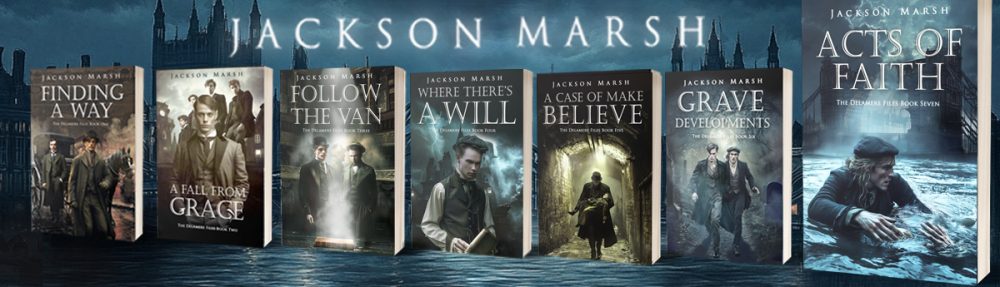
The Delamare Files

Looking Ahead and Thinking Aloud

Today, I think ahead to what you can expect from me next in a post that is something of a therapeutic ramble for me, and hopefully, an interesting read for you.

The New Series

As you will read on Wednesday, I have completed the first draft of the first book in the new series, and have still not settled on a title for the book or a subtitle for the series. I know how the series is to run, and I am looking forward to it unravelling over the coming months, and I also know it is to be a second spinoff from the Clearwater series. It will be set in the Clearwater world in London in 1892, following the adventures of the Larkspur Series, and yet, it won’t be directly related to either of the two series that have gone before. The new series will revolve around Delamere House, home of the Clearwater Detective Agency, and characters from the past stories will make appearances in supporting roles, as and when needed.

The main characters in the new series are to be:

Jack Merrit, a London cabbie from Limehouse, aged 25.
Will Merrit, his brother, a man who is very ‘precise’, aged 21.
Larkin Chase, an investigative journalist, aged 30.

Book One

In book one, the reader will also meet five characters from the previous series playing supporting roles. There are also new villains and a new ‘feel’ to the series. Let’s say, it’s more of a classic detective-story vibe, yet has all the Jackson Marsh elements of coming to terms with being gay at a time when it was illegal, first love (and sex), good Vs evil, men supporting men, class divide, action, adventure, humour and, of course, mystery.

Book one isn’t so much of a mystery, however, and is a fully contained story acting as an introduction to what will come next, which will be a mashup of Victorian mystery, MM Romance, Bromance, adventure, Action and a little bit of bonkerness from some quirky characters.

Book Two

Book two… Well, I am starting that today while book one sits and matures in my head before I address the final writes and edits. Once I am happy book two will run, I will set about releasing book one, with the second instalment coming a month or so later.

Meanwhile, I might already have a title for book two in ‘The Delamere Files’ series (just one idea), and that is ‘The Sinford Scandal’ (just another idea). The background to the story I have in mind came about some time ago while I was writing Clearwater and Larkspur books, but it didn’t fit into their flow. So… After telling you all that, here’s a little about what you can expect in the new series, or at least, the kind of story you can expect once book one is published, and the series is up and running later this year.

These notes are from my original draft of ‘Men of a Similar Heart’, a book I never wrote, but a title I very much like.

I used one of my favourite techniques for my second attempt to start this story, I opened with a newspaper cutting. This device is useful for many reasons: it can set the back story, it can give a deadline (as it does at the start of ‘Unspeakable Acts’), and it can set up the mystery, as it does in this case.

Exeter and Plymouth Gazette

Monday, November 26th, 1877

Tragedy At Sinford's
A grim discovery was made on Friday last at Sinford's School for Boys, Moorside. On rousing the men of Drake House, the Housemaster, Rev. D Spencer discovered a student absent from his bed, and soon after when searching for the pupil, was confronted with a scene of great tragedy. 
The body of Luc Verdier was discovered in the attic of the building hanging from a rafter by a rope fashioned into an ill-formed, but fatal noose about his neck. Verdier, we are told, was the son of a diplomat of the French Embassy and had attended Sinford's since coming up from prep school. Rev. Spencer described him as a highly intelligent young man with a proclivity towards physical sportsmanship, vice-captain of the First XI, first seat oarsman and holder of the school trophy for the javelin and other athletic pursuits. A well-liked and admired young man, Rev. Spencer described him as a friend to all and an enemy to no-one. The Housemaster has also said that he can think of no reason why Mr Verdier should wish to end his life, and reported the pupil had shown no signs of anxiety or distress in the days or weeks before the tragedy.
The police have issued a statement. Pupils of the house are all seniors and have been interviewed in the presence of Rev. Spencer and their Headmaster, but no further information concerning Verdier's state of mind has come to light. His study companion stated that Verdier was in his bed and sleeping before the lights were extinguished for the night, and spent an untroubled night despite, he said, of a dream which woke him once. Unable to say exactly what time he awoke, the pupil was able to confirm that Verdier was still abed and asleep at that time.
No other statements have been made about the case save for a message from the Headmaster, made through the Plymouth constabulary. In it, Headmaster McKay, BSc, asks for privacy for the school at this difficult time, a request, The Gazette shall, of course, honour.

This is the event that will, years later, lead to an intriguing mystery that will come with a deadline, a race against time and a few unexpected twists. At least, that’s the plan.

Finally

You know, writing this blog post at 4.00 in the morning has helped me put the future into focus. The more I witter on here, the more I like the sound of ‘The Delamere Files’, and the keener I am to start mapping book two. It will need to come out pretty soon after book one because some storylines in book one remain unresolved, and I won’t want to keep you hanging around. So, I shall be away now, and do just that; start a new story back-to-back with the last one, leaving book one in a state of second draftness until it is time to return to it.

Meanwhile

Talking of blogs, if you are interested to read my personal ‘Living on a Greek island’ blog, I am starting it up again after a two-year lunch break. It will go live tomorrow, Sunday, and I’ll be posting nonsense and images about island life on a more or less regular basis while keeping up my usual Jackson Saturday and Wednesday blog posts here. It will be nice to welcome you to www.symidream.com where James and Jackson meet.

http://www.symidream.com/

Return to Barrenmoor Ridge

Today, I want to say that it’s fine to improve your own work no matter when it was written or published.

The Mentor of Barrenmoor Ridge’ is my age-gap, MM romance-thriller set on the side of a Derbyshire fell in bad weather and was released in January 2018.

In terms of Kindle sales, this is my 4th best-selling title. In terms of page reads through Kindle Unlimited, it’s the 7th, and in terms of income, it’s the 6th. Above it are the first four Clearwater novels and ‘Guardians of the Poor.’

The ‘Barrenmoor Ridge’ blurb begins thus:

Following the death of his lover, mountaineer John Hamilton lives an isolated existence high on wild Fellborough peak. When he rescues 19-year-old Gary Taylor from the mountain, John can't accept that the boy may be the answer to his heartache. Gary is seventeen years his junior, confused, and being pursued by criminals.   

A while ago, my PA suggested I did some tidying up on ‘The Mentor of Barrenmoor Ridge,’ particularly the first few chapters. This was one of my first novels, and I was then, as I am now, still learning the craft.

The other day, I thought I’d drop into it, improve what I can, and eventually, have a second edition which is the same, but more polished.

I had actually started this task some time ago but got no further than the first half a page, because the Larkspur Mysteries series came along.

This morning, I took a look at what I’d done to ‘Barrenmoor’ then, and compared it to the original. Yes, well, ah-hem… there’s certainly some confusion in the opening scene; confusion around whose point of view we are experiencing the story from. It was meant to be John, the main character, but some of the time, it’s as if his friend, Sally, is the lead so that needed addressing. I think, when I was writing it, I wrote one version from her point of view and one from his and ended up mixing the two. It’s fine to use more than one point of view as long as you write in blocks (i.e. don’t change POV every other line) or put in a line break, or use some other technique that makes the switching obvious. I hadn’t done this; I’d bounced back and forth.

Here’s an example; the first 141 words of the original, which starts from John’s point of view, but swiftly changes to someone else (in italics):

John Hamilton was refusing a job at Everest base camp when he caught sight of the youth who was about to change his life. He was also ripping a piece of toast in half with his teeth while reaching for his pint mug of tea. The woman sitting opposite him in the Pot Hole, the climbers' café in Inglestone, was none too impressed that he had left their conversation hanging but assumed that John was considering her offer. After she had watched his confused expression for long enough, she leant across and pushed the piece of toast into his open mouth. 'It's an easy answer, John,' she said, smiling at his reaction. 'And you've got baked beans in your moustache.' John finally returned his gaze to her. 'What?' he said, his body at the table, his mind still across the room. 

Looking closer, I also have a problem with the second sentence, because

  1. it starts with ‘He’, and I now try and avoid doing that as it sounds weak, and
  2. because it’s weak, it’s vague, and we might be talking about the younger man across the room. Who is eating toast and drinking tea? Both of them?

My changes come next, and although they are not yet perfect, they are an improvement. Here are what are now the first 144 words.

John Hamilton was refusing a job at Everest base camp when he caught sight of the younger man who would change his life. Their eyes met, and although John was ripping apart a piece of toast and reaching for his pint mug of tea, both actions stopped in a heartbeat. The clatter and chatter around him in the climbers’ café faded, and he would have remained staring in silent awe had his companion not kicked him under the table. Sally appeared none too pleased he’d left their conversation hanging, because she leant across, pushed the piece of toast into his mouth, and said, ‘It’s an easy answer, and you’ve got baked beans in your moustache.’ John stared through her for a second before blinking. ‘What?’ His body was at the table, but his mind remained with who he had just seen.

That, to me, is better because, a) it stays as John’s point of view, therefore, b) it flows better, and c) it’s a little more intriguing. Does John know this younger man? (His mind remained with who he had just seen.) There is also the added attraction of naming his companion, Sally, rather than calling her ‘the woman’ as if he didn’t know who she was. I’ve also cut the detail about the café name and location, because that’s not vital and we’ll come to learn that information later. You’ll note I have left the opening line more or less intact. I rather like the way it mixes Everest Base Camp, refusing a job there, a younger man, a moment between two main characters, and ‘who would change his life,’ setting up what’s to come. I changed ‘youth’ to ‘younger man’ because it sounds less patronising.

The point of this is to highlight that it’s fine to return to an older work and improve it. We learn as we go, and because you can change your Amazon-uploaded files at any time, yet still keep the ISBN number and details, you can improve your work whenever you want. (As long as you don’t substantially change the story or title; in that case, you would need a new ISBN and would have to publish it as if it were a new book.) Revising those 141 words took me about half an hour, and I’m still not 100% happy, but I’ll continue when I can, and improve my ‘number five’ best seller bit by bit when I have time.

(Note from PA, “I love this opening, far more readable and the intrigue seed is planted leaving me wanting more. Bravo.”)

Imagination is more important than Knowledge: Discuss.

“Imagination is more important than Knowledge.”

So said Albert Einstein, thus inspiring today’s blog, a continuation from last week’s blog, which was about researching the taxi driver’s ‘knowledge.’

In that case, ‘knowledge’ was the thing London cabbies need before they can start transporting passengers around the metropolis. In Einstein’s case,

‘knowledge’ meant learning, what facts we have accumulated and, literally, what we know.

So, what he’s saying is pretty clear:

it’s more important to imagine than it is to know.

Thinking that, reminded me of the old adage, ‘Write about what you know.’ How many times have I heard that? I remember being told it at school when we had to write essays and short stories for English classes. However, I also remember when I was first inspired to write creatively, and here’s a little story that, unless I lose my train of thought, will point up the idea of creativity and imagination being more important than knowledge.

Soon to be Twelve, Never Been to Egypt

Picture it…

I am sitting in the library of an independent school in Folkestone, Kent. The wall opposite is filled with books, my best friend is sharing the table with me, and there’s a man with a beard facing us and the rest of the small class of uniformed pupils. It’s March 1975, and I am a few days away from being twelve years old. A few days ago, the television news carried the appalling story of a tube strain disaster at Moorgate station in London, where 43 people died because the train failed to stop and drove into a wall at speed. Not exactly the subject for a discussion during an English lesson with Mr Whitney, housemaster, historian and all-round inspirer of pupils. After a discussion about the train crash, our homework was to write a short story inspired by the event, which you might think was a little unusual or bad taste, but that’s the British public school system for you.

So, off I went after school, walking up the road to the bus stop with John (the best friend), discussing not English homework, but Hammer Horror films, because he collected the magazines, and we both liked the films, and having said goodbye, I continued to the bus stop and went home to write my short story.

Flashback: 1972, I am nine years old and in a long queue, eventually entering a huge building, walking through echoing halls and into dark chambers to wonder at the gold funeral mask of a pharaoh, Tutankhamun, and other treasures. Flash forward a couple of years, and I am watching one of the Universal ‘Mummy’ films, Boris Karloff or Lon Chaney Jr., it doesn’t matter which, I am fascinated by pyramids, Egyptian tombs and things buried underground.

Flash back to the story, and I am sitting down to write my homework based on the tube disaster. Of course, I didn’t know what it was like to be involved, I’m not even sure I’d been on a tube train by then, so all I had to go on were the images I’d seen on TV and my imagination. Oh, and my interest in Egyptology, such as it was at 11 years old.

My story, presented at the next English lesson, concerned a team of archaeologists investigating a pyramid, when that pyramid collapsed. All I remember of it were limbs sticking out from beneath rocks, dust, darkness, screams and other horror elements, and the ending; a man in a hospital bed where instead of flowers in the vase, there were the same dead arms and legs. I also remember the praise I received after its presentation in class. Mr Whitney singled it out because it had a beginning, a middle and an end, and told the whole class he’d chosen it for singular praise because I ‘Didn’t once mention a blessed train, like the rest of you. Imagination! It is far more useful than knowledge.’ Or something very similar. He then, rather annoyingly for an 11-year-old, told me it needed improvement, and I was to write it out again in my best handwriting, but not to copy it. What he did was tell me to write a second draft, thus teaching me the pain and value of editing.

The point of that story was simply to highlight the title of this piece, that you don’t always need knowledge to write creatively, and to be truly creative, imagination is more important than knowledge.

Now hang on a minute We can take the opposite view with no hassle whatsoever and be perfectly pedantic by saying: You need to know how to write. Ah ha! See, that’s knowledge. Yes, and quite right. Except, as far as we know, Homer never wrote a word, he spoke his stories, as that was the only way to pass them down back then. He didn’t need to know how to write, he needed to know how to tell a story, but storytelling is in all of us, whether it comes out in the written word or spoken, in art, journalism, comic books or gossip; we all have the ability to tell a story.

Yes, but… I know what you’re going to say. How can you write about something you know nothing about? How can you write a story set somewhere you have never been, or about something you have never experienced, or have no knowledge of?

Yeah, yeah, blah-di-blah… Tell me, dear sceptic, how many times did Shakespeare visit Italy to research his Merchant of Venice or any of the other 13 plays he set in the country? Did Bernard Cornwell OBE fight against Napoleon, or live among the Anglo Saxons of the Dark Ages? I think not. Yes, writers research, and some who write historical novels are learned historians, but they’ve still never been back in time, and let’s not mention Azimov or Arthur C Clarke, and others who write science fiction, fantasy or steampunk. Come to that, Bram Stoker never went to Transylvania or, as far as anyone knows, got bitten by a vampire or had his head chopped off.

Write about what you know, and if you don’t know about it, research. That would be a better maxim, in my book.

Ideas are the Seed of all Achievement

I found that delicious quote, from journalist, Anastasia Haralabidou, in an article titled ‘Great Ideas: Is imagination more important than knowledge?’ (2015, you can find it here.)  In her article, she points out how imagination has inspired knowledge. Example: an apple falling from a tree and narrowly missing Isaac Newton… Why did it do that? How come it fell and didn’t float away? And there we have gravity.

It’s a case of saying ‘What if?’ and then following the what if to a conclusion, and to do that, you need to use imagination, not knowledge. If you don’t have the knowledge, you can gain it, if you don’t have the imagination, well, frankly, you’re scuppered. As Haralabidou also says in her article,

“Imagination is the highest freedom of all and the one that no one can deprive us of.”

How good is that? We all have an imagination, it is as inherent as storytelling, and you don’t need knowledge to release it, you only need to know that you can, and we all can. Some with more success than others, I grant you, but it is within us all to tell stories, and if those stories are set in a time or place about which we know nothing, then, like a soon to be 12-year-old transposing what he’d seen on the news to the pyramids of Giza, we research what we must, and imagine the rest.

This all reminds me of another saying I heard once many years ago which has always stuck with me. Prevention is better than knowing who did it. That, I fancy, might be the title of a future blog.

Learning the Knowledge for a New Series

If you read my Wednesday work-in-progress blog, you will know I have embarked on a new series, currently titled ‘New Series’ in one folder, and ‘Victorian Series’ in another. So far, I have written four chapters in draft one, a rough outline, some character notes, and some research notes.

Part of my research has been around cab drivers because one of the two main characters is a young cabman, and that led me to a couple of books, a few websites, and a coincidence.

The Knowledge

When London cabbies train for the job, they spend on average two years learning ‘the knowledge.’ That’s the layout of all 25,000 or more London streets in a six-mile radius from central London, roughly.

If you’ve ever taken a black cab, as we call them nowadays (though they are not always black), you’ll feel assured that once you step in and say, ‘471 Kingsland Road,’ the driver will say, ‘Righty-o, Guv,’ and off you go. You can give as obscure an address as you fancy and, the chances are, your driver will know where it is because he’s got ‘the knowledge.’

When this term came into use, I am not sure, but then, I’ve not completed my research yet.

My ordered book has arrived, ‘The History of the London Horse Cab’, and I’ve read the introduction, but there’s a long way to go yet, so my knowledge of cab work and ‘the knowledge’ currently equates to knowing only about five streets out of the 25,000 or more.

I’ve also been looking at various collections of writings from Victorian times that I’ve found on websites, including my favourite, The Dictionary of Victorian London, compiled by Lee Jackson.

A Coincidence

While looking around for various resources, I came across a Facebook page dedicated to a book, ‘Carter the Cabman.’ After a little investigation, I discovered that this book was available on Kindle, so I downloaded a copy and set to reading, out of interest.

It turns out to be a novel, presenting in a nicely clever way, a collection of papers discovered in an antique shop in 1988, and those papers were written by a cabman called Carter in 1888, at the time of Jack the Ripper. That’s as far as I have got with my reading as I only bought it yesterday, but already, I feel a weird sense of coincidence. My Clearwater Mysteries series begins in 1888 at the time of the Ripper (though it’s not Jack), and my new series is not only about a cab driver, but is also set in 1888, though the Ripper murders are not part of the plot this time. I’m looking forward to reading the rest of ‘Carter’ and perhaps asking the author if he’d like to appear here in a guest post. (Though I’m not sure how to tell him that the word ‘weekend’ didn’t come into usage until after 1912, so his cabman author of 1888 would not have used it… but that’s me being pedantic.)

More About ‘New Victorian Series’

My notes are vague in places, and detailed in others. I have in mind a set of investigations that my two main characters will undertake, but unlike the Clearwater and Larkspur mysteries, these will involve a different investigative style. Clearwater and Larkspur use a lot of unlikely but not impossible scenarios, and inventions of the time or just before the time, such as vanishing and reappearing ink, telegraph printers, and glow-in-the-dark paint. The new series will, if all goes according to plan, focus on real issues of the time and how my two MCs put things right. A little like ‘Guardians of the Poor’, where our heroes uncover corruption at the Hackney workhouse. I have in my list of ideas notes such as:

  • Slum landlords Vs paupers,
  • The Thames Murders (cold case),
  • Mediums,
  • Quacks,
  • Lunatic asylum, and
  • ‘gay’ cases.

The latter one is also a hark back to Larkspur, where the initial idea was to base characters and stories on actual events, which I did all the way through: Dalston Blaze and the workhouse scandal, for example, or Edward Hyde’s incident on the train and the court case with that nasty Tory MP. But don’t think this new series is going to be all special investigation and doing the right thing, and don’t think it will be a repeat of issues and events from the other two series.

So far, I know that it is going to involve the following:

  • Clues
  • villains
  • adventure
  • A slow-burn romance over a couple of books
  • A character with an undefined ‘problem’ who will turn out to be a genius (at something)
  • Brotherly love
  • Bromance and MM romance (of course)
  • Falling in love, falling out of love, blah-di-blah
  • Humour
  • Real places and events

That’s where I am with ‘New Victorian Series’ right now, researching and learning more knowledge about life in Victorian Britain, especially London, around the end of the 19th century. It all starts with a journalist discovering a handsome young cabman in tears late at night on August 17th 1888. Why is he crying? That’s what you will one day find out.