Writing a Book Blurb

I have just finished the draft of my new novel, which has settled itself on the title ‘Journeyman Joe’, and I must now work on the blurb. This is often more difficult for a writer to achieve than a decent story, and gives many of us a headache to end them all.

The blurb is that text the potential reader sees after looking at the cover. It’s on the back cover for when people pick up the print book, and it’s on the book’s Amazon/other store page if it’s published that way. It’s a vital incentive for any interested party to delve further, and usually they will go next to the first page, so that needs to be good too. But that’s another story.

So, how do you go about putting together a blurb? It will be different for everyone, but here’s how I do it, and it’s not always in the same way.

What a blurb is not.

Unknown to some who use all of Amazon’s character spaces, a blurb is not a book’s synopsis. They are even more difficult to write.
A blurb is also not a detailed summary of the plot.
It’s not a review of the book either, nor is it a lengthy report to be turned in to the teacher first thing on Monday morning.

So, what is a book blurb?

It is a short and persuasive sales pitch to potential buyers.
The aim of the blurb is to arouse curiosity and lure the would-be reader towards the cash register.
It is made up of four components, or at least it should be. I’ve seen some run on for a page or more. Therefore, it’s important to keep the word count below 250, maximum.

What are the four components of a blurb?

The pedant in me wants to say, letters, words, punctuation… and it is very important to get them right, but you can’t do that until you have made clear:

* The Hook. The tagline. The impactful few words that stop people scrolling.
* The Main Character. The protagonist, or plural if you have two. No more, though. Two is complicated enough in 250 words.
* The Conflict. There is no drama without conflict, so you need to highlight any change in status quo (not the rock band), and point up what’s at risk, and what’s going to get your potential reader saying, ‘Oh my,’ and reading more.
* The Stakes. The tease. The ‘What if the main character fails?’

What should not be in there?

No spoilers, no plot twists, no backstory because no-one’s interested in that at this point. Nothing fancy to show off your grasp of language, and no subplots, brilliant though they may be.

Right then. How do you put together a blurb?

Well, first, you decide when to write it. Sometimes, I’ve written a blurb before I start on the book. This is a way of keeping yourself in check. You can refer to it as you go, to ensure you keep the four main elements of character, plot, crisis and resolution.
Sometimes, I write it as I am writing the book itself.
More usually for me, I write it after I have finished the draft and before I send it to my proofreader (always a good idea to have your blurb proofed).
During whichever process, the blurb changes as you develop the story, but if you are telling the story you planned, the main elements should always be foremost in your mind. Then, once you’ve got your loins girded and your baldrick slung, you can take on the blurb proper.

Write four paragraphs.

I write out the plot points I want to get across in the blurb, and try to keep the limit at four. I expand those into a load of gobbledegook, but at least everything I want to say is in there. For example:

ONE. The, as yet, off the top of my head blurb for ‘Journeyman Joe’ starts like this:
Spring 1895. In the rural Kent village of Runton, Joe Webster is nearing the end of his blacksmith’s apprenticeship when the churchwarden commissions him to build a traditional casket for the church records. However, it must contain a secret compartment with access known only to them.
Needs work. A lot. But we’ve met Joe; we know where and when and what, and we have the seemingly innocent yet mysterious task. Once worked, this opening should tighten the hook: why a mysterious task? However, there’s no potential conflict. That comes next.

TWO. Then, because this is an MM romance first, and a mystery second, I need to get in the ‘impact’ character; the one who is to stir up Joe’s life, cause the drama (internal and external), while innocently going about his business. This chap’s called Harvey Cade, and it’s important to mention the name only if you are going to use it again in the blurb. Don’t use it once and then call him by his job title, ‘The archdeacon’s investigator’ (or whatever). Consistency is the key, but you can also get in what the character is if necessary. When the archdeacon’s investigator, Harvey Cade, arrives in the village… Job done. Better done by adding a stop! You do this by breaking the rules of British public-school grammar: Never start a sentence with a conjunction. But when the archdeacon’s investigator… We have already seen a more acceptable pause in our reading in the first paragraph with However… (Don’t actually write that ellipsis; it will look tacky.)

THREE. Next comes the conflict, and in this case, it’s more to do with forging an illegal relationship than it is to do with the mysterious box. My current gobbledygook looks like this:
There is much gossip about Joe turning down a girl everyone thought he would marry, and the involvement of Mr Cade and the secret activity of the parish council. Only Joe can unlock the casket and reveal the truth – but he also has to decide his future.
Bare bones need resetting and, in places, fleshed out, but that’s the gist, and it’s more or less all we need for now.

FOUR. The stakes, the tease, the… rest of it. Vital to the story is village gossip, because the stakes here are that two men heading towards same-sex love (and nookie) were completely illegal, not to say shameful, in Britain in 1895. The stakes are obvious, but might need some detail, and as my story takes place at the time of the Oscar Wilde trials, there’s my comparison, because we all know what happened to him. At least, if you don’t, you should go and read up on it.

I also need to leave behind a feeling of what happens next, and how will it all end? You start with a hook, and, similarly, end with one. Or end by adding bait. Remember, your game here is to lure $4.49 from the pockets of the discerning potential reader.

With four paragraphs of probably too detailed nonsense under your baldrick, you can then start editing. This, for me, is the fun part.

But… (I did that on purpose) You must remember to use impact words. Cut down or add in, as long as every word counts, and you have your impactful words.
Joe Webster is keen to pass his apprenticeship. No. Joe Webster must, has no option to, or is desperate to pass, succeed in, get through (no, survive), etc. You see where I am going?
A book blurb should be impactful, yet not made up of smash, bang, wallop, take that, you cad! to the extent we cringe.

It should be short. In fact, start by thinking about those taglines you see with films. My favourite is for Jaws 2: “Just when you thought it was safe to go back in the water.” Or, more appropriately for Journeyman Joe, The Shawshank Redemption: “Fear can hold you prisoner. Hope can set you free.”

I sometimes use such a tagline atop the blurb. Other times, I use a quote from the book itself. It’s the part when you read it back to yourself that makes you go, ‘Ah ha! That’s what this is about.’

For an example, see Guardians of the Poor, the first in my Larkspur Mysteries. There, I quote the mentor character from the story with: “The greatest gift one man may give another is his trust.”

When you’re editing, chop out anything you think unnecessary to the potential buyer, change words to be more impactful, and if you’re having trouble, just write exactly what you want to say, and then cut it down to what you need to say.
Yes, it is that easy (not), and no, you will never be happy with it. But… (I’ve done it again), the joy of self-publishing is that you can always change it later. Maybe not on the cover, but certainly on the Amazon or wherever page.

Should I use AI to write my blurb?

Only if you want it to sound like every other AI-produced blurb, and get looks down the noses of writers with talent and persistence enough not to resort to asking a computer to do their work.
However, where AI is acceptably useful is in providing ideas. To get a decent result, you need to outline everything you want your blurb to say before you make the request, else all those bot bytes will vomit back all kinds of patronising rubbish. Mind you, you’ve already just done the hard part and summarised your work enough for a computer to understand, so you may as well finish the job yourself. You could ask it to make suggestions of what would be more impactful, but don’t then just steal the text. Take a few impact words, perhaps, but make the sentences your own. If you only copy and paste, you are copying legions of non-writers who churn out computer-generated garbage and call themselves an author. (Do not get me started.)

Instead, I will stop there, and hope this piece will be of use to someone somewhere.
For more of my thoughts on how to write a novel, blurb, and the rest, see the list of previous articles under the Author Tips link in the top menu.
The Delamere Dilemma Blurb

The publishing process has started. The manuscript is with Anne for proofreading, Andjela has my cover ideas and notes on which to base her own, and the Author’s notes are ready. I am waiting to hear back from my nephew, who may be able to make me an illustration for the inside, as we have had in the other books. I am aiming to have the book published for you by the end of the month at the latest.

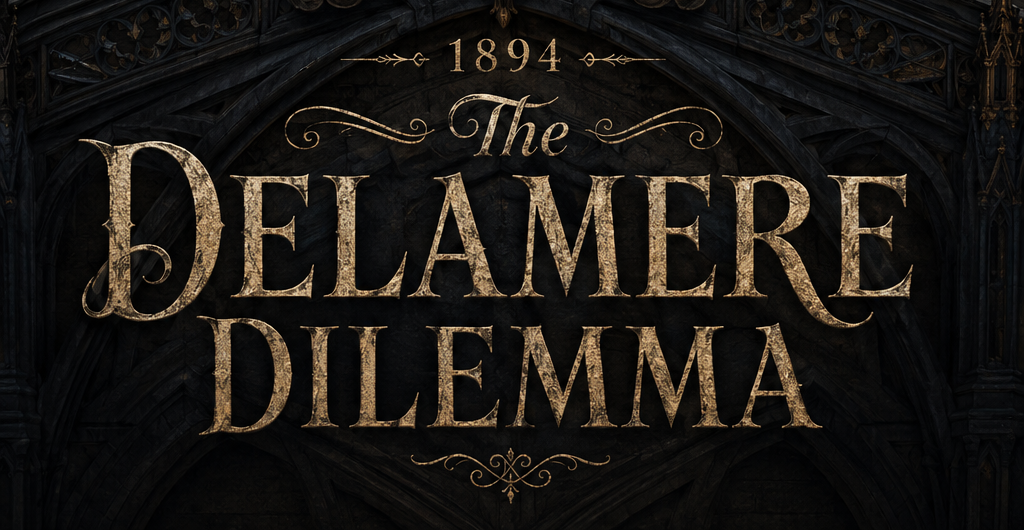
Meanwhile, I did some fiddling about with some image software and managed to come up with this – it’s not part of the title, just an aide.

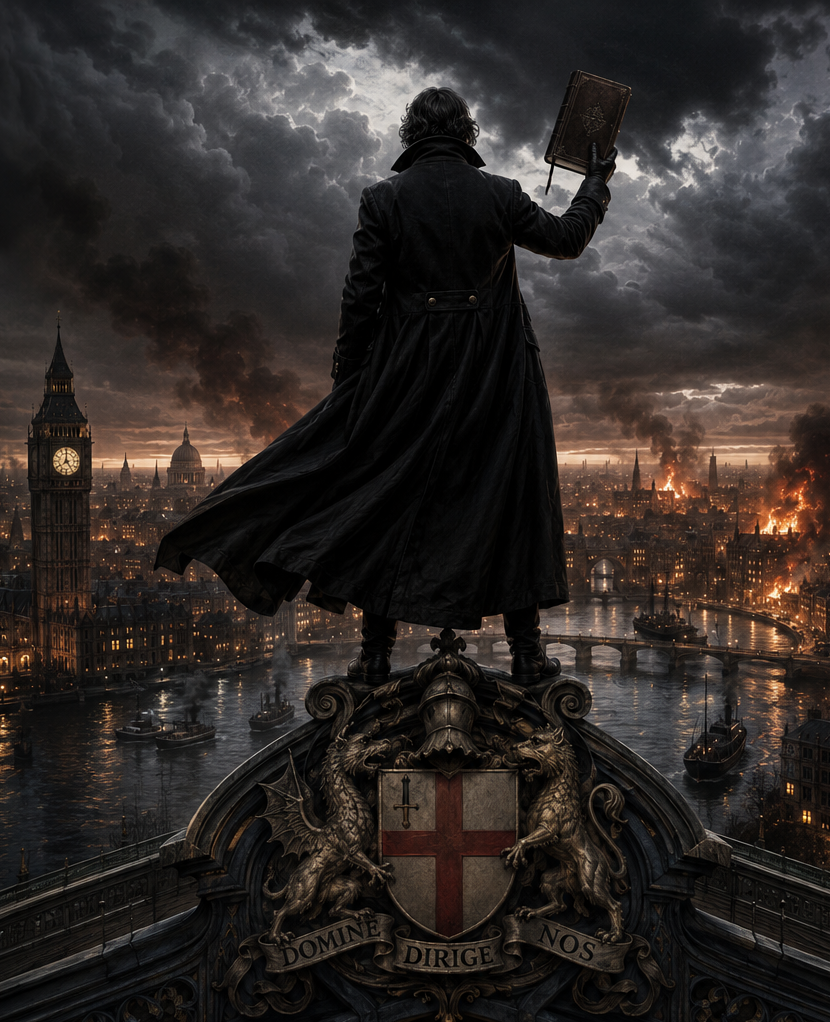
I also managed to produce another image with use of the dreaded AI, and it was rather good. However, this is only for publicity and has not been designed or put together by a real person, so I shan’t be using it for anything other than publicity. I will always pay a designer to do my covers, no matter how good AI gets at doing them. Why? Because it’s morally right, I know I will get the correct spacing for the spine and page numbering, and it keeps consistency across the series.

However, this does rather sum up a dramatic moment from the story.

The blurb may also help make sense of that image, so here it is.

The Delamere Dilemma

The Delamere Files Book Twelve

Such games we played in those dark days.

The Metropolitan Police suspect Lord Clearwater of being the infamous East End Ripper, the murderer responsible for the horrific deaths of five young men in 1888. Without proof to the contrary, Clearwater and everyone connected to him are finished, including his charities, the Larkspur Academy, and everyone at Delamere House.

The only way to save Clearwater is for Jack Merrit and his men to uncover the Ripper’s true identity and find the only evidence that can reveal the truth: a document that may not even exist — the Ripper Diary.

As the hunt intensifies, the return of the notorious murderer, Lucas Temple, and a wave of poisonings plunge London into chaos. Following clues from the past and present, Jack and his men uncover an unbelievable conspiracy that links the Ripper, Temple, and Clearwater himself.

With time running out, a city-wide catastrophe looming, and the Ripper Diary still beyond his grasp, Jack must outwit a ruthless enemy before everything he holds dear is destroyed in what could be the Delamere detectives’ deadliest case.


Newsletter

Don’t forget to sign up for my newsletter. This month, you have the chance for a free eBook download. To join, fill out your details on the newsletter page https://jacksonmarsh.com/newsletter/ and then authorise via the email that you will receive, and you’re in.

The next newsletter is due on Saturday, so be quick!

The Delamere Dilemma is the twelfth and final book in the Delamere Files series. It contains a spoiler for anyone who has not read the first Clearwater Mystery, ‘Deviant Desire.’ However, whether you have been following the Clearwater world from the start or not, your enjoyment of this series finale should not be affected.

Blurbs

How I Write Book Blurbs

The other day, someone asked me to comment on their book blurb. I did, and in doing so, reminded myself of a post I had written in 2020. I thought now was a good time to repost that post, because nothing has changed. People are still asking me to advise on their blurbs. Perhaps I should charge next time?

Maybe not. So, here’s the post from before and as relevant now as it was then.

Recently, I noticed a few new writers on Facebook groups asking for advice about their blurbs and putting up some examples of what they had come up with. I found myself cringing at some and being impressed by others, and thought I would talk about the way I write mine. This short guide is about what I do. Whether you decide this is a good way to do it, or whether you think, ‘Hm, I’ll avoid his advice,’ it’s up to you.

So, what is a blurb?

A blurb, also known as a book description, is found on the inside back cover of a hardback, on the back cover of a paperback and/or on the Amazon page under the product description. It’s the thing that a potential reader usually looks at after they’ve been impressed by your cover, or not. It’s your story in a nutshell and is probably the hardest thing to write after a logline. You are condensing your book into 150 to 200 words, after all, but you are doing so much more than that.

Start with a Logline

A logline is perhaps more of a filmmaker’s term, and it aims to reduce the film/story into even fewer words. When I write my books, I desperately fight to come up with a logline first, so I know what my story is, and then using that line as my focus to keep myself on track.

Yeah, right, well… Often I come up with it halfway through or at the end, because by then, I actually know what the story is about because the characters have taken over, but that’s me, and that’s novel writing. Film loglines, however, are a good place to start when writing a blurb because they help you focus.

An example of a logline would be: The ageing patriarch of an organised crime dynasty transfers control of his clandestine empire to his reluctant son. (The Godfather)

Loglines are not to be confused with taglines, the publicity headings if you like. A tagline would be ‘In space, no one can hear you scream’ (Alien), or, ‘There are 3.7 trillion fish in the sea. They’re looking for one.’ (Finding Nemo).

A logline for my new release (due out on Monday/Tuesday of next week) might be:
A Ukrainian refugee and the son of an Irish immigrant meet, bond, and become sex workers in Victorian London.

That’s a very simple outline of ‘Banyak & Fecks’ but is the overarching story, therefore should be the basis of the blurb.

From Logline to Blurb

Do you know what your story is about, or do you only know what happens?
A blurb isn’t a synopsis. Well, it is, kind of, but it’s not a full synopsis. It’s 150 to 200 words that a) introduce your main characters, b) set the stage for your conflict, c) establish the stakes/risks, d) show the reader why they will like this book. Simple, eh?

No, not really.

Here’s a made-up example of what I consider a bad blurb based on a few I have read.
“Jack searches for love and has a one night stand with Jock that leads to them becoming insta-lovers, but Jess gets jealous and kills Jack in a brawl the next day. Jock yearns for his lost love like a teenager with raging hormones. Will he ever find happiness?”

For a start, I am already confused between Jack, Jock and Jess. However ‘insta-lovers’ suggests a bit of nookie might happen as long as we understand the modernism, ‘insta.’ We know one of them gets killed, so that’s that tension gone, but who are these people and what chemicals were they taking? ‘A teenager with raging hormones searching for love?’ What does that mean? After that, I didn’t care who found love and moved on.

It’s difficult. In fact, writing a blurb is more difficult than writing a 120k word novel or a 100-word synopsis. I just took another look at my ‘Banyak & Fecks’ blurb and realised I’d written 196 words, which is a bit over the top, but I also noticed I’d cheated.

How? Well, I’ve put certain information outside of the book description, but I reckon that’s okay because that info will be for the Amazon page, and people will have read that before buying the paperback, so I don’t need it on the back. Your Amazon book description can give more information than you book blurb, and so, is a convenient space in which you can expand your sales pitch and description.

The ‘cheated’ info runs:

‘Banyak & Fecks’ ends the day before the first Clearwater Mystery, ‘Deviant Desire‘ begins. It is a story of friendship and platonic love set in Greychurch, the imaginary Whitechapel of the Clearwater world. Extensively researched, readers are taken from the Russian steppe and the Wirral slums to the squalor of the East End in the late 1880s.

[Genre: Historical Bromance]

[‘The Clearwater Mysteries.’ Historical MM Romance, mystery and adventure.]

You don’t need all that on the back of your book, but it’s excellent information to put on Amazon, your blog, publicity, social media etc.

My Blurb Advice Based on My Learning Curve

What you do need is a brief outline of who, what, and why. Who is/are the main character(s)? What’s the tension, conflict, interest? Why does the book appeal?

1          Keep it simple. Don’t give in to temptation and outline the entire story.
2          Use power words. (See below.)
3          Think, ‘Who am I writing for/selling to.’
4          Remember, you know who/what you’re talking about – but the potential readers don’t.
5          Don’t be indulgent. The blurb doesn’t show off what a great novelist you are or how cleverly you use words. If anything, it should show off how succinctly you can write, how objective you can be, and how good a salesperson you are.

Here’s an example of a blurb

I am not saying it’s the best example, but this is the blurb for my best-selling novel, ‘Deviant Desire.’ That’s bestselling for me, not as in ‘New York Times bestseller or anything. I’ve put notes in brackets and power words in bold. Power words are things like fear instead of ‘are scared of’, and kill rather than ‘attack.’ Murder or disembowel might have been even better.

Deviant Desire taken apart:

Deviant Desire blurb on Amazon

The Victorian East End (time and place) lives in fear of the Ripper (tension) and his mission to kill rent boys. (Character setting general. This opening line also sets the overall atmosphere and theme.)

Silas Hawkins, nineteen and forging a life on the streets (main character 1) could well be the next victim, (personal danger) but when he meets Archer, his life changes forever. (How? Why? Interest in what comes next.) Young, attractive and rich, Archer is The Viscount Clearwater, a philanthropist, adventurer and homosexual. (Main character 2, conflict between classes, sexy man suggesting ‘Mr Right.’ Homosexual isn’t the best or most powerful word, but ‘gay’ didn’t exist in that context in 1888. Even ‘homosexual’ was only used in the professional medical world, but there you go.)

When Archer suspects the Ripper is killing to lure him to a confrontation, (Why? Who is the Ripper?) he risks his reputation and his life (what’s at stake MC 1) to stop the madman’s murders. (Summary of action plot.) Every man must play his part, including Silas. (What’s at stake, MC 2) Secrets must be kept, lovers must be protected, and for Archer and Silas, it marks the start of their biggest adventure – love. (That lot doesn’t tell us what happens, it suggests what might happen and, hopefully, our imagination is stirred.)

There then follows on Amazon pages only:

A mashup of mystery, romance and adventure, (tells the potential reader if this is their kind of thing) Deviant Desire is set in an imaginary London of 1888. (Imaginary to show we’re not taking a new look at Jack the Ripper, so Ripperologists don’t get offended.) The first book in the on-going The Clearwater Mysteries series (shows there are more, and if you enjoy this one, your investment will pay off) and mixes fact with fiction. The series takes the theme of loyalty and friendship in a world where homosexuality is a crime. (Covers the overall series without going into detail, and says what kind of books follow, though not what stories.)

Insta-love, physical romance, mystery and murder. (A general covering of ‘tropes’ a word I dislike but a necessary evil.)

Some writers also put ‘triggers’ but, to be honest, with power words such as murder, Ripper, homosexual, and physical romance, you’d have to be pretty dim not to pick up on the fact this is going to be a gay murder thriller with some sex in it. ‘Physical romance’ is there because it’s best not to mention ‘sex’ on Amazon pages, they get funny about things like that.

DS Billings Mystery series box set

Another thing you can do on the Amazon page is put quotes from reviews of the book, or others in a series. You’ll see that’s what I’ve done for Deviant Desire’ and others. For ‘Banyak & Fecks’, I am lucky enough to have a quote from Olivier Bosman, author of the DS Billings Victorian Mysteries.

A colourful and enchanting tale. Beautifully written. Marsh does an excellent job of evoking the look and feel of a different age.”

Again, I’m not saying I am the expert on writing blurbs; I am simply passing on my experience. If you want professional advice from trained educators, you can easily find it through an online search.

Here’s one good, in-depth article about writing book blurbs.

Weak Words Vs Power Words

When do you write the blurb for your publication? I start it as the idea of the book is forming, because giving yourself a rough outline of the main points of the story is important. This, later, becomes the structure of the blurb, the write-up you see on the book’s back cover and/or on the sales pages. To my mind, these things need to be succinct while offering the potential reader an outline of what to expect.  

The Blake Inheritance

I’m going to give you a quote from one of my unusual romance stories, The Blake Inheritance, and here it is in sections:

An inheritance, a ring and a church organ; three clues to the Blake family mystery.
Twenty-five and fleeing a stale relationship, Ryan Blake returns home to find some answers. What he discovers is the impish twenty-two-year-old, Charlie Hatch, a homeless scamp who has a way with words, a love of mysteries, and a very cute arse.
As the two set about unlocking the Blake family secrets, Ryan finds himself falling for the younger guy. But is he ready to commit again? And can Charlie learn to accept that someone loves him?

What we have here is not a synopsis (never write a synopsis as your blurb) but it outlines the story in 91 words. It may not be the best blurb ever written, but it contains all the elements of the story while, I hope, enticing the reader to buy the book, which you can do here:

The Blake Inheritance

“Let us go then you and I, to the place where the wild thyme grows.”

The first line tells us it’s a mystery. The second paragraph tells us the main character, Ryan, is overcoming a problem, meets an impact character (one who will affect a change in the MC) and there’s a hint of something sexy. The last paragraph suggests the love story and the conflict, and that’s all we need to know. Combined with the cover that shows two young men and a lighthouse in a slightly twisted way should add a visual to the blurb. What this blurb doesn’t overdo, though, are the ‘power words.’ Then again, it doesn’t use weak words, and your blurb should be about power, not weakness.

Power Words

What do I mean by power words? Let’s move away from the blurb and look at fuller storytelling. Which sentence tells you more?

Edward went to look.

Edward forced himself to look.

Went is a weak word, forced is a power word; it tells us something about his state of mind and has a clearer meaning than ‘went.’ In this case, we can assume Edward didn’t want to look. Here’s another example taken from my upcoming ‘Starting with Secrets’:

… she said, moving to the stove

… she said, drifting to the stove

I don’t mind ‘moving’ too much because it’s vague and in this scene, ‘she’ is being vague, but ‘moving’ is an opportunity for something better. Here, she drifts to the stove because she is reminiscing as she’s talking, but were she angry, she might stomp, or if she was in a panic she might fly, she might ‘scream her way to’ or ‘bustle to’, ‘stagger in the manner of a drunk toward’ or, if you want to use ‘move’, ‘moved to the stove like a galleon in full sail’, but then, ‘sailed’ would be better, or ‘tacked’, ‘lurched’… In other words, ‘move’ is a weak word, and the others are power words.

Other weak verbs to be wary of include, stand, walk, look, feel, think, said, have, got, go. Example:

He knelt beneath the bell and looked inside.

He knelt beneath the bell and squinted inside.

Squinted suggests poor lighting or eyesight, so it adds more to the scene than looked.

Power Descriptions

As we can replace weak words with more powerful and descriptive ones, and we can improve our writing by looking out for other weak words which are easy to use but can always be bettered. I, for example, now look out for my use of the word ‘it’ because unless the ‘it’ is obviously the thing I am referring to, the word can confuse the reader. Sometimes, when editing, it confuses me, and I have to read back to remind myself what’s being talked about. So, look out for your use of the weak word, ‘it’ and see if it isn’t better replaced by something more specific. Other weak words used in this way include replacements for ‘it’ such as ‘one.’ For example:

Not as public as the one in the cathedral,

Not as public as the plaque in the cathedral,

That’s also from ‘Starting with Secrets’ and the ‘one’ we are referring to, the ‘it’ if you like, was mentioned a few sentences back, and because things have happened in between, ‘one’ might be too vague for the reader. Obviously, there are times when one, it, them, they etc., work, and you don’t want to repeat ‘plaque’ or whatever too many times.

She taught him how to make pastry and roll it.

Makes sense but there was that dreaded ‘it’, and something didn’t feel right. I changed it to:

She taught him how to make and roll pastry. It reads better and makes more sense; it’s not as clunky.

Here’s another way I try and improve my writing by swapping weak words for more powerful ones. This is an actual edit from my first draft to my second. Which do you think is more descriptive?

… but no light appeared at the window.

… but daylight refused to breach the window.

Okay, so I could have gone further: … but daylight refused to breach the grime-encrusted, leaded windowpane that stood as a barrier to the dawn… But let’s not go over the top.

‘Stood’, by the way, is another weak word. Always ask yourself how? How did he stand? How did she move?

Get/got is another one to avoid.

When he got to the junction…

When he arrived, reached, staggered to, fell upon, finally found… the junction. Much more descriptive.

However, when a character is speaking, always write as he or she would speak. Don’t put in unnecessary power words for the sake of it, not in dialogue. A character would be perfectly justified saying, ‘When you get to the junction.’

Word Order

A slight aside, but while editing the next book, I came across this sentence:

… and enjoyed standing beside her drying plates.

There’s nothing better than watching plates dry is there? Why was he standing beside plates that were drying? Why was he enjoying such a dull spectacle?

I changed the line to:

and enjoyed drying plates beside her, which is what I actually meant to say.

I could have improved the initial sentence with a comma, I suppose, but it still felt clunky. … and enjoyed standing beside her, drying plates.

Finally

I was trying to think of a way to end this post, and came across another short piece on Before You Publish that included a list of strong, mild and weak words. It’s not that easy to read unless you enlarge it, but I’ve added it to my bookmarks as a resource. You might find it interesting when you are editing. I’ll be back on Wednesday with more news on ‘Starting with Secrets’ my current work in progress.