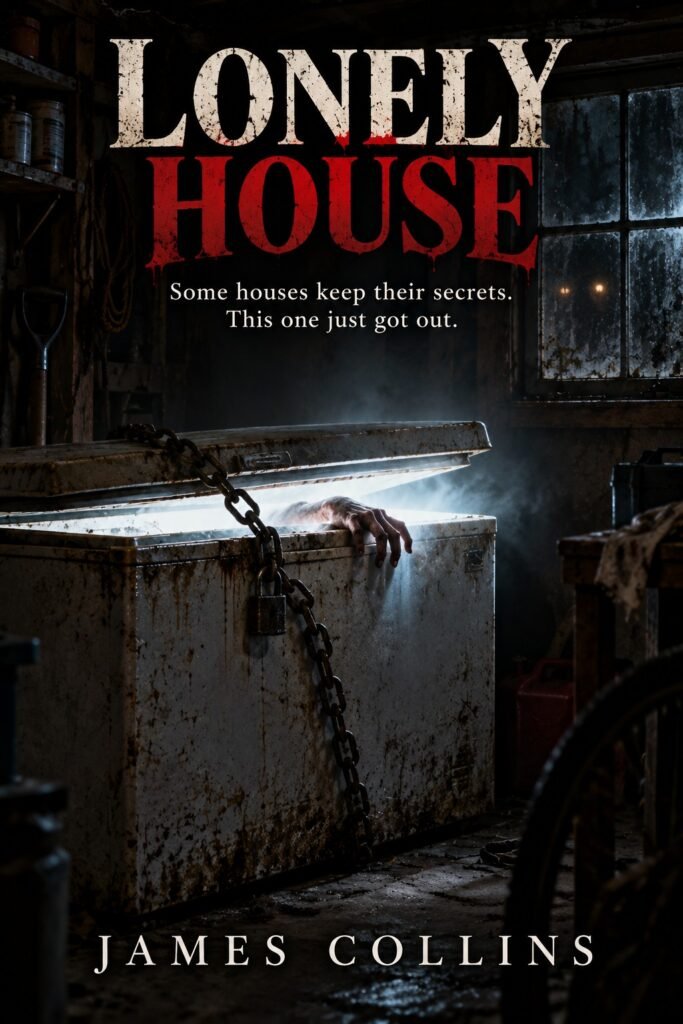
Something different today. I have been working on a rerelease of a novel I wrote when I was starting out (2015). Actually, I wrote my first ‘novel’ when I was 16 or 17, spending evenings at the desk in my bedroom inventing a story that I wanted to happen to me, writing longhand, and producing absolute drivel. I hope I’ve improved since then, and I certainly didn’t write ‘Lonely House’ wanting the events depicted to happen to me.
This story came about when I was writing for a small film company that wanted to produce a low-budget film. Low budget, in this case, was around £20,000 for the entire budget. They wanted one location, a small cast, and lots of horror. The cast of this novel numbers six, and there is, apart from flashbacks, only one location. It’s a classic ‘cabin in the woods’ scenario: a single house surrounded by a forest, and miles from anywhere. Yup. A classic cliché on which such horror films are built. However, there had to be something different about it, and so I came up with my two main characters.
Two young drifters, bound by a strange friendship and a terrible secret, with one being a criminal and the other an easily led younger chap who everyone thinks is ‘special’ or ‘slow.’ An accident in the lonely house leads to the unravelling of the horror, which only gets worse when the twists start and the past is revealed. Today, I wanted to point you towards Lonely House, which you can get on Amazon (KU, paperback, Kindle). Follow this link if you dare: https://mybook.to/LonelyHouse
How much horror can one friendship take?
Drover and Pete are two hopeful drifters looking for a better life. Desperate for food, they break into an isolated house deep in a forest. There, they accidentally shoot an old man just as the rest of his family arrive for a birthday gathering.
Under intense suspicion from the family, the boys attempt to cover up the accident. But they are not the only ones keeping a murderous secret. Mistrust and deception unearth a primaeval ritual as the lies give way to a terrifying truth.
With time running out and a deadly force closing in, Drover and Pete’s survival rests on the strength of their friendship, but they must face some horrific choices in order to stay alive.
I should warn you, though, that I am not one for peppering my blurbs and info with trigger warnings. The fact that you are in the horror section, reading a blurb about a horror novel, should be enough to tell you you’re in for some disturbing descriptions. You’re also in for a book that is written in the style of a film treatment, though much fleshed out and, after a recent edit, I hope, better than the original. It is not my usual Jackson Marsh style, because I wrote it before Jackson was born; it’s set in the present day, and… Well, you will see. It is still me, though. As for the original film idea… In the end, the production company went for another of my stories, The Judas Inheritance, which is set on the island where I live. The production went ahead, and they spent their 20k on getting everyone here, filming, falling out, and putting together something that resembled my story in no way whatsoever – but that’s another story for another day.
Monthly Newsletter
The monthly newsletter with other news and book promotions will be out next Saturday, so make sure you have signed up for it. You can do that at the top of this page.
I have just finished the draft of my new novel, which has settled itself on the title ‘Journeyman Joe’, and I must now work on the blurb. This is often more difficult for a writer to achieve than a decent story, and gives many of us a headache to end them all.
The blurb is that text the potential reader sees after looking at the cover. It’s on the back cover for when people pick up the print book, and it’s on the book’s Amazon/other store page if it’s published that way. It’s a vital incentive for any interested party to delve further, and usually they will go next to the first page, so that needs to be good too. But that’s another story.
So, how do you go about putting together a blurb? It will be different for everyone, but here’s how I do it, and it’s not always in the same way.
What a blurb is not.
Unknown to some who use all of Amazon’s character spaces, a blurb is not a book’s synopsis. They are even more difficult to write. A blurb is also not a detailed summary of the plot. It’s not a review of the book either, nor is it a lengthy report to be turned in to the teacher first thing on Monday morning.
So, what is a book blurb?
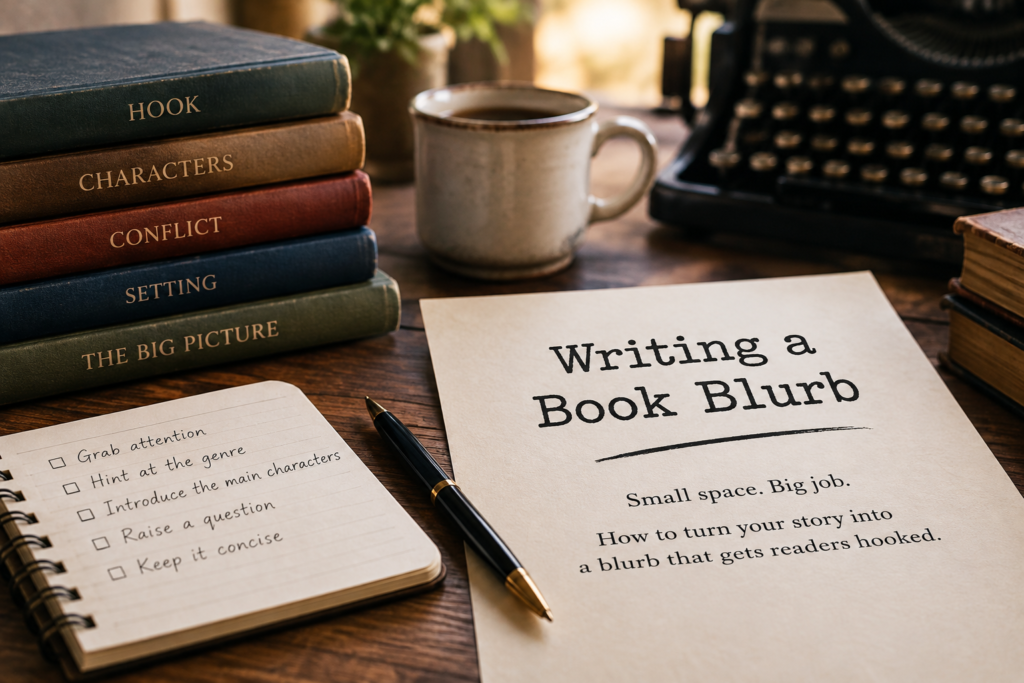
It is a short and persuasive sales pitch to potential buyers. The aim of the blurb is to arouse curiosity and lure the would-be reader towards the cash register. It is made up of four components, or at least it should be. I’ve seen some run on for a page or more. Therefore, it’s important to keep the word count below 250, maximum.
What are the four components of a blurb?
The pedant in me wants to say, letters, words, punctuation… and it is very important to get them right, but you can’t do that until you have made clear:
* The Hook. The tagline. The impactful few words that stop people scrolling. * The Main Character. The protagonist, or plural if you have two. No more, though. Two is complicated enough in 250 words. * The Conflict. There is no drama without conflict, so you need to highlight any change in status quo (not the rock band), and point up what’s at risk, and what’s going to get your potential reader saying, ‘Oh my,’ and reading more. * The Stakes. The tease. The ‘What if the main character fails?’
What should not be in there?
No spoilers, no plot twists, no backstory because no-one’s interested in that at this point. Nothing fancy to show off your grasp of language, and no subplots, brilliant though they may be.
Right then. How do you put together a blurb?
Well, first, you decide when to write it. Sometimes, I’ve written a blurb before I start on the book. This is a way of keeping yourself in check. You can refer to it as you go, to ensure you keep the four main elements of character, plot, crisis and resolution. Sometimes, I write it as I am writing the book itself. More usually for me, I write it after I have finished the draft and before I send it to my proofreader (always a good idea to have your blurb proofed). During whichever process, the blurb changes as you develop the story, but if you are telling the story you planned, the main elements should always be foremost in your mind. Then, once you’ve got your loins girded and your baldrick slung, you can take on the blurb proper.
Write four paragraphs.
I write out the plot points I want to get across in the blurb, and try to keep the limit at four. I expand those into a load of gobbledegook, but at least everything I want to say is in there. For example:
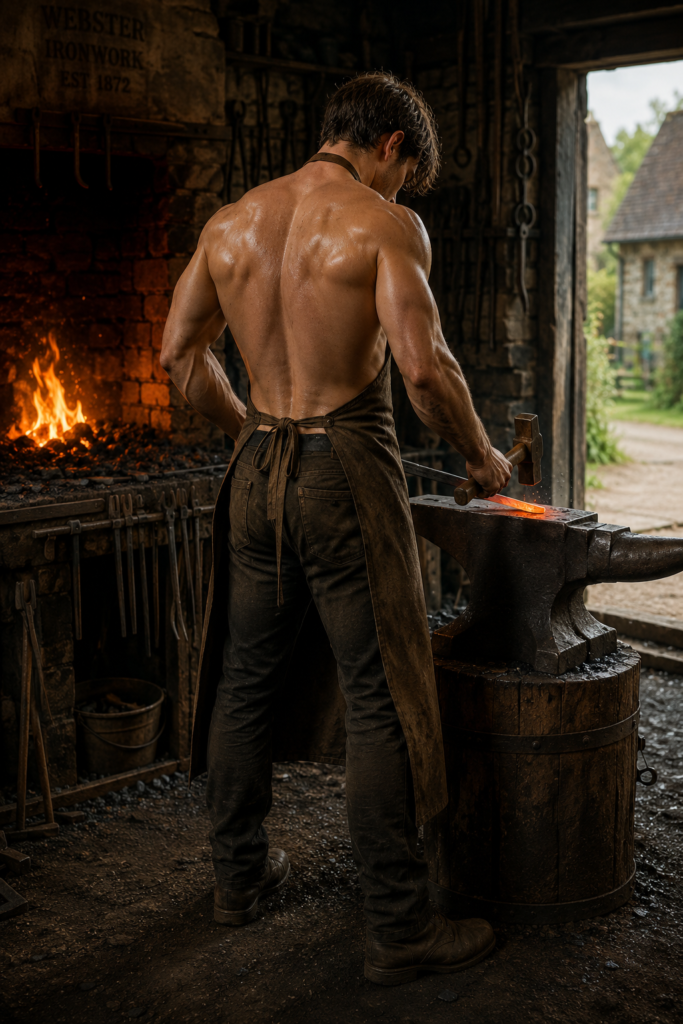
ONE. The, as yet, off the top of my head blurb for ‘Journeyman Joe’ starts like this: Spring 1895. In the rural Kent village of Runton, Joe Webster is nearing the end of his blacksmith’s apprenticeship when the churchwarden commissions him to build a traditional casket for the church records. However, it must contain a secret compartment with access known only to them. Needs work. A lot. But we’ve met Joe; we know where and when and what, and we have the seemingly innocent yet mysterious task. Once worked, this opening should tighten the hook: why a mysterious task? However, there’s no potential conflict. That comes next.
TWO. Then, because this is an MM romance first, and a mystery second, I need to get in the ‘impact’ character; the one who is to stir up Joe’s life, cause the drama (internal and external), while innocently going about his business. This chap’s called Harvey Cade, and it’s important to mention the name only if you are going to use it again in the blurb. Don’t use it once and then call him by his job title, ‘The archdeacon’s investigator’ (or whatever). Consistency is the key, but you can also get in what the character is if necessary. When the archdeacon’s investigator, Harvey Cade, arrives in the village… Job done. Better done by adding a stop! You do this by breaking the rules of British public-school grammar: Never start a sentence with a conjunction. But when the archdeacon’s investigator… We have already seen a more acceptable pause in our reading in the first paragraph with However… (Don’t actually write that ellipsis; it will look tacky.)
THREE. Next comes the conflict, and in this case, it’s more to do with forging an illegal relationship than it is to do with the mysterious box. My current gobbledygook looks like this: There is much gossip about Joe turning down a girl everyone thought he would marry, and the involvement of Mr Cade and the secret activity of the parish council. Only Joe can unlock the casket and reveal the truth – but he also has to decide his future. Bare bones need resetting and, in places, fleshed out, but that’s the gist, and it’s more or less all we need for now.
FOUR. The stakes, the tease, the… rest of it. Vital to the story is village gossip, because the stakes here are that two men heading towards same-sex love (and nookie) were completely illegal, not to say shameful, in Britain in 1895. The stakes are obvious, but might need some detail, and as my story takes place at the time of the Oscar Wilde trials, there’s my comparison, because we all know what happened to him. At least, if you don’t, you should go and read up on it.
I also need to leave behind a feeling of what happens next, and how will it all end? You start with a hook, and, similarly, end with one. Or end by adding bait. Remember, your game here is to lure $4.49 from the pockets of the discerning potential reader.
With four paragraphs of probably too detailed nonsense under your baldrick, you can then start editing. This, for me, is the fun part.
But… (I did that on purpose) You must remember to use impact words. Cut down or add in, as long as every word counts, and you have your impactful words. Joe Webster is keen to pass his apprenticeship. No. Joe Webster must, has no option to, or is desperate to pass, succeed in, get through (no, survive), etc. You see where I am going? A book blurb should be impactful, yet not made up of smash, bang, wallop, take that, you cad! to the extent we cringe.
It should be short. In fact, start by thinking about those taglines you see with films. My favourite is for Jaws 2: “Just when you thought it was safe to go back in the water.” Or, more appropriately for Journeyman Joe, The Shawshank Redemption: “Fear can hold you prisoner. Hope can set you free.”
I sometimes use such a tagline atop the blurb. Other times, I use a quote from the book itself. It’s the part when you read it back to yourself that makes you go, ‘Ah ha! That’s what this is about.’
For an example, see Guardians of the Poor, the first in my Larkspur Mysteries. There, I quote the mentor character from the story with: “The greatest gift one man may give another is his trust.”
When you’re editing, chop out anything you think unnecessary to the potential buyer, change words to be more impactful, and if you’re having trouble, just write exactly what you want to say, and then cut it down to what you need to say. Yes, it is that easy (not), and no, you will never be happy with it. But… (I’ve done it again), the joy of self-publishing is that you can always change it later. Maybe not on the cover, but certainly on the Amazon or wherever page.
Should I use AI to write my blurb?
Only if you want it to sound like every other AI-produced blurb, and get looks down the noses of writers with talent and persistence enough not to resort to asking a computer to do their work. However, where AI is acceptably useful is in providing ideas. To get a decent result, you need to outline everything you want your blurb to say before you make the request, else all those bot bytes will vomit back all kinds of patronising rubbish. Mind you, you’ve already just done the hard part and summarised your work enough for a computer to understand, so you may as well finish the job yourself. You could ask it to make suggestions of what would be more impactful, but don’t then just steal the text. Take a few impact words, perhaps, but make the sentences your own. If you only copy and paste, you are copying legions of non-writers who churn out computer-generated garbage and call themselves an author. (Do not get me started.)
Instead, I will stop there, and hope this piece will be of use to someone somewhere. For more of my thoughts on how to write a novel, blurb, and the rest, see the list of previous articles under the Author Tips link in the top menu.
It’s been a while, but here I am with a completed first draft of a new novel. Currently, it has the working title of ‘The Journeyman ’ and runs to 135,000 words.
I also have a working logline:
A blacksmith’s apprentice falls in love with another man during the trials of Oscar Wilde while forging a mysterious lockbox.
That is the basic hook, which gives nothing away, but it’s also rather clumsy, and sounds like the apprentice is doing his work in the Central Criminal Court while the trials are taking place. In fact, he lives and works in a small, rural village in Kent, some 60 miles away, and is unaware of the trials and scandal taking place in London. So, I’m still working on that while I continue to work on the manuscript.
Oscar Wilde was in court three times between April 3rd and May 25th, 1895, but the scandal began earlier that year. On February 28th, 1895, the Marquess of Queensberry left an insulting card at Wilde’s club addressed to “Oscar Wilde, posing as a sodomite.” That led to Wilde suing for criminal libel at the Old Bailey. However, facing devastating cross-examination by Edward Carson regarding his writings and relationships with young men, Wilde withdrew the suit, and Queensberry was acquitted. Immediately after, authorities issued a warrant for Wilde’s arrest. The situation for Wilde worsened from then on.
Joe Webster, a 20-year-old blacksmith’s apprentice, is approaching the end of his indenture and hoping to become a Journeyman so he can go ‘tramping’ to find a new job and a better life.
Two things cause upset in his world; a commission to make an unusual iron chest, and a man called Harvey Cade.
And then, there is a death and an inquest…
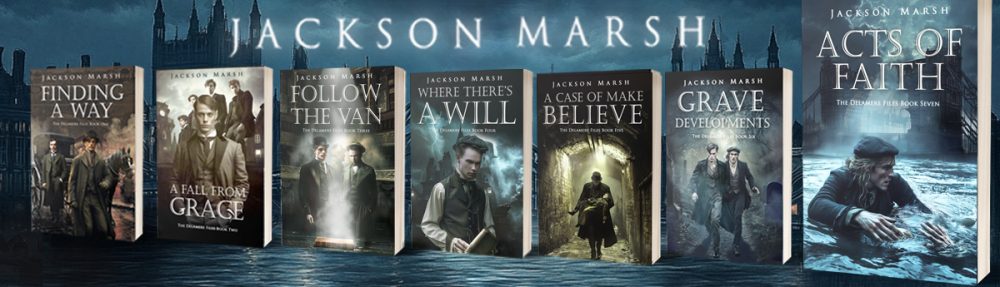
Wilde is the far-away background to the story, and not what the story is about. I chose the spring of 1895 because it follows on in the timeline from the end of the Delamere Files, although this story has nothing to do with the London characters or stories of the Clearwater, Larkspur, and Delamere mysteries, and is not like those stories at all. There is a mystery, but not one of my usual ‘improbable but possible’ mysteries, and the mystery is not at the heart of ‘The Journeyman.’ The heart of it is about two men falling in love, and a lot of it is to do with village life.
As they say, all will be revealed in time.
For now, I just wanted to keep you informed and let you know I’ve not dropped off the end of the world, and am beavering away in the background. I have some other work to catch up on this week, but after that, I shall be back to the draft and the editing work, improving the MS and thinking of covers and layout. If I can get ahead, I should have this release ready for you sometime in October, so keep an eye on my blog here and on my social media pages. You can find the links in the right-hand sidebar. I will keep you informed about the journey of Journeyman Joe (another possible title).
Promos
Meanwhile, the publicity work continues, and that’s the side of things I’m not very good at. Too busy writing to think about it all, and with no money to pay even a reputable company to do it for me. The best I can do for now is rely on these free promo-shares from BookFunnel, and here’s one that you might like to explore.
LGBTQ+ Books
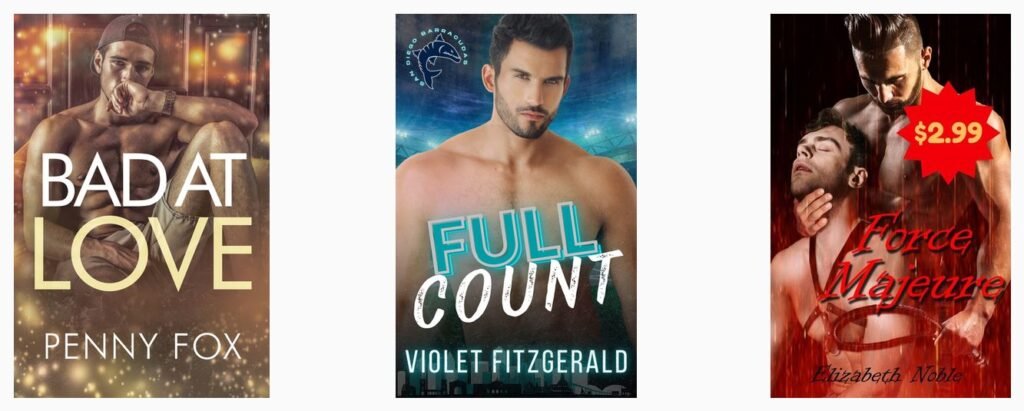
Genres: Romance / LGBT. The books in this promo have to be romance, but with no erotica, and then it says there must be some heat – so, I assume, they will be low-level-heat romances. I have my three series starters in there, because they are romance/mystery with a little heat.