Writing a Book Blurb

I have just finished the draft of my new novel, which has settled itself on the title ‘Journeyman Joe’, and I must now work on the blurb. This is often more difficult for a writer to achieve than a decent story, and gives many of us a headache to end them all.

The blurb is that text the potential reader sees after looking at the cover. It’s on the back cover for when people pick up the print book, and it’s on the book’s Amazon/other store page if it’s published that way. It’s a vital incentive for any interested party to delve further, and usually they will go next to the first page, so that needs to be good too. But that’s another story.

So, how do you go about putting together a blurb? It will be different for everyone, but here’s how I do it, and it’s not always in the same way.

What a blurb is not.

Unknown to some who use all of Amazon’s character spaces, a blurb is not a book’s synopsis. They are even more difficult to write.
A blurb is also not a detailed summary of the plot.
It’s not a review of the book either, nor is it a lengthy report to be turned in to the teacher first thing on Monday morning.

So, what is a book blurb?

It is a short and persuasive sales pitch to potential buyers.
The aim of the blurb is to arouse curiosity and lure the would-be reader towards the cash register.
It is made up of four components, or at least it should be. I’ve seen some run on for a page or more. Therefore, it’s important to keep the word count below 250, maximum.

What are the four components of a blurb?

The pedant in me wants to say, letters, words, punctuation… and it is very important to get them right, but you can’t do that until you have made clear:

* The Hook. The tagline. The impactful few words that stop people scrolling.
* The Main Character. The protagonist, or plural if you have two. No more, though. Two is complicated enough in 250 words.
* The Conflict. There is no drama without conflict, so you need to highlight any change in status quo (not the rock band), and point up what’s at risk, and what’s going to get your potential reader saying, ‘Oh my,’ and reading more.
* The Stakes. The tease. The ‘What if the main character fails?’

What should not be in there?

No spoilers, no plot twists, no backstory because no-one’s interested in that at this point. Nothing fancy to show off your grasp of language, and no subplots, brilliant though they may be.

Right then. How do you put together a blurb?

Well, first, you decide when to write it. Sometimes, I’ve written a blurb before I start on the book. This is a way of keeping yourself in check. You can refer to it as you go, to ensure you keep the four main elements of character, plot, crisis and resolution.
Sometimes, I write it as I am writing the book itself.
More usually for me, I write it after I have finished the draft and before I send it to my proofreader (always a good idea to have your blurb proofed).
During whichever process, the blurb changes as you develop the story, but if you are telling the story you planned, the main elements should always be foremost in your mind. Then, once you’ve got your loins girded and your baldrick slung, you can take on the blurb proper.

Write four paragraphs.

I write out the plot points I want to get across in the blurb, and try to keep the limit at four. I expand those into a load of gobbledegook, but at least everything I want to say is in there. For example:

ONE. The, as yet, off the top of my head blurb for ‘Journeyman Joe’ starts like this:
Spring 1895. In the rural Kent village of Runton, Joe Webster is nearing the end of his blacksmith’s apprenticeship when the churchwarden commissions him to build a traditional casket for the church records. However, it must contain a secret compartment with access known only to them.
Needs work. A lot. But we’ve met Joe; we know where and when and what, and we have the seemingly innocent yet mysterious task. Once worked, this opening should tighten the hook: why a mysterious task? However, there’s no potential conflict. That comes next.

TWO. Then, because this is an MM romance first, and a mystery second, I need to get in the ‘impact’ character; the one who is to stir up Joe’s life, cause the drama (internal and external), while innocently going about his business. This chap’s called Harvey Cade, and it’s important to mention the name only if you are going to use it again in the blurb. Don’t use it once and then call him by his job title, ‘The archdeacon’s investigator’ (or whatever). Consistency is the key, but you can also get in what the character is if necessary. When the archdeacon’s investigator, Harvey Cade, arrives in the village… Job done. Better done by adding a stop! You do this by breaking the rules of British public-school grammar: Never start a sentence with a conjunction. But when the archdeacon’s investigator… We have already seen a more acceptable pause in our reading in the first paragraph with However… (Don’t actually write that ellipsis; it will look tacky.)

THREE. Next comes the conflict, and in this case, it’s more to do with forging an illegal relationship than it is to do with the mysterious box. My current gobbledygook looks like this:
There is much gossip about Joe turning down a girl everyone thought he would marry, and the involvement of Mr Cade and the secret activity of the parish council. Only Joe can unlock the casket and reveal the truth – but he also has to decide his future.
Bare bones need resetting and, in places, fleshed out, but that’s the gist, and it’s more or less all we need for now.

FOUR. The stakes, the tease, the… rest of it. Vital to the story is village gossip, because the stakes here are that two men heading towards same-sex love (and nookie) were completely illegal, not to say shameful, in Britain in 1895. The stakes are obvious, but might need some detail, and as my story takes place at the time of the Oscar Wilde trials, there’s my comparison, because we all know what happened to him. At least, if you don’t, you should go and read up on it.

I also need to leave behind a feeling of what happens next, and how will it all end? You start with a hook, and, similarly, end with one. Or end by adding bait. Remember, your game here is to lure $4.49 from the pockets of the discerning potential reader.

With four paragraphs of probably too detailed nonsense under your baldrick, you can then start editing. This, for me, is the fun part.

But… (I did that on purpose) You must remember to use impact words. Cut down or add in, as long as every word counts, and you have your impactful words.
Joe Webster is keen to pass his apprenticeship. No. Joe Webster must, has no option to, or is desperate to pass, succeed in, get through (no, survive), etc. You see where I am going?
A book blurb should be impactful, yet not made up of smash, bang, wallop, take that, you cad! to the extent we cringe.

It should be short. In fact, start by thinking about those taglines you see with films. My favourite is for Jaws 2: “Just when you thought it was safe to go back in the water.” Or, more appropriately for Journeyman Joe, The Shawshank Redemption: “Fear can hold you prisoner. Hope can set you free.”

I sometimes use such a tagline atop the blurb. Other times, I use a quote from the book itself. It’s the part when you read it back to yourself that makes you go, ‘Ah ha! That’s what this is about.’

For an example, see Guardians of the Poor, the first in my Larkspur Mysteries. There, I quote the mentor character from the story with: “The greatest gift one man may give another is his trust.”

When you’re editing, chop out anything you think unnecessary to the potential buyer, change words to be more impactful, and if you’re having trouble, just write exactly what you want to say, and then cut it down to what you need to say.
Yes, it is that easy (not), and no, you will never be happy with it. But… (I’ve done it again), the joy of self-publishing is that you can always change it later. Maybe not on the cover, but certainly on the Amazon or wherever page.

Should I use AI to write my blurb?

Only if you want it to sound like every other AI-produced blurb, and get looks down the noses of writers with talent and persistence enough not to resort to asking a computer to do their work.
However, where AI is acceptably useful is in providing ideas. To get a decent result, you need to outline everything you want your blurb to say before you make the request, else all those bot bytes will vomit back all kinds of patronising rubbish. Mind you, you’ve already just done the hard part and summarised your work enough for a computer to understand, so you may as well finish the job yourself. You could ask it to make suggestions of what would be more impactful, but don’t then just steal the text. Take a few impact words, perhaps, but make the sentences your own. If you only copy and paste, you are copying legions of non-writers who churn out computer-generated garbage and call themselves an author. (Do not get me started.)

Instead, I will stop there, and hope this piece will be of use to someone somewhere.
For more of my thoughts on how to write a novel, blurb, and the rest, see the list of previous articles under the Author Tips link in the top menu.
Update and Make Notes

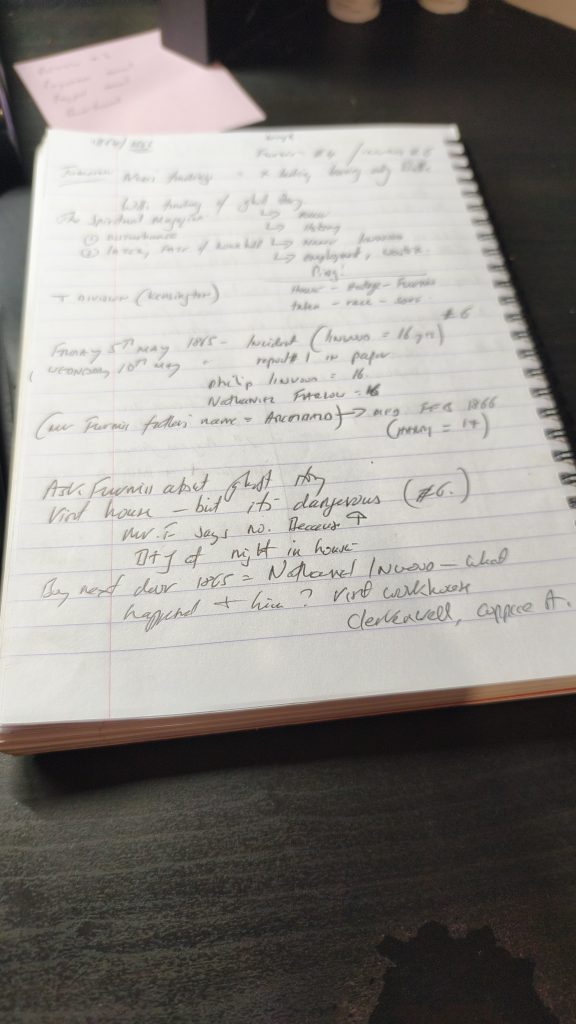
Today’s work in progress update is to let you know that I am now over halfway through the first draft of ‘Thirteen’ (working title, and it’s book 11 in the series), and had just had my midway twist. The trouble is, I wrote it a couple of days ago, and have had a day off in between, and now, I can’t remember what I wrote, so today will start with reading back. I turn to my notes, and find them of some help, although, as you can see, they may baffle some people, including myself.

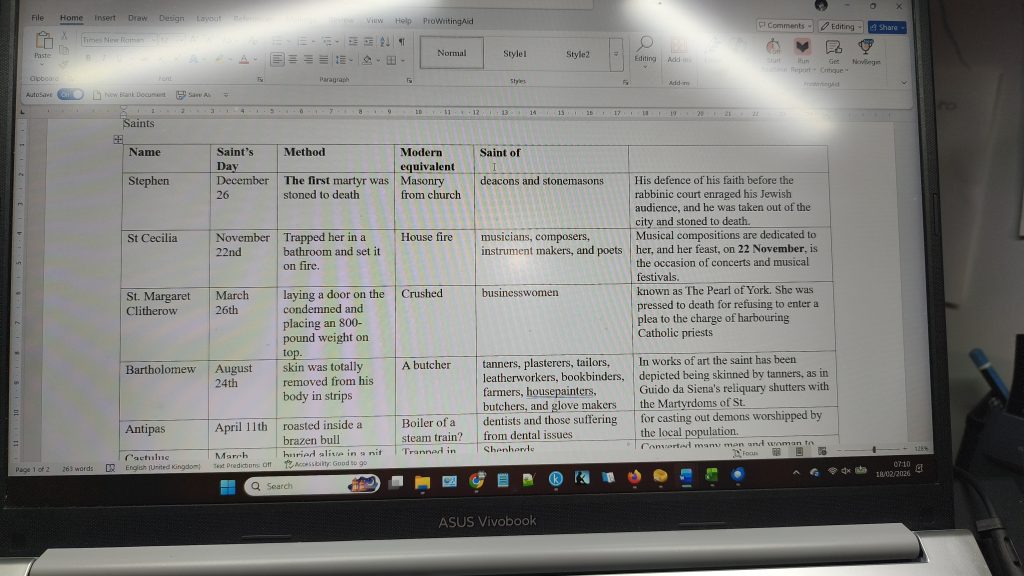
That is one page of 11 so far on this story alone. As I write the chapters, I jot down important facts for later, and then, when the mood hits, I filter the notes and write up a file that I can edit as I go. Here, for example, is a chart I made up to keep track of the murders in ‘Acts of Faith.’

In the case of ‘Thirteen’, I have a file called ‘Tie ups’, which is where I note plot points, conversations, clues and questions that I must come back to and answer later in the book. I can’t show you that or tell you too much as that would give away spoilers.

Do all authors do this? I don’t know. I do know that some authors plot and plan their entire story before starting out. They make up lengthy backstories about their characters, they, as they do when making a film, will have a character ‘bible’, and list all their traits and mannerisms, loves and hates and so on ad infinitum. Then, they will so the same with the plot, and draw grids with action lines and other grids with emotional throughlines, great big red arrows for twists and, beneath, a rough wordcount. Then, they will start writing.

I have tried that approach, and it’s not for me. In the case of Delamere Eleven, I was reading a newspaper from 1893, looking for ideas, when I came across a mention of the Thirteen Club. I’d not heard about them before, so I did some research, and later that day, started writing the book. I had a rough idea where the story would end up, and nothing else. That’s the fun part about making it up as you go – I only know as much as my characters know. I write, mainly, from the point of view of my leads, Jack and Will Merrit, and now, Ben Baxter (sometimes others). These are the investigators, and they have no idea what they are investigating until they begin, and neither do I.

When starting a new story, I set a scene for something to come, and near the start of the story/scene, I make sure the ‘domestic’ matters are up to date. (I have a nasty habit of placing characters and keeping readers informed of their lives. Example: in this book, Simeon is learning to drive. Is that relevant to the plot? It might turn out to be, I don’t know yet.) How the scene/story will end, I can’t tell you, not at the start because Jack and Co don’t know what’s coming their way either.

Therefore, I make notes as I go. Notes and ideas. They drop into my head as I’m bashing the keyboard, and I take a hurried moment to write something down, which is why my handwriting is so messy. Later, after reading back what I have written, I will adjust them or file them in the Tie Ups file. Also, when an idea occurs, I note it at the start of the next chapter. I finish, say, Chapter Nine, reread it and type up a list of where the story is going next. This I do under a new document, in this case, ‘Chapter Ten.’ Not only does this remind me of what I was thinking, but it usually gives me a PoC. A Point of Chapter, as I call it. Every sequence, section, scene, needs a point of some sort, and if you set off on a new chapter with the PoC in mind, you can’t go wrong.

Where you go wrong is when you forget to make notes and rely on your characters to remember what they were going to do, talk about, or discover. Sadly, without you knowing, they don’t know, so all you can do is knuckle down and see what they are going to throw at you next.

Yesterday, when setting up today’s writing, I prepared Chapter Fifteen, and the first few notes read:

Friday morning
Jack bad night worrying about Larkin
Catch up on hotel visit
Ned’s findings

There you go. That’s what we can expect to find in the next chapter, except there are 540 words of notes and reminders, so who knows what Jack is plotting. Not me!


If you’re still up for it, here’s a promo to promote and check out this week – if you can.

LGBTQIA+ Book Fair

Genres: General Fiction / LGBT and Romance / LGBT

Here’s another mixed bag for you. There are 41 titles here, ranging from Victorian MM Mystery to contemporary love stories.

Click to browse.

https://books.bookfunnel.com/bfhostlgbtqiaslfeb/elfhzuiyuj

From Dreams to Secrets

What I did then Vs what I’d do now.

Times have changed, and we’ve often rewound the clock…’

The opening lines of ‘Anything Goes’, and the starting place for today’s blog.

Not only have times changed, but so has my writing. It has changed greatly from when I wrote ‘Other People’s Dreams’ in 1996 to now, when I am writing ‘Starting with Secrets’, my 35th novel. I thought it would be interesting to look at how I write 26 years after beginning my career. Reading what I have already published is not something I do very often, because I always think ‘I wish I’d written that better,’ and that causes regret. However, it is a useful exercise as long as you turn the ‘I wish I had…’ into ‘The next time, I will…’ and learn from your own naïveté.

The more I have written, the more I have learnt to write better.

Let’s start by improving that.

The more I write, the better I get.

I don’t like the word ‘better’ or ‘get’ come to that, and ‘come to that’ is not necessary.

The more accurate I become? The more literary? The more I improve?

The more I write, the more improved my writing becomes…

You know what I am trying to say. Like a fine wine, a writer improves with age, as long as he continues to write, criticize his own work, and learn from his experience. The first novel I wrote is called ‘Other People’s Dreams,’ a line from a song by Janis Ian that has always resonated with me.

Other People’s Dreams

I began writing this novel while on holiday on Symi, Greece in 1996. When I returned home, I read parts of it to my flatmate and, as all new writers do, I thought it was the best thing since The Catcher in the Rye. It wasn’t, but my flatmate was encouraging, offered positive advice (he was a published journalist), and most of all, encouraged me to finish it, and then rewrite it. I rewrote it several times, and then put it away, and it didn’t see the publishing light of day until some years later.

The story opens with an advertisement. A thirty-six-year-old man is looking for four handsome young men to crew his yacht in the Greek islands. It’s a perfect summer job opportunity, but there are ‘Certain strings attached.’ That’s the hook, and I liked the way it set up the premise and a little mystery.

Then, we have a section of a screenplay in which there is an accident at sea. That’s unexplained, and we have another hook.

Then we have a flashback which sets up a third hook as we wonder what that story is all about, and it’s not until after that’s done that the present-day story starts.

Blimey. These days, I wouldn’t write so many introductions.

In the next chapter, we meet one of the four young men who will form the crew. This scene sets up people’s reactions to the advertisement, the ‘present day’ to separate the action from the flashback, and a character called John. Fine.

Then, we jump to a swimming pool, and we meet Mick, another of the four, and a character who doesn’t know where he’s going or what he’s doing. He will become the impact character when we finally meet the anti-hero.

Which we do in chapter four. Yippee! We finally feel the story is settling down, and then we’re hit with the job applications. These are presented as snippets of letters, and the chapter gives us more of an insight into our anti-hero, Jake, and another of the boys who will be the third to join the crew. It’s a neat device, and I still use letters in my novels as they make the stories feel more real. Letter writing is also a good way of putting across a character’s inner thoughts. I am using the device in ‘Starting with Secrets.’

As ‘Other People’s Dreams’ progresses, we meet the fourth character, and the first act comes to an end when Jake has selected his four men, and they are about to set off to Greece. Meanwhile, the flashback story has also reached its act one ending as the man in the past meets the object of his lust, a Greek lad called Andreas.

Looking back at the book now, it’s interesting to see that I must have had a natural feel for the four-act structure even though I knew nothing about it. There’s a turning point halfway through both stories (the flashback and the present day), and both lead to a crisis and then a climax and resolution. It’s at the climax that we know for sure how the two stories and the screenplay relate, though most readers would have worked that out along the way.

When I sent OPD to a publisher, and they sent it to their readers for an opinion, I received some positive criticism with the rejection. Although the readers found the characters ‘well drawn, especially the Greek man, Nikos, their final decision was ‘Almost but not quite’, which I think should be the title of my autobiography. I wasn’t disappointed, but took the critique on board and was actually quite buoyed by it. So much so, that I looked for an agent and found one. She took OPD to read, and I was so thrilled, I immediately began a second book.

This was a dreadful thing full of dodgy sex and a murder mystery. Set in the street in which I lived in Brighton, it was titled ‘Neighbourhood Watch.’ Although it was never published, it did turn up on some gay adult sites, because I licenced it as filler content along with some erotic short stories. This, by the way, was years later, and as far as I know, it might still be out there. I sent ‘Neighbourhood Watch’ to the agent, she read it, had a heart attack, and emigrated to Spain.

Almost but not quite…

Dreams Vs Secrets

Looking back at OPD and the way it is written, I can see plenty of things I would not do now, and I don’t just mean the structure of the opening. When examining your own past work, it’s important to look at everything from characterisation to the old ‘show and tell’ mystery, to the sentences themselves. I do this on every rewrite of every book, and there are now particular things I look out for and try to avoid.

Here are some examples of what I did in older novels that I try not to do in the newer ones. Some are necessary, some are unavoidable, but the fewer I have of them, the better I feel. (The more satisfied I feel, damn it!)

Starting a sentence with ‘He…’

At some point in my writing past, I noticed I often started sentences with He. He heard no engine, no unnatural noise, just the animals. That’s telling not showing. We know who we are reading about, we’re in his point of view, so why not write, The silence of a dead engine was the canvas on which goats and sheep painted their bleating. Well, it’s a bit naff, but I am thinking off the top of my head. Starting a sentence with He is fine now and then, but in some passages of my early books, I do it all the time. It’s a cop-out. He saw… He knew… He felt… These, to my mind, are all telling and thus, robbing the reader of the chance to experience the atmosphere.

Punctuation

This is why I have a proof reader. My punctuation, I notice, is based on how I speak, and is not always grammatically correct. I have to admit, now I use a proof reader, I don’t bother dithering over whether my punctuation is 100% accurate, because I know someone else will sort it out. However, I do know what to avoid. The other day, someone showed me the first proof of their first book, and with great excitement, asked me what I thought. I opened it at random and leapt in shock. The whole thing was in a sans serif font, Ariel or something. That’s a no-no, because serif fonts like Times New Roman are much easier on the eye when reading large blocks of text. Sans serif is fine on web pages like the one you are reading now, but, in my opinion, they should be kept out of print books.

Another thing this chap had done was hammer out exclamation marks as if they were the three-million rivets on the Titanic! I mean, one or two in a novel is fine, but eight or nine on each page! I mean, that’s overkill! Exclamation marks add emphasis for sure! But they also add an upturn in your reading voice! And if every sentence is exclaimed, the reading suffers from hiccups! And repetition! You see what I mean?!

?! is even worse, and try to avoid starting sentences with And and But. Although it can be argued it’s a style thing, there’s always a better way to start a sentence than with a conjunction.

Similar words

Again, my proof reader comes into play when I write discreet but mean discrete. The same applies to practice and practise, and several others. However, thanks to her notes, I now know to check certain words to ensure I have the verb rather than the noun, or the adjective rather than the verb. I also know what my most common typos are, and I keep a list of them so I can run a search/find on the full manuscript and change form to from and fro to for, etc.

Repetition reminders

Something I do a great deal of when writing a first draft is remind myself that I have already said that. I will state a fact the reader needs to know, and then I’ll state it again from someone else’s point of view later, and probably, do it a third time. This is a subconscious thing in the first draft, and I do it because I am unsure if I’ve mentioned the fact before. Either that, or I repeat it so the reader knows a different character knows the fact. I reckon a reader only needs to be told once, so, in the second draft, I consciously look for such repetitions and ask myself, ‘Do we know this already?’ Very often the answer is yes, so I take it out. An exception might be if a vital fact or clue is mentioned in chapter one and comes into play again in chapter thirty; then, it’s acceptable to remind the reader, but it must be done subtly.

Shoe Leather

Every chapter must have a point, and I keep a list I call POC. Point Of Chapter. As long as the plot or character details I want known come across, then the chapter has a point. That’s one thing, but another is the shoe leather scene, as they call it in screenplay writing. These are scenes to be avoided and, in some screenplays, they are there because the writer needs to present 90 pages and only has 87. A chapter only needs to be as long as it needs to be, you don’t have to aim for 3,000 or 4,000 words. In fact, it is better to vary the length of chapters as it is to vary the length of sentences. If your chapter feels too short, don’t bung in any old description or, worse, repetition just to make it longer. I used to do this, but now as I reread, I think to myself, ‘Do we need this?’ ‘What’s the point of this paragraph?’ ‘We’ve been here before.’ ‘We’ve done this…’ Ad infinitum

And Finally, Cyril

I am in danger of wittering on ad infinitum, so I will stop there. The point of this post has been to highlight how a writer can, and must, learn from his or her own writing. The above is simply an early morning reflection on what I have to say about the subject, and I hope you found it of use. To finish with, and just for fun, I want to give a few lines from both ‘Other People’s Dreams’ (1996) and ‘Starting with Secrets’ (2022, first draft). Both sections are from towards the beginning of the novels. See if you can spot the differences.

Other People’s Dreams

There was no doubt about it, the older man in the red trunks was flirting. This was the second time he had walked slowly past the lifeguard station, staring up and looking for a moment too long. Mick caught his eye again and immediately looked away, tiring of the attention. Not only was he working, he was simply not interested.

He had become used to the admiring glances of the men and women whose lives he guarded for six hours a day; there was no more novelty to it.

Starting with Secrets

[Character name]* tore the page from the newspaper, and threw the rest into the coal scuttle to use as kindling. Beyond the window, a sickly glow of yellow light coloured the overhanging fug, through which came the sound of clatter-carts and costermongers calling their wares, the sharp cackle of the prostitute and the crash and roar of warring couples. A policeman’s whistle pierced the night, and boots thudded on the cobbled street, chased by others and accompanied by shouts. Slops cascaded from the room above to catch a child unawares, resulting in screams and foul language, and soon after, came the threatening tread of a father mounting the stairs to seek revenge.

* I removed the name because it might have been a spoiler

Other People’s Dreams is on sale here.

Starting with Secrets should be ready for publication by the end of October. It will be the sixth book in the Larkspur Mystery series.