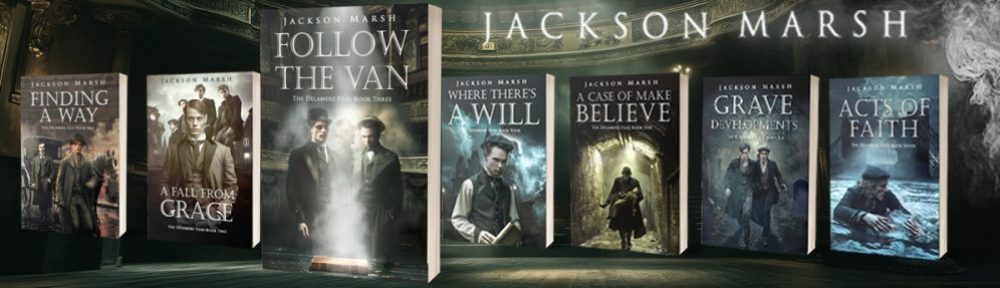
If you have been following the ‘Speaking in Silence’ journey from London Paddington to Bodmin, you will know that it’s been an interesting train ride so far. In the word count scheme of things, I’d say I was now at Exeter, being at roughly 72,000 words, with the destination being 100,000 or thereabouts. After some shunting around in a yard several miles back, I have had a clear run from Bristol, and am now approaching the final reel. The final ‘act’ as they say in film terms.
I started the ‘Speaking in Silence’ journey knowing that I wanted it to be about two characters who appeared in the last book, but who we don’t yet know; Henry Hope and Edward Hyde. In this story, Edward is the protagonist, and yet, not only does he hardly speak, he also hardly communicates. That poses a few challenges for the author. Unlike Joe Tanner, who is deaf and communicates through sign language, Edward has taken a vow of semi-silence. The only person he speaks to is Henry, and Henry knows why. We, the reader, come to learn why Edward chose to do this, and we come to understand there is only one thing that will enable him to feel able to speak again. Justice. Therein lies the plot of the novel.
That was what I started with 72,000 words ago, and the rest I have, quite literally, made up as I have gone along, including the characters of Henry and Edward and a hell of a lot of backstory, which trickles out over time. I have used the flashback technique, and it was only while writing those scenes that I came to know the characters. They introduced themselves to me while Henry was telling me his and Edward’s story if you like, and that didn’t happen until I was quite a way into the story. That’s why we had the shunting around a few miles back, and I had to backtrack and change the point of view of some of the earlier chapters. If there’s a lesson there, it’s ‘know your characters before you start’. (A note to fellow authors, if you would like to stretch your character’s bio then you can always drop in for a ‘character interview’. Contact my PA for more details jeninesymi@gmail.com).
To give you a flavour of the novel, and without giving anything away, here’s a short excerpt from the first draft – unedited so excuse any errors. The skeleton is a character who will remain nameless for now, and I have changed the name of the second character to ‘John’ so as not to spoil things for you. John, the villain, is going to see the other villain at his new lodgings in Greychurch:
The skeleton’s previous lodgings above the ‘Princess Alice‘ had, John thought, been about as low as a man could go, but when he took a deep breath and entered the ‘Hops and…’ as the broken sign described it, he realised he had been wrong.
His foot fell on a rat, but it didn’t squeal because it was dead, but the child playing with it gave him a mouth of abuse, which he ignored. Dishevelled heaps, rather than people, sat at the few tables, some sucking on pipes whose fumes hardly disguised the stench of damp clothes, sweat and something else he didn’t like to think about, while across the room, no more than ten feet from the door, two men stood at a trestle table that served as a bar, while three rested against it on the floor, either drunk or dead. The most unnerving thing about the place, however, wasn’t the landlord with wooden teeth, only one eye and one hand, nor even the miasma of fire, pipe and opium smoke, but the silence. No-one even looked at him, no-one jereed at a well-dressed man from the west of the city entering their destitute realm, and nobody, apart from the child, made a sound.
These people, if he could call them that, might still be able to hear, he thought, and so he prepared to whisper to the disfigured landlord. As he leant over one of those asleep at his feet a movement to his right caught his eye. One of the heaps unwound itself from the table it had been slumped across and dragged itself to its feet. It said nothing, but a skeletal hand emerged from the sleeve of its black gown and beckoned to John like death, before gliding towards a door beside the makeshift bar.
Pleased to be with someone he knew, albeit vaguely and nefariously, John followed the skeleton through to a passage, and down a set of steps to a cellar. Ahead, the scurry of clawed feet suggested their path was clear, but still, when they arrived below ground, several pairs of pink eyes glinted in the candlelight, watching from the crevices for the time they could reclaim their dominion.
The Princess Alice pub was one of the pubs frequented by prostitutes in the East End of London at the time of the Ripper crimes
More on my WIP blog next Wednesday, but don’t forget to be here on Saturday for my other weekly post.
The WIP news this week is that I am up to 55,000 words and chapter fifteen of the Larkspur Mysteries book five, Speaking in Silence. On our train journey from London to Cornwall, we have reached somewhere around Bath or Bristol, and that’s appropriate because it means I’ve just met the villain of the piece coming the other way. Chapters 14 and 15 are set on a train journey from Cornwall to Devizes, in Wiltshire, and in the story, the train has recently left the city of Bath.
You know when you get halfway through a draft and suddenly think to yourself, ‘Something’s not right’? Well, I had that twice during the last week, so some of my workload has been fixing a couple of things, or rather, fixing one, and thinking about how to fix the second.
In the first instance, I’d left what they call a plot hole and needed to go back and fill it in. This meant adding an extra chapter so that what a character did next would make sense.
In the second instance, I realised I have started the story from too many points of view. Simply put, it opens with the villain, cuts to Silas’ POV, then to Frank’s, then back to Silas’, and then there’s a backstory section from Henry and Edward’s points of view. The story was originally to be about Frank and his involvement with someone else’s story, but now I am further in, I realise it’s not about Frank at all. So, the earlier scenes that are from his POV need to be from someone else’s, Henry in this case, and so they need rewriting.
Hey ho! That’s how it goes. Now, having told you this, I am going to get on with chapter 16 and move the story into its second half.
In showbiz, they say, ‘It’s not how you start, it’s how you finish.’ When writing a novel, I say, it’s how you start and finish.
While standing in the bookshop or browsing through Amazon, many people will pick up a book and look at the cover first. If the cover and title grab them, they will then read the back blurb. If that intrigues them, they will read the first line, and if that appeals, they may read the first page. After your cover, title and blurb, your first page is the most important part of your book, so today’s blog is about what a first page should do. You can expand that to the first couple of pages or the first chapter, but really, what the first page should do is grab the reader and drag them into the story.
Opening Lines
Before we get into an examination of what’s on your first page, I wanted to have a look at some opening sentences, just to make a point:
It is a truth universally acknowledged, that a single man in possession of a good fortune, must be in want of a wife.
Jane Austen, Pride and Prejudice (1813)
It was the best of times, it was the worst of times…
Charles Dickens, A Tale of Two Cities (1859)
There was a boy called Eustace Clarence Scrubb, and he almost deserved it.
C. S. Lewis, The Voyage of the Dawn Treader (1952)
And the point is, it’s not only the first chapter or page which should engage, the very first line should too. When I wrote the first line of The Mentor of Barrenmoor Ridge, I wanted to sum up the entire story, set the background and inspire the reader to look forward. This is what I came up with:
John Hamilton was refusing a job at Everest base camp when he caught sight of the youth who would change his life.
Barrenmoor Ridge is about a mountaineer coming to terms with the death of his lover while rescuing a younger man from a mountain and falling back in love. The first page opens halfway through a scene, as all good scenes should, they say. Having just written that, I thought I’d examine some of my other opening lines to see whether I followed my own advice.
Andrej waited until the darkest hour before he untied his wrists with his teeth, and freed his feet from the knots.
You can see, there’s something of a formula, but not always. The opening for ‘Other People’s Dreams’, my first novel, is an advertisement:
Do you want to live out my dream?
One yacht, a thousand islands and all the time in the world.
36-year-old guy with the money and the fantasy seeks four fit, young, gay lads to crew his boat in the Greek islands. (No experience necessary)
You must be trustworthy, attractive, loyal, adventurous, uninhibited and free from June through to September with no ties.
All expenses and living allowance paid in return.
Certain strings attached.
Write with photo to Jake, Box No. 2006
The first sentence in your novel is as important as all the others, but is usually the first one someone will read before deciding whether to buy a book. Grab ’em from the start and hold ’em until the end. But before they even reach the end of chapter one, they need to get past the first page…
Meanwhile, on the First Page
One Stop For Writers (OSFW) released a guide, ‘How to Craft a Winning First Page’ (see the image), and I am using that as a guide while I examine the openings of two of my novels. The details of each section are on the image, but below, I’m comparing what OSFA suggests against what I did. Bear in mind, I hadn’t read this advice or any like it when I wrote the two novels I’m going to look at, The Mentor of Barrenmoor Ridge (2018), and Deviant Desire (2019).
The notes on the image expand the OSFW advice, but in summary, it suggests five things a first page should do:
Start in the right spot – begin just before a major event in the main character’s life
Show – basically, don’t start with too much backstory (plenty of time for that later)
Tighten up – don’t be wordy, don’t drag it out (plenty of time for that later too)
Raise a question – create intrigue
Build empathy – make the reader like the MC
How do my two examples compare?
The Mentor of Barrenmoor Ridge
Here’s the opening line:
John Hamilton was refusing a job at Everest base camp when he caught sight of the youth who would change his life.
Start in the right spot. Catching sight of the impact character (Gary) is the catalyst for the love story that follows. We also enter the story halfway through a discussion. That’s a common trick used by Shakespeare among many others. Other good ways to open are on a journey in progress, with an argument, with a bang, or right in the middle of some action. When I wrote Banyak & Fecks, I originally started with Andrej (Fecks) standing over the ruins of his burnt-out home and remembering his childhood. That section is still in the first chapter, but it was too slow for an opening. Now we start with him escaping from a camp, stealing back his knife, and running from certain death. A little more grabbing than a character feeling sorry for himself.
But I digress…
Show. I.e., trimming down the backstory. My Barrenmoor Ridge first page contains lines such as, ‘You were talking about another base camp season,’ he said, showing us that John has worked at Everest base camp before, he’s got something to do with mountaineering, and a discussion has happened before we arrived. Showing, not telling, is something that confuses many aspiring authors, and it can be a hard one to get your head around. I tell plot and action all the time, because sometimes you have to, but I always aim to show things like emotion and feeling. Rather than saying ‘he felt sad’, or ‘John was angry,’ show John crying or kicking over a chair and shouting. The reader will imagine more and thus, be drawn further into the story and character. In Barrenmoor Ridge, John is distracted and not concentrating, and he’s shaking because of something or someone he’s just seen.
Tighten up. There are two paragraphs on my first page that tell us where we are, what’s going on, and give us some atmosphere. We are in the climbers’ café in Inglestone, where cigarette smoke hung in the clammy air mixed with the blue fog of over-fried food. That’s enough to set the scene. We don’t need too many other details of the café beyond the tablecloths and plastic bottles of sauce.
Raise a question. Hopefully, the opening line, John’s trembling hand and a couple of other things raise questions. Who did he just see? Why is he trembling? Why is he refusing a job? How will his life change?
Build empathy. In the opening scene/page, John is doing what most of us have done: meeting with someone in a café and having breakfast. It’s what in screenwriting terms they call ‘the normal world.’ However, the second character tells him, ‘Not just any season,’ she said. ‘Possibly your last. You’re not getting any younger.’ So, we now know he’s getting on a bit, it’s a special opportunity, and he’s done it before. Over the page, we learn that John is getting over the death of his lover, so hopefully, that builds more empathy.
Having just reread that opening, I know I could have done better for a variety of reasons, but, in my defence, it was only my second novel as Jackson, and I was still building my style. A year later, I wrote what was to be a standalone novel based around the Jack the Ripper murders (although in an area of London called ‘Greychurch’ where the Ripper was killing rent boys). Deviant Desire then became the first in an ongoing series of Victorian mysteries, but that wasn’t my original intention. Had it been, I probably would have begun the story in exactly the same way.
Deviant Desire
Opens with:
Silas Hawkins was searching for coins in an East End gutter when a man four miles distant and ten years older sealed his fate.
Can you see the similarities between that and Barrenmoor? Yeah, well, if it ain’t broke don’t fix it.
Start in the right spot. That opening line tells us that the catalyst is on its way; Silas’ life is about to change because of what someone else is doing off stage. The first paragraph goes on to say that even if Silas knew what was to become of him, he wouldn’t have been bothered, because Silas wasn’t the kind of youth to shy from a challenge, not even one that might threaten his life. (Ooh, something dangerous is coming…)
Show. This is about cutting out too much backstory, remember? Well, there isn’t any on the first page, but there is plenty in later chapters. Although this opening is ‘wordy’ in that it is descriptive, that is to set the atmosphere of an October night in London’s East End in 1888. You can’t write about the Ripper and not have atmosphere. Thus, I get a bit Dickensian while making the reader want to know more about Silas’ past:
“In these times, hunger was a keener motivator than sense. It drove need, need drove experience, and in the four years since he had turned his first trick, experience had prepared him for the dangers of life.”
There is some backstory there, four years since he had turned his first trick, but I didn’t really go into detail about those four years until nine books later when I wrote the prequel, Banyak & Fecks, and the story in which those four years come back to haunt Silas, Negative Exposure.
Tighten up. I refer you to the section above about atmosphere. However, the story starts with a bold statement that tells us something major is about to happen to this man who is searching through rubbish leftover at a market hoping to find food. He’s hungry, cold, and he ‘turns tricks.’ We also learn a bit about his character while reading what I hope is suitable and descriptive prose.
Raise a question. As with Barrenmoor, the questions arise from the opening sentence. Who is Silas Hawkins? Why is he searching for coins? Who is the man four miles distant? Why should he change someone’s life? Is the ‘ten years older’ relevant? Will we get an older/younger romance? Later on the page, we learn he’s been turning tricks and we might wonder why, how, and will we get to know more about that?
Build empathy. If you don’t feel sorry for a gamin (street urchin) rooting through trash so he can live, shivering, prostituting himself even during the time of the Ripper and generally not having a pleasant life, then you need to work on your empathy skills. Joking aside, it’s the writer’s job to make the reader feel empathy. Hence, phrases on this page such as Every night on the grimy, gaslit streets was dangerous, and every unlit customer a potential killer, but the threat of starvation gnawed harder than the fear of violence.
A Few Last Words About the First Words
There is a practise in the film script writing world to do with how you introduce a character and how you say goodbye to them. It’s a case of first impressions count, but so do last ones, and the same applies to novel writing. I’m not necessarily talking about the main character here; the rule applies to all characters and to the novel itself. How you meet an entire story is as important as how you meet the MC and others, but so is how you leave it.
Take from the attached advice from One Stop For Writers what you will, but I am going to end with an ending.
In Deviant Desire, we meet Silas on that grimy street, and we leave him 300 pages and one adventure later somewhere entirely different. As for the story, it starts thus:
Silas Hawkins was searching for coins in an East End gutter when a man four miles distant and ten years older sealed his fate.
By the time I got to the end, I decided it was to be an ongoing series, thus, it ends with a different character whose name I have omitted so as not to spoil the story for you.
Revenge was not something [he] thought he would ever contemplate, but he found the idea of it suited him and, as he ordered an ale, he turned his mind to a variety of ways it might be exacted.
Continued in part two, Twisted Tracks
Remember, it’s about how you start and how you finish. It’s about how you introduce your reader to your story, how they leave the story and how the story leaves them. The mark of good storytelling comes when a reader finishes a book wanting to know what happens next to the people in it. This means they have connected with the characters and their world and don’t want the journey to end. The mark of a good first page is to do the same in reverse: to make your reader want to take the journey in the first place.
You can join me on my writer’s journey by tuning into my regular Wednesday work in progress blog. Currently, we’re journeying through Speaking In Silence, the Larkspur Mysteries book five.
We are now well on the way to Devizes in Wiltshire. In fact, we will be there at any moment. I am comparing the journey of Speaking In Silence to a train ride from London to Bodmin and looking at my old map of the GWR lines, I’d say Devizes was about a third of the way there or 35,000 words in first draft terms. When we reach Bodmin (estimated time of arrival, 100,000 words), we will have to make the return journey via the second and following drafts, but that’s for much later.
Devizes is also appropriate because that is where my villain lives or lived in real life. At least, he was a member of parliament for the area back in 1891 when the story is set. When I say ‘in real life’, I am basing my character on a newspaper article and on a character from it, but because of what he does in the story, I must point out that the real man didn’t do this in real life. He might have done what he was accused of in the newspapers of the time, but the case was never tried, so who can say?
Research this week has seen me looking up chemical reactions, reading first-hand accounts of London’s East End in the 19th century, and the etiquette of a country house Friday-to-Monday, what we now call a weekend. The word ‘weekend’ only came into use just before 1920, so it’s another of those words I can’t use, like ‘okay’, ‘teenager’ or, to a certain extent, ‘adolescent.’ ‘Homosexual’ is another one I shouldn’t use (common usage after 1900, only specialised medical use a few years before), and when my books are filled with homosexual adolescents recounting their okay teenage years at the weekend… Well, I revert to the thesaurus on a regular basis. Meanwhile, Jenine has been researching letters patent and advancement of titles, the process of lobbying for someone to receive an earldom and how that happens. Poor thing.
Whitechapel 1890
Letters patent issued by Queen Victoria in 1900, creating the office of Governor-General of Australia as part of the process of federation.
It’s been a busy journey so far, and we nearly had a derailment around Newbury when I found myself stuck. I had planned an ending, but as the characters started telling me their story, I realised the ending was wrong. I had to think up another direction, and we almost jumped the tracks. Now, though, we’re back on them, and the destination is the same, only with a slight detour. As usual, I can’t tell you too much, but I can say that what the near derailment has done, is force me to write characters as knowing what is going on in the story while not being able to tell the reader. You see, in this book, it’s all about what’s not being said that’s important, and yet an awful lot is said. Hence, Speaking In Silence.
A couple of weeks ago, I was telling you about my author’s bible. Today, I thought I would look at my author’s bookshelf and give you my opinion of what every author should have on their shelf. At least, I’m going to tell you about a few of the reference books I have on some of my shelves, and tell you my go-to resources for when I am writing.
The Basics
For anyone writing in English, the must-have book has to be an English dictionary. You can use an online dictionary, and there are several, but be aware that you may not always find the correct English spelling (they may be in American). For example, if I want to check a definition or existence of a word, I do an online search, but searching for ‘harbour definition’ gives me the result ‘harbor’, the American spelling.
What’s useful about this method is that the search results also include the origin of the word and there’s a section which gives me the word’s use over time.
However, bear in mind that this graph probably relates to the use of the word in print, and words only make it to a dictionary based on their printed use. Also, it may be American print, not necessarily British. This is a useful tool for when I am checking if a word I want to use in dialogue existed at the time that dialogue was spoken. I’ve mentioned before some words I wanted to put into my Clearwater and Larkspur historical mysteries (1884 to 1891) only to discover they were not in common usage back then. I scream when I see a TV series or read a book set before the 1930s and a character says ‘Okay.’ Why? Well, take a look at this more detailed chart of the word’s common use:
There are others, some more surprising, such as ‘paperwork’ (1934). So, the online dictionary is useful for this kind of thing, but if you want a proper definition, head to the real deal, print dictionaries, and the more extended the book, the better.
The same can be said of the thesaurus. There are online resources for looking up synonyms and antonyms, but again, check for American spellings. I use https://www.thesaurus.com/ but even this doesn’t always have older synonyms, which is why I have a Collins thesaurus beside my dictionary. You’ll also notice other useful resources in the photo below, including the Collins Dictionary of Quotations, and a few Oxfords: Guide to the English Language, Dictionary of Rhyming Slang and Dictionary of Idioms. All very useful. The rhyming dictionary is a leftover from when I used to write cabaret songs and musicals, and it’s now very handy for when I am inventing poetic ransom notes or clues in the mysteries. An Unkindness of Ravens gives me common collective nouns which can also be fun to browse. Did you know that a group of writers is a worship of writers? A group of nuns is a superfluity, but my favourite is a drift of fishermen.
By the way, the Samuel Johnson dictionary is fun to browse to find obscure words from the English language and to check older origins. I just opened it at random and found ‘Humicubation – the act of lying on the ground.’ Next time your toddler is throwing a paddy in Sainsbury’s, you can tell those giving you disdainful looks, ‘Ignore it. My dandiprat is merely humicubating in his dander.’ (‘My little fellow is lying on the ground in a temper’).
At the other end of this shelf, I have the complete works of Shakespear because everyone should have one, a Brewers Dictionary of Phrase and Fable, and between them, a set of three books by Mark Forsyth. Rather than explain these ‘witty and erudite’ books, as The Times called them, I’ll direct you to his blog where you can learn more: https://blog.inkyfool.com/
Sitting alongside these on the dictionary shelf are copies of old and specific dictionaries, namely one of Kentish dialect (for use in my Saddling series and for Thomas Payne in the Clearwater collection), and Passing English of the Victorian Era, another go-to place for word finding and checking. I find such things from https://www.forgottenbooks.com/en Forgotten Books because I like them in print, but some can also be found online. In my browser’s research bookmarks, for example, I have a link to an English to Cornish dictionary in PDF format, one to a Cockney rhyming slang translator (but always check the date of first usage), and one to an online copy of The Vulgar Tongue, which I am constantly referring to when writing Frank Andino in the Larkspur books. I also have a hardback copy of this beside me as I write, and it’s another great resource for old street slang and cant. (Cant: Language peculiar to a specified group or profession and regarded with disparagement. I.e. “Thieves’ cant.”)
I also have a link to an online video dictionary of British sign language which I use when writing Joe Tanner, and from which I am constantly trying to learn new signs. https://www.signbsl.com/ Check it out and get signing!
Moving on to structure.
On another shelf, I have a collection of screenwriting books. Unsurprisingly, I bought these when I was writing screenplays, but what they contain is of use to novelists. This is because films are all about structure (unless they are art-house or experimental films), and structure is vital to a novel (unless it’s a bad one). Robert McKee’s ‘Story’ is an excellent guide to the structure of stories, and Aronson’s The 21st Century Screenplay is excellent for outlining and giving examples of the various story structures used in films which can also apply to novels. Elsewhere, I also have a copy of the Writer’s Journey by Vogler which is the go-to book for understanding the hero’s journey of classic story telling. This was given to me by Anne Zouroudi, the best-selling Bloomsbury author of The Greek Detective Series, and as she swears by it, so do I.
You will also notice in there, ‘On Writing’ by Stephen King, a good read and useful. Part autobiography and part advice giving, it’s well worth having.
To be a Little More Specific
On a third shelf, I have a collection of reference and research books dedicated to my period, the late Victorian times. The photo below gives you an idea of what I research for the Clearwater and Larkspur novels. The Victorian Country House, Britain’s Stately Homes, Life Below Stairs, and a history of the Garrick Club are general to life at Larkspur and Clearwater House characters. Others relate to Silas, Fecker and the poorer East End renters and characters who appear on the other side of the great divide. East End 1888, Slumming, The Cleveland Street Scandal/Affair and The Good Old Days have all been mined for information.
Then, there are more specific books to dip into, such as Dying for the Gods (Human sacrifice in Iron Age and Roman Europe, used for Keepers of the Past); Personal Reminiscence of Henry Irving by Bram Stoker (used in Bitter Bloodline); Egyptian Hieroglyphs for Complete Beginners (used for Guardians of the Poor); and The Gates of Europe (used to understand more about Andrej’s background in Ukraine).
And then there are the research books I have on my Kindle, but that’s for another day.
Beneath these shelves, I have another that contains maps and pamphlets, small works about specific places and other bits and pieces, all of which have been or will be used in background reading and research.
Above them, though, I have a shelf now nearly full of my own publications, and I’ll show you a picture of it, not to show off, but so you can see that a successful series isn’t just about typing words for eight hours a day. It’s about knowing your subject, exploring the past, getting in the details without flooding the page with unnecessaries, and understanding what it was like for people back then. From using the right words (or not using the wrong ones), to knowing what kind of wing collar a viscount might wear in 1890, from knowing what a butler might earn in 1888 to discovering how a parrot might be poisonous, the answer will be contained in a book somewhere. Or these days, online, but always check your online research, and don’t take the top search result’s words as true; double check, and if in doubt, buy the books, read them, and use them.
The result of all this reading and hard work? This:
And this:
Hope you enjoyed this pry around my office shelves. See you on Wednesday for my Work In Progress,
I started back on Larkspur Five, Speaking in Silence, on Monday. I’d done some work on it previously, but I wasn’t that happy with what I’d written.
The first chapter is fine (for now), and it’s rather Dickensian as we follow a mystery character into the depths of Greychurch (Whitechapel) for a clandestine meeting which sets up the rest of the story. Then, however, I’d cut to a couple of men at the Larkspur Academy and had written a very prosaic ‘waking up’ scene. This was followed by breakfast where Fleet asked all the characters what they were doing, and filled us in on what’s happened at the academy since we finished reading Seeing Through Shadows.
What I’d actually done, I realised, was tell myself what had been happening and where everyone was. Cadman was mapping the estate, Clem was about to start his business, Frank had been doing XYZ and Hyde and Hope were blah-di-blah. The reader didn’t need to know all that in the second chapter, and it was a bit ‘in yer face.’ So, I scrapped it. Rather, I put it in the ‘cuts’ folder because there are parts of it I will need later. I just didn’t need to bung it all in right at the start in the manner of a ‘Previously on Larkspur…’ announcement at the start of a TV show.
So, with chapter two out of the window, I moved chapter three, which I’d started, to second place, and carried on, and now things are flowing much more smoothly.
The story proper starts in chapter two (one being something of a prologue), and it starts with a dinner party at the Hall. Bigwigs and important MPs have come to inspect the academy, and among them are the men who will decide if Archer should be raised to the rank of Earl.
I need to do some research there, because things might have been different in 1891 to how they are now, and I know it’s not as simple as the monarch awarding the title like the good old medieval days. At least, I don’t think it was like that… I’ll let you know.
Anyway, the news is that the train has left the station and I am driving it, albeit slowly to start with. If you’ll excuse the analogy, I reckon I’ve just left Paddington and am still building up a head of steam. I’ve only reached the western suburbs so far, and my destination, Larkspur Hall in Cornwall, is still a long, long way away.
Hi everyone! I’m Ally Lester and I write queer romance across the rainbow spectrum as A. L. Lester. Firstly, thank you so much for having me visit your blog today Jackson! I’m really delighted to be here and to get to chat with your readers.
I’ve come to talk about Warning! Deep Water my release that is coming out on Saturday 7th May. It’s part of a project with Holly Day, Nell Iris, K. L. Noone and Amy Spector. As regular readers of my blog will know, Ofelia Grand (who also writes as Holly), Nell Iris and I write together in the early mornings. This involves a fair amount of chat and discussion about what we’re working on. As Holly, Ofelia writes stories to mark all the different holidays throughout the year and one day in December we were teasing her about what she should write next. We joked that World Naked Gardening Day would be an excellent idea…and lo and behold, here are five of us writing on a similar theme.
Warning! Deep Water! is a 16,300 word novella set in England in 1948. When given half a chance I slip back in time, obviously. It’s set on a horticultural nursery in Somerset. Did I grow up on a horticultural nursery in Somerset? Yes, yes I did. Was this weird? Yeah, a bit—half way through I realised I was having trouble writing any scenes with sexing because the MC reminded me of my dad. Did I change that fairly rapidly? YES, DEAR READER. YES I DID.
Once I’d got over that little hiccup however, it was extremely fun to write. For my historical background I rang my mum. She and my dad met in the 1950s whilst they were working on a nursery that grew mostly chrysanthemums. During the second world war, the place had had to stop growing flowers and focus on growing food. They grew lettuce and tomatoes, mostly to supply the local army camp, and were only allowed to grow a small amount of flowers every year to keep the stock fresh. After the war, once food supplies weren’t such an issue, they expanded back in to flowers and by the time the nursery shut and was sold for building at the end of the 20th century, they were known all over the country for their different varieties—they were the people that other nurseries bought cuttings and rootstock from.
This was the place on which I based Roseland, as a sort of mash-up with my own memories. My family’s place was more diverse—they grew flowers and tomatoes, lettuce, beans and cucumbers; and had pick-your-own fruit as time went on. In later years, my Mama grew plants and sold them at local country markets. We had three big stoke-holes that I remember being converted from coal to oil as a child in the 1970s. Before that we had regular deliveries of coal to keep it going.
The big water tank where George finds Peter swimming is directly modelled on the irrigation tank in #1 greenhouse. It always fascinated me…the mossy sides and the stillness of the water. It’s pumped up from a bore-hole and is fresh and crystal clear. We weren’t allowed to go in the greenhouse by ourselves in case we fell in and drowned, and I can remember getting the bollocking of my life one day when there wasn’t much water in there and my sister and I slid a ladder over and climbed down inside to paddle.
It was an idyllic childhood—of course there were dangers, from water tanks, to piles of broken glass from the greenhouses, to sharp tools, machinery and weedkillers. But we pretty much ran wild when we wanted to. Roseland is an affectionate look back at that and I hope that comes across behind Peter and George’s story.
If you want to find out some more about me and my books, my website is allester.co.uk, where you can sign up to my newsletter for a free paranormal-historical novella; or you can find me on social media, mostly as @CogentHippo. For now though, here’s a bit more about the story, and an excerpt.
Warning! Deep Water
It’s 1947. George is going through the motions, sowing seeds and tending plants and harvesting crops. The nursery went on without him perfectly well during the war and he spends a lot of time during the working day hiding from people and working on his own. In the evening he prowls round the place looking for odd jobs to do.
It’s been a long, cold winter and Peter doesn’t think he’ll ever get properly warm or clean again. Finding a place with heated greenhouses and plenty of nooks and crannies to kip in while he’s recovering from nasty flu was an enormous stroke of luck. He’s been here a few days now. The weather is beginning to warm up and he’s just realised there’s a huge reservoir of water in one of the greenhouses they use to water the plants. He’s become obsessed with getting in and having an all-over wash.
What will George do when he finds a scraggy ex-soldier bathing in his reservoir? What will Peter do? Is it time for them to both stop running from the past and settle down?
A Naked Gardening Day short story of 16,300 words.
“You didn’t say you liked music,” Peter said, as they were sitting across the table from each other over a cup of tea, once he’d finally pulled himself away from the instrument and reverentially closed the keyboard.
“Well,” said Peter. “It didn’t come up, did it?” He paused. “Mother used to play a bit,” he said, eventually. “Not like that, though. Hymns, mostly. She was big on chapel.”
There was clearly a story there.
“It’s nice to hear it played,” George went on. “Instruments should be used, not just sat there as part of the furniture. And…,” he paused again and blushed, “And you play very well.”
“Well,” said Peter shuffling with embarrassment. “I learned as a nipper and just carried on with it. Dad wanted me to go and study somewhere, but I wanted to get out and earn. It would have taken the joy out of it if I’d had to pass exams and such.”
George nodded. “I can see that. And you’re good with your hands.” He blushed again and became very absorbed with mashing the tiny amount of butter left from the ration into his baked potato.
Peter coughed. “Well yes,” he said. He couldn’t help smiling a little at George, although he didn’t let him see. He forged on. He really didn’t want him to be uncomfortable. “I think mathematics and music sort of go together, you know? And I was always good with numbers as well…it’s a good trait in a joiner.”
George nodded, clearly feeling they were on less dangerous territory. “Yes,” he said. “There’s all sorts of things you can use maths for; but music is pretty rarefied, isn’t it?”
Peter nodded. “This way I get to keep the music and earn a living. There’s always work for a carpenter, like you said the other day.”
He gradually became less self-conscious about playing when George and Mrs Leland were in the house over the next few weeks. It made him feel like another piece of what made him a person was coming back to life.
****
What it didn’t do was make him any less confused about what was happening between him and George. Half the time he thought George was completely uninterested. But then something would happen that would make him reconsider. The comment about being good with his hands was a case in point. It was a perfectly commonplace thing to say and George shouldn’t have been embarrassed. But he had been. Which meant he’d thought of it in a context that might cause embarrassment.
Peter spent several very enjoyable hours spread over several evenings working through different variations of what the other man might have been thinking.
George was nobody’s Bogart. But he was decent-looking. Nice face, especially when he smiled. A bit soft round the middle, but otherwise hard muscled from the physical work he did day in, day out. Clever…did his own accounts. Liked music. Made Peter laugh with his dry commentary on things in the paper or local gossip and the social pickles the girls reported on in the break room.
Peter liked him a lot. And fancied him. After the third night of considering at length how he could demonstrate how good with his hands he actually was, he gave up pretending. He fancied George a lot.
About A. L. Lester
Writer of queer, paranormal, historical, romantic suspense, mostly. Lives in the South West of England with Mr AL, two children, a terrifying cat, some hens and the duckettes. Likes gardening but doesn’t really have time or energy. Not musical. Doesn’t much like telly. Non-binary. Chronically disabled. Has tedious fits.
Week two of the creation of ‘Speaking in Silence’ and I’m afraid I will have to be rather silent on the subject. I said in my last WIP blog that I intended ‘beginning on the book proper in a couple of weeks.’ I still do, and the couple of weeks has now become one week. I intend to start on it on Sunday. Meanwhile, I have been reading about railways, investigating a few other matters I need to know, and inventing scenes in my head.
So, the WIP news this week is that there isn’t any WIP news this week, but I’m looking forward to knuckling down again in a few days. Summer is fast approaching, and that means I’ll be up at my usual summer morning time of 4.30-ish, at the desk by five if not sooner, and will have all morning and, when it’s not too hot, all afternoon to dedicate to the next Larkspur adventure. I’ll be keeping you informed as I progress through it.
Or, in my case, two bibles, and we’re not talking religious texts. We’re talking about notebooks. Today, I thought I’d take you through my author’s bible. In other words, how I keep track of characters, places, descriptions and facts when writing a long and ongoing series. The photos show my two main notebooks, with brief explanations as to what you are looking at.
In the Beginning…
I have a chest in which I keep my original notes. I started this collection about two years BC (that’s Before Clearwater), and the papers are now yellowing, and the writing is fading. I used to make notes about the stories I was writing on pieces of scrap A4 paper, usually the backs of drafts I’d had printed, and among them is a list of most commonly mistyped words. I use that to check the full manuscript when I reach the end of a draft; words like form and from, for example. But these notes are not my author’s bible, that is a leather-bound, blank page notebook Neil bought me for Christmas 2018, and just after I’d written ‘Curious Moonlight’, I decided to start keeping my story thoughts in it. The first few pages concern a Gormenghast type story I was thinking of writing, and the only thing not now crossed out is a list of names: Anthem, the choirmaster, Pook, a serving boy, Tripp, a footman, and Archie with no job, but whose name means ‘genuine and bold.’
The beginning. As you can see, the Clearwater Series started in January 2019, and the first book was originally titled Deviant Lamplight, then Deviant Devotion and finally, Deviant Desire because the other two ideas were, frankly, terrible.
And therein lies the beginning of the Clearwater Mysteries. ‘A brethren of seven…’ was among my first notes, and I carried that idea over to the Clearwater crew: Archer, Silas, Fecker, James, Thomas… Well, a brethren of five that later becomes seven with Jasper and Billy, and then eight with Mrs Norwood, and so on until I now have a cast of thousands.
So, with 11 Clearwater books and, now, four Larkspur novels, how do I keep track of the details, and why?
Why is Easy
If you read a book and the character has blue eyes in chapter one, but brown eyes in chapter ten… If Larkspur Hall was in Bodmin one moment, and near Bodmin the next, or if Silas’ mother came from Dublin in one book and somewhere else in another… You see where I am going with this? It’s easy, as an author, to think I’ll remember that, and not write things down. Later, say two or three full novels later, you think, Ah yes, I remember I had to remember that, but what was it…? And then, you spend half a day searching your copy of the novel you thought the fact was in, only not to find it, and end up rewriting your section to avoid having to mention the important fact.
Keeping concise but accurate notes about the world you are inventing is safer all-round, even though you think, It’s my world, I won’t forget that.
You will.
How is Another Matter
Every author has their own way of keeping a record, notes, the author’s bible, as it’s commonly known. Some hire people to do it for them, to read the entire series and make notes on everything. Some people do this because they are fans, others, to earn money. I do it as I go, but I don’t do it in any structured way, by which I mean, my bible doesn’t have an index. I do, though, know roughly where to find things, and failing that, I flick through the pages.
Once I knew Deviant Desire was going to lead to a second book, I decided to use my new leather notebook to keep my facts, and started with Archer.
Archer’s notes updated over time.
These two pages contain the basics about my main character. His full name, titles, date of birth and other unchangeable facts like where and when he went to school and his physical description. Over the page, we have a double-page spread about Silas, including the date he and Archer met, and how old he is. Then comes Andrej (Fecker), Thomas, ‘East End and other characters’, minor characters not seen, other locations, a glossary, the list of murders, places and dates (from Deviant Desire), and a page of random notes.
After a blank page comes the name Sam Wright… Crossed out and replaced by Jim… Crossed out and finally replaced by James Joseph Wright, messenger, 25 years old (born Jan 10th 1863), started at post office aged 14, not 100% attractive (sorry, Jimmy), Fecker’s nickname for him Tato (daddy), and ‘James writes with a pen (book 9).’
Moving through the book, I find lists of dates as to when things happened, who works at the house next door, a page listing servants’ wages in 1888, and a rough plan of the ground floor of Clearwater House.
Clearwater House. My first attempt at a layout to help me picture how to get from one room to another, to improve consistency.
As you might have gathered by now, I keep the notes according to the book I am writing at the time. I stop now and then, usually after completing a book, to add to the previous pages and make other notes and lists about the world, not about the stories; that’s a separate matter. For the Clearwater series, I kept story notes in a separate notebook, jotting down ideas and points to answer, clues to solve and how, and story details, then later, I put the pertinent ones in the bible. If I filled the pages of the leather book with story notes, there would be so many things crossed out, it would make the book messy and even harder to read than it is.
Moving on, we next find a page outlining the characters’ skills, because, at that time, I was comparing them to superheroes – not in the stories, but in my head. So Archer was Iron Man and skilled in combat, money, and status. James (Captain America), communications, fitness, strength. Fecker (Thor), strength, loyalty, transport. Thomas (J.A.R.V.I.S.), Logic, cool head, planning… And so on.
For ‘Twisted Tracks’, I drew a map of the railway route I’d invented. Book three’s notes include a page of villains, and who was dead by then, and book four outlines who was on the board of the Clearwater Foundation. Also in the Fallen Splendour section are notes such as ‘Silas wears Curzon cologne’, and ‘Fanny… crossed out, Sarah… crossed out… Mrs Norwood, 40s, James’ old schoolteacher.’
Book five is set at Larkspur Hall, and as that was the first time we’d been there in detail, there’s a list of servants, places on the estate, ‘A patchwork of a property,’ ‘Ruined church from Dissolution’, and ‘abbey given in 1538,’ which is a worry as I am sure I’ve said it was another date in another book.
You see, even though you keep notes, you don’t always use them. I know I once messed up on the address of Clearwater House saying, in one book, it was in Bucks Avenue and then in another that it was in Bucks Row. (Bucks Row was a site of a Jack the Ripper murder.) I was able to go back and change that later, but I am sure there are other minor inconsistencies caused by ‘I remember that, no need to look it up.’
Occasionally, I paste things into the bible, such as this note, written on the back of receipt.
Romanian. Gabriel’s translation and some of my notes about pronunciation.
I was sitting at our local café one day and was joined by a Romanian friend. That was handy because I was writing ‘Bitter Bloodline’, which features a Romanian villain, and although I’d used Google translate, I wanted to be sure the most important sentence in the book was correct. Gabriel, my Romanian mate, wrote it down for me, and then I told him we were talking about Transylvania in 1889. He rewrote it, because the language would have been slightly different, and that’s what that note is all about.
What Else Should Be in the Bible?
I don’t want to bore you with details of every page of my book, but apart from those things mentioned above, it also contains pages titled:
Height, Hair & Build (brief character references)
Skills (again, but with more characters)
Archers’ family tree by three generations
Notes about Larkspur Hall
A calendar of character’s birthdays (Harvey, a minor character, June 2nd, Jasper Blackwood, 1st August, Silas, 21st October, etc.) These minor facts are useful to know and use because they add depth to stories, even if it’s only a mention.
A calendar of years of birth. Archer 1859, Thomas 1861, Fecker, probably 1865 but no-one really knows.
A rough map of the area around Clearwater House
Extended family tree for The Clearwater Inheritance
Who’s Who at Larkspur Hall, March 1890
The guest list for Archer’s 31st birthday party
Ages. Character’s ages through the years and some other major events. This makes it so much easier to remember how old people are. If you look closely, you’ll see that Fecker started renting in 1883 when he was 16, though he may have been older, and James started at the post office (PO) in 1877. You never know when such trivia will come in useful.
And so on and so on until we hit a page on which I have (badly) drawn three standing stones and the title The Larkspur Mysteries, June 2021, and underlined it in red as if it were school homework.
Two Bibles
I’m now a two-bible household. I keep the leather notebook going, and still add to previous pages, while using up more to give the same basic details of the new characters from the Larkspur Mysteries. However, when I started this second series, I decided to use a large, lined book that a friend had made for me. The cover is decorated with the titles of the books from the Clearwater Mysteries, but I am using the book as a bible/notebook for the Larkspur Series.
Big book. Notes on the viscountcy of Larkspur from 1541 to the present day (1891), for ‘Seeing Through Shadows.’
That’s one example of how I am creating the Larkspur bible alongside the Clearwater bible. I’m not repeating facts from the first to the second, but I am adding facts from the second to relevant places in the first. I’m also using it to outline the stories, track the timeline, create character arcs, and make story notes. The Clearwater bible remains my go-to place for the basics, but now, using the larger Larkspur book, I can keep all my story notes in one, lovely to write on, set of pages and not the old trunk.
Revelations
I hope you found the above interesting. If I have a final point to make about why authors should keep a bible, it’s this:
When you create a fictional world, you are the Creator. You are omnipotent and expected to know all, see all, and care for all you have created. Unless you really are the Creator, it’s unlikely you will store every fabulous fact in your memory, so if in doubt, write it down.
Notebooks yet to be used, except for the green one which I used when writing the Saddling series as James Collins.
As for me, I have plenty more notebooks waiting to be filled…
Speaking in Silence Well, I have the title of Larkspur five! I also have an outline, I know where I am ending up (kind of), and I know where I am starting.
I also have an idea of where the characters are going to take me once they start on the adventure, and I have begun the opening chapters to see how they work out. I’m also doing my background reading, and that’s going to take me another week or so. After that, I should be able to forge ahead and get the story down in the first draft.
But what I can I tell you about it as, together, we embark on the next adventure?
This is where I have to be careful as I don’t want to give away anything that happens in the previous book, in case you haven’t read it yet. I can tell you, though, that it will involve characters you met in ‘Seeing Through Shadows’, there will be an ongoing love story, a mystery (of course), and we won’t stay in Cornwall the whole time. In fact, the story starts with a prologue set in Greychurch (Whitechapel), in January 1891, and then jumps forward to March of that year. I’m currently reading newspapers of the time, and I am reading about the great blizzard that swept the south of England between 9th and 13th of March, making roads and railways impassable, wrecking a number of ships, and killing at least 200 people.
My story begins just after that, and it’s going to involve at least one Clearwater detective in the mentoring role, as a small group of academy friends seek justice for one of their number. Other old favourites I hope to use in ‘Speaking in Silence’ are Creswell, my barmy barrister, and Dr Markland, my even madder medical man. They will be cameos, because that’s what those characters are good at, while the main leads will be two Larkspur Academy men. The fun part, for me, is going to be how to convey the backstory of a character who doesn’t speak. (He can, but for some reason, he chooses not to, and understanding why, is one of the mysteries to be solved.) I have an idea for how this character will tell us about his past, and that’s one of the many ideas I am jotting in my notebook. For now, it’s back to the newspapers of the time, working out logistics, setting the timeline and then, beginning on the book proper in a couple of weeks.
Stay with me and follow the creative journey through my Wednesday WIP, and remember to check in on Saturdays for a new, more in-depth blog post or MM romance news, interviews and other things, and I’ll see you there. Meanwhile, you can catch up with the Larkspur Mysteries here.