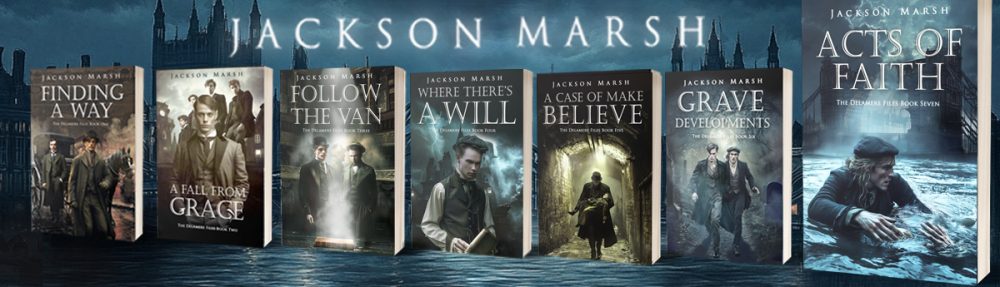
If you have been following the ‘Speaking in Silence’ journey from London Paddington to Bodmin, you will know that it’s been an interesting train ride so far. In the word count scheme of things, I’d say I was now at Exeter, being at roughly 72,000 words, with the destination being 100,000 or thereabouts. After some shunting around in a yard several miles back, I have had a clear run from Bristol, and am now approaching the final reel. The final ‘act’ as they say in film terms.
I started the ‘Speaking in Silence’ journey knowing that I wanted it to be about two characters who appeared in the last book, but who we don’t yet know; Henry Hope and Edward Hyde. In this story, Edward is the protagonist, and yet, not only does he hardly speak, he also hardly communicates. That poses a few challenges for the author. Unlike Joe Tanner, who is deaf and communicates through sign language, Edward has taken a vow of semi-silence. The only person he speaks to is Henry, and Henry knows why. We, the reader, come to learn why Edward chose to do this, and we come to understand there is only one thing that will enable him to feel able to speak again. Justice. Therein lies the plot of the novel.
That was what I started with 72,000 words ago, and the rest I have, quite literally, made up as I have gone along, including the characters of Henry and Edward and a hell of a lot of backstory, which trickles out over time. I have used the flashback technique, and it was only while writing those scenes that I came to know the characters. They introduced themselves to me while Henry was telling me his and Edward’s story if you like, and that didn’t happen until I was quite a way into the story. That’s why we had the shunting around a few miles back, and I had to backtrack and change the point of view of some of the earlier chapters. If there’s a lesson there, it’s ‘know your characters before you start’. (A note to fellow authors, if you would like to stretch your character’s bio then you can always drop in for a ‘character interview’. Contact my PA for more details jeninesymi@gmail.com).
To give you a flavour of the novel, and without giving anything away, here’s a short excerpt from the first draft – unedited so excuse any errors. The skeleton is a character who will remain nameless for now, and I have changed the name of the second character to ‘John’ so as not to spoil things for you. John, the villain, is going to see the other villain at his new lodgings in Greychurch:
The skeleton’s previous lodgings above the ‘Princess Alice‘ had, John thought, been about as low as a man could go, but when he took a deep breath and entered the ‘Hops and…’ as the broken sign described it, he realised he had been wrong.
His foot fell on a rat, but it didn’t squeal because it was dead, but the child playing with it gave him a mouth of abuse, which he ignored. Dishevelled heaps, rather than people, sat at the few tables, some sucking on pipes whose fumes hardly disguised the stench of damp clothes, sweat and something else he didn’t like to think about, while across the room, no more than ten feet from the door, two men stood at a trestle table that served as a bar, while three rested against it on the floor, either drunk or dead. The most unnerving thing about the place, however, wasn’t the landlord with wooden teeth, only one eye and one hand, nor even the miasma of fire, pipe and opium smoke, but the silence. No-one even looked at him, no-one jereed at a well-dressed man from the west of the city entering their destitute realm, and nobody, apart from the child, made a sound.
These people, if he could call them that, might still be able to hear, he thought, and so he prepared to whisper to the disfigured landlord. As he leant over one of those asleep at his feet a movement to his right caught his eye. One of the heaps unwound itself from the table it had been slumped across and dragged itself to its feet. It said nothing, but a skeletal hand emerged from the sleeve of its black gown and beckoned to John like death, before gliding towards a door beside the makeshift bar.
Pleased to be with someone he knew, albeit vaguely and nefariously, John followed the skeleton through to a passage, and down a set of steps to a cellar. Ahead, the scurry of clawed feet suggested their path was clear, but still, when they arrived below ground, several pairs of pink eyes glinted in the candlelight, watching from the crevices for the time they could reclaim their dominion.
The Princess Alice pub was one of the pubs frequented by prostitutes in the East End of London at the time of the Ripper crimes
More on my WIP blog next Wednesday, but don’t forget to be here on Saturday for my other weekly post.
Or, in my case, two bibles, and we’re not talking religious texts. We’re talking about notebooks. Today, I thought I’d take you through my author’s bible. In other words, how I keep track of characters, places, descriptions and facts when writing a long and ongoing series. The photos show my two main notebooks, with brief explanations as to what you are looking at.
In the Beginning…
I have a chest in which I keep my original notes. I started this collection about two years BC (that’s Before Clearwater), and the papers are now yellowing, and the writing is fading. I used to make notes about the stories I was writing on pieces of scrap A4 paper, usually the backs of drafts I’d had printed, and among them is a list of most commonly mistyped words. I use that to check the full manuscript when I reach the end of a draft; words like form and from, for example. But these notes are not my author’s bible, that is a leather-bound, blank page notebook Neil bought me for Christmas 2018, and just after I’d written ‘Curious Moonlight’, I decided to start keeping my story thoughts in it. The first few pages concern a Gormenghast type story I was thinking of writing, and the only thing not now crossed out is a list of names: Anthem, the choirmaster, Pook, a serving boy, Tripp, a footman, and Archie with no job, but whose name means ‘genuine and bold.’
The beginning. As you can see, the Clearwater Series started in January 2019, and the first book was originally titled Deviant Lamplight, then Deviant Devotion and finally, Deviant Desire because the other two ideas were, frankly, terrible.
And therein lies the beginning of the Clearwater Mysteries. ‘A brethren of seven…’ was among my first notes, and I carried that idea over to the Clearwater crew: Archer, Silas, Fecker, James, Thomas… Well, a brethren of five that later becomes seven with Jasper and Billy, and then eight with Mrs Norwood, and so on until I now have a cast of thousands.
So, with 11 Clearwater books and, now, four Larkspur novels, how do I keep track of the details, and why?
Why is Easy
If you read a book and the character has blue eyes in chapter one, but brown eyes in chapter ten… If Larkspur Hall was in Bodmin one moment, and near Bodmin the next, or if Silas’ mother came from Dublin in one book and somewhere else in another… You see where I am going with this? It’s easy, as an author, to think I’ll remember that, and not write things down. Later, say two or three full novels later, you think, Ah yes, I remember I had to remember that, but what was it…? And then, you spend half a day searching your copy of the novel you thought the fact was in, only not to find it, and end up rewriting your section to avoid having to mention the important fact.
Keeping concise but accurate notes about the world you are inventing is safer all-round, even though you think, It’s my world, I won’t forget that.
You will.
How is Another Matter
Every author has their own way of keeping a record, notes, the author’s bible, as it’s commonly known. Some hire people to do it for them, to read the entire series and make notes on everything. Some people do this because they are fans, others, to earn money. I do it as I go, but I don’t do it in any structured way, by which I mean, my bible doesn’t have an index. I do, though, know roughly where to find things, and failing that, I flick through the pages.
Once I knew Deviant Desire was going to lead to a second book, I decided to use my new leather notebook to keep my facts, and started with Archer.
Archer’s notes updated over time.
These two pages contain the basics about my main character. His full name, titles, date of birth and other unchangeable facts like where and when he went to school and his physical description. Over the page, we have a double-page spread about Silas, including the date he and Archer met, and how old he is. Then comes Andrej (Fecker), Thomas, ‘East End and other characters’, minor characters not seen, other locations, a glossary, the list of murders, places and dates (from Deviant Desire), and a page of random notes.
After a blank page comes the name Sam Wright… Crossed out and replaced by Jim… Crossed out and finally replaced by James Joseph Wright, messenger, 25 years old (born Jan 10th 1863), started at post office aged 14, not 100% attractive (sorry, Jimmy), Fecker’s nickname for him Tato (daddy), and ‘James writes with a pen (book 9).’
Moving through the book, I find lists of dates as to when things happened, who works at the house next door, a page listing servants’ wages in 1888, and a rough plan of the ground floor of Clearwater House.
Clearwater House. My first attempt at a layout to help me picture how to get from one room to another, to improve consistency.
As you might have gathered by now, I keep the notes according to the book I am writing at the time. I stop now and then, usually after completing a book, to add to the previous pages and make other notes and lists about the world, not about the stories; that’s a separate matter. For the Clearwater series, I kept story notes in a separate notebook, jotting down ideas and points to answer, clues to solve and how, and story details, then later, I put the pertinent ones in the bible. If I filled the pages of the leather book with story notes, there would be so many things crossed out, it would make the book messy and even harder to read than it is.
Moving on, we next find a page outlining the characters’ skills, because, at that time, I was comparing them to superheroes – not in the stories, but in my head. So Archer was Iron Man and skilled in combat, money, and status. James (Captain America), communications, fitness, strength. Fecker (Thor), strength, loyalty, transport. Thomas (J.A.R.V.I.S.), Logic, cool head, planning… And so on.
For ‘Twisted Tracks’, I drew a map of the railway route I’d invented. Book three’s notes include a page of villains, and who was dead by then, and book four outlines who was on the board of the Clearwater Foundation. Also in the Fallen Splendour section are notes such as ‘Silas wears Curzon cologne’, and ‘Fanny… crossed out, Sarah… crossed out… Mrs Norwood, 40s, James’ old schoolteacher.’
Book five is set at Larkspur Hall, and as that was the first time we’d been there in detail, there’s a list of servants, places on the estate, ‘A patchwork of a property,’ ‘Ruined church from Dissolution’, and ‘abbey given in 1538,’ which is a worry as I am sure I’ve said it was another date in another book.
You see, even though you keep notes, you don’t always use them. I know I once messed up on the address of Clearwater House saying, in one book, it was in Bucks Avenue and then in another that it was in Bucks Row. (Bucks Row was a site of a Jack the Ripper murder.) I was able to go back and change that later, but I am sure there are other minor inconsistencies caused by ‘I remember that, no need to look it up.’
Occasionally, I paste things into the bible, such as this note, written on the back of receipt.
Romanian. Gabriel’s translation and some of my notes about pronunciation.
I was sitting at our local café one day and was joined by a Romanian friend. That was handy because I was writing ‘Bitter Bloodline’, which features a Romanian villain, and although I’d used Google translate, I wanted to be sure the most important sentence in the book was correct. Gabriel, my Romanian mate, wrote it down for me, and then I told him we were talking about Transylvania in 1889. He rewrote it, because the language would have been slightly different, and that’s what that note is all about.
What Else Should Be in the Bible?
I don’t want to bore you with details of every page of my book, but apart from those things mentioned above, it also contains pages titled:
Height, Hair & Build (brief character references)
Skills (again, but with more characters)
Archers’ family tree by three generations
Notes about Larkspur Hall
A calendar of character’s birthdays (Harvey, a minor character, June 2nd, Jasper Blackwood, 1st August, Silas, 21st October, etc.) These minor facts are useful to know and use because they add depth to stories, even if it’s only a mention.
A calendar of years of birth. Archer 1859, Thomas 1861, Fecker, probably 1865 but no-one really knows.
A rough map of the area around Clearwater House
Extended family tree for The Clearwater Inheritance
Who’s Who at Larkspur Hall, March 1890
The guest list for Archer’s 31st birthday party
Ages. Character’s ages through the years and some other major events. This makes it so much easier to remember how old people are. If you look closely, you’ll see that Fecker started renting in 1883 when he was 16, though he may have been older, and James started at the post office (PO) in 1877. You never know when such trivia will come in useful.
And so on and so on until we hit a page on which I have (badly) drawn three standing stones and the title The Larkspur Mysteries, June 2021, and underlined it in red as if it were school homework.
Two Bibles
I’m now a two-bible household. I keep the leather notebook going, and still add to previous pages, while using up more to give the same basic details of the new characters from the Larkspur Mysteries. However, when I started this second series, I decided to use a large, lined book that a friend had made for me. The cover is decorated with the titles of the books from the Clearwater Mysteries, but I am using the book as a bible/notebook for the Larkspur Series.
Big book. Notes on the viscountcy of Larkspur from 1541 to the present day (1891), for ‘Seeing Through Shadows.’
That’s one example of how I am creating the Larkspur bible alongside the Clearwater bible. I’m not repeating facts from the first to the second, but I am adding facts from the second to relevant places in the first. I’m also using it to outline the stories, track the timeline, create character arcs, and make story notes. The Clearwater bible remains my go-to place for the basics, but now, using the larger Larkspur book, I can keep all my story notes in one, lovely to write on, set of pages and not the old trunk.
Revelations
I hope you found the above interesting. If I have a final point to make about why authors should keep a bible, it’s this:
When you create a fictional world, you are the Creator. You are omnipotent and expected to know all, see all, and care for all you have created. Unless you really are the Creator, it’s unlikely you will store every fabulous fact in your memory, so if in doubt, write it down.
Notebooks yet to be used, except for the green one which I used when writing the Saddling series as James Collins.
As for me, I have plenty more notebooks waiting to be filled…
I’m pleased to tell you that the Larkspur Mysteries book four, Seeing Through Shadows, is now uploaded on Amazon. It should be available for you in Kindle, KU and in paperback in the next couple of days. (edit, it is now live!)
As you can see from the title of this brief post, this is week 14 in this book’s life. (The 2 refers to the fact this is my second book since starting the WIP blog, the 14 refers to the week.) Some books, they say, write themselves, and Seeing Through Shadows was one of them. I started with an idea, made some notes and did some research, as I always do, and drew a simple outline. After that, the characters took over, I kept them in line with the structure I wanted, and I was strict with myself when first-drafting, which meant less time had to be taken on the following drafts and edits. I think I’m finally getting this process down now, and once an idea has formed, it’s taking me less time to write a novel.
What’s interesting about ‘Shadows’ is that the idea came about back in 2018, before I’d even thought about the Clearwater Mysteries, let alone the Larkspur mysteries. I’d just finished writing ‘Curious Moonlight’, a kind of ghost story and first love mashup, and considered writing a sequel.
Curious Moonlight is about two guys meeting, and having their relationship hampered by a troubled and troublesome ghost called Billy. I thought it might be fun to have the three team up as spectral investigators, with Billy being ever present and always naughty. I invented a location (Blackwood Abbey), and a history of a ghostly sighting, drew a plan of the estate and mapped out the story, but never sat down to write it.
In a way, I am glad I didn’t, because Blackwood Abbey eventually became Larkspur Hall, and what I was doing back then was only planting the seed of an idea. When you read Shadows and learn the history of the Larkspur ghost, it is actually the same history of that created for the Curious Moonlight sequel that never was. The twist at the end of Shadows was to be the explanation for the Curious ghost (kind of), and the Larkspur estate is more of less what I’d made up for Curious. Confused? Never mind, it’ll become clear when you read Seeing Through Shadows.
“He’s back. He’s angry, and I am fleeing for my life.”
Escaping bad choices, Luke Grey arrives in the Cornish fishing village of Madenly determined never to fall in love with a straight man again. But then he meets Peran Box.
Peran’s passion for investigating historical mysteries is his only escape from a loveless relationship. But then he meets Luke.
Attracted to each other’s differences, the two embark on an intense friendship which sparks hope for Luke and ignites Peran’s gay-curious feelings.
But then they meet Billy, dead for three-hundred years and determined to keep them apart until the mystery of his murder is solved.
I thought it was time I told you a little more about ‘Seeing Through Shadows’, the fourth book in The Larkspur Mysteries series, the series that continues from the highly popular ‘Clearwater Mysteries.’
The previous Larkspur story, ‘Agents of the Truth’ concluded on 31st October, 1890, and ‘Seeing Through Shadows’ is set in January 1891.
However, October 31st was an important date for its main character, an erudite young man of twenty-two called Chester Cadman. As Lord Clearwater was hosting his annual charity ball at Larkspur, and as Dalston Blaze was chasing a potential assassin, Chester Cadman was in London, working for a mapmaker and indulging in one of his favourite pastimes: debunking the spiritual entertainments offered by Mr Maskelyen and Mr Cooke.
These stage productions were popular in Victorian times, and you can find advertisements for such things in the newspaper archives, and elsewhere. Chester was attending one at the Egyptian Hall in Piccadilly, and while there, met another, equally handsome, young man called William Barnes. The following day, Chester’s life changed—but I’m not going to tell you how because I don’t want to give away any spoilers.
The Egyptian Hall in Piccadilly, London, was an exhibition hall built in the ancient Egyptian style in 1812, to the designs of Peter Frederick Robinson.
The Egyptian Hall, Piccadilly
Long demolished, this West End venue was home to a museum, art exhibitions, Victorian ‘freak shows’ and magic shows. Victorian magic duo John Nevil Maskelyne (1839-1917) and George Alfred Cooke (1825-1905) hosted a show at the venue for 31 years. It’s been claimed Maskelyne invented the illusion of levitation, as well as the coin-operated toilet lock. [Memoirs of a Metro Girl, a London culture and history blog.] January 1891
When I began ‘Seeing through Shadows’, I had no idea how it was going to unfold. Then, after writing the first chapter, I knew where I was heading, and spent a couple of days at the writing desk, plotting, planning, and inventing a fair amount of history. Along with factual history, I invented 18 Viscounts Clearwater, their birth and death dates, and the year they came to the title. I also had to refine and define the history of Larkspur Abbey, how it was affected by the Dissolution, when it was extended, altered and re-landscaped, and several other historical points. Why? Well, because the novel’s action plot focuses on a recurrence of a historical haunting, and that’s all I can say about that, for now.
Back to that first chapter. When I started it, I didn’t know who my main character was to be. I often do that; I think of a name, age, big event from the past and set that character against a plot device on which to hang a mystery, and decide who is to be his impact character. (An impact character’s role is very simple: they are there to inspire, enable, or somehow make another character change. Usually the other character is the main character or protagonist.) The first paragraph I wrote for ‘Seeing Through Shadows’ came from nowhere, but I knew it was a good place to start, because all good stories start with a railway journey. ‘Shadows’ opens with:
The Cornish Riviera Express en route to Cornwall January 1891
Chester Cadman turned his attention away from the passing scenery and wondered if he hadn’t made another terrible mistake. His travelling companion was a quiet stranger to whom he had handed his wellbeing and future, and he had put his life in the hands of men he knew nothing about. Again.
The Cornish Riviera Express
A Classic Mashup
I guess ‘Shadows’ is one of my classic mashups. Along with a mystery that needs solving, we have a story of developing love, and there are a couple of sexually charged scenes in this novel. Not full-on descriptive scenes as there are in ‘Deviant Desire’ or my Mentor series, but something more subtle and, I hope, imagination fuelling. There is also some humour from our regular cast, Frank Andino ( read his recent interview here) and Fleet, and we meet two new academy men, Henry and Edward, who, I imagine, will come to the fore in a future novel. Dalston and Joe are in the story now and then, too, but they are about to head to London for their new lives, which may well lead into the third series, ‘The Delamere Mysteries’ next year.
Meanwhile, at Larkspur Hall, Thomas Payne becomes our protagonist because Clearwater is away in London dealing with something which will become a Delamere Mystery in the future. Barnaby Nancarrow, the country’s youngest butler, makes an appearance, and some other Hall characters are developed a little more. While all that’s going on, Chester is adjusting to his new life, conflicted about his feelings for someone, desperate to please Clearwater and repay his kindness, and generally turning heads among the academy men.
‘Seeing Through Shadows’ is one of those stories where, along with the main character, the reader is invited to work out what the hell is going on. Unlike ‘Agents of the Truth’, there is no villain as such, and no-one’s life is in danger. ‘Shadows’ progresses through several twists, and chapters tend to conclude with a ‘What if?’ or an emotional or mysterious cliff hanger. There are also inserts where the mystery is seen from an unusual perspective. Only short sections, but ones which are intended to lend atmosphere and, of course, mystery. These were interesting to write as events are seen from the perspective of an owl, a fox and a cat. I’ll leave you with just such an excerpt. I’ve not yet fully edited this, but here is what I have at the moment. It’s from the end of a chapter later in the story, the night before the ‘great reveal’ when the mystery is explained, and it’s one of the inserts as seen from an owl’s point of view.
Not all was harmonious with the night, however, and the owl ruffled its feathers in a shiver of disquiet. Off to the west, something unrequited was advancing through the fragile air. It was still at a distance, but it was coming from across the moor, beneath the ground, making its steady path towards the hall as it had done before. Unstoppable, it would appear and disappear; it was real, and it was ethereal; it was alive where it lived, and yet it would die if it stayed there. Something that couldn’t be laid to rest until it was understood, its appearance was inevitable. Nervous, the owl screeched its disapproval, and fell from the battlements, wings spread. The uplift took her high above the sloping tiles and the last of the drifting woodsmoke, the treetops and moorland, and she circled wide and slowly to the Academy House where her interest lay. Passing the sleeping outbuildings, the yards, and windows dark with the hour, she came to one aglow, and landed on the sill. Within, flames swayed on the last of their wicks, languid as they burned away time. Their faint light withdrew from corners to candles as they died, and drew their cast across carpet, over chairs, through a field of jumbled clothing, to the cliff edge of the bed. Ascending as it faded, the light lasted just long enough for the owl to see the shape of two men, naked, entwined, fulfilled and dreaming. The ground was laid for the inevitable, and knowing there was nothing she could do but watch, the owl dropped from the window and once again became one with the night.
‘Seeing Through Shadows’ is due for release later this month.
To celebrate what would have been Lord Clearwater’s 163rd birthday, I have made two books free for two days. ‘Banyak & Fecks’, the Clearwater Mysteries’ prequel, and the first book in the series, ‘Deviant Desire’, are free on Kindle for this weekend only. Click here to check out the series.
Saturday, March 26th, 1859. The Illustrated Times, on its front page, began thus:
The coming congress.
So it seems that the great questions which for months have threatened Europe with war, are to be brought to the test of arbitration, and settled on the principles of common sense.
(The illustration shows ‘The Prince of Wales’s balcony on the Corso, Rome, during the carnival.’)
One hundred and sixty-three years later, the headlines aren’t that dissimilar, which is a shame, although there is less common sense in some areas of the world. Since Archer, Lord Clearwater, was born, there have been other historical events on his birthday, one of which is the birth of author James Collins (aka Jackson Marsh), in 1963. Also of note might be, the birth of Tennessee Williams in 1911, Richard Dawkins in 1941, Diana Ross in 1944, Bangladesh became an independent state in 1971, and (I hate to say it) Vladimir Putin was elected Head of State in 2000. On a happier note, Doctor Who returned to UK television on this day in 2005.
As it is Archer’s 163rd birthday, I thought I might take a look at what he has been through since he came to literary life on March 7th, 2019. Archer is only three years old in book terms, but he has been on, or played a part in, 13 adventures so far, appearing in 10 of the Clearwater Mysteries, and, so far, three of the Larkspur Mysteries. He doesn’t appear in the Clearwater prequel, Banyak & Fecks, other than as a vague reference in a dream Silas has, where he dreams of meeting such a man in a carriage full of money. He will appear in the fourth Larkspur mystery, ‘Seeing Through Shadows’ due out next month, although only briefly, because he is mainly away in London, dealing with events which are taking place in ‘The Delamere Mysteries.’ This is an idea I have for a second spin-off from the Clearwater Mysteries, and which I hope to write next year.
Adventures Archer has been involved in during his literary life so far.
As I was saying… His first claim to fame was unmasking the East End Ripper, the villain, based on Jack the Ripper, who started the series off in Deviant Desire. Since then, he has faced many perils, including: Fighting on a dockside gantry and falling into the Thames. Battling a villain on the roof of a speeding steam train heading for disaster. Racing across the country in a blizzard to rescue two kidnap victims. Appearing in court in full regalia to defend his innocent friends. Confronting other villains, falling into a mineshaft, and sword fighting his way out of an assassination.
Archer is quite an active chap, both in and out of the bedroom. In 1877, he became a lieutenant on The Britannia, where he served under his brother, Crispin, during conflicts on the Black Sea.
HMS Brittania entering Portsmouth UK
Archer was honourably discharged from the navy in 1886 following a near-fatal injury inflicted by his own brother. When Crispin was declared incurably insane, the 18th viscount reluctantly gave into Lady Emily’s wishes and arranged for Archer to succeed the title on his death. His naval training and upbringing have served him well, but he has natural talents too. These have seen him through love, laughter and a lot of laughs, while leaving him loyal, lordly and loving. I couldn’t think of anymore ‘L’ words to alliterate his character, only to add that he’s also rather lush.
He is handsome, debonair, and extremely well endowed, both financially and… elsewhere. In my writer’s imagination, Archer started off as a classic young, good-looking, wealthy aristocrat who was, in a way, a reluctant hero. His brother, Crispin, should have taken the title and all that goes with it, but Crispin was a psychopath and is already locked up when the stories start. Archer suffered much in his childhood because of Crispin, but also because of his father, who thought he was soft and unmanly, treated him appallingly both physically and emotionally, and made his early life as difficult as hell. However, Archer managed to live through all that, and when he was elevated to the title in 1888 (two months before the stories start), he did so with resolve.
Archer is, as we would say, gay, and has known it since an early age. His first sexual awakenings happened with Tommy Payne, then a hall boy at both Larkspur Hall and Clearwater House. Later, Tommy became Thomas, the footman, and when Archer took the title, he elevated him to the role of butler, where he became Mr Payne.
1827 Belgravia Square
Inspiration for my fictional Clearwater House in London
Through the series, Archer and Thomas’ love for each other bubbles beneath the surface, and rolls in waves between physical desire and platonic love. Because of their stations in life, there is no chance of a physical relationship, however, not even when Archer makes Thomas his steward, and Thomas becomes Tom. A steward is the highest rank Archer can give him to make him a gentleman, without Thomas leaving to become a man of business, and that’s something Thomas would never do. Tom and Archer will be together in an endless bromance until they die. Meanwhile, when Archer is away from Larkspur, Tom more or less takes his role, and some of the staff have commented privately that Tom is the new Lady Clearwater.
Archer has had lovers, though, and it was being discovered with one while in the navy that led to Crispin’s attempt to murder him. But, Simon Harrington died, leaving Archer to face civilian life and the viscountcy alone. Thus, he put his energies into his philanthropic endeavours, and because he understood what it was like to crave a life with ‘men of a similar heart’, and not be allowed one, he set about creating the Clearwater Foundation. In other words, Archer was gay, being gay was illegal in those days, and he wanted to help other gay men to exist as themselves. He began this with the Cheap Street Mission for rent boys, and while setting that up, wanted to interview one or two renters to get their thoughts and understand their needs. Enter Silas Hawkins. The two meet, and the earth moves. It’s love at first sight, and although the river of true love hasn’t run smoothly, Archer and Silas are still together to this day in 1891, which is where we are currently at in the Clearwater world.
Silas Hawkins, street-rat and renter
Archer has a knack for knowing when another man is ‘of a similar heart.’ In other words, he’s got good gaydar, and that’s why his house is gradually filling up with gay staff. It’s not because he lusts after them, because he doesn’t (although I think he harbours a secret desire to experience what gave the straight Ukrainian, Andrej, his nickname ‘Fecker’, but then, don’t we all?). Archer simply likes to help people, particularly, but not exclusively, young gay men. Hence, he opened the Larkspur Academy for young, gifted, and, probably, gay men from underprivileged backgrounds.
Larkspur Hall Inspiration
By the time he did this, early in 1890, he had gathered around him a team of loyal and good friends, elevating each one of them to a better position in life, as he himself was elevated to viscount. Thomas we know about (hall boy to steward). From the slums of the Wiral to the back alleys of Greychurch, Silas goes on to become his own man of business. James Wright enters the series as a messenger, becomes household staff, a valet and later has his own private company. Andrej, a Ukrainian refugee, goes from war to circus, renting, groom to horse master. Lucy, from maid to head cook. Sally, from chambermaid to the youngest housekeeper of a grand house in the country. Barnaby Nancarrow from footman to butler, other stable lads at Larkspur become household staff or are promoted, and gradually, the young take the places of older staff, as Archer rids his life of his father’s legacy, and makes his land, estates, properties and business his own.
Currently, as I mentioned, he is in London working on some cases that I’ve not even thought of yet, and while he is there, the Larkspur Academy is about to welcome its next man, Chester Cadman. You will be able to read ‘Seeing through Shadows’ soon. If you will excuse me, I shall return to working on the new novel while wishing Archer a happy birthday, and looking forward to whatever he is going to be doing next.
So, where am I?… Oh yes, the still untitled Larkspur book four. It’s still called ‘Chester Cadman’ as a working title, because that’s the name of the new main character. All I can tell you about him is that he comes with a few surprises. I could tell you a lot more, as I am getting to know him quite well, but I don’t want to spoil anything for you. I am currently at chapter 10 and 37,776 words of a rough, first draft.
I’ve had to double-check the layout of Larkspur Hall and the grounds, look up the history of Larkspur Abbey, and invent a few stories from the past. This has involved delving beyond my newspaper archive right back to 1541 and the dissolution of the monasteries (1536 to 1541).
Larkspur Hall
Merevale Hall, the buliding on which the Larkspur Academy is based.
The dissolution of the monastries
This week in pictures
The present day is January 1891, as the country suffers a very cold winter, and the location for book four is Cornwall. So far, it looks like it’s all going to take place on the Larkspur Estate and at Academy House as well as inside the main Hall, out in the grounds and further afield to one of the farms on Bodmin Moor. There is an old mystery to solve, so in a way, this book is going to be like a cold case solved by a new character. For a change, Tom Payne has more of the protagonist role than Lord Clearwater, Frank Andino plays a major part, and I am setting up other characters, threads and mysteries for the future.
Here’s a brief extract from a book found in the Larkspur library:
An Account of Strange Events Witnessed and Reported at Larkspur Hall
Compiled from Documents, Diaries and Other Sources
by Hedrek Nancarrow, Librarian, 1878
There are many tales of the nocturnal visitant to the Larkspur Estate, some handed down through generations by word of mouth, others documented by Hall staff and the family, and some from testimony given, in later years, to the police. Earlier, there are others given to the village bailiff, the incumbent vicar or rector, and previous notable men of Larkspur village. Below, I present a selection of such reports in the order of their date, and from this, several things will be noted…

Thus, I conclude the origins of the story. Suffice to say, in 1540, a tryst between the monk, Madroc, and an unnamed serving girl gave rise to the dismissal of both, and that, in turn led to the formation of a ghost believed to be the spirit of the murdered girl, which was, in fact, an invention to keep out the unwanted. During the civil war and estate troubles of the mid-1600s, the tale passed into lore, and did not rear its spectral head again until much later.
The exciting news today is that the third Larkspur mystery, ‘Agents of the Truth’ is now available on Amazon. As I write, the Kindle version can be found here, and in Kindle Unlimited, and the paperback should be live any moment now.
Uploading to Amazon
I am often asked about the process, not just of how I write my novels, but how I publish them. So, today, I thought I would let you in on my system. As usual, this is how I do it, and other authors have their own ways of going about things. My version isn’t necessarily right for you, but it works for me. Here it is in stages.
One. Write the Book.
That’s the part that takes the time. ‘Agents’ took me just over three months from start to finish, but I am able to write full time; sometimes for other people, mostly, though, for myself. There are other blog posts such as this one which you can find with a search which tell you about my writing process, but in a nutshell it’s: draft one, draft two for consistency and repetition, style and ‘saying it better’, draft three for grammatical accuracy, draft four for finality. My husband reads draft one for consistency, knowing I will improve the writing, and I take on board what he says. Meanwhile, I contact Andjela, my cover designer, and she works up a cover for the Kindle version. After draft four, I send the manuscript to be proofread, and while that is going on, I begin work on the Amazon process. While that’s happening, I advise Andjela of the final page count so she can make the full cover. I don’t have the finished PDF print file by then, but I can make an educated guess of the final page count from the word length of the final MS and comparing it with previously published books.
With the MS back from proofing, I then have another read to agree the proofs, and make any minor changes that might have been niggling me between times. I have usually started on the next book by then but put that aside while I deal with the Amazon things.
Preparing to Upload to Amazon
The first thing I do, after logging into my KDP (Kindle Direct Publishing) dashboard, is ‘create a new eBook.’ All I can do at this stage is enter the title, the series information, the author’s name and the blurb (which I can change when it comes back from proofing if necessary). I also put in keywords and select the two categories, in the case of Clearwater and Larkspur, that’s Gay and Historical. On the next page, I can’t do anything about uploading the internal file or the cover as I don’t have them by then, though sometimes, I can upload the Kindle cover. With Kindle, I then press ‘save as draft’and turn to the print version. The info I’ve added is already there, but not the cover. However, I opt for an Amazon ISBN because I only sell my novels through Amazon and KU, and I need that ISBN for the front matter.
The KDP Dashboard – all very user friendly
Front and Backmatter
The frontmatter of a book is made up of the first few pages. The publishing disclaimer and copyright claim etc., and in there, I need to put the ISBN number I’ve just had created. I also list those who have contributed to the book; the proof-reader, cover designer, illustrator and layout company. More about that in a moment. I basically take the front matter from the previous book, make sure I change the title, date and ISBN, and add to the list of ‘also by Jackson Marsh.’
The backmatter consists of author’s notes and a list of my titles with a little more info, and, for the Kindle version, direct links to where the books can be found.
Front and backmatter are two sperate Word doc files.
Formatting a Book for Amazon
I used to do the internal layout myself, using Adobe InDesign. Not being a graphic designer, this was something of a learning curve, and not a process I enjoyed. Since Clearwater nine, ‘Negative Exposure’, however, I have used Mongoose Author Servies at Other Worlds Ink.
This process costs me an extra $60.00, but it’s more that worth it. I contact the guys in advance and warn them I have a layout job coming up, and when I am happy with the proofs of all printed matter, gather them into one ‘final files’ folder. Other Worlds Ink have a list of requirements, and I go through them for each book, to make sure I communicate to them what I want them to know and how I want the internals to look. They now have a template for me, so it’s an easy task both ways. Within a couple of days, I have the PDF of the print version sent back to me, and I can go through it to pick up anything that we want to change. I.e., if there’s a stray line at the top of an otherwise blank page. Mind you, they use Velum to create the internals, and that programme automatically sorts out most oddities.
Once I’m happy with the print version, I agree it, and they send me seven other files including the Kindle, ePub and Kobo – not that I use any of the others, but sometimes, I’ll give a book away for free and some readers prefer those other formats.
And Back to the Amazon Upload
So, now I have all files, including the full, wrap-around cover from Andjela, so the task ahead is easy. I simply upload the interna Kindle file via KDP (Kindle Direct Publishing), and when that’s done, I set the price. Then comes the nerve-wracking bit where you have to press ‘I am ready to publish my book,’ but because OWI have done the layout, I know I’ve got nothing to worry about.
You may, once you’ve uploaded your internal file, get a message saying Amazon have found spelling mistakes, and you’re able to check these and the layout before you publish. My ‘spelling errors’ are usually unusual names or slang/dialect I have used along the way, but I still check them and ensure the book looks good in the Kindle, phone and table viewer.
Then, with the Kindle under review, I turn to the print version and do the same thing: upload the full cover and the internal file, both in PDF format. Again, you can check the layout and look before you proceed to pricing and publishing.
That’s it, really. Amazon say it can take 72 hours before the book goes live, but the ‘Agents’ Kindle version went live within two hours of me hitting ‘publish.’ The print version usually takes longer, but for me, no more than two days. Then, you can see all the links to the various Amazon stores where it’s available, and simply copy them to wherever you want them.
And After Amazon?
My next task, which I must see to today, is to list my latest book with my usual services. I use Queer Romance Ink as a listings place, because they do all kinds of wonderful things like interviews, giveaways, newsletters and features.
I also have to update my Amazon Author Page and make sure the new book is listed there. I do this once both versions are available to make sure they both get listed.
I don’t know how it works with Goodreads, but somehow, my books find their way to an author page there too. I tend not to use Goodreads much.
Then? Well, then I hand things over to my PA Jenine and she organises me to put up posts of Facebook and in various groups to get the publicity machine rolling.
It’s not as hard as your think to publish on Amazon. I’ve been doing it for several years now it gets easier each time. I still have a checklist though, and read the terms, conditions and instructions in case they have changed. Go slowly, but if you do get into trouble, their author services help department are responsive and quick, very helpful and there to assist.
And now… Now I must return to chapter seven of Larkspur Four. Check Wednesday’s Work In Progress blog for my next update.
‘Agents of the Truth’ is nearly ready for publication. I am aiming for next weekend, 5th or 6th February for it to be live on Amazon. You will find the cover reveal at the bottom of this post along with the blurb and a section of the author’s notes to whet your appetite.
When I started on the Larkspur Series, I intended each book to concentrate on an individual new character and an independent mystery. Well, that went the way of the dodo, and books one to three turned out to be a trilogy. This happened for a couple of reasons. One, I fell in love with Dalston Blaze and Joe Tanner. Two, the mystery Dalston was brought to the academy to solve turned out to be too big for just one book. Actually, one mystery is dealt with in book one, but in doing so, a second mystery arises, and that’s what sees us through book two. By the time that finishes, there’s still an unanswered question, and that’s what drives book three. So, before ‘Agents of the Truth’ comes out, I thought you might like an outline of books one and two, just to remind you of the story so far, or tempt you to start the series if you’ve not yet read it.
Guardians of the Poor (The Larkspur Mysteries Book One)
Starting in the cells of Newgate prison and a courtroom at the Old Bailey, Guardians introduces the reader to the Larkspur Academy through the eyes of Dalston Blaze. Dalston (named after where he was born) travels to Larkspur Hall, where he meets Lord Clearwater who asks him to investigate mysterious symbols carved into ancient standing stones on the Larkspur estate. As well as meeting other characters at the academy, including the eccentric genius, Barbary Fleet, Dalston and the reader experience the house and grounds and learn some of the history of the Hall and the area. However, he has a mystery of his own, and as he gradually reveals his past to Clearwater, so he exposes himself to self-examination in what is essentially a coming-of-age story. Dalston’s personal mystery takes us back to where he was brought up, the infamous Hackney Workhouse, where we meet Joe Tanner and learn of a dark secret Dalston and Joe need to expose. With two mysteries running concurrently, and only one solved by the end of the book, the way is paved for a continuation, and that is book two.
Keepers of the Past (The Larkspur Mysteries Book Two)
The mystery of the standing stones is not yet fully understood, but now we have Joe Tanner in the picture. Joe is deaf and incredibly intelligent, and, since coming to live at Larkspur, allowed to be himself and his talents encouraged, he begins to investigate a mystery of his own. The coming-of-age element continues as Joe and Dalston’s relationship is able to develop, freed from the strictures of the workhouse. But, the course of true love never runs smoothly. With the pressures inherent in deafness, a secret relationship and adapting to a new life, Joe retreats into himself to solve his mystery. While doing so, it becomes apparent that a series of murders over the past eight years not only have a connection to various ancient sites on Bodmin Moor but also to Larkspur Hall. Joe is convinced there is to be another, and with Fleet’s mentoring, and empowered by the academy to believe in himself, he sets about solving a very complicated riddle. By the end of this story, Dalston’s original mystery might be solved, but another question arises: Who has committed the murders? That’s the mystery that leads us into book three.
Agents of the Truth (The Larkspur Mysteries Book Three)
In book one, we got to know Dalston Blaze. In book two, we learn much about Joe Tanner. In book three, we see them working together, although it is Dalston who, through no fault of his own, is left to put the puzzle pieces together. Again, I have gone for a double mystery, and the story centres around Larkspur Hall and Clearwater House as Dalston and Joe head to London to solve clues. While there, they meet well-known archaeologists and painters, while, at Larkspur, Lord Clearwater prepares for a royal visit. Meanwhile, a shadowy figure from Clearwater’s past prepares to return…
The Blurb for ‘Agents of the Truth’:
“Despite your adversities, Mr Blaze, you remain unbroken because of who you are, not what you can or cannot do.”
Mrs Norwood, October 1890
Shakespeare, the Bible, Edgar Allan Poe… What could a series of random quotes have to do with a masked ball and eight unsolved murders?
Archer, Lord Clearwater, is hosting a masquerade at Larkspur Hall, and Prince Albert Victor is the guest of honour. The vitally important event is miles away from London, where Jimmy Wright has enlisted the help of Dalston Blaze and Joe Tanner in solving two mysteries: Who has been sending Archer cryptic notes, and who has murdered eight men on Bodmin Moor?
Dalston finds himself the only one who can solve both riddles, but self-doubt, his concerns for Joe, and his newly found admiration for Jimmy Wright are obstacles he must overcome if he is to prevent Lord Clearwater’s downfall.
But, what if the killer isn’t after His Lordship? What if the plan is to assassinate the prince? Or worse, someone much closer to Dalston’s heart?
Notes from the author
For this series, I am adding author’s notes to the end of the book. In the past, readers have asked me for information about some of the historical facts in the Clearwater Mysteries, so I decided to put these notes in purely out of interest. The other day, my author friend, Elle Keaton said she is immediately drawn to a book that has ‘archaeologist’ in its blurb, and as ‘Agents’ introduces us to three from the past, I thought this extract from the notes might be of interest.
From the author’s notes:
[While in the British Museum Reading Room in October 1890…] Dalston meets Samuel John Carter, father of the famed archaeologist, Howard Carter who discovered Tutankhamun’s tomb in 1822. Samuel Carter was an artist and illustrator, and in 1890, Howard would have been sixteen, and was already showing a talent for sketching antiquities. That pursuit was encouraged by Lady Amhurst of Norfolk (as Stoker tells us in his letter), and, in 1891, she prompted the Egypt Exploration Fund to send him to the excavation of Beni Hasan in Middle Egypt. In 1892, when he was eighteen, Howard Carter worked with Flinders Petrie.
Joe and Dalston not only meet the Carters, but also two renowned archaeologists and Egyptologists, Flinders Petrie (1853 to 1942) and Margaret Murray (1863 to 1963). Petrie was already established in the field by that date, but Murray didn't begin her Egyptian studies until 1894 when she attended University College London, so I took a slight liberty there. However, her department head at UCL was Flanders Petrie, so again, it’s not impossible they used the Reading Room at the same time.
The cover reveal
And now, the cover reveal. Again, Andjela has come up with a masterpiece that evokes the atmosphere of the story while highlighting two elements from the plot. Click the image to open the cover in a new window.
The Larkspur Mysteries Book Four
As yet untitled, I can tell you that Book Four starts with Dalston Blaze bringing a new character to the Academy. The first sequence is a bridge between books three and four, but from then on, we have a whole new mystery, a new lead character, a love story and, of course, plenty of complications, facts and fiction combined, some humour and an adventure. There are also to be plenty of surprises… But that’s another story…
Agents of the Truth is the third novel in The Larkspur Mysteries, and the stories are best read in order.
The Larkspur Mysteries follow on from The Clearwater Mysteries series, and both feature gay main characters, and are set at a time when homosexuality is illegal. They are a combination of MM/romance, mystery, and bromance, and are inspired by historical fact.
I am working on chapter 23 of ‘Agents of the Truth’, line-checking for grammar, typos, consistency, through-line and style and finding the occasional ‘ouch!’ I just found one right at the beginning of the chapter. The previous chapter ended with a fight, and in my first draft, chapter 23 started with:
Dalston was disorientated. Everything had happened so fast. His throat burned, his lungs tore as he gasped for breath, and the room was a blur through watering eyes. His ears, however, heard the next words without hindrance.
Okay, you say, what is wrong with that? For me, reading it again after some time, it is this:
Dalston was disorientated. First of all, it’s a passive sentence, so not brilliant as a chapter opening and, in the context of a fight scene, passive sentences are not immediate or ‘action’ enough. Secondly, it’s a classic ‘tell’ sentence, and we all know the rule of ‘show don’t tell.’ Dalston was disorientated gives the reader no opportunity to feel disorientation, and therefore, no chance to connect with the character.
Then we have:
Everything had happened so fast. What’s wrong with that? It’s true, isn’t it?
Answer: Yes, it’s true, but it should be what we, the reader, just experienced at the end of chapter 22. In fact, we did experience it because the fight scene was a short, sharp shock, as W.S. Gilbert would have it. Therefore, the reader doesn’t need to be reminded, rather, shouldn’t need reminding. The previous scene should have shown us Everything had happened so fast. Secondly, it’s a cliché and an opt-out for the writer. Again, if what we’ve just read left us feeling breathless and bashed about, there is no need for the writer to remind us.
His throat burned, his lungs tore as he gasped for breath, and the room was a blur through watering eyes. Isn’t this also telling? Well, yes, but then all storytelling telling, but how do you avoid that?
Sometimes you can’t, and you just want to set the scene and move on, but when editing line by line, you have the opportunity to stop, take stock and start again. How can I make that line better?
His throat was aflame. Better, because we imagine what that felt like and, if we’ve ever had a sore throat, we can associate ‘aflame’ with the feeling.
His lungs tore as he gasped for breath. I’m letting that one go, because it tells us he was gasping for air, and the word ‘tore’ is vague enough to make us think of pain.
… and the room was a blur through watering eyes. Yes, well, that’s rubbish, if you ask me. It’s too clumsy. He saw the room through watery eyes, is more precise, but how about, his vision was blurred? Isn’t that, again, telling, not showing?
The room came into view as a series of shifting shadows and wavy outlines, unsettled in his watery vision until he wiped his eyes. Getting there, but too long. Needs breaking up, or editing down, and I might change wavy to distorted, and unsettled to swimming.
His ears, however, heard the next words without hindrance. Eek! I know what I meant to say, but surely, there’s a better way? Do your ears hear? Or is it your brain? Why mention ears at all? It’s Dalston who is hearing, isn’t it?
He heard the next words without hindrance. Simple, to the point, but not good. I don’t like starting sentences with ‘He’ or ‘She’ because it’s too easy. I have read so many books where we have He did this. He did that. He saw this… Maybe it’s a personal thing, but I try to avoid such sentence starts (though I admit they are sometimes unavoidable). Without hindrance… Clumsy! The voice, however, was clear. Simple, and leads into the next line, which is a short speech from another character and the inciting incident for the chapter to come. ‘Mr Blaze. — is hurt. Can you stand?’
(I omitted the character name so as not to spoil anything for you.)
Now then. I am not saying I am the master of this kind of self-appraisal and editing, and you may not agree with what I am saying. That’s fine. In fact, that’s good, because we should all have our own style. What I am saying is that we owe it to our readers and ourselves to be critical of our own work, and should strive to make it the best it can be. While line editing, we have the chance to self-analyse and be as critical as we can or want to be. It’s not easy, and you can tie yourself in knots over it to the point where you mess up your rewrite. That’s why I always keep a copy of the first draft chapters; I can always start again. It also takes time to pick apart every sentence, and if you’re as impatient to publish and move on as I am, impatience is something you must learn to control.
There are times when you become so involved in reading or get caught up with the story, that you let dodgy lines go, and I am as guilty of this as any writer. Again, self-control is called for (or a third-party editor you trust and can pay to do the job for you), and thus, you need to ensure you have set aside enough time for the work.
Currently, I am ‘between jobs’ or ‘resting’ as they say in the theatre, and looking for freelance work, so my own writing is my full-time job, and I have plenty of time for it. If you don’t, then you will have to make time.
The opening paragraph of chapter 23 took me roughly five minutes to rewrite. A year ago, it would have taken me ten, and a year before that, I probably wouldn’t have changed it at all. Experience comes with time and training, and in a year’s time, maybe I won’t need to rewrite as many first-draft paragraphs as I do now. I am already rewriting fewer than I used to because I am writing better first drafts. The message, is to be self-critical, take your time, and always think, ‘Is that the best I can do?
Here’s the paragraph again as I have left it for now. There will be another read/draft once I have finished the line edits on the entire 31 chapters, and who knows, by then I might come up with something even better.
His throat was aflame, and his lungs tore as he gasped for breath. The room came into view as a series of shifting shadows and distorted outlines that swam in his watery vision. The voice, however, was clear. ‘Mr Blaze. — is hurt. Can you stand?’ Dalston wiped his eyes…
‘Agents of the Truth’, the Larkspur Mysteries Book Three, is due for publication in February 2022.
The news this week has been about the ten nominations my novels have received at the Goodreads MM Romance awards. All ten are from the Clearwater and Larkspur series of books, where we have a mix of MM romance, mystery, history and bromance. I thought, today, I might give you the list of nominations and a few words about each. If you follow the links, you will see a list of nominated titles/authors in that category. Find the one you want to vote for, and click. You might need to be signed up to Goodreads to do this; I already am, so I could go straight to the pages. If you’re not, then it’s free and doesn’t take long, and you’ll discover a world of reading once you’re a member.
This is pleasing to see because I consider this one of my best novels. After writing eight Clearwater Mysteries in a row, I wanted to take a step back. I knew that Silas and Andrej were the best of friends when we meet them at the start of the series, in chapter one of book one, actually. What I didn’t know, was how they came to meet, other than what I described in ‘Deviant Desire.’ So, the purpose of ‘Banyak & Fecks’ was to put their two stories together. I also wanted to write something more personal to them, rather than a typical all-out Clearwater adventure.
This involved not only researching travel from Ukraine to England in the mid-1880s but also involved looking in-depth at the male prostitution scene of the same period. Not a lot has been written about that, and it’s hard to find references in the newspapers of the time. However, what I did find was invaluable, and much of what you read in ‘Banyak & Fecks’ is based on truth, including the fairground scene, the workhouse scene, and the rent boy rackets. As always, I incorporated localised cant (slang) and street language, Silas’ ‘Irishisms’ and Andrej’s Ukrainian heritage.
Guardians of The Poor nominated in 5 categories
There are incidents and characters in ‘Banyak & Fecks’ that have a knock-on effect years later when we get to book nine of the Clearwater series, ‘Negative Exposure’. That’s why I recommend reading the series prequel after book eight and before book nine. Book ten, ‘The Clearwater Inheritance’ leads on from book nine and was intended to be the finale of the series.
However, I wasn’t able to let the characters and their world go, and neither were my readers, so I developed ideas for the follow-on series during books nine and ten, and that’s how we come to the Larkspur Mysteries.
Larkspur is Clearwater’s country house in Cornwall. The series aims to bring in new characters while keeping the Clearwater crew in the background, sometimes in the foreground. Doing this enabled me to continue the popular Clearwater world, and have existing characters play parts big and small while giving us something new.
I always like to have an historic ‘theme’ in my novels, hence male sex workers in ‘Banyak & Fecks’, the theatre in ‘Unspeakable Acts’, Bram Stoker in ‘Bitter Bloodline’ and now, the workhouse in ‘Guardians of the Poor.’
‘Guardians’ kicks off the new Larkspur series with a new character, introduced at the beginning of it all, Dalston Blaze. (The name is explained in the story.) It was intended as a linking story between the two worlds, Clearwater and Larkspur, and it achieves that aim. What it also does, is start a three-part adventure for Dalston and his deaf lover, Joe Tanner (my favourite character, but don’t tell the others), which I am now finishing in book three, ‘Agents of the Truth’ due out early next year.
‘Guardians of the Poor’ has been nominated for five out of my ten nominations, which is stunning, and here’s a note about each one.
The history behind Guardians is accurate. Some of the story takes place in the Hackney workhouse, I took some of the character names from newspaper reports of the time, and particularly, a scandal involving staff and inmates and illegal MM sex at the Chelsea workhouse. Even the law Creswell states in court in the early chapters is real, although I twisted it slightly, but the conditions of workhouse life, the terminology and some of the minor characters are all from real life. At least, they are from reports and experiences of first-hand witnesses written around the time the story is set.
The title, Guardians of the Poor comes from a description of the role of workhouse guardians (committee members) from the 18th century. It is what the philanthropists and staff of the Poor Law Unions were called, but in my case, it also refers to Dalston, Joe, and the Clearwater crew.
This award is one of the most gratifying because it is not for me, it is for Andjela Kovacevic. I found Andjela through a freelancer for hire website when I began writing as Jackson Marsh, and she has been with me ever since. She has designed all 22 Jackson covers now, and I couldn’t ask for anyone better. It’s got to the stage where I’ll send her an email telling her vaguely what the story is about, when it’s set, and what I thought of for the cover. She will send back something perfect that I’d never have thought of. We tweak it sometimes, and there we go. Great design, great price, eye-catching cover and meaningful. It’s like she reads my mind. One day, we may even meet.
The cover art for Guardians shows my deaf character Joe Tanner signing the BSL word for deaf while thinking, and in the background is a moody depiction of life in a Victorian workhouse. Simple, to the point, and gorgeous—as is Joe.
When ‘Guardians’ starts, Joe and Dalston are already lovers, and I always knew they would be. What I didn’t know was how that was going to be possible in a workhouse at a time when homosexuality was punishable by two years in prison with hard labour. (Hanging as a punishment had not long been abolished.) Their backstory grew organically as Dalston told Clearwater his history. It was as if I let him tell the story, and I just transcribed it, and after a little adjusting for authenticity, I was rather pleased at how he told it. Writing the flashback sequence was gratifying because the character did the work for me.
Dalston and Joe start out as strangers when they are 12, with Dalston fascinated by the deaf mute, and Joe in need of understanding. Thanks to Dalston’s surrogate mother, the workhouse matron, Joe is allowed to live in the general population rather than the ‘imbeciles’ ward’ where deaf children would have been put. As was standard, he and Dalston share a bed. That’s all fine and innocent until they get to seventeen/eighteen when their best friendship becomes something more intimate. Maybe just for comfort to start with, but quickly it turns to love, and it’s that which keeps them surviving through their ordeals of ‘Guardians of the Poor’, ‘Keepers of the Past’ (though it’s a rocky road) and into ‘Agents of the Truth.’
Dalston Blaze and Joe Tanner. Virgins? Don’t make me laugh… Seriously, they were, once, and I think they deserve an award for losing their virginity to each other while living in the Hackney Workhouse. After all, it must have happened. The only question is how? Although there are no intimate sex scenes in the Clearwater and Larkspur series (apart from in the early books and Banyak & Fecks), there are ‘fade to black’ and suggested sex moments; the rest being left to the reader’s imagination. However, there is no doubt that when Dalston and Joe meet, they are virgins, but when we meet them in Guardians, they know each other intimately and lovingly.
Romance features throughout the series. It’s a bit clunky in Deviant Desire as if I was fishing around trying to make a story about Jack the Ripper into a classic MM romance, and then deciding that, actually, it’s a mystery during which two unlikely people fall in love. It is, though, the start of a very romantic series where all the main characters are gay. Apart from Andrej/Fecker, who’s only ‘gay for pay.’
We have some lovely couples through the series: Rich Vs poor, Clearwater and Silas. Delicate Vs masculine with Thomas and James. Not allowed and can’t happen, between Clearwater and Thomas. Male-flirty between Silas and James. Bromance between Silas and Andrej. First-love with Jasper and Billy which has resulted in Best Coming of Age Home From Nowhere . Love under pressure, and between hearing and deaf with Dalston and Joe. Even straight love (in the background) with Andrej and Lucy.
All said and done, the series relies on bromantic male friendship for the emotional through lines and a darn good and historically accurate mystery for the action, and judging by popularity, award nominations and sales, it’s a winning mixture.
I’d always wanted to write Dracula. Well, not the story, of course, but to write something in a similar, epistolary style. ‘Inheritance’ is not 100% epistolary, as Dracula is (it’s not all written in diary form), but I use newspaper articles, telegrams and letters as a good 50% of the storytelling. There is also a classic journey involved, in this case, across Europe by train during the 1889 Russian flu pandemic, and part of that journey involves the Orient Express. This is the longest Clearwater novel, at 150,000 words, and was probably the most satisfying and fun to write.
Well, what can I say? I am my all-time favourite author too.
Seriously, thank you again for the nomination and thank you to anyone who takes the trouble to vote.
That’s a lot to take in, I know, and I shall say no more about these awards except for… How thrilling it is to have been nominated by the committee, how grateful I am to my readers for reading these novels, and how honoured I am even to be nominated. This kind of thing makes you realise that the hours you put into creating a novel are worth it, that others enjoy what you do, and that your creations bring pleasure to so many people. After all, that’s what it’s all about.
Click the links to vote, but for me, being nominated is the prize.