
Self-Publishing: How I Do It
Everyone should write a book, and many people do. Good. What you then do with it is another matter. What follows is what I do. I’m not saying it is the best or only way, but it has worked for me for several years, and I’m happy to share my thoughts and experience. So, here is what I do to get my books published.
No Vanity Publishing
First of all, I have never paid a vanity publisher and I never will. That’s where you pay a company to produce your book, and they send you a few copies and promise to sell the rest. You should never pay anyone to publish your work. Publishers should pay you, and that’s that. Of course, getting your work to a publisher is one story, having them accept it is another, and then having to abide by their guidance is something else entirely, and a topic for another day.
If you want to find an agent or a publisher, I recommend The Writers’ and Artists’ Yearbook. It has everything you need.
My Method, Step by Step
I self-publish my books on Amazon as paperbacks, Kindle and Kindle Unlimited. There are many other ways to sell your book online, but this is the method I use.

My desk this morning.
I Write the Book
First, I write the book… Actually, first I write the blurb, the text that goes on the back of the cover and on the book’s Amazon page. Doing that helps me focus on what the book is about, and I can always change the blurb later. So, with an overall idea of the story noted down, I start writing.
I write draft one.
I start again with draft two.
Then I start on draft three, which is more like an edit of draft two, then draft four… and so on. Often, before I have finished editing, I set my mind to the cover.
Covers
Book covers sell books, and it’s worth investing in a designer who knows what they are doing.
 I used to design my own covers, and there are still some of my older books out there (as James Collins) with my designs on the front. Since writing as Jackson Marsh, I have employed a professional designer. My designer charges me €80.00 for the main front cover (for Kindle), the full cover (for print), and her price includes changes, setting the back text, working out the spine and sending me the upload file. All Jackson Marsh covers have been designed by Andjela K.
There are several places you can go to find a designer, and prices vary. I found Andjela through People Per Hour and her page is here. Andjela K. From there, you can explore the rest of the site.
Recently, I commissioned another artist to draw me some illustrations of the Clearwater characters, mainly for my website, but perhaps, one day, they will end up in a book. I found Dazzlingdezines on Fiverr.com, and again, you can explore the site from that link. I recently commissioned my first map from Khayyam Aktar who I found on the same site.
These sites have strict rules about copyright and ownership of commissioned work, and it is worth reading them before you commission someone.

The map designed by Khayyam Aktar
When the Writing Stops
The book is finished, yippee! You’ve written it, edited it, cut and paste, ripped things out, started again… whatever, you are happy with your final draft. If you are not, ask yourself why and go back and fix what your gut tells you isn’t right.
Then, read it through again from top to bottom to see how many typos you can pick up.
Leave it alone for a week or so.
Read it again and see how many more typos you can pick up.
Hire a proof-reader.
Now then, there is also a stage there which I’ve missed out and that’s working with an editor. I have a friend who is a professional editor and who reads and comments on my third or fourth draft, and I listen to what he says. You may want to hire a professional editor, but I can’t tell you what costs you might incur, because I’ve never paid an editor.
Back to the Proof-Reading.
You can read your own work 100 times and still not notice every error of spelling or punctuation. I used to have several friends read my final draft and send me their own notes/corrections, and frankly, it was clumsy, and I felt bad about asking them. These days, I hire a professional proof-reader, Ann Attwood.

One of Dazzlingdezines’ character sketches
When I think my manuscript (MS) will be ready in, say a couple of weeks, I contact Ann to fix a date when she can work on it. That then becomes my deadline and pushes me towards getting the MS polished. Ann reads it, I wait like a schoolboy expecting an exam result, and the MS comes back. In this case, it comes in Word with ‘track changes’ open, so I can see what Ann has changed or fixed, and I can agree with them or not. (I invariably do.)
Having read through the MS again, I check the blurb one last time. Then, I send the blurb to Andjela to add to the full cover, and give her a rough idea of the page count so she can fix the spine. You won’t know the final page count until the book has been laid out, so make sure your designer is flexible about making changes after the cover is done.
As for the cost, you should expect to pay around £1.00 per 1,000 words, though prices vary, and different proof-readers charge different amounts.
Layout
Previously, I used Adobe InDesign to do my own internal layout. Remember, I am not a designer, but I knew how to use about 10% of the program and that was all I needed.

Other Worlds Ink author services
From ‘Negative Exposure’ onwards, I have been using Other Worlds Ink to layout my pages, and they do a great job. They understand about widows and orphans (odd words hanging on the first and last lines that don’t look right) and use a program that takes care of other technical things that were tedious to do in InDesign. They also sort out the page numbering, content, front and back matter* setting, and insertion of maps and illustrations – should I ever have any.
My files come back from Other Worlds Ink, and they supply the PDF for print, the various files for e-readers, Kindle etc, and they will also undertake changes when, a few months after publication, you realise you’ve left in a couple of typos.
* Front and back matter. Your book should have ‘front matter’ for sure. That’s the publishing details. If in doubt, look at the front pages of one of my books and you will see what I include; legal notice, credits, list of other novels etc.
And So, To Amazon
Everything you need to know about self-publishing via Amazon is on Amazon, you just need to know where to find it.
Kindle Direct Publishing(KDP) is the place. First, read the pages on the site.
Set up an account, or use your Amazon account login, and you will find a dashboard that’s easy to use. Mind you, I have been using it for so many years now, I’m bound to say that. I seem to remember some trial and error, but nothing daunting as long as you read everything carefully. They have a very good help department for authors.
To take you through the actual uploading process would take too long, and would be rather pointless as it’s self-explanatory, but…

My author page on Amazon (part of it)
You create an eBook, paperback or both. Upload details such as title and author name, and assign an ISBN (International Standard Book Number). Amazon will assign you one if you are only going to sell on Amazon, and as that’s what I do, I can’t comment on how you go about getting ISBNs for other publishing platforms.
You choose your genre, categories and keywords, and upload your blurb, cover and internal files.
You set your price to ensure you make something on each sale. The base price is a minimum that covers Amazon’s costs. Then, you press submit.
There are processes for checking as you go. You can test the Kindle file on various online readers, and see the print book’s inside to check its layout, and Amazon will get back to you if there are any issues. They are particular about cover size, for example, so always read the guidelines.
A day or so later, sometimes more immediately, a message comes back to say your book is available, and they give you the links to the pages where it appears.
And Afterwards?
Well, that’s all to do with setting up an author page, maybe a website, a Facebook page, organising your publicity, and trying to sell the thing. That is definitely a post for another day.
For more information and advice, I’d suggest joining a Facebook group or two. There are plenty, and you will soon come to realise which is best for you. Everyone’s experience is different, as are their methods, and the above is a basic outline of how I go about it. I’m happy to answer broad questions if I can, and you can contact me on my email here.
Before you do, though, please note: I won’t publish your book for you, I don’t read unsolicited samples, and I’m not going to hold anyone’s hand as they explore Amazon KDP for the first time because all the instructions are there. If in doubt, hire an expert. Yes, you will have to pay, but you won’t be paying a vanity publisher, which means, you keep control of your work from start to finish. Amazon says you can ‘publish for free, but really, you must expect an outlay. Without taking into account my time, I expect to pay around €300.00 to publish one of my books. I pay for the cover design, stock photos to use on the cover, professional proofreading and the layout artist. I do it because I love writing stories and improving my writing with each one.
That’s it. See you next week.
 He is called Dalston Blaze, and the story is about him and his friend from the workhouse, Joe Tanner. Joe is deaf, and although he’s not on stage much, he is, if you like, the protagonist. It’s him we are putting on the cover, and the lady who does my character drawings,


 Her latest is a sketch of Doctor Markland, the scatty but brilliant doctor who first appears in ‘Deviant Desire.’ (He actually appears in the prequel, Banyak & Fecks too, if you look closely). The Doc has just appeared in an early scene in the new Larkspur Academy series, so he’s still with us. I thought I’d end by showing you the sketch. This is how I imagine him. Oh, and here’s a little known fact… When I was born, I was delivered — in the harsh winter of 63 when the Romney Marshes were deep in snow and the roads impassable — by our family doctor, Doctor Markland. He was nothing like the Doc in my books, though he did, apparently, take a first look at me and say, ‘He looks like a keen beer drinker; you should call him Toby,’ so he wasn’t far off.


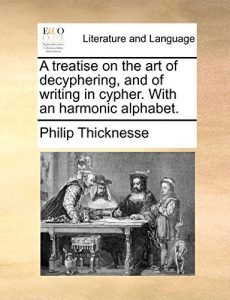 Wow, that’s a title and a half, but it is actually a real book. I now have a copy of it and dipped in and out of it when writing my current novel. It was written in 1772 and plays a part in the story. Naturally, I couldn’t let the name of the author go by without at least one character making a reference to Thicknesse. It is too good a word to turn down. (Inserts a wink emoji.)


 These days, we would probably call it pornography, back then the word, although in existence, wasn’t widely used, so I’ve gone with ‘erotica’ and other Victorian euphemisms. James leads the investigation, with Silas and Fecker also involved, and it takes them back into Silas’ past and an event from ‘Banyak & Fecks’, on to the Cheap Street Mission, and later, to the wilds of the west coast of Scotland. During all of this, there is a growing sexual frisson between two major characters who should not be attracted to each other. There is no great love story, other than my favourite theme of friendship and how far we would go for our friends.
 First, though, I am finishing my cup of tea before going for a short walk around our village for the exercise. It gets in the way of my writing but must be done, and while I am doing it, I can put together an outline for Book 10, which has a working title of ‘The Final Prelude’, but that’s very much at the in-the-imagination draft stage right now.
 Silas Hawkins
 Archer, Lord Clearwater
 Thomas Payne
  The word ‘novel’ originated from the Latin novella, a singular noun use of the neuter plural of novellus, diminutive of novus, meaning ‘new’. We’ve probably all used the word, as in, ‘That’s a novel idea,’ and that’s exactly what a novel should be; a novel idea expressed through the medium of storytelling, one of mankind’s oldest forms of communication. Take it to the extreme, and you could write anything and call it a novel. For example, I’ve seen some books that had no punctuation or no speech marks around dialogue… Hideously affected if you ask me, and they come across as publisher-wank, for want of a better way to put it, and being ‘original’ for the sake of it. My advice? Avoid!
 For all of them, then, I have either a beginning to launch me into the story, or an end I know I have to aim for, and what happens in between is made up as I go along. Sometimes, the characters add the twists for me. I’ll be beavering away on a chapter, and it’s flowing, and I’m heading towards the last line which I imagine to be one thing, and one of the characters will suddenly say something I wasn’t expecting. Either that, or I throw in a line to see where it will lead to, and I take myself by surprise. There’s an example in ‘Fallen Splendour’ at the end of chapter four when Mr Norwood answers the door to find three men looking for Silas.


 And now, I shall thank you for reading, and head back to chapter 19 of ‘Something Exposure’ where one of my MCs is just about to confront the IC, while my other two MCs race to stop him. I must take what should be a cordial meeting to the point of fatality in a realistic and thrilling way without being ridiculous or allowing the pace to slacken. We’re at the crisis and climax stage, and I really can’t leave these boys hanging around a cold castle in the wilds of Scotland any longer.