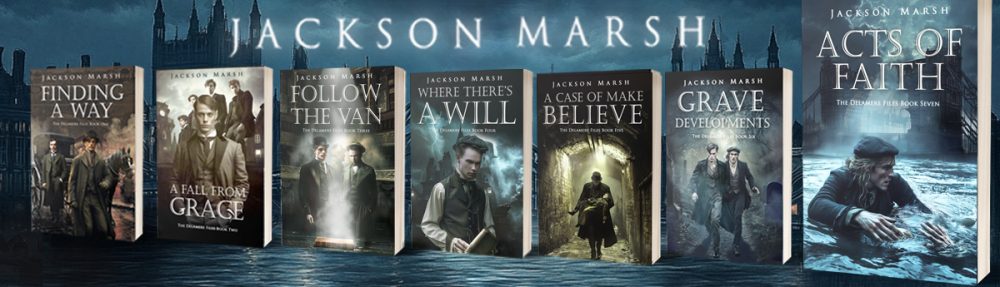
Where There’s a Finished Will

Well, maybe not exactly finished… It’s still to be proofread, and then I need to have another look and maybe tidy up before I go to layout, but… ‘Where There’s a Will’, the Delamere Files book four, is now drafted and ready to be typo-checked. Hopefully, if all goes well with the cover and any rewrites I might do, I will have it available by the end of the month. Watch this space, and, as usual, my Facebook page.

Meanwhile, I am also closing in on a book I’ve been trying to get out there for about 20 years. I mentioned it before, I think, the biography of my gay godfather. I have now been through the version I compiled several years ago, and while doing that, I had a choice. I could either rewrite the thing as I might write it now, and it’s around 50,000 words, or I could leave it as it was. I decided to leave it, because it is more authentic. Okay, so it’s not brilliantly written, but that’s because all I’ve done is copy my godfather’s words from the tape recordings to the page. I’ve done some tidying up and some fact checking, but otherwise, what you read is more or less how he used to tell his stories to anyone who would listen.

I’ll give you more news on that soon.

Meanwhile, meanwhile, there’s another promo that might interest you if you’re up for books set in an academic setting. They look to be mainly straight romances, but Guardians of the Poor is on the list too, because these books are all book one of a series. So, if you fancy sending the page to anyone you know who might like some suggestions for new reads, then feel free. The three others are also still running, so here’s the full list of this month’s promos for you to choose from. Remember, it costs you nothing to click and browse, and by doing so, you’re helping a lot of indie authors (and me).

Academy Series Starters

LGBT Reading Party (only until 8th June)

Mayhem and Motives

Pride Month

June Promos

History and romance mix month June

Hello everyone! Apologies if you just received a newsletter and it was exactly the same as this post, more or less, but it’s the start of a new promo month. Therefore, I have news of promos running in June, the month in which I will release the 4th Delamere Files novel, ‘Where There’s a Will.’

I am very pleased to say that the new series has been doing really well, and that’s mainly thanks to you, my readers and supporters, and to the Book Funnel promotions. This is where a group of authors get together and promote each other’s books, simply by sharing the link to the promo page. Our readers and supporters go to the page to browse, and, hopefully, pick up some copies of a new author’s book. The promotions are themed, and naturally, I go for the historical novels ones, and/or the adventure, romance, action, mystery… whatever is suitable to the book.

So, here is news of what promos you can go and check out this month. Apart from one, they are all running until the end of the month. It doesn’t cost you anything to click, but the more clicks I get direct from this newsletter, the better it makes me look – wink, wink.

LGBT Reading Party

(Only available until 8th June)

This is a celebratory sales promo for authors of works with characters who would identify anywhere within the LGBTQIA+ spectrum.

Click this link: LGBT Reading Party

Mayhem and Motives

MAYHEM & MOTIVES: Mystery, Thriller, & Suspense Reads is a genre-themed sales promotion brought to you by BookMojo.

There are just over 100 books in the list, all mystery or thrillers.

Click this link: Mayhem and Motives

Pride Month

Find your next queer read.

Anyone can join the promo, as long as the main character of the book is part of the LGBTQIA+ community. Well, for me, that’s ripe for all three of my series starters, and they are in there along with over 200 other titles. Plenty of new LGBT authors, stories and series to check out there, and from all genres.

Click this link: Pride Month

All that and a new novel too? Yup, that’s what coming this month. So, here’s wishing you a great June ahead!

Mildly Excited

I’m mildly excited for two reasons. Firstly, I have almost finished editing ‘Where There’s a Will’ and aim to send it off to be proofread next week. That leaves me now having to work out the blurb, author’s notes and front cover over the weekend. The story has appeared more smoothly than I imagined, and I am rather pleased with it. It’s quite funny in places, because of Will’s character, and my only concern (as I rework the climax slightly) is that there’s not enough tension, and the climax almost comes out of nowhere. I’ll have to let the reader be the judge in due course. Maybe in another couple of weeks, and it’ll be on the shelves.

The other reason I’m excited because I am only a few Euros off having my best sales month ever. I am happy to say sales and KU reads have gone up over the last few months, and I think that’s mainly to do with joining the author cross-promos on Book Funnel. I am still in this one for a few more days:

Click through, and check out some of the books – all available on KU

I have three promos lined up for June, and news of them will be in a newsletter at the start of the month. If you’ve not yet joined my occasional newsletter group, then here’s the newsletter Page.

Today Back Then (1892)

Sometimes when I can’t think of anything to write, I need to go looking for inspiration. Today, being in the state of not knowing what to write here, I went looking for inspiration in the British Newspaper Archives. I thought I’d have a look and see what was in the newspapers this day in 1892.

Page one

The London Evening Standard, as with many newspapers, leads with births, adverts and listings, as many front pages did in those days. Their top-left advertisement was for a funeral service, and that was followed by the birth of a daughter to Mr J A G Bengough of Gloucestershire. It’s not until page two that you get to the tightly packed columns of text and political news.

Page two

There were no headlines, as such, and every single letter and number had to be placed in the printing frame by hand, and backwards. It still amazes me that newspapers looked like this and were put together by hand.

Also on this day in 1892, a Wednesday, you could have had the choice of newspapers. In London, where I am looking, I have the Standard, the Morning Post, The Sportsman, Globe, Pall Mall Gazette, St James’ Gazette, Islington Gazette, Sporting Life, the Hackney and Kingsland Gazette, the Public Ledger and Weekly Advertiser, and the Commercial Gazette, among others. That last one had an image on its front page, so I went to examine it in more detail. It was this:

An advertisement for the Zeeland Steamship Company, running between England and the continent twice daily by paddle steamer. However, because I lived in the house my character Larkin Chase lives in in the Delamere Files series, I opted to look at the Hackney and Kingsland Gazette, to see what was happening in my ‘hood’ 132 years ago today.

Again, a front page of advertisements for church events, schools, doctors, breweries, and many other businesses, because although only a few pages long, the H & K Gazette needed income from advertising to survive. House and shop sales cover page two, some theatre news, and then, finally, some local news. A woman didn’t like the people at the Cock pub in Mare Street and smashed their plate glass windows. Damage estimated at £25.00, the culprit was committed for trial. Then, there’s a strange thing where, it seems, the Salvation Army was using the plight of London’s match girls to sell their own matches. Their advert/piece states that if we all used Salvation Army matches, the ‘poor match girls in East London would be saved from much suffering, anguish, disfigurement and often death.’ I mean, talk about layering it on a bit thick, not to mention being hypocritical.

Later on, there is some cricket information which would have pleased Doctor Markland, a whole column dedicated to the Conservative and Liberal Unionist electors, and then some interesting deaths. A 71-year-old sleepwalker fell from a window (suspicious), and at 10.20 in the morning, a middle-aged man expired while pushing his heavy barrow through Stoke Newington, poor chap. Doctor Markland would have had a field day with the next short story. It concerns a man who, while watching a cricket match, was struck on the head by the ball and later died. There will be an inquest.

The last page of the publication takes us back to advertisements and notices. So, when people ask me where I get my ideas from, very often, they come from browsing through these old newspapers of the past. If you are interested, the British Newspaper Archive can be found here.

Don’t forget the Historical Novel promotion is still running, highlighting various books and periods, and all are available on KU. Click the pic to uncover all the covers.

Closing in on the Last Chapters

Just a quick update. I am now at 85,000 words of the first draft of ‘Where There’s a Will,’ and it’s all starting to kick off. We’ve had a long trail of seemingly random clues, and now, they’ve all got to tie up and tie in, so I can tie up the draft and get to the really fun stuff, the editing and rewriting.

The other day, someone said something which warmed me old cockles. It was either in a review or in a group, but they were saying how much they like my transformation scenes, as I call them. I also rather like them because they are good for the passing of time and place, and they are relatively easy to write. I just picture it in my head and out it comes. What am I talking about?

https://www.amazon.com/dp/B07RPCKF4L

One of the times that stands out for me happens in ‘The Clearwater Inheritance’, and it’s more or less the beginning of the climax. Jasper and Fecker are on the Orient Express, and Jasper has something of a crisis, but we leave his scene in their compartment and see them through the window. Then the ‘camera’ takes us along the train, through the steam and smoke, over the snowy fields lit by moonlight, across France, over the Channel, across London and down to Larkspur in one take, as it were. I’ve used the technique in other novels. In ‘The Larkspur Legacy’ I do it on the back of a storm in one place, and another train in another case, and there is often an owl at Larkspur that sees things while moving us around the Hall and grounds.

As Jack Merrit would say, ‘Anyways…’ I’ve just done a similar transition scene in ‘Where There’s a Will.’ Just thought I’d let you know.

Don’t forget to click over and have a browse through the historical novels and academia-based romances in the KU promotions.

Writing a True Story

As well as writing my fiction, I am working on a true story. It is that of my godfather who was born in 1919 and lived well into his 80s. Uncle Bob, as I called him, was gay and wanted everyone to know his story, so when I was in the UK several years ago now, I recorded him telling his lie story, and later, started transcribing it. I am now working on a version for publication (eventually), and today, I thought I would share the opening with you.

I have checked and amended certain facts as best I can (because his memory of all those years ago may not have been accurate), but other than that, the text is written more or less as he spoke it.

Here’s the first page.


Tooting           1919 – 1933

When I was born in 1919, our house was worth 100 pounds. Fourteen years later, I was earning that amount each week as a rent boy in Piccadilly.

Three things happened to me between 1919 and 1933 that had a lasting effect on my life. I look back on them now as defining moments, but at the time they were more than that. I suppose you might call them revelations. I didn’t realise at the time what exactly they meant to me, only that they were important. But now, recalling the 85 years of my life, I can place them in the order of things, and understand their significance.

They were small events at the time but things which shaped the way I approached my life – a life that took me from the house of my birth in Tooting, to the West End of London when I was still only thirteen, and from there to Wormwood Scrubs, the Royal Navy, the Mediterranean and the Pacific, and then back to London where, in the course of my professional duties, I was to meet politicians, religious leaders and royalty. They are the first things that I remember encountering on my path through almost a century of gay life – a century that saw the world change rapidly. Television, telephones, computers and gay rights were not even things of science fiction when I was born.

But what are these three clear-as-a-bell memories from an early twentieth-century childhood? They are more than just recollections of a post-First World War life in south London. They are not just snapshots of a life lit by gaslight, when boys went to school barefoot, and Mr Gilman walked ahead of the horse-drawn funeral carriage, stopping the traffic. I am certain they are not parts of dreams that come back to me in old age, tricks played on the mind by my four score years and five. These moments are as real to me now as they were then. It is as if I can reach out my hand and touch my own history, like Alice putting her hand through the looking glass and reaching into another world. Only, when I do it I am touching another time.

I can still see the group of ex-servicemen, wearing women’s clothes and pushing a barrel organ along our street.

I can still feel the older man’s hand touching mine.

I can still remember the moment another boy kissed me for the first time, and I realised what was different about me.

These are the three most prominent moments in my memory of a childhood in Tooting. But they are not the only ones.

Tooting High Street, 1919. Looking south towards Colliers Wood with what’s now the @themanortooting
on the right, Longley Road on the left. Photo from Tooting Newsie on X

Beginnings

My birth was the result of the Great War, although not the only result, of course. Far more important matters were taking place in the world at that time, but on November 12th, 1919, a year and a day after the fighting had stopped, and London was beginning to return to normality, I was delivered into my parent’s front room. More precisely, I sloshed out into the world in the safe hands of Mrs Allen, the formidable, fat midwife who delivered all the children in the street. Like some matronly earth mother, she was also the one who laid out the dead, often before the doctor arrived; if the doctor arrived at all. She was a central character in Gambole Road, Tooting, whereas I was just another post-war baby.

Gambole Road was typical of its time; a side street of terraced houses, dimly lit at night by gas burners. Each lamp was hand lit at dusk by the man whose job it was to walk the streets and ensure that we had light. There were three families living in our building, number 30. The house had three floors, one family on each, and like most houses at that time it was rented. It was quite common for one landlord to own several properties in a street, as ours did. He was a local decorator and kept his houses in good repair, investing some of his rental income back into them.


Academic romance novels promo collection – click and rowse

Delamere Book 4 Update

‘Where There’s a Will’ the fourth book in the new Delamere series, is now at 75,000 words of the first draft and we’re entering the final reel. The writing is going smoothly, though will need some editing because of my ‘condition of repeatedness’, as Will might say. My habit of putting in notes to myself as I go to ensure the reader has got the point. Later, I take these out. They are tricky enough not to write in a standard mystery, but this one has so many details, I find myself doing a whole paragraph of reminding the reader of what we already know. So, I’ll have to make sure and look out for those as I go through the MS for draft two.

Still, we’re getting to see the world from Will’s point of view, starting to understand some of his ‘condition of preciseness’ a little more, and he is growing as a person, detective and character generally. It’s also interesting to see his view of his brother as we’ve not had much of that, and to learn some of their history that we may not know already.

Soon, I shall have to start thinking of the blurb and the cover design, but I will save that until I am into the second draft and sure of the story. I usually commission a drawing for the inside, but I have done the three main characters from the Delamere series (Jack, Larkin and Will) and most of the characters in Where There’s a Will are only going to appear in this book, though there is one I may reuse, he’s not a vital player in this story. There might, instead, be a map of Templar Island, where the story is set. I’ll think about it.

Meanwhile, this series, and the others are doing very well thanks to the two promos I am taking part in this month. First there’s:

Academia Romance of all genres as long as academia is involved.

Then, there’s:

Historical fiction, all periods pre-1950 and all available on Kindle Unlimited.

Click the pics to find the offers and titles.

Logogram or Logotype, but Logo is out

You know how I research words as best I can so that I don’t put anachronistic words into the mouths of my 19th-century characters? Well, I’ve been doing it again. If you’ve read this blog over the years you will know I sometimes talk about words I can’t use because they weren’t in general usage in 1888 to 1892 when my series are set, words like okay, paperwork, acerbic, or even acidic. If I’m not sure, I go and look the word up in a dictionary or use the online one which tells me when the word was first found in printed material. That’s usually a reasonably accurate indication of when the word was also spoken, but there are things to bear in mind. A) words are often spoken for a while before they are accepted into a dictionary, so the date shown is probably slightly earlier, and B) this online dictionary has a bent towards when the word was first used in America, and the date might be slightly different for Britain.

Anyway…

I was writing a chapter for ‘Where There’s a Will,’ and one of the clues involved the publisher’s logo on the spine of a book. Logo…? Off I go to look it up, and sure enough, it was hardly used until the 1950s. I can’t use logo, but these things must have had other names, so I turned to a friend of mine who knows about such things and this is how the email exchange went.


‘What was a publisher’s logo called before the word logo came about, any idea?’ I asked, and clarified with, ‘The Penguin symbol on penguin books, for example, is there a better or older word for one of those things, other than logo? I think they were called logograms or logotypes, and logo is an abbreviation – just wondered if you knew of any other word for them.’

My books don’t have a logo

This was his reply.

Interesting question, to which I don’t actually know the answer.

I know the word logotype has a specific history in printing. It was something printers used to save time when making up common words. Typesetting was all about making up text from individual letters cast in metal or made of wood. Some bright spark hit on the idea that for certain common words it would be quicker to cast the whole word as one piece of metal or wood. For example, in newspaper printing, the word that made up the paper’s title on the front page could be cast as one big block of text. And these word blocks were called logotypes.

But the modern concept of the logo symbol really goes back to heraldry and beyond. People had their crests and devices, and shops and inns had their signs.

So my guess would be that in the 19th century, people would refer to signs, devices, crests, symbols, marks, and that kind of thing. Goldsmiths and silversmiths had marks which were stamped on their wares. With the advent of industrial-scale advertising, you get companies like Coco Cola designing their name in a specific font that would have been cast as logotypes for printing purposes. The Coca-Cola logo is a word and therefore originated as an authentic logotype.

From my shelves

But I don’t think the word logotype would have been in common use outside of printing circles in the 19th century, and ordinary people would have referred to anything that was a symbolic representation of a trade, product, organisation, person, as a crest, or a device, or a sign, or a mark, as appropriate. Possibly symbol. You don’t really get the catch-all word “logo” until major advertising takes off in the early 20th century. And as you say, it was probably the abbreviated form of logotype getting into popular use, because these symbols would have been cast as a single block for printing.

I think these days they differentiate between logotype, still basically a word block, and logogram, which is a symbol. The Penguin would be a logogram. Since the company was founded in the 1930s the word used for the symbol would have been logo or logogram.


Well, I found it interesting. I also had to find another way to describe what my character was seeing, because even the self-educated genius, Will Merrit, would not have used the word logogram.

More books in the study – I need more shelves!

Where There’s an Update

The news today is that I am now 61,000 words into Delamere four, ‘Where There’s a Will.’

We have just had Easter here in Greece, so my writing regime was interrupted, what with family dinners, returning visitors wanting to see us, and all those festivities, but I am back to normal now and beavering on with the first draft of this more classic mystery.

What I mean by ‘more classic’ is that this is a simple mystery set in an isolated location where the reading of a will calls for the presence of at least one independent investigator. When I first outlined the idea to a writer friend of mine, her first question was the same as mine; why an investigator? Exactly! Why would anyone stipulate they wanted/needed a detective at the reading of a will? I wasn’t sure myself when I started, and I am still not too sure, but that’s the joy of writing mysteries. I often leave it up to the story and characters to work out what’s going on, because I don’t have a clear idea when I start. (I can also go back and change/clarify or exclude things later.)

My artist’s drawing of Will Merrit.

In this case, I had a rough idea, and so far, it is working. I have been dropping clues like breadcrumbs, so I might need to highlight or discard some of them, otherwise when it’s all worked out at the end, the list of pointers and clues will be too long.

That’s all technical. What is more fun with this one is that Will Merrit is the main POV character, so I am writing from his point of view. There is a secondary character whose point of view we also get, and he is the love story (gay love story of course). This isn’t just because my readers like a gay love connection and sometimes nookie in the books, his storyline is vital to the solution of the riddle at the heart of the story—why call a detective to the reading of a will.

When I started, I envisioned the classic ‘Cat and the Canary’ scenario, and apart from the murders, I have it, so far. I have my cast cut off during a storm on a private island in the Bristol Chanel, with one of them going mad, one already mad, a love story unfolding, and only 48 hours to solve the puzzle, or else everything, including the island, goes to the Church. Fun stuff, and I’m well on my way to the final act.

More news soon.

Jack and Will (behind)

History and Academia

Historical Fiction in Kindle Unlimited

Click the pic to find the offers

This month, I am promoting Deviant Desire and Guardians of the Poor, and I am doing it through two promo outlets which might interest you. The first is for Deviant Desire (and Guardians as that’s in both promos), and that book is up there with 38 other titles by some great authors.

If you like 20th Century historical fiction then KC Savilis is the writer for you, with his ‘The Devil’s Spies’ being set during the Cold War, and his ‘Operation Teardrop’ set in 1944. If you like historical fantasy, then ‘Legacy of Hunger’, by Christy Nichols might suit you, and if you want to go right back, then ‘The Frowning Madona’ is set in 412 A.D.

There is a wide range of historical fiction on offer, though not necessarily gay historical fiction as in Deviant Desire. The first in my Clearwater series of Victorian mysteries, ‘DD’ starts the ball rolling with the East End Ripper – my take on Jack – with some references within the novel being factual and inspiring the ongoing series. For example, my Ripper is never caught, the same as Jack was never caught, but in my world, you, the reader, will find out not only who he is, but why he was never exposed.

You can find all the books through this link.

Academia Romance

Guardians of the Poor has a place in an Academia Romance collection of 19 books on offer through the Academia Romance promo on Book Funnel. Going by the titles and covers, these are mainly straight, academy-themed stories, and Guardians does rather stand out as being something different. Perhaps that will attract some new readers, perhaps it won’t. What I do know is, if you are looking for more KU books to add to your TBR list, and you like the idea of teachers and students, or students and students, or teachers and… you get the idea… then this promo is for you.

Click the image to take a look.

Jackson’s Academy

I was going to leave things there, but then I started thinking about how many of my novels feature an academy, or a mentor. Guardians of the Poor starts off the Larkspur Series, and these are set at the Larkspur Academy, so there are seven right there. Then, I have the Mentor series where an older guy mentors a younger guy through coming out and accepting he’s gay. You can add to that, the Students of Barrenmoor Ridge which is about two school leavers.

I was only allowed to put one title in the academy promo, hence Guardians is there because it’s a series starter, and the story introduces us to the Larkspur Academy, Professor Fleet, and a string of new lead characters.

As usual, you can find all my books through my Amazon page, and they are all available in KU.

[KU = Kindle Unlimited. TBR = To Be Read.]