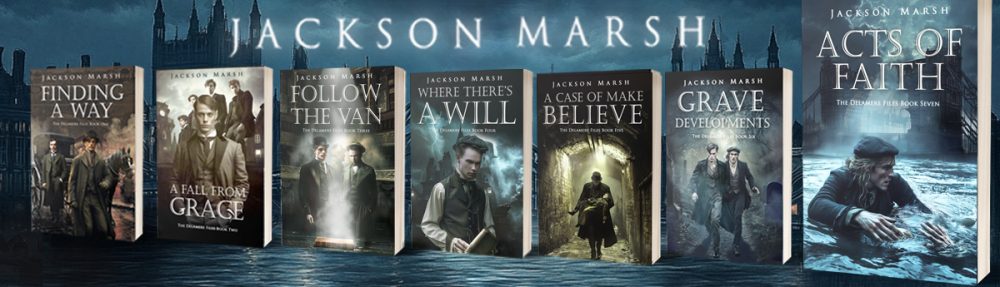
Later this week, I will be releasing ‘Finding a Way’, the first in my new Victorian mystery series. I don’t have an actual date for this because I don’t do pre-orders. Instead, I upload the files to Amazon when they are ready, and Amazon then releases the book. Sometimes, this takes a couple of hours, and at other times, it can take a day or two. Recently, publication has been happening within a short time, and often, my loyal readers receive notifications from Amazon before I do. Also, I am in Europe and Amazon is based in the USA, and I never know which day is which.
I will, of course, announce the release on my Facebook pages when the book is published.
I have revamped the blurb for the book and the series, so here they are with the cover.
When he is robbed by a fare, London cabman, Jack Merrit, thinks his life is over, but then he meets the dashing writer of social observations, Larkin Chase, a man in search of love.
Larkin sees the chance for Jack to earn a twenty-pound reward. All Jack has to do is identify the pair of crooks that robbed him, but the crooks are part of a notorious East End gang who know no boundaries when silencing a witness. Despite the possibilities Larkin offers, Jack’s world begins to crumble. He must either deny or allow his unnatural desire, and decide if he is to see justice done and win his reward. But when an equally dashing young detective arrives on the scene, Jack’s life becomes even more complicated.
Finding a Way is the first of a new series of thrilling Victorian mysteries.
If you enjoyed the Clearwater Mysteries and Larkspur Mysteries, you’ll love this book. There is no need to read them before you buy now before the price changes!
The series blurb looks like this:
The Delamere Files
The secrets of London’s Victorian underworld are revealed in The Delamere Files, the latest instalment in the highly successful Clearwater Mysteries and Larkspur Mysteries series.
It is 1892, and the Clearwater Detective Agency is tasked with the difficult job of solving crimes involving men who love men while maintaining complete discretion in a society where homosexuality is punishable by up to two years in prison with hard labour.
Follow the lives of Jack Merrit, Jimmy Wright and their fellow private investigators as they uncover the mysteries of a world in which they themselves are considered criminals.
In true Jackson Marsh style, you can expect a mix of historical mystery, MM romance, bromance and adventure, and you’ll be kept on the edge of your seat throughout.
If you enjoyed the Sherlock Holmes series, you’ll love The Delamere Files. Buy now before the price changes!
‘Finding a Way’, the first in my new series of Victorian mysteries, has nearly found its way to your Kindle and bookshelf. Meanwhile, the sequel to it, ‘A Fall from Grace’ is also doing well. Here is the news on both:
Finding a Way
The first book in the series sets up the three main characters and the underlying villains who will continue through a series of investigations. The baddies won’t appear in every book, but they will make appearances as and when least expected.
I have the cover, another triumph for Andjela V, and it has received excellent feedback from members of my private Facebook group, Jackson’s Deviant Desires, which you are welcome to join. The blurb is ready, and here it is:
It began with a man sobbing in the night.
Twenty-five-year-old Jack Merrit struggles to make a living as a London cabbie, and when he is robbed by a fare, he can see no future for himself and his beloved younger brother, Will.
Enter Larkin Chase. A dashing writer of social observations and a man in search of love. After learning Jack’s story, Larkin sees the chance for him to earn a twenty-pound reward. All he has to do is identify the pair of crooks that robbed him.
The crooks, however, are part of a notorious East End gang who know no boundaries when silencing a witness. With Jack’s world crumbling around him, an unnatural desire draws him to Larkin which he must either fight or allow if he is to see justice done and win his reward. When an equally dashing young detective arrives on the scene, Jack’s life becomes even more complicated, and when the criminal gang exacts their revenge, they set him on a life-or-death quest that will forever change his life. Or end it.
Finding a Way is the first of a new series of Victorian mysteries. Following on from the highly successful Clearwater Mysteries and Larkspur Mysteries, the series starts in London in 1892, and involves some of the original Clearwater characters in supporting roles. There is no need to have read the preceding two series, though it would be a shame to miss them.
Still to do
I still have a few pieces of the process to complete before I can announce the book as released, but you can expect it in around 10 days (roughly). I have still to:
Finish checking the proofs now it’s back from the proofreader.
Receive the full cover from Andjela V.
Have the guys at Other World Ink see to the layout, which will include a drawing of one of the main characters, as that’s something I am keen to continue in this series. (I have the illustration already.)
Sort the Amazon stuff like ISBN, and upload the files.
A Fall From Grace
Meanwhile, ‘A Fall from Grace’, the second book in the series, is now at 65,000 words and is doing well. This story continues the one begun in book one, because ‘Finding a Way’ resolves only one of the two plots; the action plot, while the emotional, love interest story is ongoing. I envision the series will include a slow-burn romance which will develop over time, and yes, there will be some sexy parts in it, though they won’t be overly graphic in nature.
‘A Fall From Grace’ is a detective story, as the series is a detective series, with a new mystery each time, and one to be solved by my three main characters, a new band of investigators. However, they come to their new jobs thanks to existing characters from the Clearwater world, and, I hope, you will have some nice ‘Ah ah!’ moments as you read both books. I’ll say no more on that and will leave it for you to discover what lies ahead when you start on the series, hopefully in a couple of weeks.
And now, it’s back to the typowriter and my proofing of book one, while book two waits in the wings to be taken up again once I have ‘Finding a Way’ ready to go. Not long now.
Finding a Way is the first book in the new Delamere Files series, and today, you can see the full cover for the first time.
This series begins in June 1892, six months after the Larkspur Mysteries ended. It is set in the Clearwater world of late Victorian England, and some characters from the Clearwater and Larkspur mysteries appear or are mentioned, but they are not the main cast.
If you have read the Clearwater collection, you will know that Delamere House is the property next door to Clearwater House in London. It is where Lady Marshall used to live, and the building is owned by Lord Clearwater. In the early 1890s, it became the headquarters for the Clearwater Detective Agency under James Wright and is also the house where Joe Tanner and Dalston Blaze live. The house appears later in ‘Finding a Way’, and will feature more as the series continues.
However, ‘Finding a Way’ is not about Delamere House, it is about Jack Merrit, a young London cabbie with a heap of challenges who finds himself unwittingly involved in the solving of a crime. Around this central story is a story of self-acceptance, coming out (as we’d call it these days), and a very slow-burn love story that will develop through several of the books to come.
‘Finding a Way’ will be available in August, and I will let you know when it is published. Meanwhile, here is the blurb as it stands now, and below that, the title. Click on the title to see the cover and meet two of the cast.
Finding a Way
The Delamere Files book one
It began with a man sobbing in the night.
Twenty-five-year-old Jack Merrit struggles to make a living as a London cabbie, and when he is robbed by a fare, he can see no future for himself and his beloved younger brother, Will.
Enter Larkin Chase. A dashing writer of social observations and a man in search of love. After learning Jack’s story, Larkin sees the chance for him to earn a twenty-pound reward. All he has to do is identify the pair of crooks that robbed him.
The crooks, however, are at the top of the heap of a notorious East End gang who know no boundaries when it comes to silencing a witness. With Jack’s world crumbling around him, he is drawn to Larkin by an unnatural desire which he must either fight or allow if he is to see justice done and win his reward. When an equally dashing young detective arrives on the scene, Jack’s life becomes even more complicated, and when the criminal gang exact their revenge, he is set on a life-or-death quest that will forever change his life. Or end it.
‘Finding a Way’ (The Delamere Files book one) is nearly there, so I have now switched to Work In Progress seven, although it is not my seventh book, but the seventh since I started the WIP blog.
‘A Fall from Grace’ (The Delamere Files book two) is currently at 51,000 words, around halfway through, and the pace is picking up. This is very much first-draft material, and I am still surrounded by pieces of paper stuck to my desk to remind me of vital clues to explain later and where the story is going.
I saw a post on Facebook the other day where writers were encouraged to put up the first lines of the first three chapters of their current work in progress, and I thought that would be a fun idea for today. I can’t remember what these lines are, so I have opened the chapters to take a look.
What I have for you now are the opening lines of chapters one to three of ‘A Fall from Grace’, and this will come as much as a surprise to me as to you.
Chapter One (Summer 1880) Jacques Verdier hit the rockery at some time between two-thirty and four-thirty in the morning of the thirty-first of July, eighteen-eighty.
Chapter Two (London, Twelve Years Later, July 1892) His life two weeks ago: Surrounded by boatyards and barge-builders, chandlers and wharfingers, sails, masts, ropes, cable chains, blocks, cranes, and makers of everything needed for the dockyards and river trades.
Chapter three (Sinford’s School for Boys, Kent. 1875 to 1880) Sinford’s School no longer exists, but when I was sent there in 1875 at the age of thirteen, it was a rambling place full of terror, noise and prospects.
A few notes: I think there are too many hyphens in the opening of chapter one, so I may change the time to an hour, rather than a half. Chapter two needs to be two chapters because it does two things, and it does them too quickly. It tells us about the MC’s change in fortune, and it introduces the protagonist. That’s fine, but the protagonist needs more time to get to know and trust the detectives he has come to for help before he lets them read his memoirs, which start at chapter three. So, that’s a second draft issue to be sorted out.
‘Finding a Way’
Maybe I should whet your appetite for book one by posting the opening lines of the first three chapters. ‘Finding a Way’ should be out on Kindle, KU and paperback within the next couple of weeks, but meanwhile…
Chapter One June 1892 It began with a man sobbing in the night.
Chapter Two After some investigation of the cabmen’s shelter, Jack returned to the hansom to announce that Speckle Sam was frying them each a grunting peck, and two mugs of prattle broth were waiting for them on the bench, because the night was so warm, and the hut was so ard, he could barely catch his breath.
Chapter Three There was money to be made on the way home, but Jack ignored the potential fares as he passed through Borough, and turned down the drunks and those leaving the all-night coffee houses.
As for the rest, you will have to wait and see, but you will be able to see the cover here on the blog on Saturday when I do the full reveal. Join me then, and you will meet my two new main characters for the first time…
The Clearwater Companion. Larkspur Mysteries, book four
Have you read ‘Seeing Through Shadows’ the Larkspur Mysteries book four? It actually doesn’t matter if you have or haven’t, as this unpublished excerpt gives nothing away.
Chester Cadman has been duped by unscrupulous men, ridiculed in the newspapers, and disowned by his family. Only twenty-two, he is on the verge of starvation when a Clearwater detective makes him an offer he can’t refuse: Join the Larkspur Academy and investigate a haunting that has plagued Lord Clearwater’s family for nearly four hundred years.
What I have here is the original opening for the book, a section I wrote before the Clearwater Mysteries came about. It was to be the opening of a sequel to my standalone, slightly paranormal romance, ‘Curious Moonlight,’ when I invented an abbey in Cornwall and an ancient scandal that occurred around the time of the Reformation. This section is a very early work for me (another way of saying it’s a bit rough around the edges, a first draft and unedited), but the idea behind it stayed, and eventually became the backstory for ‘Seeing Through Shadows.’
Which is why I never throw anything away. Even if the text didn’t appear in the book in this or edited form, the idea behind it did.
It’s a quick read, but before you set off into the past, make a note that next Saturday, I will be revealing the cover of the first in the new series, ‘Finding a Way.’ More about that on my blog posts next week. Meanwhile, step back in time to 1538 and a moonlit night in the grounds of Larkspur Abbey…
Larkspur Abbey, 27th March 1538
The Abbot stood, cloaked and shadowed by the yew tree, his lantern dark and unnecessary thanks to the full moon. It painted the scudding cloud with outlines of silver and caused the unsettled mist to shimmer as it undulated over the damp grass and wove among the ancient stones. The moor mist played silently at the Abbot’s feet, stroking leather shoes before swirling to investigate his companion. As it drew near the second man, it seemed to realise its error and held back, skirting him before pouring down the hill towards the graveyard. There it pooled in a natural bowl, lapping at the base of the knoll as if waiting for a door to open and admit it to the earth.
‘The time draws near,’ the Abbot whispered, his eyes fixed on the far side of the graves.
‘Shall I go down, Father?’
‘No, Jacob. Wait awhile until we see it.’ He flicked his eyes across the tombstones to the church wall in case the apparition had appeared during the blink of an eye, but the mist was undisturbed, and no figure walked. ‘The monk has not returned, I hope?’
‘No, Father,’ Jacob replied. ‘Nor will he. He rides to Plymouth tonight, and thence Exeter and north. He shan’t be seen again.’
The Abbot crossed himself. ‘You know,’ he said, ‘the King’s commissioners are at Dartmoor.’
‘Aye, Father. We all fear for the Abbey.’
‘They will find no corruption here, Jacob.’ The Abbot’s voice was as firm as his belief that he ran an order beyond reproach.
‘Not now the monk has been sent away.’
‘Exactly.’ The Abbot shuffled his feet. ‘And not after you have done your duty.’
Jacob gripped the wooden handle of a dagger, his fingers itchy for work, his muscles tensed and ready.
In the graveyard, the mist became agitated and gathered at a cut in the hillock. Drawn to one place, it swirled in delight when a patch of grassy hillside opened like a door, and swept inside to the dark, unexplored tunnel. It poured around the skirt of a young girl, cowled and wrapped in a cloak of rough wool. Her boots cut through the vapour which pawed and petted before rushing on, as she trod a slow, deliberate path towards the graves.
‘There!’ the Abbot hissed and pulled his man to the cover of the tree. ‘See how it walks? As if floating above the mist.’
The girl made slow, cautious progress towards the east window, pausing to listen, crouching behind headstones when a breeze played at her hood and a startled night creature darted nearby.
‘Shall I go now?’
The Abbot sighed and closed his eyes in a brief prayer of forgiveness. ‘Yes, Jacob,’ he said. ‘But remember how the monk walked and be sure to do the same. Slowly, carefully go, because you know you are doing wrong, because you know God is watching and yet you act against your vows.’
‘I took no vows, Father.’
‘Which is why you are the only one who can do this. But picture yourself as him, and she will not suspect until you are on her.’
‘Aye,’ was all Jacob said as he hid the dagger.
He set off towards the church keeping to the shadows, but when there were none and the moon caught him in his guilty act, he behaved as the monk had done, crouching and crabbing low to the ground. If the girl saw him coming, she would think it was her assignation and not, as the Abbot had planned, her assassination.
He should have seen this months ago. It had become common knowledge in the Abbey despite the vow of silence, a vow he knew his monks rarely kept. If the King’s Commissioner heard of that, there would be trouble enough, but if they learned of the monk, the abbey would be torn down for sure.
The sinner was on his way to Plymouth now, on a mission to take the word of God into the county of Devon, further if possible. The cause of the Abbot’s fear had left, but only half of it. The girl was now against the church wall and creeping around the east to the south side where the shadows deepened in the recesses of buttresses. This is where they met, he had learned. Nightly when there was no rain, the monk and the serving girl from the Hall. It had first been noticed by a novice and gone unreported for the lad feared he would be accused of betrayal. Later, he confessed to a second novice who had the courage to approach the Abbot.
The Abbot knew the monk in question was otherwise virtuous and he rather the man found his way to a woman, rather than any of the noviciates as many monks did. He also knew the lord of the manor. If he reported the matter to him, he would flog all servant girls and possibly throw them out, bringing poverty to their families. The Abbot held his tongue and let the matter proceed. Young love was a fickle thing, he believed, and the pair would soon tire of each other. There should have come an end to it the moment he confronted the monk and told him to stop, but, as the younger man pointed out, it was hypocrisy on the part of the Abbot to cast stones before removing the plank from his own eye, and the Abbot was shamed into silence.
The girl vanished into the darkness between buttresses as Jacob reached the west end wall. He appeared and disappeared as he made his way towards the girl, entering every recess to stay in darkness, just as the monk had done.
It was the news that the King’s Commissioners were coming to Larkspur that forced the Abbot to act. Within a week of the news, he had cleaned house, threatened every monk, and taken every step to ensure the King received a favourable report and thus, he kept his job, his income and peccadillos. The fly in the ointment had been the one monk, so in love with a serving girl that he defied not only his Father but God.
Left with no choice, the Abbot gave the monk an ultimatum. To leave that day on horseback, or in a coffin. The monk had ridden off within the hour, leaving the girl ignorant of his departure, but still living. A confession from her and the abbey was lost.
Jacob reached her recess and slipped into the void. The Abbot listened but heard nothing. Cloud darkened the moonlight, and the scene descended to monochrome gloom until the high breeze took away the cover. As it did, it revealed Jacob dragging the girl’s body into the moonlight and kneeling beside it. His instructions were to haul it to a prepared grave and there bury it, but the man looked up, towards the trees and then back to the body. In a second he was on his feet and running towards the Abbot.
‘The idiot,’ the Abbot hissed.
The hour was late, and no lights glowed in the arched windows of the dormitory or church, and no-one moved in the cloisters. Nocturns had been said and the monks returned to their beds, there to sleep until the bell for Lauds. The perfect time for illegal assignations, but since the Abbot’s dire warning, none had dared. None but the banished monk, now not only a fornicator but the cause of a young girl’s death.
Jacob puffed his way ungainly to the top of the rise and clambered to his master.
‘Father,’ he said, his face paler than the moonlight, his eyes wider than the night sky. ‘I can’t bury the body here.’
Furious, the Abbot gripped the man’s cloak, dragged him close and glared. ‘You fool,’ he spat. ‘Get about your task.’
‘Father, I can’t,’ Jacob protested. ‘Come and see, and you will understand.’
Curious Moonlight
Escaping bad choices, Luke Grey arrives in the Cornish fishing village of Madenly determined never to fall in love with a straight man again. But then he meets Peran Box.
Peran’s passion for investigating historical mysteries is his only escape from a loveless relationship. But then he meets Luke.
Attracted to each other’s differences, the two embark on an intense friendship which sparks hope for Luke and ignites Peran’s gay-curious feelings.
But then they meet Billy, dead for three-hundred years and determined to keep them apart until the mystery of his murder is solved.
I am nearly at the end of the editing process for ‘Finding a Way’, the Delamere Files, book one. A few more chapters to re-re-read and re-re-edit, and the whole MS can go off to Anne for proofing. The cover is done, the blurb is almost ready, and there will be a full cover reveal in the next couple of weeks.
I’ve been taking on some extra paid work, so haven’t had much time to continue with book two, ‘A Fall from Grace’, but I will be back to it today as soon as I have sent the first book to be proofed. Book two is at 48,000 words, about halfway through, and book one comes in at just over 100,000, so plenty of new reading will be coming your way soon. Neil is currently reading Finding a Way, and I’m looking forward to his feedback. I think.
Without giving away too much of the cover, here’s the face that inspired the face – a before and after if you like, as created by my wonderful cover designer, Andjela V.
Jack Merrit, a young cab driver. The original photo from pre-1900
Archer’s full title is Archer, Lord Clearwater, Viscount of Riverside and Larkspur, and in effect, he has three viscountcies. However, as is custom, he only uses one, unless it is for a formal announcement. The Riverside and Larkspur viscountcies were added long after the original Clearwater title, Clearwater being the (imaginary) area of Cornwall where the first title was created.
While putting together the Clearwater stories, and ‘The Clearwater Inheritance’ in particular, I delved into Archer’s family history, but never needed to go back further than his father and grandfather. There is mention of his mother’s ancestry in some of the novels, and Archer also has honorary titles after his name thanks to Lady Clearwater’s family: Lord Baradan of Hapsburg-Bran, and Honourable Boyar Musat-Rasnov, are the two that are dragged out on very formal occasions, or when he has a need to impress, such as his court appearance in ‘Fallen Splendour.’ These titles are completely made up, and I used them only to show he had a far-distant connection to the crowned heads of Prussia and Eastern Europe, for a romantic touch.
Archer, Lord Clearwater, Viscount of Riverside and Larkspur
As for the Clearwater title, when I came to write ‘Seeing through Shadows’, I needed to be sure of the history of the viscountcy, and that meant I had to draw up a line of men who had held the title. British titles only carry through the male line, so, in ‘The Larkspur Legacy’, Archer’s nephew could not have inherited his title because the nephew is descended from Archer’s sister.
When I first introduced Archer as the nineteenth viscount, to me, it sounded like it was a very old title, and that is what I wanted. However, later, when writing ‘Shadows’, I realised that for someone to be a nineteenth generation would have meant the title was created around 1240, and the first viscountcy in England didn’t come about until John Beaumont was created Viscount Beaumont by King Henry VI in 1440. My calculation, that the nineteenth generation, Archer, would have come about 646 after the first, is based on the average interval per generation of descendants being 34 years, according to the International Society of Genetic Genealogy.
In other words, it was improbable that a man born in 1859 was the nineteenth generation of the title. Luckily for me, there was a civil war in England during which families fought against families, and it wasn’t impossible the title of Viscount Clearwater could have passed between several sons, brothers and cousins at that time.
This is explained in ‘Seeing through Shadows’ as Chester carries out his research, but what follows is the list of viscounts I created as background research for Chester’s research, and I’ve included it out of interest. Not all viscounts are named, because I didn’t need to name them, but you might like to know:
First Clearwater Viscount was created by King Henry VIII after the Dissolution of the Monasteries.
The fifth to the tenth viscounts were usurpers and feuding brothers, cousins, and uncles during the Civil War from 1642 to 1652.
The fourteenth and fifteenth viscounts were smugglers and crooks.
The sixteenth, Archer’s great-grandfather, was the Renaissance man and made the money.
The ‘should-have-been’ nineteenth viscount was Crispin, Archer’s demented brother, deemed unfit, thus, disinherited of the title by Royal Decree.
The Viscounts Clearwater
From William Riddington, 1541 to Archer Riddington, 1888.
The two-at-once scenario persists. I am giving ‘Finding a Way’ my almost final read-through before sending it to be proofed. After that, I will do another read before setting a release date. Andjela has provided me with several cover ideas, and I have chosen one. By the look of the cover, I have invented a new TV detective series set in the late 1800s, which is (almost) what I intended. Dazzling, who does my illustrations, is working on a character drawing of one of the MCs, because I like dropping them at the front of the books these days, and I am still fussing about whether the book is any good or not, but that’s par for the course. (It is good, but because it gives us new characters, I always worry about what’s going to happen to them.)
Fall From Grace
Meanwhile, book two in the new series has a title and 45,000 words of a slowly evolving mystery, during which my main character starts to find his feet as a Clearwater detective and as a recently able-to-be-out gay man in 1892.
Where book one is more of an introduction/prequel than a mystery, book two starts off with a case. A client charges my new detective with finding a missing man. My newbie, Jack Merrit, is being tutored by old hand, Jimmy Wright, and is finding the transition… Well, I’m not saying too much right now as I’m not even halfway through, but I know where I am going – though the characters don’t yet know what’s in store (insert an evil laugh), and I know how things are going to work out in the end.
The end will, of course, lead to book three… But that’s a way down the line right now.
The Series
I was going to keep details of the new series quiet for as long as possible, but I’m getting to the stage where I have to start dropping teasers and hints. So, I can now give you the title, font and subtitle that will accompany the new books, and the first one will look like this:
The Delamere Files, eh? Uh huh. Each one (after book one) will be a case for my trainee detective. I intend to keep my three main characters and build them and their relationships as they find their way through this new world of being investigators of one sort or another, and around them, I’ll build more traditional mysteries than the sometimes-outlandish ones we have in Clearwater and Larkspur. (All of which were perfectly feasible, and some of which actually happened.) While all that is going on, favourites from Clearwater and Larkspur will give us guest appearances, and the main characters of Jack Merrit, Will Merrit, and Larkin Chase will develop, fall in and fall out, and… who knows what else.
So, that’s where I am right now. I am heading back to book two, chapter 11, somewhere in West Kent in July 1892, and a graveyard…
Today, I have the great pleasure of welcoming Anne Barwell to talk about the research for her historical series, Echoes Rising. I asked Anne to tell us about her novels and what goes into creating them and was delighted to discover she is as passionate about research as I am. There are similarities between the time in which Anne writes and my Clearwater Victorian era (illegal and dangerous to be gay). I won’t dilly-dally but will hand you straight over to Anne.
Anne Barwell
Thanks, Jackson, for hosting me today.
My Echoes Rising series is set in WWII so I needed to research not only location, but the time period too.
I’d wanted to write not only an action drama story but one that had at its heart a relationship between two men during a time when the discovery of their relationship risked severe repercussions, even death. I also wanted to explore characters who needed to do some serious soul-searching in order to break free of expectations of themselves and their society.
I knew in writing a historical I had a lot of research ahead of me, especially as I planned to write a three-book series. Shadowboxing is set in Berlin, Winter Duet is a road trip across wartime Germany, and Comes a Horseman takes place in France leading up to, and including D-Day.
I used a range of resources for my research. I work in a library—shelving in the 940.5 section is not a great idea as I get distracted by shiny things. The library, and its databases, were a fantastic writing resource. Half the fun was finding the resources, which weren’t just in the history section, as I also needed travel books—for locations—and information about clothing and weapons. Early on in the writing process for the story, I found a book called The Bomb by Gerard DeGroot which was about the ‘life story of the Bomb’ and subtitled A History of Hell on Earth. I bought my own copy of it.
The Forgotten Voices series, another invaluable resource, relays personal accounts by both servicemen and women and civilians about what it was like to live through that time. The internet also provided a lot of interesting information although some things were next to impossible to find, the specifics of German telephones being one. The only information I could find was about the US system at the time! Luckily one of my beta readers was German and she proved an invaluable source of information. She also checked facts on websites written in German and provided/suggested the German used in the story.
However, history can also work for a story rather than against it. After all, there’s no need to find a way to blow something up when it’s already documented that the Allied forces dropped bombs in the area at that time.
Many of the other locations in the story are real places. The Michaelskirche—St Michael’s Church—in Berlin where Michel meets the Allied team was still intact in 1943, although it was damaged later in the war. The Klosterkirche, a nunnery on the site of another church, where Michel and Kristopher take refuge, is also a real place, as is St Gertrud’s convent in Alexanderdorf. I was able to draw on photos of those places to describe them as well, which was very helpful. Other landmarks included the Brandenburg Tor and the Spree River.
Some of the other settings were not real but I studied maps in order to place them in actual locations, so I could work out what route the characters had to take to reach them. I also used Google map directions to figure out long it would take to get there, although I had to make some adjustments, given the time period. Cars didn’t travel as fast seventy years ago, and this story is set during a war. Google street view was also useful too although I had to again keep in mind the time difference. I based my fictional locations on real places so they would sound authentic. It’s the details that throw a reader out of a story, although it’s impossible to get everything right, and sometimes a writer has to take some liberties for the sake of a good story.
I used books of street maps of the area—because sometimes you want something in hardcopy, rather than flipping back and forth on browser tabs—and firsthand accounts of people who had been in Berlin at that time. Databases were very helpful, especially the Times Digital Archive, as they gave more of an insight into what it was like living there at the time. Travel books like The Lonely Planet Guides were useful too, but again had to be adjusted because they focused on what Berlin is like now, rather than describing the city in 1943.
Music plays a big part in Winter Duet, book 2 of my WII Echoes Rising series. Two of the characters—Kristopher and Michel—are musicians. Kristopher plays the violin, and Michel the flute, and they’ve promised each other a duet if they survive the war. Although the title reflects that promise, it also refers to a duet of another sort as the team is split into two for a good portion of the story.
I’d attended a lecture on music code as part of one of my music papers at uni, and had always wanted to use it in a story. I also studied Schubert’s Winterreise as part of the same paper, and given the setting of Winter Duet, it worked perfectly for it. The lyrics for the music come from a collection of poems by Müller so I used lines from one of the poems—’Frühlingstraum’—as code phrases used by the Resistance. Kristopher takes the conversation about music a step further and devises a code which he and Michel can use to leave each other a note that will not be easily deciphered if found by the enemy.
Music code was not only used in WWII but long before that. Bach used musical notation to spell out his name in his compositions using the fact that modern music notation had developed from modes—in German ‘B flat’ is ‘B’ and ‘B natural’ is H—and phonetics. Later Schumann used several musical cryptograms in his music, spelling out not just his own name, but that of Clara Wieck, who would later become his wife. Other codes were based on pitch, motifs (repeated music phrases) and note lengths. There are many more examples and variations out there across a range of different composers.
And yes, Clara Lehrer, Kristopher’s sister, is named after Clara Schumann. I’ve learnt a lot more about WWII while writing this series than I ever thought I would, and despite the work involved, I’ve really enjoyed it. I still have a notebook, a folder, and bookcases full of information about the period, and although this team’s story is told, I wouldn’t be surprised if that information proves useful in another story sometime.
Shadowboxing, Book 1 of Echoes Rising, is on sale this month.
Complete their mission or lose everything.
Berlin, 1943
An encounter with an old friend leaves German physicist Dr Kristopher Lehrer with doubts about his work. But when he confronts his superior, everything goes horribly wrong. Suddenly Kristopher and Michel, a member of the Resistance, are on the run, hunted for treason and a murder they did not commit. If they’re caught, Kristopher’s knowledge could be used to build a terrible weapon that could win the war.
For the team sent by the Allies—led by Captain Bryant, Sergeant Lowe, and Dr Zhou—a simple mission escalates into a deadly game against the Gestapo, with Dr Lehrer as the ultimate prize. But in enemy territory, surviving and completing their mission will test their strengths and loyalties and prove more complex than they ever imagined. Author’s note: This is the third edition of Shadowboxing. The first and second editions were released by another publishing house. This story has been re-edited and uses UK spelling to reflect its setting.
Anne Barwell lives in Wellington, New Zealand. She shares her home with kitty siblings Byron and Marigold who are convinced her office chair is theirs.
Anne works in a library, is an avid reader and watcher of a wide range of genres, and is constantly on the lookout for more hours in her day. She likes to write in series and even so-called one-shots seem to breed more plot bunnies. Her writing is like her reading – across a range of genres, although her favourites are paranormal, fantasy, SF, and historical. Music often plays a part in her stories and/or her characters are musicians.
She also hosts and reviews for other authors, and writes monthly blog posts for Love Bytes. She is the co-founder of the New Zealand Rainbow Romance Writers, and a member of RWNZ. Her books have received honourable mentions five times, reached the finals four times—one of which was for best gay book—and been a runner-up in the Rainbow Awards.
I’m not, actually. Not at sixes and sevens, that is, but I am working on book two of the new series, which would be work in progress seven since I started the WIP blog, and I am also working on the first in the series, which would be WIP six. The first is almost complete, I am doing my ‘last edit before proofing’ but haven’t set a date for proofing yet, because I need to be further into book two first. So, unusually for me, I have two major works on the go at the same time. We also have family visiting, which means fewer working hours, but I’m still up at 3.00 each morning to get started and make the most of the time I have.
Where did the expression ‘at sixes and sevens’ come from?
Here’s an aside. First of all, this is an idiom, a group of words established by usage as having a meaning not deducible from those of the individual words. (Deducible: possible to discover based on the information or evidence that is available.)
Grammarist. Usage of the idiom over time.
According to Grammarist.com: The idiom at sixes and sevens came out of the 14th century from an old dice game where throwing a six or a seven was filled with risk and uncertainty. It appeared in Chaucer’s work “Troilus and Criseyde,” back in 1374, and the excerpt read, “Lat nat this wrechched wo thyn herte gnawe, But manly set the world on sexe and seuene.”
Those last words are six and seven in Old English. (Just in case, like me, you were asleep when they did Chaucer at school.) Good old Wonkipedia agrees that the idiom evolved from a card game, and adds: William Shakespeare uses a similar phrase in Richard II (around 1595), “But time will not permit: all is uneven, And every thing is left at six and seven“.
Meanwhile…
Currently, my desk is surrounded by pieces of paper stuck to the shelves, and beside my open notebook. This is because book two in the new Delamere (or Clearwater Detective Agency) series involves a lot of detail in its backstory, and I have to keep track. A man is missing, and it falls to the newly appointed detective’s assistants, Jack and Will Merrit to investigate. While they are doing this, Jack is still coming to terms with his feelings for Larkin Chase but is confused by his feelings towards his new boss, James.
The typing corner in my workhouse today.
The story fits into the Clearwater world, after ‘The Larkspur Legacy’ and is set in London. A couple of Clearwater/Larkspur characters have made appearances in the first and now, second, book, but it’s not about the Clearwater crew, as the previous series were. It’s about my new MC, Jack Merrit, a handsome hansom driver with a very ‘precise’ younger brother, and how they find themselves rocketed from Limehouse to Knightsbridge, poor to middle class, through a series of unexpected circumstances. As per my usual, there is a mystery to solve, action and adventure, and in this case, a slow-burn love story that, over the course of several books, will see the MC travel from longing to lust to losing, to…? At least, that’s the plan.
I am currently on 28,000 words of book two, which doesn’t yet have a title, but which is inspired by ‘Men of a Similar Heart’ a story I wanted to tell, but one which didn’t fit into the Clearwater world. Until now.
Symi Dream Blog
By the way, as soon as I have posted this, I am off to post on my other blog, SymiDream. If you want to see the non-story side of me and where I live, then bookmark that blog which I update around five times per week with all kinds of island chat and other matters. Whatever takes my fancy really. Today, I am talking about this blog a little, so it makes sense on this one to talk a little about that one…
You see what I mean about being at sixes and sevens? Lol.