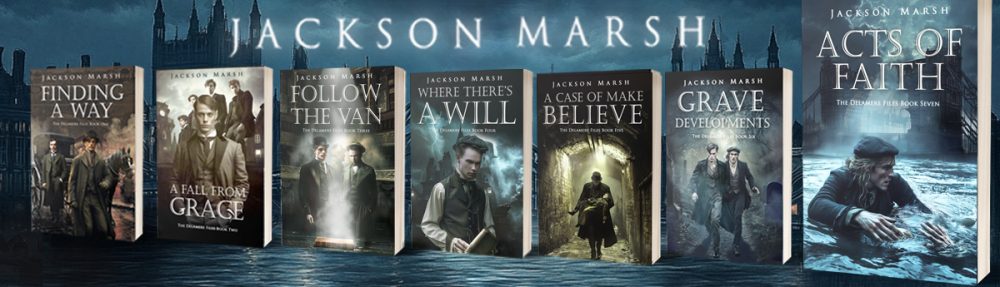
I am up and running on ‘The Larkspur Legacy’, the seventh and last Larkspur Mystery, due out in spring 2023.
I’ve been working on this for some time, making notes and plotting plots while writing ‘Starting with Secrets’, so I am already up to 40,000 words. The title of ‘Starting with Secrets’ refers to the start of a great adventure, Lord Clearwater’s hunt for his mother and godmother’s great ‘treasure’ and ‘secret’, and although the story starts in book six, it is left unfinished and continues in book seven.
As usual, I’ll give away no spoilers, but I can tell you I am currently in a Falmouth shipyard inspecting a schooner barque. For my research, I have been reading books about merchant schooners, studying rigging plans, and looking up all kinds of interesting facts about sailing ships of the late 19th century. It’s a whole new world, and, more exciting for me, a whole new language. I’m also looking up what I call ‘sailor speak’ to get the terminology the sailors in my story would have used, while also looking into mysteries of the past, European travel of the time, Thomas Cook escorted tours, and other related matters.
Falmouth Harbour
Talking of spoilers, I used to outline my plots to Neil, as it is always useful to have someone to bounce ideas off. However, there is such a big twist at the end of ‘The Larkspur Legacy’, I must throw around my ideas in code, so I don’t spoil his reading for the first draft. He won’t get to see it until next year, but if I can continue at the pace I am, I should have it ready for him to beta read around February. Having said that, comparing the current word count to the basic plot outline, I am only about one-fifth of the way through. Either I will end up with a novel at 200,000 words, or I will have to cut some ideas and slash the draft when completed. ‘The Clearwater Inheritance’ came in at 150,000 words, and I am aiming for the same for ‘the Larkspur Legacy.’
You will note, perhaps, a similarity in the titles (Inheritance and Legacy). Both end a series, and both involve something left behind for another. There is always a double meaning in my titles.
I will say no more, except to remind you to take part in with my Advent quiz via my Facebook page. 26 books, 25 days, 25 chances to win a special prize soon to be announced (and it won’t be a book, but a one-off… something that only the winner will receive).
In today’s blog, I am looking at words. Well, it’s what I do every day. Write them, look at them, go over them, misspell them, then go over them again and rearrange them. Some days, I write so much I get a kind of word blindness, and what I think I am looking at isn’t what I am seeing; I see what I meant to write, when in fact it’s gobbledegook.
Gobbledegook is a word that didn’t come into common English usage until around 1936 (there had been some printed instances of it in the 1920s), after that, it shot right up the usage charts to reach a peak in 1955. So, if you are writing historical fiction set before 1936, don’t write gobbledegook. I’ve talked about this subject before, but today, for lack of anything else to talk about, I wanted to present an old favourite of mine: words from the past.
For this, I am using two resources. ‘Passing English of the Victorian Era, a Dictionary of Heterodox English, Slang & Phrase’, compiled by J. Redding Ware, originally published in 1909, and ‘Dictionary of the Vulgar Tongue’, published in 1811 and compiled by ‘Captain Grosse et al.’ Both books are available from ForgottenBooks.com. I’m going to give you some random words from each book, starting with ‘Passing English’ which includes American as well as British words.
To find my first word, I ran a search/find in my PDF version and looked for the word Toby. I found one instance.
Five words/phrases in use before 1909
Cross-life men(Thieves) Men who get their living by felony. Used amongst themselves rather plaintively it would seem, and in remarkable contrast with the 18th century term, ‘gentlemen of the road’, ‘high toby men’, and others.
According to Green’s Dictionary, ‘High Toby’ meant highway robbery; as low toby, on foot, and high toby, mounted robbery. “[They] were but ‘low toby-men,’ from their frequenting the by-ways.”
Duffer-fare (London. Cabmens’ slang). In the neighbourhood of the theatres, as closing time approaches, the police will not allow cabmen to drive empty cabs through the Strand highway. In order to get past the police, and so obtain a chance of a fare when the theatres vomit their thousands, cabmen will ask a pedestrian to be chummy enough to jump in, and be driven into the Strand. Here arrived the ‘duffing-fare.’
So, a duffer-fae was cabbies’ slang for giving someone a free ride so you could access the Strand when theatres were ‘vomiting their thousands.’ (Love that image.) And talking of theatres…
Ten bob squats (Theatrical) Stalls in a theatre. About 1880 going to the theatre had become so fashionable, owing possibly to the steady patronage of the Prince of Wales, that the price of stalls in most of the best houses was raised. (To ten bob, I suppose.)
In old British money, a ‘bob’ was a shilling. The Bank of England 10-shilling note (notation: 10/–), colloquially known as the 10 bob note was a sterling banknote. Ten shillings in £sd (written 10s or 10/–) was half of one pound. The ten-shilling note was the smallest denomination note ever issued by the Bank of England. [Wiki]
And still talking of theatres, here’s an expression we still use. Barnstorming is ‘to make a rapid tour of an area as part of a political campaign’, and/or to ‘travel around giving exhibitions of flying, and performing aeronautical stunts’, but did you know its origin and original meaning? (From the USA, I reckon.)
Barn-stormers (Theatrical, 18 cent.) Inferior actors who play in barns. Used, of course, in scorn by those comedians who have reached permanent footlights. The term has now almost passed away in consequence of the enormous increase in the number of theatres which now exist, even in the smallest towns. The ‘barn stormers’ hire a barn near a village, and there give their performance – frequently of Shakespeare.
Shakespeare in a barn? Whatever next? Next, is another random word, I found hanging about.
Marwooded (Hanged) This term prevailed while Executioner Marwood held office. He died in 1883.
Some words/phrases in use before 1811
Randomly selected from The Vulgar Tongue are these five, picking up where we left off.
COCKLES.To cry cockles is to be hanged: perhaps from the noise made whilst strangling. (This is street slang also known as cant.) Related to this, we have COLQUARRON. A man’s neck. His colquarron is just about to be twisted; he is just going to be hanged.
Not to be too fixated, but related to both of those is CROP. To be knocked down for a crop; to be condemned to be hanged. Cropped, hanged. So now we can see where the expression, ‘to come a cropper’ comes from. Also on the same subject, if you danced upon nothing, you’d been hanged. There are several other words associated with this subject, but let’s move on to something more pastoral and talk about the fruitful vine.
FRUITFUL VINE.A woman’s private parts, i.e. that has FLOWERS every month, and bears fruit in nine months.
Or maybe not. How about returning to my roots on the Romney Marshes and the image of sheep safely grazing in the fields?
WOOLBIRD is another name for a sheep, or you could refer to one as a BLEATING CHEAT (don’t ask me why), just as you would refer to a sheep rustler as a CHEATING RIG.
By the way, we have to thank sheep for giving us condoms. Have a read of this:
CUNDUM.The dried gut of a sheep, worn by men in the act of coition, to prevent venereal infection; said to have been invented by one colonel Cundum. These machines were long prepared and sold by a matron of the name of Philips, at the Green Canister, in Half−moon−street, in the Strand. That good lady having acquired a fortune, retired from business; but learning that the town was not well served by her successors, she, out of a patriotic zeal for the public welfare, returned to her occupation; of which she gave notice by divers hand−bills, in circulation in the year 1776.
Not sure about the use of the word ‘machines’ when describing a cundum, however.
I could go on all day, but I won’t. The point to be made from all this, if there is a point at all, is that when writing historical fiction, you need to be aware of the words your characters and narrator would have known and not known. However, my advice is to also consider your reader. Too many colloquialisms, slang, cant and obscure words, and your writing will be Hubble de Shuff, your readers will be Both-Eared, and your sentences will be Nonsense, which, you might like to know, was the word used to describe the act of melting butter in a wig.
Good morning. Today’s blog is in two parts: a quick catchup on where I am with ‘The Larkspur Legacy’, and news about a quiz which starts on my Facebook page on Thursday, December 1st.
The Larkspur Legacy
My current work in progress is progressing well. I am over 20,000 words in, and I am in the middle of act one, the ‘normal world’, the setting up of the story to come, and I am arranging all the pieces as we approach the point where the action really gets going. There is going to be a lot of it, and somewhere in there will also be what my friend Charles recently described as the ‘heart’ of the story. (Thanks for the review and the message, Charles!)
Without giving anything away, so far in the story we’ve had a chase on horseback, someone creating an invention that’s ahead of its time, Clearwater is not happy, men are plotting, someone has been attacked, and the skies are darkening with the wings of chickens coming home to roost. I’m only on chapter eight! Lol.
The Jackson Marsh Advent Quiz
Every day from the 1st to the 25th of December, we are going to pose a question about one of my 26 books. The answer will be the title of a different book every day, so no book will be an answer more than once. Some of the answers can easily be found by looking at my author page on Amazon because some questions refer to the blurb, the cover, or the first page of a book. For others, you will have to delve deeper and darker into your memory, but even if you’ve not read all 26 books, you can still have a guess.
There will also be a bonus question; which of the 26 books in my collection has not been used as an answer? So, keep a list as you go.
Anyone who comments with an answer will have their name put into a hat as many times as you answer. Then, on Boxing Day (26th December), we’ll ask my godson to pull a name from one of my husband’s steampunk top hats (don’t ask!), and that person will win the star prize. We’ll announce what that will be when the quiz starts on Thursday. I’m saying ‘we’ because Jenine will be running the admin side of the quiz for me to ensure impartiality.
Silas Hawkins is one of two main characters in the prequel to the Clearwater Mysteries, ‘Banyak & Fecks.’ This novel, written after book seven in that series, but coming in date order before the first, tells the story of how Silas met the first real love of his life, Andrej Kolisnychenko (Fecker or Fecks to his friends). Their love was destined to be platonic but has remained strong through both the Clearwater and Larkspur series, and Silas features in the latest Larkspur instalment, ‘Starting with Secrets’ and will be a main player in the last of the Larkspur books, ‘The Larkspur Legacy.’
Silas appears on five of the Clearwater Mysteries book covers. Banyak & Fecks, Deviant Desire, Twisted Tracks (running for a train in silhouette), Unspeakable Acts, and is represented on the cover of Negative Exposure.
It struck me that we had never had an in-depth interview with the trickster, mimic, petty criminal and love of Lord Clearwater’s life, so I called him into the interview room for a debrief, and here is what transpired.
Silas Hawkins
Born: October 21st, 1868.
Place: Canter Wharf, Westerpool (The Wirral), England
Nationality: Conceived in Ireland, born in England, but staunchly Irish.
What is your full name? Do you have a nickname?
Silas Hawkins. That’s it. I was named after the priest who slapped me arse when I was born without breath and got me life started. Father Patrick was called Silas before he took holy orders. And aye, I do have a nickname. Me best man, Andrej, calls me Banyak. It’s a word from his village in Ukraine where it means ‘cooking pot.’ He says I got so much boiling in me, I’m like a peasant stew. He’s a one to talk. I call him Fecker, on account of him being a handsome fecker who’s hung like one of them horses he’s mad about.
Where and when were you born?
I were slapped into life in a doorless slum in what they now call the Wirral, on the wrong side of the river to Liverpool, in a place called Westerpool. Our row of tenements was called Canter Wharf, but I forget the number now. Me mam was doing well just then, so we only had a few of us sharing the room, and we had glass in the window. Some of the time, at least.
Who were your parents?
Me mam’s me mam, least she were until she died in 1884, leaving me to the mercy of Cousin Rose, the drunken whore, and leaving me to mind me two half-sisters. Me da’, I never knew, as he put me in me mam back in Ballymum and fecked off before she came to England.
Me mam’s old boyfriend, Billy O’Hara, was more of a da’ to me than anyone though. He’d come by, sing me to sleep when I was little, and ended up being me half-sisters’ father. Strange thing was, he also ended up being my mate Jake’s da’, so Jake and the twins are halves, and me and the twins are halves, and that makes me and Jake like brothers, even though we’re not. Anyway, when I took up renting, I also took up Billy O’Hara’s name for a while. He’d not have liked that, but it was the first name to come to mind.
Where do you live now?
Ach, well ain’t you a nosey cur? I live some a the time in London with Archer at Clearwater House in what’s now known as Knightsbridge. Other times, I’m down at Larkspur, his estate near Bodmin in Cornwall. Most of the time I’m in town, because I work with Jimmy Wright more than Archer these days, and we have an investigation business to run.
What are your hair colour and eye colour?
I’m what they call ‘black Irish’ on account I have black hair and blue eyes. Can you not see? You’re sitting right in front of me you culchie eejit.
What do you miss most from your childhood?
Aye, well that’d be me mam. She was a strong woman, leaving Ireland because she fell pregnant and refused to name me father, walked to the coast, got herself on a ship, started a life on her own, carrying me, worked her fingers down, birthed me, and still attended mass. Then, from when I was five, she had to put up with me thieving and me ways, then bore the twins, and all the time putting up with Cousin Rose and the other drunken culchies of Canter Wharf. Got carried off with the sweating sickness when I was sixteen. When she died, I promised her I’d get her a good, stone headstone and sure enough, five years later, I did. That was the last time I went back to her, but she’s with her God and keeping an eye.
What did you want to be when you grew up?
You didn’t have aspirations in Canter Wharf. If you were a little’un, you went up the chimneys. If you were a bigg’un, you worked in the docks, if you could get any work at all. Me? I didn’t want to be anything. All I wanted was to have money in me pocket, and I didn’t care if it came from someone else’s. Came to London in 1884, and soon saw there were more ways of earning a coin than dipping a pocket, and more exciting ways too. Now, at 23, I’m happy where I am. Living with Archer, working with Jimmy, and using me old Westerpool skills of mimicry and trickery when I need them.
What do you consider the most important event of your life so far?
Ach, there’s many: Leaving Westerpool, meeting Mickey the Nick in London and learning his ways, the adventures with Archer and the crew, being shot… But the two that stand out the most?
In date order, first would be meeting Fecks. I was down on me luck and very near out of me life when all I had was water from the borough pump and what I could find in the trough. I stumbled into this court in the Greychurch back alleys to take a leak and let it go over a man chewing on Fecks’ massive… Well, you don’t need to know the details, but I remember finding this massive, blonde statue of a man with his pants down, and I ran away. Then, next thing I remember, he’d taken me in and brought me back from the edge of death. So, that was important.
Second would be when Tommy Payne brought me to Clearwater House because his boss wanted to interview a genuine renter from the streets. There was cash and food in it, and I was waiting in “His Lordship’s” servants’ hall, getting Tommy wound up, when the most gorgeous man I’d never imagined came down the stairs and looked at me. I tell ya, I nearly emptied me happy sacks there and then. Something shifted, you know? Like me mam’s voice in me head said, ‘This is what you have been looking for, Silas Hawkins. This was meant to be.’ She was right.
Archer, the love of his life
Do you have any scars?
I’ve a fair few. I got one on me chin in the exact same place Archer has one. He got his from a swordfight with his brother, I got mine from the Ripper’s knife. Then there’s the bullet wound in me shoulder, and a few scars on me shins from burgling that went wrong, and a couple on me heart for friends and me mam who’ve died.
What is your biggest secret? Does anyone else know about this?
I’m a private investigator, man, of course I’ve got secrets. I was a renter, so there’s a fair few there, I can tell you, and I’ve not exactly stayed on the right side of the law since I was five, but I’m not going to give you details. Aye, I’ve got a few secrets, but in my line of work, it’s best to keep them where they are. But… I do have one big secret that no-one knows, not even Fecks, not even Archer.
Oh, no… Wait. One man does now because I had to ask his advice on it. Professor Fleet at the Larkspur Academy is the only man who knows what I’m planning, but he’s not going to say anything, and besides, everyone will know it soon enough.
If you could change one thing in your life what would it be?
I’d have me mam back, she’d be living in a decent house, and the twins with her, and none of them would be servants. Mind you, Iona and Karan like where they are, they’ve got friends, they’re well paid, and Mrs Kevern treats them good.
Other than that, I’d like Archer not to be so worried all the time, but that’s temporary. Kingsclere is trying to discredit him in the newspapers at the moment, but I’ve a plan to put a stop to that one way or the other.
What is your most treasured possession?
Well, that’s a long story. It’s a small black and white pebble that came from a river in Ukraine. It is a piece of Fecker’s homeland, and he brought it with him when he fled the Russians. That and his grandfather’s dagger was all he owned when we met in London, and once the Ripper started on his rounds, and we was fearing for our lives, he gave it to me to prove he loved me – as a friend, but that’s enough.
What three words would others probably use to describe you?
Sexy little fucker. Thieving little bastard. Loyal best friend. Dirty whore-pipe scum… Take your pick, I’ve been called them all.
Where do you see yourself in five years?
Right where I am now. Loving Archer, working with Jimmy, making the most of life, dodging the law, and still never having got on a horse. They’re beasts and should be banned. Who knows where we’ll be in five months, let alone five fecking years? I should have been dead years ago, and would have been if it weren’t for Fecks. I can say the same about Jimmy who caught me when I nearly fell eighty feet into an opera. So, I’d like to be where I am with all me mates around me, waking up in Archer’s bed and happy. That’s only me and Archer waking up in his bed, not me and all me mates… Ach, you know what I mean.
What do you have in your pocket?
Er… Me black and white pebble, a set of lockpicks, fifty pounds and a receipt from a jeweller in Bond Street, which reminds me… I’ve an appointment, so if you’re done with your nosing, I’ll be about me business. Oh, and you’d best not print any of this.
As it always is with me, once one book is out, it’s a case of ‘on with the next’, and today is no exception. Actually, I started work on ‘The Larkspur Legacy’ a few weeks ago, because what happens in ‘Starting with Secrets’ has a bearing on what comes next.
While writing the last book, I made notes about the next one, and that led me to a basic plot outline. Since early this year, I have had scenes in my head, moments from the novel I want to get in, twists, ideas and scenarios, and I am still thinking them up. I have, though, started writing, and have four draft chapters already, plus the more detailed outline, though that still has some holes in it. The characters will fill those in later when they start taking over the story.
I’ve also started on my research, and am currently reading this…
‘The Larkspur Legacy’ is going to involve a group of characters aboard a schooner, a clipper or barquentine, something like this…
As you can see, these pages are from The Merchant Schooners by Basil Greenhill, a two-volume look at the history, building, launching and sailing of these vessels. I have already picked up some words and expressions and read several excellent descriptions of boatyards, shipbuilding villages and ships.
So, it’s back to 1891 and chapter five. Before I go, I must thank everyone who supported the launch of ‘Starting with Secrets.’ It went straight to #2 in the Amazon charts of new releases/historical.
‘Starting with Secrets’is the title of the sixth Larkspur Academy mystery, and is the first part of a two-part adventure set in the Clearwater world. This, as you may know, is my invention of late 19th-century England. Both the Clearwater and Larkspur mystery series is set among real places, and feature people who lived at the time, but the main cast is invented characters. Many of the background events are true, and the Clearwater world sticks to actual dates and times as much as possible. I am even able to have characters take train journeys according to extant timetables of the time, down to the day of the week, route and times of the trains. I love adding that kind of detail.
Starting with Secrets has such a train journey, and it also uses real locations, described as best I can according to reports and documents of the time. In this case, we have the invented estate of Larkspur Hall, another one in Hertfordshire, Clearwater House (somewhere on the edge of Hyde Park in Knightsbridge, London), and Greychurch, which is my name for Whitechapel. The characters find themselves in some well-known locations, such as inside the dome of St Paul’s Cathedral and the Round Reading Room at the British Museum, both in London. They also visit villages that still exist today, although I have changed the names of two of the main locations to not upset anyone who might still be living there or who might own the property I have adapted.
I won’t give away the plot of ‘Starting with Secrets’, but if you like a good Dan Brown mystery/adventure, and if you like historically based riddles and conspiracy theories, then you’ll like this novel. I’ve tried to write it so you can solve the clues as the story progresses. At least, you can with some of them. What I am also trying to do with this two-part adventure is bring in as many of the Clearwater and Larkspur main characters as I can without losing focus. There is a relationship story, a background emotional reason for two characters to sort themselves out, and there is at least one ‘Ahh’ moment when I, for one, experienced a shiver and the prick of tears. You will find villains, heroes and a couple of new characters that we’ll learn more about in part two, and there’s a lot going on in the background where existing characters’ lives are developed.
It’s been three years since the saga started with ‘Deviant Desire’, the first Clearwater mystery, and even longer since Silas and Andrej met in ‘Banyak & Fecks.’ Actually, the more I write these series, the more I realise the whole lot tells the story of Andrej, a Ukrainian immigrant who fled his homeland to escape the Russians. (Nothing changes.)
Although Andrej, ‘Fecks’, is not the main-view character in ‘Starting with Secrets’, he is there, along with others we met in book one of the Clearwater series, Lucy Roberts the maid-then-cook, for example. Archer, Silas, James, Tom and Andrej, the ‘canonical five’ as I call them, form the centre of the cast for this one, and they are aided by the Larkspur Academy men, Dalston Blaze, Joe Tanner, Chester, Frank, Edward and Henry, and the new man, Bertie Tucker. Bertie’s a sailor, or was until he got caught doing something that was, in those days, illegal, and he’s the unwitting catalyst in both action and emotional storylines.
But that’s enough of a teaser for now. As I write (Friday), I am waiting for the final files to come back from being laid out, and then, as I now have both covers, I shall be able to upload the book to Amazon and you’ll be able to download it, order it in paperback or read it in Kindle Unlimited, as you can with all my novels. So, not long now, and you will have a 380-page adventure, bromance, mystery, treasure hunt story to get your teeth into, while I carry on biting away at the last in the Larkspur series, ‘The Larkspur Legacy.’
Keep an eye on my Facebook page for news of the publication day, and why not join my group, Jackson’s Deviant Desires where I post more personal news from time to time and where you and others can discuss any or all of my books.
I have sent ‘Starting with Secrets’ to be formatted, I have both covers, and we’re nearly ready to launch the sixth Larkspur Mystery upon you. To reward you for your patience, today we have the blurb and the cover reveal.
It feels as if it’s been a long journey to get this novel ready to add to the series, but in truth, it’s not taken any longer than any of the others. It has taken more research and there is a lot more detail, there are more clues than ever, and a wide cast of main players. ‘Secrets’ has probably taken up more pages in my notebook than any of the others too, and when you get deeper into the story you will realise why.
Now, I must start work proper on the last in the series, and if I thought ‘Secrets’ was a hard beast to tame, I am sure ‘The Larkspur Legacy’ is going to be even more in-depth, detailed, complicated and yet fun to get right. Work on that starts this afternoon. Meanwhile, here’s the blurb for ‘Secrets’ which should be available in a few days.
Starting with Secrets
The Larkspur Mysteries
Book Six
“The greatest reward often lies at the end of the stoniest path.”
Lady Dorothy Marshall, March 1891
When Lord Clearwater inherits a set of enigmatic clues and a compass, it becomes clear he has the means to uncover a momentous secret. He calls upon the men of the Larkspur Academy to help with the hunt, including the latest recruit, the bewildered ex-sailor, Bertie Tucker.
The academy men investigate follies, national monuments and ancient churches, using their diverse skills to unlock a series of random messages. The men must work together to find Clearwater’s secret and ‘treasure’, but relationships threaten the status quo. Edward Hyde has turned his affections from Henry and aimed them at Bertie Tucker, opening a rift which must be mended if the hunt is to succeed.
And when two of Clearwater’s adversaries conspire to beat him to the secret, what begins as an adventure becomes a game of cat and mouse that leads to a fight for survival.
Starting with Secrets is the sixth book in the Larkspur Mysteries series. With themes of friendship, bromance, male love and revenge, the story is the first part of a two-part adventure, and combines historical fact with fiction. As with all of Jackson Marsh’s mysteries, the novel contains humour, love and action, while offering the reader the chance to solve the clues with the cast of disparate, well-drawn characters.
Hello! I’m not long back from our trip to Scotland, and it’s high time I gave you an update of what’s going on in the world of Jackson Marsh. There’s more about the next Larkspur book in a moment, but first…
On the way to our son’s wedding, I found myself alone in Edinburgh for a day, and there, wandered the old streets and the new, admired the buildings and visited the castle grounds. While on my walkabout, I stopped off at The White Hart, reputed to be the oldest inn in the city and a place where the grave-robbers Burke and Hare used to hang out.
Later, I was just thinking about heading back to my hotel when I stumbled upon the Writers’ Museum. This is a collection of artefacts and information pertaining to three Scottish writers; Robert Louis Stevenson, Robert Burns and Sir Walter Scott. It’s housed in Lady Stair’s House in the Lawnmarket area of the city, and the building is as interesting as the exhibits. I took a few (bad photos) which you can see below.
A few days later, I was in Inverness with my brother-in-law while waiting for Neil and his son to collect us and take us to the wedding. This was held in a castle by the river and was a splendid affair, and yes, I wore a kilt. The architecture of old Inverness along its riverbank was somewhat inspirational, so I’ve included a couple of shots I took there.
Now back at home, where the weather is glorious, I am back at work. I have a backlog of freelance typing to catch up on while I am also going through the final read of ‘Starting with Secrets’, the next Larkspur mystery. I am still aiming to have this ready for you in a week or so—probably more like two—and will send it off for its laying out next week. Andjela has done herself proud with another stunning cover and there will be a cover reveal soon. So, stay tuned to this channel for more information on my Wednesday work-in-progress blog, and prepare yourself for the first half of an epic Clearwater/Larkspur adventure that will conclude in the final book of the series. I am hoping to start on that as soon as ‘Starting with Secrets’ is published.
Meanwhile, here are a few of my dodgy shots of the Writer’s Museum, Edinburgh, and the riverside in Inverness.
The grand hall, now a gift shop.Robert Louis Stevenson’s childhood rocking horse. Looks rather painful.Robert Louis Stevenson’s pipe.The three great men in art form.It was Halloween, so I bought another copy of Dracula and read some of it back at the hotel.InvernessInverness Castle.
Lucky for some, this is the thirteenth post about my work in progress, ‘Starting with Secrets’, the sixth Larkspur Mystery. And the news is…
I am currently doing the last read before sending the MS off to be proofed on Friday. Andjela has designed the cover and there will be a reveal in due course. Also on Friday, Neil and I are off to Scotland for our son’s wedding, and I shan’t be at my desk again until November 9th, so expect no more updates to my blog until that week.
The journey to Scotland and back has already taken on epic proportions, in the style of a Clearwater novel actually, or any decent adventure story. All good dramas need conflict because you can’t have one without the other, and although I’m pleased to say we have no villains on our backs, we have already met a few challenges. To start with, KLM managed to charge me three times for one flight, and when we finally sorted it out and I got two refunds, the flight was from the wrong airport. However, we could live with that because although it meant a four-hour train journey on 5th November, the route takes us through the Scottish Highlands. If only it were on a steam train!
If only there wasn’t now the possibility of a train strike on the 5th of November either. We’re not sure yet if that will affect us, but in case it does, we have tickets booked on a coach as well. To add insult to KLM’s injury, they ended up cancelling our flight and moving it to some ridiculous time the following day. This would have meant another night in a costly hotel, plus missing a night already paid for in another, and travelling from two in the morning until about seven that night. I took the refund option and booked better and direct flights with Aegean, my favourite airline. Better times, better service, flexible and fair, though a little more expensive, the difference was less than the cost of the extra hotel.
Living on an island is wonderful; getting off it sometimes isn’t. We were due to leave on Friday evening on a ferry departing at 20.30 or something sensible. Thanks to a strike by some ferry workers yesterday, our boat will fall behind schedule, and now, instead of departing on Friday evening, we’re leaving at 02.50 on Saturday morning. That’ll be a bit of a bleary-eyed experience, but worth it as we will see much of the 18-hour journey in daylight, whereas usually, we sleep through the more interesting destinations.
So, with boats, taxis, trains and possibly coaches, we’ll be getting into Victorian mystery mode as we spend one night here before heading there, and from there, to somewhere else the next day, with only two days where we have a whole day without travelling. During those days, I intend to visit Edinburgh Castle, meet the latest grandchildren, and Neil will be fitted for a kilt. Och aye, it’ll be a fair fun twelve days. Assuming there are no more strikes or cancellations.
Whatever happens, I’ll be back online after 9th November and will give you a full update on Starting with Secrets.
When do you write the blurb for your publication? I start it as the idea of the book is forming, because giving yourself a rough outline of the main points of the story is important. This, later, becomes the structure of the blurb, the write-up you see on the book’s back cover and/or on the sales pages. To my mind, these things need to be succinct while offering the potential reader an outline of what to expect.
The Blake Inheritance
I’m going to give you a quote from one of my unusual romance stories, The Blake Inheritance, and here it is in sections:
An inheritance, a ring and a church organ; three clues to the Blake family mystery. Twenty-five and fleeing a stale relationship, Ryan Blake returns home to find some answers. What he discovers is the impish twenty-two-year-old, Charlie Hatch, a homeless scamp who has a way with words, a love of mysteries, and a very cute arse. As the two set about unlocking the Blake family secrets, Ryan finds himself falling for the younger guy. But is he ready to commit again? And can Charlie learn to accept that someone loves him?
What we have here is not a synopsis (never write a synopsis as your blurb) but it outlines the story in 91 words. It may not be the best blurb ever written, but it contains all the elements of the story while, I hope, enticing the reader to buy the book, which you can do here:
“Let us go then you and I, to the place where the wild thyme grows.”
The first line tells us it’s a mystery. The second paragraph tells us the main character, Ryan, is overcoming a problem, meets an impact character (one who will affect a change in the MC) and there’s a hint of something sexy. The last paragraph suggests the love story and the conflict, and that’s all we need to know. Combined with the cover that shows two young men and a lighthouse in a slightly twisted way should add a visual to the blurb. What this blurb doesn’t overdo, though, are the ‘power words.’ Then again, it doesn’t use weak words, and your blurb should be about power, not weakness.
Power Words
What do I mean by power words? Let’s move away from the blurb and look at fuller storytelling. Which sentence tells you more?
Edward went to look.
Edward forced himself to look.
Went is a weak word, forced is a power word; it tells us something about his state of mind and has a clearer meaning than ‘went.’ In this case, we can assume Edward didn’t want to look. Here’s another example taken from my upcoming ‘Starting with Secrets’:
… she said, moving to the stove
… she said, drifting to the stove
I don’t mind ‘moving’ too much because it’s vague and in this scene, ‘she’ is being vague, but ‘moving’ is an opportunity for something better. Here, she drifts to the stove because she is reminiscing as she’s talking, but were she angry, she might stomp, or if she was in a panic she might fly, she might ‘scream her way to’ or ‘bustle to’, ‘stagger in the manner of a drunk toward’ or, if you want to use ‘move’, ‘moved to the stove like a galleon in full sail’, but then, ‘sailed’ would be better, or ‘tacked’, ‘lurched’… In other words, ‘move’ is a weak word, and the others are power words.
Other weak verbs to be wary of include, stand, walk, look, feel, think, said, have, got, go. Example:
He knelt beneath the bell and looked inside.
He knelt beneath the bell and squinted inside.
Squinted suggests poor lighting or eyesight, so it adds more to the scene than looked.
Power Descriptions
As we can replace weak words with more powerful and descriptive ones, and we can improve our writing by looking out for other weak words which are easy to use but can always be bettered. I, for example, now look out for my use of the word ‘it’ because unless the ‘it’ is obviously the thing I am referring to, the word can confuse the reader. Sometimes, when editing, it confuses me, and I have to read back to remind myself what’s being talked about. So, look out for your use of the weak word, ‘it’ and see if it isn’t better replaced by something more specific. Other weak words used in this way include replacements for ‘it’ such as ‘one.’ For example:
Not as public as the one in the cathedral,
Not as public as the plaque in the cathedral,
That’s also from ‘Starting with Secrets’ and the ‘one’ we are referring to, the ‘it’ if you like, was mentioned a few sentences back, and because things have happened in between, ‘one’ might be too vague for the reader. Obviously, there are times when one, it, them, they etc., work, and you don’t want to repeat ‘plaque’ or whatever too many times.
She taught him how to make pastry and roll it.
Makes sense but there was that dreaded ‘it’, and something didn’t feel right. I changed it to:
She taught him how to make and roll pastry. It reads better and makes more sense; it’s not as clunky.
Here’s another way I try and improve my writing by swapping weak words for more powerful ones. This is an actual edit from my first draft to my second. Which do you think is more descriptive?
… but no light appeared at the window.
… but daylight refused to breach the window.
Okay, so I could have gone further: … but daylight refused to breach the grime-encrusted, leaded windowpane that stood as a barrier to the dawn… But let’s not go over the top.
‘Stood’, by the way, is another weak word. Always ask yourself how? How did he stand? How did she move?
Get/got is another one to avoid.
When he got to the junction…
When he arrived, reached, staggered to, fell upon, finally found… the junction. Much more descriptive.
However, when a character is speaking, always write as he or she would speak. Don’t put in unnecessary power words for the sake of it, not in dialogue. A character would be perfectly justified saying, ‘When you get to the junction.’
Word Order
A slight aside, but while editing the next book, I came across this sentence:
… and enjoyed standing beside her drying plates.
There’s nothing better than watching plates dry is there? Why was he standing beside plates that were drying? Why was he enjoying such a dull spectacle?
I changed the line to:
… and enjoyed drying plates beside her, which is what I actually meant to say.
I could have improved the initial sentence with a comma, I suppose, but it still felt clunky. … and enjoyed standing beside her, drying plates.
Finally
I was trying to think of a way to end this post, and came across another short piece on Before You Publish that included a list of strong, mild and weak words. It’s not that easy to read unless you enlarge it, but I’ve added it to my bookmarks as a resource. You might find it interesting when you are editing. I’ll be back on Wednesday with more news on ‘Starting with Secrets’ my current work in progress.