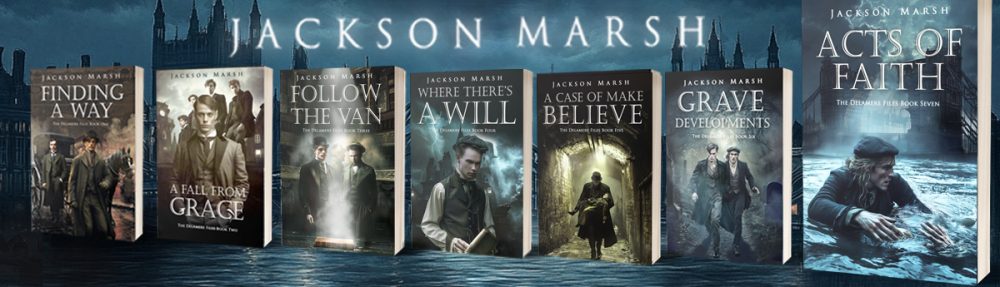
The Clearwater Mysteries: What’s next?

The Clearwater Mysteries: What’s next?

My next novel, ‘Banyak & Fecks’ should be available in a couple of weeks, and my newsletter will tell you when it has been published. There will also be news on my Facebook page. It occurs to me that I have done a rather strange thing, or I am about to. I realised that what I have done is write an eight-part, ongoing series over the last two years, and now, I’ve gone back to before that series started and written a prequel. So, that’s kind of cart about horse, as Fecker might say.

The Theme of The Clearwater Mysteries started with a pebble

Banyak & Fecks works whether you’ve read some, all or none of the series, and you can slip it into your reading at any time without it interrupting the flow of the series. It won’t give away any spoilers either, but it will explain a few things you might wonder about as you read the eight books.

For example, in book one, ‘Deviant Desire’, Silas’ only possession is a small, black and white pebble and when he wakes up at Clearwater House to find his clothes have been burnt, he is desperate to know where it is. Luckily, Thomas, the footman, being a caring chap as well as drop-dead gorgeous, finds and keeps it, assuming that it has importance to the urchin.

Later in the series, we learn that Andrej gave Silas the pebble, and Silas kept it as a reminded of their deep friendship. What we don’t know, in detail, is how Andrej (Fecks) came by it and why it is so important to him. In Banyak & Fecks, we not only learn how Fecks got the pebble, but also why and what it means.

As I was writing Banyak & Fecks, I realised that this small object carries the weight of the story’s theme – the series’ theme in fact: friendship and male bonding; bromance if you like. The pebble is a symbol, and although not mentioned in every book, is still in Silas’ possession at the end of book eight.
The pebble also has significance for me, and I don’t mind sharing that with you. In fact, I can do better and show you a photo of it.

I’ve had this pebble since I was 16. (It is 1.5 inches wide and sitting in a bowl made from a coconut shell I bought in Croatia.) It was given to me by my best friend, Andrew when we were walking on the beach. It was just a ‘Here you go, a present for no reason,’ moment, and nothing more romantic because our relationship was platonic. However, it meant much to me; it must have done as I still have it 41 years later. That sense of best-friendship, strong platonic love between one young man and another, is what drives the Clearwater Mysteries, or the relationships side of the stories, and I guess, the overarching theme stems from then, my teenage years.

Fecker and his horses

Another piece of backstory which is never fully explained in the series is Fecker, his horses, and his riding ability. In book two, ‘Twisted Tracks’ we have a classic ‘chasing a steam train on horseback’ scene. Archer (Viscount Clearwater) and his crew have answered a call to confront his nemesis, the Ripper. During the scene, the new footman, James, finds himself inching along the side of the coal cars at speed, trying to reach the cabin to pull the brakes and stop the train from crashing. At one point, he is hanging by his fingertips, in danger of falling to his death, when Fecker gallops alongside, stands and pushes James back to safety before calming riding on. How can he do this? At some point in the stories, Silas has said something vague like ‘He trained in a circus’, and it’s kind of left at that. In ‘Banyak & Fecks’, however, we find out how Fecks came to work in a circus, what he learnt there, and the dreadful thing that happened to make him leave. You might also be interested to know that a horse he has towards the start of the story is called ‘Banyak’, a word that in Ukrainian slang, means ‘idiot’. The word also has another, kinder, meaning which is explained in the book, as is the way in which Silas and Andrej came to call each other Banyak and Fecks.

Fecker’s skill with and love of horses is also developed in book four, ‘Fallen Splendour’, by which time he has become Clearwater’s coachman, and fallen in love with Lucy, a maid.

Sexuality in The Clearwater Mysteries

Hang on, didn’t Silas and Andrej work as rent boys in the East End? How can Fecker do that if he’s straight? Ah-ha! This is also explained in ‘Banyak & Fecks.’

My vision of ‘The White Ship’ where Banyak and Fecks lived in the East End

Andrej was 16 when, by necessity, he turned to renting on the streets of Genoa. Without being too graphic, most men will remember how easy it is to, um, perform at that age and beyond, and how embarrassing it was that one’s hormones often kicked in at the most inopportune moments. Fecker is still renting when we first meet him in ‘Deviant Desire’, but stops as soon as he doesn’t need to do it anymore. He does it because he can and must, not because he wants to. Having said that, there’s a scene in ‘Banyak & Fecks’ where he loses himself in a moment, can’t help himself, and kisses another man. By this time, he’s about 18, and, we would now say, confused (slightly) about his sexuality.

Silas’ sexuality is in no doubt from the moment we first meet him in the prequel, and he loves the fact it makes him a criminal because he’s quite proud to be one. He too undergoes a confusing transition, from wanting to know what sex with a man is like, to his first time with X (spoiler avoidance there), to finding it mundane when renting. It’s not until he meets Archer, however, that he is fully able to be himself, and that happens in ‘Deviant Desire.’

Running through the series, but not starting from the prequel, is the theme of Archer’s, Thomas’ and James’ sexuality. Later, we meet Jasper and Billy, also of the same ‘persuasion’, we’re never quite sure about Doctor Markland (but then neither is he), and there are even questions about which way Mrs Norwood leans, and what Lady Marshall has got up to in her past. In my Clearwater world, I wanted everyone to be gay, but that’s not realistic, but there’s no doubt that my core characters are. Apart from Fecker, who is always something of an enigma.

Making connections

One of the fun things about writing a prequel after eight books that follow it was laying down connections and bringing in backstories from the books that follow, if you follow me.

For example, in book three, ‘Unspeakable Acts’, Silas returns to a boy brothel at Cleaver Street. (I took my inspiration for that one from the Cleveland Street scandal of 1889.) He remembers being taken there by a man called Eddie Lovemount who propositioned him in The Ten Bells when Silas was renting. In ‘Banyak & Fecks’, we see that meeting and what followed, and Silas’ experiences at the brothel are set out in more detail. Eddie also mentions a messenger boy he’s got his eye on. He fancies him, but the lad won’t play ball, and he names him as James Wright. We meet James in book two, ‘Twisted Tracks’ (and briefly in book one), and there, we learn more about him and Eddie Lovemount and their days as messenger boys. James then has a meteoric rise from messenger to footman to valet to private detective, but that’s the kind of magic Clearwater weaves.

While putting these scenes together, I had to refer back – or forwards – to books already written to make sure my facts tied up. While doing that, I made a few minor changes to books one to four (nothing that alters the plot, mainly getting rid of words that weren’t in existence then, like homosexual, teenager and okay), so it was a useful exercise in that respect.

Similarly, because Banyak & Fecks ends just as ‘Deviant Desire’ is about to begin, the end of the prequel takes place once the Ripper murders have started. ‘Deviant Desire’ begins after the third (or fourth) murder, and they and the Ripper are the ‘action plot’ if you will. So, when I came towards the end of the prequel, I needed to remind myself of how book one starts and was able to bring in more facts and details from the real Ripper murders. In a couple of cases, I have quoted sections from actual news reports of the time, changing only names to suit my story. I was also able to bring the victims into the story, as many of the Ripper’s victims knew each other, and so, when you read Banyak & Fecks, you will meet some of the unfortunate boys who don’t make it to the end of the book.

So, what’s next?

As I said, ‘Banyak & Fecks’ should be available soon. My proof-reader is currently going through it, no doubt tutting at my punctuation, Andjela, the designer, is working on the back cover, and when I have both, I shall have one more read-through, make up the Kindle and print files and send it on its way.

Which begs the question, what to write next? I must admit I’ve been in limbo land these past couple of weeks unsure whether to return to Clearwater and write a book nine or look at something else. Book eight, ‘One of a Pair’ feels like the end of something in the way that book four ‘Fallen Splendour’ feels like the end of a chapter or the halfway point in a longer epic, and I have been wondering where to go now.

I also have my Saddling series to finish (as James Collins), because that’s crying out for a fourth and final book. At the same time, I have this inner stirring which feels like the need to start on another series entirely. I’m still thinking gay, mysterious, adventurous and Victorian, and wonder if I am being drawn towards Steampunk. It’s not a genre I’ve read, even though my husband has The Steampunk Bible and likes the fashion, but I like the thought of inventing another world within Victorian London. After all, I’ve done so much research for The Clearwater Mysteries, it would be a shame not to use it.

So, I will leave you on that note – hopefully looking forward to ‘Banyak & Fecks’ and telling all your friends to read the series, and I’ll take a couple of days off while I wait for inspiration to smack me in the face.

Remember, you can sign up for my monthly newsletter here.

A week in lockdown: A personal post.

A week in lockdown: A personal post.

Over recent weeks I’ve blogged about ‘Banyak & Fecks’, book covers, my ghost and horror stories as James Collins, my editing process and Coming Out Week. This week, I thought it high time I filled you in on what I, as a person, have been doing, and what is happening in my real world. So, here is a personal post about a week in lockdown.

Where I live

As you may know, I live in Greece on a small island called Symi, which, if you look on the map, you will find not far north-east of Rhodes. It’s in the south Aegean, closer to the Turkish coast than it is to the next Greek island. Symi is small, yes, but not the smallest island in the country, and we have around 3,000 inhabitants. There are only two main settlements on the island, Yialos, the harbour area and Horio, the village that rambles from the top of the harbour bay, through a dip and up again against the side of our ‘mountain’, the Vigla. Neil and I are lucky enough to rent a house overlooking the harbour entrance, and our view is… Well, our view is this:

Greece is currently in its second lockdown since March. When this pandemic first reared its ugly head, Greece was one of the first countries to react and called the country into lockdown well before the end of March. I know that because we were returning from a once in a lifetime holiday to Canada. When we left Greece in early March, the virus was something that was happening elsewhere but still something to keep an eye on. Travelling through Athens and London, we were advised to wash our hands, use sanitiser and keep a little distance from others; that was it, and that was how it was when we reached Canada too.

After five days travelling across the country on a train, we got off in Vancouver to find the world had changed, and the return journey involved changing flights and plans, isolation and, ultimately quarantine at home.

Symi Dream

If you want to know more about this trip, I have just started blogging about it on my five-times-a-week blog over at www.symidream.com There, we’re currently on day six (still in London), but you can click back to find the start of the story, or just click to this page to read the first post and carry on from there.

We’re almost in that situation again because we’re not allowed out between 9pm and 5am, we must send a text message for permission to go to shops and a few other allowed activities, and we can’t visit friends. Everything is closed apart from essential services, and we have another two weeks to go before we can ease off.

So, what have I been doing?

Writing

As you can see from the way I ramble through these blog posts, I enjoy writing, and that’s what I have been doing. Actually, this past week, I have been doing a fine edit on ‘Banyak & Fecks’, the Clearwater prequel due for release at the end of the month. I have five days before it is due with my proof-reader, and still a quarter of the book to go through. I’ll reread it again after proofing of course, but we’re nearly there.

Between reads, I reread ‘Fallen Splendour’, one of my favourite Clearwater adventures. I’ve been going through the books making a few minor adjustments like typos we all missed (not many), getting rid of a few words the characters use that I’ve since learnt were not in use in 1888 (eek!), and generally checking facts against what I am writing in the prequel to maintain consistency.

Another of the projects I am working on, in the background, now and then, is The Clearwater Companion. This may end up on this website as a guide for fans of the ‘Clearwater Crew’, or it may end up being published, but it’s a collection of notes and backgrounds about the characters and the story. I have an artist in India who is turning cover images and descriptions of characters into pencil drawings for the book, and this month’s drawing is of Silas Hawkins. She sent it over this week, so I present it here for the first time.

Reading

I do like a good book. Not only as something to read, but something to hold, and this week, I took delivery of two new research books.

The first is titled, ‘East End 1888’ and is by William J. Fishman. It is a study of Tower Hamlets through the year 1888, which is perfect for me. Tower Hamlets (a London borough) includes the districts of Whitechapel and Limehouse, or, in my world, Greychurch and Limedock, and 1888 was, of course, the year of the Ripper murders, the inspiration for ‘Deviant Desire.’

The second book is titled. ‘The True History of a Little Ragamuffin’ by James Greenwood. James Greenwood (1832-1929) was a British social explorer, journalist and writer, and brother of the editor of The Pall Mall Gazette. You may remember, a while ago, I wrote about reading ‘A Night in the Workhouse’, the first piece of what we’d now call undercover journalism, published in January 1866. I found this via the online newspaper archive and have it in PDF if anyone wants to read it. I read about it first in ‘Slumming’ another book I recently acquired, and the workhouse article is the basis of Silas’ night in a workhouse in ‘Banyak & Fecks.’

‘The True History of a Little Ragamuffin,’ is a reprint of the original story Greenwood wrote based on his research and experiences working in the slums of East London. It tells the story of a young boy growing up in Clerkenwell, so, for me, it’s full of observations, language and details about the time I am currently writing in. It is, though, in tiny print and not easy to read.


The smell of books

Recently, before lockdown, my 13-year-old godson came for a piano lesson (I’ve been teaching him for a year now). One of the things I get him to do is find fun facts from an encyclopaedia of music I bought him last Christmas as the lessons are also about music generally. I have the same book, given to me on my 13th birthday, and thus, it’s rather old now and has a distinctive smell, as books do. Harry (or Little Mozart as I call him because he is so talented), was sitting next to me as I opened the encyclopaedia and he said, ‘I love the smell of books.’ I couldn’t agree more, and to hear it come from someone brought up with screens and phones, video games and computers as learning materials, I thought it was delightful. It pleased me to hear so much, I almost let him off his scales that day. Almost.

Other Symi winter things we do

But my world isn’t all about writing, I’d say only 80% of it is, the other 20% is made up of watching TV.

No, I’m joking, although we do spend a lot of the wintertime watching TV as there’s not a lot else to do on Symi in the darker months. This lockdown, to us, is not dissimilar to a usual winter on a small Greek island where many tavernas are closed, the beaches too, and where the weather can range from gloriously sunny to Biblically thunderous. One of the most popular questions from summer visitors is, ‘What do you do in the winter?’ I shan’t tell you what Neil says we do all winter but will tell you that there is a lot to see to, and plenty of things to keep one occupied.

Walking, for example. Up the hills, down to the bays, or even just around the ruins of the old village, many of which have not been repaired since WWII and the years afterwards when the island struggled to get back on its feet. It’s an atmospheric place, and was the inspiration for my book, ‘The Judas Inheritance’ (James Collins) which was made into a film in 2013 called ‘The 13th‘ (still to be released).

My writing station

As well as that, when we’re not locked down, we spend time with our godsons (Harry, 13, and Sam, 17) and their mum, Jenine (age withheld), playing cards, having family dinners, laughing a lot and being a family. Armistead Maupin once made a distinction between his ‘biological family’ and his ‘logical family’, and the boys and their mum are our ‘logical family.’ We have spent every Christmas with them bar one for the last 18 years, and we are looking forward to doing the same again this year.

So, another thing I’ve been doing this week is buying Christmas presents online as the shops are closed.

My other writing station, my father’s old desk.

We’ve also been preparing the house for the winter. Summers are hot here, up to 45 degrees and above sometimes, but winters are cold, down to 5 degrees but with a windchill that produces ice on the rosemary bushes. We also get a lot of rain, so we’ve painted the flat roofs to stop the rain coming through, and found the old towels to wedge under the ill-fitting doors and windows. I’ve yet to hang the draught-excluder curtains at the balcony windows (they face north) and the front door, but that’s on my list. As is my Invisible Man horror model kit which I started last winter and aim to finish this year.

What lies Ahead?

What lies ahead for me for the next week is finishing ‘Banyak & Fecks’ before 20th. I also have two piano lesson/practice sessions with Little Mozart which we are conducting via WhatsApp, me at my piano, him at his further up the hill, and I really should go out and do a few more healthy walks. Apart from that… We have a new season of The Crown on Netflix starting tomorrow, so that’s going to be a binge, I have two books to read, and my Clearwater bible to keep up to date with info from the prequel that I’ve not yet entered into it.

Inside the Clearwater Bible

As well as all that, I need to find time to make those minor changes to ‘Fallen Splendour’ and upload the new files to Amazon. Doing this doesn’t take the book off the shelf, and I’ve done it with books one to three in the series recently. It only takes a couple of hours, and I feel much better for doing it, which I do at my other desk on my old computer as this one doesn’t have the same programme. It gives me a chance to sit on the posh chair at the posh desk (above) which was my father’s, rather than my computer station. Oh, and I must also hoover the carpet because our cleaning-man (Sam, the other godson) can’t come for the next two weeks. We pay him, by the way, it’s not slavery, it’s his job, and very good he is at it too.

So, that’s a personal ramble to make a change from the books and writing posts of late, and I hope I’ve not bored you too much. I’ll be back next Saturday with something else. Meanwhile, if you want to escape lockdown and come on an adventure with us, click over to my personal Symi Dream blog. We’re currently in London with Paddington bear, meeting Jennifer Saunders and some old school friends, and are about to jet off to Toronto and Vancouver.

See you next week!

Symi Dream
The Judas Inheritance

Do We Judge a Book by its Cover?

Do We Judge a Book by its Cover?

This week I am revealing the cover for my next novel, ‘Banyak & Fecks’ a Clearwater prequel. To help celebrate this, we asked a few fellow authors to answer some questions about how they arrive at their covers. I’m thrilled to post the replies from A.L. Lester, Samantha SoRelle and Vincent Virga along with their covers and links to where you can find their books.

My new Clearwater cover is posted at the end of this blog, but first, let’s take a look at how these three authors arrange their book covers, see those covers and find out a little more about author and book.

A.L. Lester, Taking Stock
Published 19th September 2020
[Historical, Gay romance, 1970s, Disabled MC, Hurt-comfort.]

It’s 1972, and Laurie is a farmer with a problem. He’s had a stroke, and he can’t work his farm alone any more. Phil is running away from London and the professional suspicion that surrounds him at his City job. They’re both alone and unsure what the future holds. Can they forge a new life together with their makeshift found family in Laurie’s little village?

Why did you choose this cover for your book?
Honestly? Because it was purple!

Do you design it yourself or pass over to a specialist designer? What’s your process?
I work with my publisher, JMS Books, to get the cover that I want. I fill in a cover form when I submit the manuscript, saying what I think would work; and that’s a starting point. I pick out some cover art and tell them what I’m visualising, and then we have a couple of rounds tweaking the look of it and changing things if necessary.  I find it all quite stressful…decisions and all that. I don’t much like them!

Are you making a statement with the cover?
With Taking Stock it was really, REALLY hard to find appropriate cover models in the stock photography libraries. It’s set in the 1970s, and the models all tended to look like refugees from a book of knitting patterns. The sexiness levels were somewhere in the minus figures. I found a few pictures I liked that gave the right vibe for the book though, and I decided to use those rather than go for strictly accurate sideburns-and-flares type chaps. So my cover statement is more ‘Oh thank goodness, these people are in love and gazing at each other romantically’ than ‘Hey! It’s the 1970s! We all wore flares and had insanitary moustaches!’ if that makes sense?

Do you ask others for feedback or go with your gut feeling?
I rely on feedback from the cover artist. We have a good relationship, and if I say that it’s not working for me, the artist gives it another go. There’s mutual trust there, I think–they try and do their best for me, and I try not to take the mickey and be a primadonna about it.

Do you usually do a cover reveal event? If yes, is it only for selected viewing, e.g. through your newsletter?
I have in the past, but not recently, properly. I think in the future, it’s something I will make available through my newsletter or in my (tiny) Facebook group. I like people who are loyal followers to feel special.

Who would be your ultimate person to provide a quote or appraisal for the cover of one of your future books?
Oooh, good question! Can I have a dead person? I’ve got a series of 1920s mystery books planned for the next year, and I REALLY love this picture by Joan Miro, called ‘Horse, Pipe & Red Flower’. I’d love the trilogy to have covers similar to this!


Website: https://allester.co.uk
Facebook: https://www.facebook.com/ALLesterAuthor/
UBL: https://books2read.com/takingstocklester

Samantha SoRelle, His Lordship’s Master
Published 20th November 2020. Series: His Lordship’s Mysteries
[Gay, Historical, Romance, Mystery, Scottish.]

Still reeling from the horrific events in London, Alfie thinks Balcarres House, the seat of his earldom, will be just the place to recover. But unexplained noises in the night, figures that vanish into thin air, and ghostly tales of the infamous Wicked Master all make for a less-than-restful stay. When one of the household turns up dead, matters only get worse. 

While Alfie tries to solve this mystery, his lover Dominick struggles to fit into his new station in life. It feels like the mud from the slums still sticks to his fine new clothes. He starts to worry that he’ll never be able to stand by Alfie’s side, and about what will happen when Alfie realises the same.

But Balcarres House holds secrets that cry out for blood. If Alfie and Dominick aren’t careful, they may become the next ghosts trapped within its walls. 

His Lordship’s Master is the second title in the His Lordship’s Mysteries series.

Why did you choose this cover for your book?
It’s a striking image that conveys the tone of my book, and the figure looks like shockingly similar to one of my main characters.

Do you design it yourself or pass over to a specialist designer? What’s your process?
I designed it myself using Canva at first, then Gimp once I became more familiar with the program.  My process is pretty simple. First I scour the internet or my own photo archives for a picture that fits what I’m looking for, then AFTER CHECKING THE USAGE RIGHTS, I spend endless hours tweaking it, moving it one pixel to the left, shading it two degrees cooler, etc. I know I spend more time fussing with it than most would, but when you’re your own designer, you’re allowed to make endless revisions!

For the first book in the series, “His Lordship’s Secret”, I used a photo I took myself then played around with the coloring, then was fortunate enough to find the painting I use for “His Lordship’s Master” which already fit my color scheme of golden yellow and navy blue, however with the emphasis on the blue as opposed to “Secret” being predominantly yellow. So the two are distinct but still maintain that stylistic link.

Are you making a statement with the cover?
The only statement I’m trying to make is “Here’s a book you want to read! Come take a closer look.” I do try to keep similar elements within a series, so someone who has read book one will immediately know book two when they see it.

Do you ask others for feedback or go with your gut feeling?
I ask for feedback after I have a rough version marked up, or if I can’t decide between certain elements, but mostly I just go with my gut.

Do you usually do a cover reveal event? If yes, is it only for selected viewing, e.g. through your newsletter?
So far, all I’ve done is tease for a few days on social media before releasing the cover.

Website: www.samanthasorelle.com
Facebook: @samanthasorelleauthor (www.facebook.com/pg/samanthasorelleauthor)
Amazon Series Page: www.amazon.com/author/samanthasorelle
Amazon Link “His Lordship’s Master”:  www.amazon.com/gp/product/B089FSQLLV

Vincent Virga, Gaywyck
Published 1980
[The first gay Gothic romance]

In the summer of ’75, pissed off by the fashion in the bestselling contemporary gothic romances of having the husband’s evil secret not a crazy wife in the attic but a hunky male lover in his bed, I decided to prove that genres have no gender. Essentially, it was about claiming territory. I was captivated by 19th-century writers like Charlotte Bronte, who used spooky happenings for spiritual shake-ups while prowling the labyrinthine corridors of self-discovery. My central character Robert Whyte’s psychological dilemma is not his being gay; it is his being human and prey to romantic delusions. To make this point, I rampaged through world literature and Hollywood movies abducting lines associated with female characters and putting them into the mouths of my male characters with no camouflage. (Like Bette Davis in “Now, Voyager,” Robert bursts into tears in Chapter 18 when being called “darling” for the first time.) I knew I had succeeded when Irish Murdoch sent me a note welcoming the new genre–the gay, gothic romance.  

In one sentence, tell us why you choose this cover for your book?
The book was published by Avon; and their art department, having much experience with romance novels, had great, brilliant fun with it on their own.

Do you design it yourself or pass over to a specialist designer? What’s your process?
With my own Amazon reprint, I did my own simple cover: a single peony for the first volume of the trilogy.

Are you making a statement with the cover?
Yes, peonies are my favorite flower and make an appearance in both published volumes of the Trilogy.

Do you ask others for feedback or go with your gut feeling?
With my own reprint, I knew what I wanted.

Do you usually do a cover reveal event? If yes, is it only for selected viewing e.g. through your newsletter?
There were no cover reveal events. They were first seen in reviews & in bookstore windows.

Who would be your ultimate person to provide a quote or appraisal for the cover of one of your future books?
I would have to talk this over with my editor. All of my nonfiction books have quotes from appropriate people.

My website is www.vincentvirga.com

Back to Jackson

I’m waving at my screen and saying a huge thank you to those authors for taking the time to give their answers, which I hope you found as interesting as I did.

Three very different sets of answers to the same questions.
That shows us that everyone has their own approach, or their publisher does, and that book covers are very personal things. I’m thinking of A.L. Lester’s comment about purple, and Vincent Virga’s comment about peonies. And what’s interesting about Samantha SoRelle’s comments about the image fitting how she imagined one of her main characters, hits home with me.
Which leads me to my next cover. As usual, I discussed this with my professional designer, Andjela K, and, because this novel is about two of the Clearwater series’ main characters, I wanted them to be on it. I gave Andjela descriptions and some photo ideas, and she agreed to create portraits of the two boys circa 1884, giving the cover an old-world feel with the colouring.
So, once again, my thanks to Ally, Samantha and Vincent (whose books are now in my to-be-read collection), and will leave you with the front cover of ‘Banyak & Fecks’, due out at the end of this month.

Jackson Marsh, Banyak & Fecks
Publishing at the end of November
[Historical, Bromance, Male prostitution, Survival]

Halloween Reading: Lonely, Curious or a Judas?

Welcome to Halloween, and the chance for me to talk about three of my novels.

My Horror History

When I was 11, I hankered after all things Hammer Horror, the British film company that made a series of Dracula, Frankenstein and other horror films. I’m not sure what it was that attracted me to these films at such an early age, but my best friend and I shared the Hammer Horror magazines. Where some boys smoked or did other naughty things ‘behind the bike sheds’, we pored over the horror stories. These magazines had glossy photos of Christopher Lee impaled on a cartwheel, or Peter Cushing bearing a crucifix, and those, I found more exciting than the busty vamp playing the leading lady. That Christmas (1974), I asked my dad to buy me Dracula, the Bram Stoker novel, and I have since read it innumerable times. My novel, ‘The Stoker Connection’ is based on it, and Bram Stoker appears in the Clearwater Mystery book five, ‘Bitter Bloodline.)

I was also into James Herbert novels like ‘The Rats’ and ‘The Fog’, Universal horror movies, and even made the Aurora glow in the dark horror model kits. Strange then, that I have only written one or two horror novels… So far.

Horror Novels

Actually, thinking about it, I’ve written more, if you include ghost stories and dark thrillers. For example, as James Collins, I have three books in the Saddling series. Starting with The Saddling, they follow the MC, Tom Carey, who returns to his ancestor’s village of Saddling in pursuit of a mystery which, if solved, will land him an inheritance. What Tom finds is a village living in the past with its own rituals and way of life akin to the 19th century. He also finds confusion when he meets the ethereal, mysterious and stunningly attractive Daniel Vye, and later finds love. I won’t give too much away, but the plot was inspired by The Wicker Man film from 1973. Part two, ‘The Witchling’ is about a returning witch seeking revenge, and part three, ‘The Eastling’ concerns one of the annual festivals and a dark spirit that inhabits the marsh mists. You can find them on my James Collins Author page.

As for my first, true horror story, well, that’s also a James Collins and was inspired by a true story.

Lonely HouseLonely House

Some time ago, two youths broke into a lonely farmhouse to rob it but encountered the owner with a shotgun. Outraged, the owner shot the boys and later, was put away for the crime. I wondered, what if it was the other way around? Two boys break into a lonely house because they are vagrants and starving. They encounter a man with a shotgun, but instead of him shooting them, they shoot him and kill him.

They do this just as a car arrives at the house; the family coming to the old man’s birthday party. The boys hide the body and try and cover their tracks, but as the story unfolds, they learn that things are not what they seem. Forced to confess, they take the family to where the body is hidden, only to find it gone.

And then things get really bad.

Ancient rituals are involved again, as is a supernatural inheritance, a lot of deception and a freezer full of body parts, but I’ll not spoil the story for you.

Unsurprisingly, this novel is called ‘Lonely House’, and you can find it on Amazon. It’s a kind of ‘cabin in the woods’ story with plenty of twists and two central main characters who not only have a dubious past but what one reviewer called ‘a Steinbeckish relationship’, which I thought rather flattering. We are also left wondering if they end up as a couple.

The Judas Inheritance

Also, as James Collins, I wrote ‘The Judas Inheritance‘ back in 2014. At the time, I was working with a collaborator on ideas for a low-budget horror film. He was involved with a film company who wanted to make good-quality but cheap-to-produce horror films, as they are, apparently, best sellers in the film world, or were at the time.

I came up with a story set on a Greek island during the Greek financial crisis of the time, and one which could easily be scripted and filmed here.

I used Symi, my home, as the island because of it’s ruins and scenery which would provide the sets should the film ever get made. It was! Well, a budget was raised, and a crew came over, we filmed for two weeks during which I was reduced from scriptwriter and producer to location manager, office manager and catering, but that’s how low-budget films get made. Neil even appeared in it as a character who wasn’t even in the script when we started, and the film, although looking fantastic and sounding good, wandered from the script so much, there was a problem in post-production, and it was never released. Such is life in the screen trade.

Anyway… ‘The Judas Inheritance’ is presented in two voices. The narrator via diary form (note the ‘Dracula’ inspiration) and in the third person, so the reader is at times in the story and at other times, outside. It concerns an inheritance left to a reluctant hero who travels to the island to claim his late father’s possessions and discovers an island in decline. An evil spirit has been set free by the father’s investigations into the whereabouts of the 30 pieces of silver given to Judas in the Bible story. The spirit of a guilt-ridden Judas causes islanders to kill themselves in ever-increasing nasty ways, and if not stopped, will cause the end of the entire population. There’s the analogy to the financial crisis if you want one.

The story combines actual island history with supernatural imagination, and as with many of my books, is a mix of fact and fiction.

Jackson’s Horror

And then we switch over to Jackson Marsh. I started writing as Jackson because I wanted to be freer with my storylines and characters. The Judas Inheritance is the only novel with no gay character, but the James Collins ones are tame in terms of gay relationships and openness of sexuality and sex. I didn’t want to confuse my established readers, who follow my autobiographical books about moving to and living in Greece, by presenting them with two guys bouncing around a bed, and so came up with Jackson Marsh. As him, I can write more intimately about men and what we do together.

That’s one thing, and after a few books with a fair amount of erotica involved (such as ‘The Mentor of Wildhill Farm’, I am now veering more towards the ‘fade to black’ handling of sex scenes, or at least, writing fewer of them.

Curious Moonlight

In ‘Curious Moonlight‘ I went for the ‘fade to black’ approach because I wanted to write a story about a gay-curious guy struggling with feelings towards an out gay guy. Luke moves into an old house on a Cornish clifftop and needs a repairman. Peran turns up to do the job, but that’s where the clichés end. The house comes with an unsettled spirit and a long history which, together, Luke and Peran investigate.

As they do, they come closer together, but Peran is straight… ish. The trouble is, the spirit, or ghost, doesn’t want them to be happy until his story is known and understood, and starts misbehaving. I’m making it sound like a comedy, but it isn’t. It’s a slow-burn, paranormal romance and mystery.

Curious Moonlight was inspired by an old Cornish legend. In it, an old sea captain, living alone and remotely, was the go-to person when young, newbie sailors wanted to be blessed before their first voyage. A night spent with the old man would ensure safe travels, but when the sailors returned the next morning, none would speak of what had taken place, or what the ‘blessing’ consisted of, only that it took all night. Well, you can imagine how my imagination set off on a voyage of its own with that one! That story is the background of the haunting.

Whatever you decide to read this Halloween or after it, I hope you enjoy it. Meanwhile, here’s the latest news from my desk.

Banyak & Fecks

Banyak & Fecks has been booked in for its proof-reading on November 20th. That means, I should have it back and approved about a week later, and that means, I should be able to release it around the end of that month. Andjela, the cover designer, has shown me the first proofs of the cover idea and has created two portraits, one of Fecker and one of Silas. I think they’re fab. We’ll do a proper cover reveal in due course.

As usual, you can find all my novels on my two author pages.

Jackson Marsh
James Collins

Editing the next Clearwater Story

Work in progress: Banyak & Fecks

I’m working on ‘Banyak & Fecks’, the prequel to the first Clearwater mystery. This isn’t a mystery, however, and it’s not MM Romance, though it is romantic. It’s a story about the friendship between a Ukrainian refugee and the son of an Irish immigrant who meet in London in 1884.

The story starts in 1881 when Andrej (Fecks) leaves his homeland, and the first five chapters are dedicated to him and his journey across Europe. The next five chapters start in 1884 when Silas (Banyak) leaves his home in Westerpool to travel to London looking for work so he can send money home to his twin sisters.

Deviant Desire‘, the first book in the mystery series, begins in 1888, when they have known each other for four years. The second half of ‘Banyak & Fecks’ is about those four years, what happened to them as rent boys, and how their friendship developed. The story takes us up to the day before the first scene of ‘Deviant Desire’ during the time of the Ripper murders.

Here’s the book title taken from the first draft of the cover. There will be a full cover reveal in a couple of weeks.

That’s a quick summary of the story. What I wanted to talk about today is how I am working on it. I finished draft one a couple of weeks ago and am now editing draft two. It’s a slow process.

Editing

Everyone should have an editor, but not everyone likes to have one. Why? Well, because lots of people don’t like someone else telling them what they should do with their creation. The author knows best, right?

Wrong.

I learnt this years ago when writing musicals. I’d write the book (dialogue/story) and the songs, and be happy with what I’d created. There’s no point writing a musical that no-one will see, so I then raised funds to produce them. For the first one, I hired a director who turned out to be useless; all she did was tell the actors where to stand. I watched rehearsals in horror and realised that, although it needed improving, the director didn’t want to interfere with what I’d written. I got rid of her and took over. I collaborated with the cast on character, dialogue and lyrics, and worked with the musical director on the score, cutting, improving, moving things around and so on. I even changed a scene because the set designer had a better idea than mine. The show was better for it, and when I revived it a few years later, I changed, edited and improved it again.

The point here being, collaboration can be a good thing, and usually is.

‘But my creation is perfect!’ cries the newbie author in the manner of Victor Frankenstein exclaiming, ‘It’s alive!’ Yes, well, we all know how that turned out.

Some people can solo-edit, and that’s up to them. Others can afford a professional editor, and that’s wonderful as long as it’s someone you trust. You should always stay true to your vision but remain open to suggestions, and learn to swallow your pride. Your work will benefit from the discussion if not the input, because writing is a solitary pastime.

Back to Banyak & Fecks

Having finished the first draft of ‘Banyak & Fecks’, I sent the first chapter to a trusted friend of mine who had proofread some of my James Collins’ novels, and with whom I had collaborated on a film script or two. He’s what I’d call a ‘word technician.’ An Oxford classicist, ex-newspaper editor, BBC journalist of the past, and also a long-standing, highly pedantic friend, so, I trust him.

I sent him the chapter knowing it was good and made perfect sense to me, and he came back with It certainly has lots of promise but definitely needs a lot of re-working and re-writing, as you probably realise. As a writer, you think, ‘Really? Not sure I agree with you there…’ Then he comes up with notes such as over-dense, slightly confusing, and quite hard to get through… confused over timelines… descriptions were good but lacking in emotion… quite a lot of passive voice… I was also a bit confused about… make that moral response more ambiguous and flexible, otherwise you’re creating a stereotype…

And so on. There were many positive comments too, I should add.

I wasn’t disheartened. I took the comments on board and thought about them as I began editing.

Editing alone

Now then let me pull out two phrases from what I’ve just written, afford a professional editor, and quite a lot of passive voice.

Not everyone can afford to pay a freelance editor, myself included. So what do you do?

I use two plug-in programmes. Grammarly, and Pro Writing Aid (PWA). Both are good at what they do, they have different ways of working, you can customise them, and I use them for two kinds of writing. Grammarly, I use for my freelance review and copywriting and find it’s good at picking up on punctuation and typos. Here it is in use on what I am writing right now.

As you can see, I’ve not gone back over this post yet, as I’ve not reached the end.

I don’t use Grammarly as an editor I use it more as a proof reader. (When I am happy with a drafted novel, I pay for a professional proof reader.)

Pro Writing Aid, however, I do use as an editor because it covers all manner of technical things, such as passive voice, adverb use, repetitions, sentence length, readability and clichés. It also compares the writing to published standards, giving notes such as, ‘68% of sentences start with a subject (compared to 72% in published writing).’ It’s just said that about what I’ve written for this post so far. When you visit their website, you can find out how they compare to published writing, and find explanations for passive voice, ‘sticky sentences’ and the rest.

I can tell you, examining every sentence with this writing tool is a slow business, because it’s so in-depth, and it’s tempting to skip some features because there are so many. I try not to. Here’s a screenshot of PWA at work on my sentence length.

You also have to be aware of over-editing. When I’m using PWA, I start with the Grammar & Style feature which picks up on grammar, spelling, readability, passive verbs and repeated sentence starts. Later, I check overused words, then repeats in close proximity, sentence length and… You know, it goes on and on. The thing is, the programme might suggest cutting this and changing that, and if you cut things around too much, you can lose your voice, your style. So, such programmes should be used judiciously, and you should approach your editing as an individual. If everyone did as these plug-ins suggest, all our writing would come out the same.

And back to the editor

Which is why, whenever possible, writers should work with a living, breathing editor. Together, they can improve the work technically while keeping an eye on the wider picture. What these programmes can’t do is examine a whole manuscript and check things like character arc, pace, repetition of theme or descriptions, and obvious errors.

I’m thinking there of a paragraph in ‘Deviant Desire’ that originally said Silas and Andrej met at night-time, and then, in the next, describes the meeting as being in the afternoon. I mean, that contradictory information was only two sentences apart! I only noticed when I reread DD some months after publication, but I changed the manuscript and reloaded it to Amazon. The joy of self-publishing! Fixing errors after publication is easy, but then, if I’d had an editor, there wouldn’t be errors to fix.

And finally


‘Finally’, is an adverb, and adverbs are to be avoided in creative writing because they tell not show. (There are 29 of them in this post so far. PWA is not happy.) Anyway… Adverbs are to be avoided. (Passive verb: to be avoided. Better is, ‘you should avoid adverbs.’) You should do this for your whole manuscript. (Style improvement: ‘a complete manuscript.’) As I was trying to say… Adverbs are to be avoided… (Repetition: Frequent 5 word phrases, ‘adverbs are to be avoided’, try these ten suggestions…)

That’s the kind of thing my PWA programme comes up with, and believe it or not, I don’t mind.

What’s come out of all this ‘editing with a robot’ experience?

  • They can be useful for those who can’t afford a professional editor.
  • You learn a great deal about grammar and spelling. (Both programmes can be customised to English-English and the America equivalent.)
  • You don’t always have to agree with what they say.
  • It’s easy to overwork your MS, so be careful.
  • You still need to see the story from afar for the wider picture.
  • It takes a hell of a long time to do a line edit.

And there I will leave you and return to chapter 18 of ‘Banyak & Fecks.’ Another three hours lie ahead (or is it lay ahead?), and that’s just on the one chapter. The Clearwater prequel should be ready before Christmas. Once I, Grammarly and PWA have done with it, it still needs to go through my proof reader, and if you are looking for one, I can recommend Anne Attwood at https://www.facebook.com/AnnieA2017/ who also offers editing services.

Jackson Marsh on Facebook
Grammarly
Pro Writing Aid

Coming Out

Coming Out

Last Sunday was International Coming Out Day (October 11th), and that turned my mind to coming out novels, or first-time stories as they are sometimes called. I’ve been talking about some of my coming out icons and scenes on my Facebook page all week, but to round it off, here’s a little more.

I didn’t come out until I was 25, probably because for the first 21 years of my life, I was illegal, the age of consent then being 21 in the UK. I didn’t start reading overtly gay literature until I was in my twenties. Where I grew up and when, there was no such thing as popping to your local bookshop to order the latest Gay Men’s Press publication, even if I knew of its existence. There was no Amazon to buy from because there was no internet, and it wasn’t until I moved to London in the early 1980s that I even knew gay literature existed. (Not counting Wilde, Forster et al. who were spoken about in hushed whispers at school.)

Once I found an outlet for gay novels through Gay’s The Word bookshop and others in the capital, I was off and reading. As I was writing this post, two novels came back to me, and I looked them up to see if they are still available. I particularly remember ‘In The Tent’ and ‘The Milkman’s On His Way’, both by David Rees, both of which were about young men (late teens, at school) struggling with their sexuality and coming out. Both, I found uplifting, reassuring and helpful.

They, for me, were the front runners of what I do now – write gay literature. Oh, and there’s another recommendation for you, ‘The Front Runner‘ by Patricia Nell Warren.

I had a look at my catalogue of books and wondered, ‘Have I written a coming out story?’ That might sound like an odd thing for an author to ask, but I decided I’d never sat down to write a coming out story. At the heart of most of my novels, I decided, was friendship, and when a character summons the courage to tell a friend he is gay, I see it more of a test of friendship than a coming out novel. I think, because, I have read so many coming out novels that seem to be the author coming out rather than a character, I subconsciously shied away from it. Or did I?

The Stoker ConnectionThe Stoker Connection
In this novel, the premise is ‘What if Stoker didn’t write ‘Dracula’ but merely put together actual diaries and evidence supplied to him by the characters in his story?’ Not what you’d immediately think was a coming out novel, would you? Yet, when I got to the end of it, I realised that what I had written was indeed a novel about coming out wrapped up in an engaging YA mystery.

I even wrote the blurb: Dexter and Morgan meet on their eighteenth birthday. The attraction is instant but confusing. As they deal with coming out, they are bound together by more than first love. They’re bound by coincidence and destiny as it happens, but along the way, Dexter’s coming out is pre-empted and complicated by his well-meaning but slightly dim best friend, whereas Morgan’s took place under the knowing eye of his sex therapist mother. Each boy had a completely different coming out experience with friends and family, but both had a third when they come out to each other. Still, I maintain that the story isn’t your classic ‘coming out’ story because that’s not the main thrust of the plot.

I’d be interested to hear your thoughts if you’ve read, ‘The Stoker Connection’. You can comment on my Facebook page and let me know what you think.

The Mentor Collection
I call it a collection rather than a series because the stories are not linked. They all concern a younger man and a relationship with an older man, so they are what some people call; ‘May to December’ or older/younger romance novels. Except, the first one, ‘The Mentor of Wildhill Farm’ is more erotica than it is romance, but it was my first, and I was finding my feet.

The Mentor of Lonemarsh HouseThe Mentor of Lonemarsh House
I’m sometimes asked, what is my favourite of the four Mentor books, and although I like all of them, I would have to say ‘The Mentor of Lonemarsh House’ because it’s closer to a classic coming out novel. In this story, 35-year-old Matt Barrow takes on Lonemarsh House, an isolated manor in the Kent marshes. When he meets 23-year-old Jason Hodge, a brilliant violinist, Matt knows this is the young man he wants to share his new life with, but Jason is closeted and at the mercy of his treacherous friends.

There’s your classic coming out trope – treacherous friends – which equates to peer pressure, and in the story, also the non-understanding parents and remote-village locals with backwards attitudes. Jason knows he is gay but can’t tell anyone (his female best friend already suspects/knows, of course), not until he meets and falls for the older man, Matt. ‘The Mentor of Lonemarsh House’ is definitely MM Romance, but it is older/younger romance with an element of coming out, and yet, still not a coming out story. Again, you may disagree, and I’m happy to have a discussion on my Facebook page, or even personally via email.

Another reason I am fond of ‘Lonemarsh’ is because it is set where I grew up, on a lonely marsh. The house that John buys and is moving into when he meets Jason is based on the house I grew up in, and, I guess, I based Jason on myself – a young man closeted because of where he lived, though he’s a far better violinist than I am a pianist.

The Students of Barrenmoor Ridge
Outside of The Clearwater series, my top-selling title is ‘The Mentor of Barrenmoor Ridge‘, another older/younger, kind-of-coming out story set in the world of mountaineering and mountain rescue. This one, I felt, needed a sequel, but not one specifically about the older/younger couple of the story, so I came up with ‘The Students of Barrenmoor Ridge.’

Now then, this story probably comes closest to your typical coming out novel. Liam has set himself a goal. To come out to his best friend, Casper, before his 18th birthday while hiking at Fellborough in the Yorkshire Dales. You don’t get much clearer than that! In Liam’s case, though, it’s not the pressure of friends and family that’s kept him from coming out to his bestie, it’s the fear that Casper won’t want to know him any longer if he does. That’s another pressure on young guys wanting to come out that is often explored in coming out novels. Set at Barrenmoor again, bad weather and mountain rescue are involved, but it soon becomes apparent that the rescue is more than physical. Liam and Casper both have secrets that when known, have the potential break or mend their hearts.

In ‘The Students’ you can see the influence that David Rees had on me when I was a young reader, and not only because some of the story takes place in a tent between guys who are 18 and holding secrets. Also, in all the mentor books, you can feel an influence of ‘The Front Runner’ which, it could be argued, is a story about mentoring and love with an age gap.

Why do coming out stories matter?
Coming out a favourite theme for many writers of gay literature, particularly new writers, because it is something every gay person either suffers or just gets on with. It’s something every out gay person has done, and something every closeted gay person wrestles with or in some way has to deal with. Coming out is a rite of passage that only gay people go through, no matter their sex or age. I think it’s the duty of authors of gay lit when writing about coming out, to give the younger or closeted reader not only characters they can identify with but hope that their personal story will come right in the end. You might even offer advice, as in ‘The Students’ which is basically saying, ‘If he’s your best friend, he’ll understand; if he doesn’t, he wasn’t…’

Links

David Rees at Goodreads

My author page on Amazon where you can find all my books

An Interview with Frank Butterfield

This week, I’m delighted to host an interview with the delightful and talented Frank Butterfield, author of the Nick Williams mystery series and the Golden Gate love stories series, along with many other books.

Who is Frank Butterfield? Give us your bio

I was born and raised in Lubbock, Texas, but have lived all over the US. I went to the University of Texas in Austin mainly to learn Portuguese and, after three semesters, dropped out and never looked back. I started off working in the hospitality industry, from one of the best hotels in Manhattan to a bed-and-breakfast in Provincetown. After a while, I realized I could learn how to code, got a job working as a US government contractor, and ended up managing very large contracts. Finally, I knew I needed to work for myself. I started off as a kind of spiritual life coach (something I still do) and then decided to try my hand at writing. Although I’ve done a lot of travelling as a child with my family and as an adult (I’ve been to every state in the lower 48), I now stay close to home in Daytona Beach, Florida.

As a child, what did you want to be when you grew up?

I first wanted to be a teacher. Then a minister.

When did you know you wanted to write, and when did you discover that you were good at it?

I knew I wanted to write when I was 9 years old and tried to write a short story. In school, I hated writing because I hated how formulaic it was and, for whatever reason, decided I couldn’t write even though I had the desire to do so. Then, in 2016, when I was 49, I figured out a way to write that worked for me and it’s been going gangbusters ever since!

What was your first published work? Tell us a little about it.

I self-published The Unexpected Heiress on June 1, 2016. It’s a short mystery novel which introduces the two main characters around whom I’m building an extensive universe. Their names are Nick Williams and Carter Jones.

They’re a couple, living together in a bungalow in 1953 San Francisco. Things kick off when Nick’s sister is murdered. The story is fast and doesn’t linger (two things I like in my writing). I had no idea what I was getting myself into when I first started, but I’m in love with everything Nick and Carter have brought into my life. I’m wrapping up my 67th title as I write this and expect a lot more to come.

Why did you choose your particular time period to set your stories in?

I’ve always been fascinated by the middle part of the twentieth century. I sometimes think I was born about 40 years late. I’ve also always been fascinated by the lives of LGBTQ folks during the time before Stonewall.

What kind of research do you do, describe the balance between research and writing?

For each historical fiction title, I start off with the newspapers and magazines published on or around the first day the story begins. I always find tidbits of things to add in to give the backgrounds of the stories some colour. If I’m going to include a historical figure in the story, I try to find a video of them speaking and moving around so I get some insight into how they would express themselves. In most cases, that’s easy enough to do.

“Every book seen is something I use for research, including The Hardy Boys!”

Once I have a sense of who is involved and what they might do, I turn the stable of characters I’ve already established loose on them. In my latest short story, Nick and Carter (who are wealthy and donate a lot of money to the Democratic Party) make one of their multiple futile attempts to meet John Kennedy. That had one bad run-in with his brother, Robert, during the time of the McCarthy hearings, about 8 years before. In this short story, neither John nor Robert appear but I did include the man who was governor of Michigan at the time (Labor Day of 1960). He turned out to be quite a character and was a lot of fun to write about.

For the most part, research gets the writing ball rolling. Then, as I’m writing, I do verify bits and pieces as I go along. Since I have access to a lot of newspapers, I can do things like find out what radio or TV program was on at a particular time on a particular day. I try to include as many little things like that as I can. I want the reader to smell the cigarette smoke that’s everywhere, hear the scratchy sound of a record player, and feel the tightness of leather shoes that are still new and how slick they can be on a rainy sidewalk. That sort of thing.

Give us 5 tag words to describe your current series

I work on three series at the same time. My current book is in my contemporary series. Five tag words for the series: Football, Megachurch, Coming Out, Billionaires, Ghosts

Tell us about your current book? And when can we expect to see it?

My current title is This Thing Called Love. It’s book 7 in The Romantical Adventures of  Whit & Eddie. It’s set during the first week of September of this year (2020) so there’s lots of masks and social distancing and testing. It starts off with Whit & Eddie moving to San Antonio for the football season (they own a fictional NFL team). Eddie’s mother, who lives in nearby Austin, decides to escape her self-imposed isolation and just shows up at their new house. At the same time, Whit’s mother drops a bombshell on her megachurch congregation and that leads to all sorts of twists and turns.

Are your characters based on anyone from real life?

All of the primary and secondary characters in my historical fiction novels are created out of whole cloth with a couple of exceptions: actress Rosalind Russell and her husband, Freddie Brisson, are recurring secondary characters. Their son is still alive so, in the scenes where someone politely asks about him, he’s always at camp or at a friend’s house.

In my contemporary series, I’m Eddie, the narrator. Our timelines diverge in 2014, but all of his past is my past. My mother is Eddie’s mother along with the rest of my family. I blur certain random things but all of them know I’m doing this. In many ways, this series is my mostly true memoir. Whit’s experience in the NFL is based on that of Tim Tebow, an actual football player. Whit looks like a beefier version of Rob Gronkowski, another actual football player. His personality, however, is very much distinct from either man.

Do you have a favourite character? Or maybe one that sometimes drives you crazy?

I have many favourite characters. Nick is at the top of my list. Carter and Whit and Ronnie (Daytona Beach historical series and contemporary series) are all tied for second.

There are two characters I really don’t like.

One is Carter’s ex, an engineer by the name of Henry. As he gets older, Henry gets more and more impatient with the changing world around him. For example, when we get to the 70s, he really doesn’t get why Stonewall and gay rights are such a big deal. His husband, Robert, is a saint!

The other character I don’t like is Nick’s second lover, Jeffery. He’s very much into how things look and can’t make up his mind if he’s gay or straight. He ends up getting married and having a daughter. Nick is about the only person in the world who really loves him.

How many hours a day do you write?

It really depends. I write when I want to write. I’m not good at adhering to schedules. On average, I probably write around 4 hours a day. But some days I can be at my laptop for 8 to 10 hours, easily.

How do you relax and unwind?

I go to the beach and walk or jump in the water. I don’t live right on the beach, but it’s only a 7-minute drive away.


If you could go anywhere in the world tomorrow, where would you go? And would you take anyone with you?

I would go to the island of Kauai, one of the Hawaiian Islands. I’ve written about it and know lots of people who’ve lived there. But I’ve never been. For my first time, I’d probably go by myself…

Who would you invite to your dream dinner party?

Dorothy L. Sayers (but not Agatha Christie since I’d want to dish about Dame Agatha with Miss Sayers).

George Washington Carver and his lover, Austin Wingate Curtis, Jr. I hesitate to invite them because I’d just want to listen to Dr. Carver talk and talk which would probably be boring for him. He was such a fascinating man and truly a wonderful human being.

One of my ancestors: Ferdinand Flake, who was a newspaper publisher in Galveston, Texas, before, during, and after the American Civil War. He was against Texas seceding and got in trouble for that but survived, nonetheless. I suspect he was a real hoot.

Marsha P. Johnson. She may or may not have been at Stonewall. I always wish I’d met her when she was alive. I’ve heard her speak and she’s a real firecracker.

Barbara Gittings. She was a lesbian activist and one of my favourite people. She and Miss Sayers would probably go to town and have a lot to talk about.

Describe where you are sitting right now


I’m in my living/dining room sitting at my dining table which is also my desk. My view is of my sweet little neighbourhood south of downtown Daytona Beach. There are palm trees (which the woodpeckers love) and cypress all covered in Spanish moss. It’s a lovely spot.


Who is your favourite author and how has their writing influenced you?

I don’t have just one: Dorothy L. Sayers, J.R.R. Tolkien, James A. Michener, Armistead Maupin, E.M. Forster, Andrew Holleran. The first four taught me about story structure, writing epics, and detailing personal vignettes to give plenty of feel and colour for times and places far away. The latter two taught me how to move into the souls of gay men, in particular, to reveal them. I can hear Nick telling me those are some ridiculous and high-falutin words right there…

Leave us with some words of wisdom, either your own or borrowed from someone else…

Write what you want to read.

Website: https://frankwbutterfield.com
FB: https://www.facebook.com/FrankWButterfieldAuthor
Instagram: https://www.instagram.com/frankwbutterfield/

Check out Frank’s latest book, ‘This Thing Called Love’.

As I read more about Frank, I realised what we have in common: historical stories, world-building, research methods, and even the glasses and a beard. I particularly like his closing quote, ‘Write what you want to read’ as that’s exactly what I do.

Now all that’s left to do is thank Frank for taking the time to answer the questions, and click on over to his website to look up some of those 67 Nick and Carter stories. I’ve got some catching up to do!

Unspeakable Acts: Male Sex Workers in Victorian London

Unspeakable Acts: Male Sex Workers in Victorian London

October is LGBT History month in America. Founded in 1994 by a high school teacher, October was chosen because schools were in session and October 11th is Coming Out Day. Each year, the organisation celebrates 31 LGBT icons and asks for nominations for the following year. There’s a link to the website at the end of this post.

So, what has that to do with the title of this post and my series set in the 1880s? Let me explain.

Astute readers may have noticed the titles of the first four books in The Clearwater Mystery series, and how each one employs a word once used to describe gay men; Deviant Desire, Twisted Tracks, Unspeakable Acts, and Fallen Splendour. Yes, I did that on purpose, and the second word of each title relates to the story:

Deviant Desire – Archer’s (then considered) deviant love for Silas, and the Ripper’s deviant desire to kill. Twisted Tracks – the trail the Ripper leaves

The Royal Opera House, London, one of the settings for ‘Unspeakable Acts’

as he tries to escape, and the finale happens on top of a moving train. Unspeakable Acts – set at the Royal Opera House where a speech is unspeakable because the speaker may be murdered if he makes it and an opera also has acts. It also relates to the activities that go on inside the Cleaver Street male brothel. Fallen Splendour – based on Tennyson’s line, ‘The splendour falls on castle walls’, where the splendour of the characters’ friendship flourishes, we end up at Larkspur Hall, Clearwater’s country home, and we have a splendid appearance of a particular character right at the end.

Each one is a play on words, fine. So, what has that to do with the title and male sex workers in Victorian London let alone LGBT History month?

Well, I thought, ‘Who might be a gay icon from the 1880s?’ , if such a thing took place and being gay then was acceptable/legal. I decided, apart from Clearwater who is fictitious, I might have nominated John Saul.

John (actually christened Johannes also known as Jack, or Irish Jack) was born in Dublin in 1857.

The Sins of Jack Saul

He was involved in a homosexual scandal at Dublin Castle in 1884, came to London and worked briefly at Drury Lane, but was also a sex worker. The book ‘The Sins of Jack Saul’ by Glenn Chandler is available from Amazon if you want the full story. John/Jack Saul is also thought to be the author of a famous gay, erotic novel, ‘The Sins of the City of the Plain’ (1881), and I can tell you, it’s an eye-opener. I don’t know whether nominating such a chap is the right thing to do, he was in and out of court, but never actually imprisoned (as far as I can remember), probably because he entertained titled and wealthy gentlemen, and they didn’t want to risk being exposed. Still, having researched what such young men had to do to survive, I’ll use him as my imaginary nomination for LGBT History Month 1888 on behalf of all sex-working young men of the time.

Currently, I am researching and writing a Clearwater prequel, ‘Banyak & Fecks’, and these two characters turn to sex work to stay alive. Every time I search for resources about male prostitution in London in the 1880s, I come up against three main categories: Jack Saul, telegraph boys, and the Cleveland Street Scandal. (The trial of Oscar Wilde is beyond my current era, so that hasn’t happened yet.)

I have used all three as inspiration in my series.

A bust, possibly of Jack Saul, found in Paris.

Left: No photograph of Saul is known to exist. However, in 2020 Glenn Chandler was contacted by a reader of his biography who owned a paper-mache head of a smiling young male which had been purchased in a Paris flea market years before. It bears a metal plate reading “Jack Saul 1890”

Silas Hawkins (of the Clearwater Mysteries) is loosely based on the Jack Saul from ‘The Sins of the City…’. Although Silas a very good-looking young fellow, he is not effeminate but does have a fresh-looking, beardless face and sparkling blue eyes. The Jack Saul of the story is also described as having …an Adonis-like figure… especially about what snobs call the fork of his trousers, where evidently he was favoured by nature by a very extraordinary development of the male appendage. A description which inspired my character, Andrej (Fecks), and the fact that Thomas in my series has auburn hair the same as Jack Saul and an extraordinary development of his own, isn’t coincidental either.

Telegraph boys were also notorious for giving ‘extras’ for a small fee. These young men, some as young as thirteen, were employed to deliver telegrams, the equivalent of today’s texting, I guess. Smartly dressed in tight blue uniforms, fit from walking, and employed to knock at the doors of private homes, you can imagine how gay men, closeted by necessity, might find them tempting, and as the youths weren’t well paid, ‘tips’ were often welcome.

James Wright enters my series in book one as a telegraph boy, but only to deliver a message and make eyes at Thomas, and comes into his own in book two, ‘Twisted Tracks.’ When younger, James, like many young men in the service, had been approached by an older messenger who suggests he could do well if he gave ‘extras.’ James isn’t interested. Later, the same older boy, Eddie Lovemount, tries to interest him in a male brothel in Cleaver Street, and again, James isn’t interested.

However, in book three, ‘Unspeakable Acts’, Silas, on seeing Viscount Clearwater’s old school friend at dinner, thinks he remembers the man from a time he was taken to Cleaver Street (by Lovemount) to consider becoming a kept ‘Mary-Ann.’ Silas declines, but, in the story, has to return there to discover if Clearwater’s friend uses the brothel, and James assists him. In the house, Silas witnesses what would have been called unspeakable acts taking place, and parts of the mystery start to come together.

Hopefully, you can see the connections I am making here.

Newspaper illustration of The Cleveland Street Scandal.

Jack Saul was called as a witness in the Cleveland Street Scandal which came about after Thomas Swinscow, a General Post Office messenger was investigated for having too much money about his person. Swinscow admitted that he made his cash working for Charles Hammond at 19 Cleveland Street, a male brothel. A couple of other young men involved were called Newlove and Thickbroom (honestly), so I think I was justified in calling my brothel agent Lovemount. Another was called George Wright, but it was coincidental that I called my character James Wright.

In Unspeakable Acts, I refer to the brothel as being at Cleaver Street for the same reason Whitechapel is Greychurch, and Limehouse is Limedock because I wanted to be creative with certain facts. For example, the Cleveland Street Scandal didn’t break until later in 1889, and my story takes place in November 1888, and in Deviant Desire, the Ripper is killing rent boys, not female sex workers.

Let’s get back to ‘Unspeakable Acts’ and LGBT History Month, and let’s do it via ‘Banyak & Fecks’ which is still currently ‘on the typewriter.’

This prequel fills in information about Silas and Andrej (Banyak & Fecks as they nickname each other), and part of their backstory is about selling their bodies for sex in order to eat. It’s nothing like ‘The Sins of the City of the Plain’ in that it is not graphic, though we’re not left in any doubt what they have to agree to do to earn their money. As I was/am writing it, and researching into what life would have been like for them, and while trying to find research other than Saul, messenger boys and Cleveland Street, it occurred to me how dangerous the job would have been (and still can be, I imagine).

Silas Hawkins depicted at The Royal Opera House

These young men of the past risked all kinds of disease and infections from lice to syphilis. They risked death, as their female counterparts did at the hands of Jack the Ripper. They suffered abuse in the name of fetish, such as hinted at in ‘Unspeakable Acts.’ Some were used as male models and went willingly to the studios, while others were coerced and then forced into pornography. Meanwhile, although the death penalty for sodomy in the UK was abolished in 1861, thanks to section 11 of the Criminal Law Amendment Act, the Labouchere amendment, ‘gross indecency’ was a crime carrying a penalty of up to two years with hard labour.

The thing that got me in the Cleveland Street scandal and other trials of telegraph boys and male sex workers was that if a scandal did break, or an arrest was made, it was usually the victim who was punished, not the instigator. The victim being the youth who undertook the work because he had no choice, the instigators often being rich, titled or older men with the contacts, finances and ability to get themselves off – if you will excuse the term.

Which is why, if now was 1888, and I was voting for my LGBT icon of the day, I’d vote for Jack Saul, deviant though he no doubt was, and through him, Silas, Fecker and all those other lads who had no option but to use the only thing they had to make money, their bodies.

Links:

LGBT History Month
The Sins of Jack Saul by Glenn Chandler
The Sins of the City of the Plain
The Clearwater Mystery Series, by Jackson Marsh

Slumming it in Victorian London

Slumming it in Victorian London

While researching for my Clearwater Series, and ‘Banyak & Fecks’ in particular, I have been investigating the slums of Victorian London. Thanks to books like Slumming: Sexual and Social Politics in Victorian London by Seth Koven, and websites such as www.victorianlondon.org/ and The British Newspaper Archive, I’ve learnt a little about slums and slumming.

You often hear the phrase ‘slumming it’, you may even use it, and you know what it means today. But did you know when and how it originated? (I expect you do, but just in case, I’ll explain anyway.)

Origins of word usage, ‘slumming’

I searched through the newspaper archive looking specifically for the word ‘Slumming’ and found a couple of instances from the 18th century. They interested me because I thought the word didn’t come into use until the mid-19th century. They turned out to be spelling errors and were meant to read ‘summing’, so that made sense. Between 1800 and 1849 there were 77 instances of usage in the newspapers kept in the archive, and early instances were, again, typos, ‘summoning’, ‘slumping’ and similar instead of slumming.

In the second half of the 19th century, however, instances rose sharply to 3,741, and that figure was surpassed in the first half of the 20th century, at 3,799. I wasn’t about to check every single instance, so refined my search to the 1800s, as I am currently writing in that decade, and found most usages came in 1884, January, to be precise. Interestingly, that’s the year when, in my current work in progress, Banyak and Fecker meet.

So, from that basic hunt, I concluded ‘slumming’ as a word began in the mid-19th century, as I thought. But what was it?

This excerpt from The St James Gazette explains it neatly.

[Incurably idle, defiantly vicious, delicious horror, valuable acquisition at dinner parties… just about sums it up!]

Simply put, it became fashionable for the well to do, the West-enders, or middle and upper classes, to take themselves off to the slums of Chelsea, Whitechapel and other places, to see ‘how the other half lived.’ Abhorrent to us these days, perhaps, and the equivalent of rubbernecking a road accident, but that was how things were. Parties would be organised, some daring the streets and slums on their own, others finding a local guide, and not all of them dropping shillings to those whose homes they nosed around in.

Examples from newspapers and publications

There are plenty of mentions in publications of the day, and I picked out just a couple of examples for you.

“Now, then, who will go slumming down Chelsea way? It is apparently as nasty, and is far more convenient for West-enders to get at, by road, rail, and river, than Whitechapel.”

[The Sportsman, July 16th 1887]

Slumming appeared in literature both serious and comedic, such as I found in  ‘A working class tragedy’ by H. J. Bramsbury (chapter XXXVII), which appeared in a publication called Justice, on February 16th 1889.

Click for full size

You might be able to see from the screenshot I took, how a visitor asks if friends would like to go slumming, and when asked what that is, explains: ‘It is quite the thing now. How the poor live is quite the newest idea. You go around and visit the slums as they are called.’

When asked what good it does, the visitor replies, ‘Well, I think it makes one feel thankful that one doesn’t belong to the lower orders.’

‘But what good do the poor derive from it?’

‘Oh, I don’t know that it does them much good except you give them a shilling occasionally… It’s quite astonishing what the interesting inhabitants are willing to do for a shilling.’

We might gape at such an attitude these days, and I’m hoping the story was satirical, but it highlighted not only what slumming was, but the upper classes’ attitude towards it as it because a popular fad. What also caught my attention was the institution that the poor would do ‘astonishing’ things for twelve pence. (Banyak and Fecks charge more or less than a shilling depending on what ‘service’ they provide.)

Slumming even turns up in popular songs of the time, as this verse from ‘The Barrel Organ’ attests.

Since high society first found a pleasure new in “slumming,”
And visiting an East-end court was deemed a task becoming
We’ve oft been told how sad a state the “masses” now are in
And what foul wretchedness is bred of ignorance and gin.

[Quoted in ‘Truth’, February 23rd 1888]

Click for full size

A charitable reason.

Some slummers, you might call them, went to the East End and elsewhere for charitable reasons, to see conditions for themselves, and as slumming became more popular, so more people learnt of the conditions in which the poor lived. You can find a page at Victorian London here which gives an excerpt from Dottings of a Dosser, by Howard J. Goldsmid, 1886, which includes, “Slumming” became a popular amusement; and with this amusement, and the appointment of a Royal Commission to inquire into the matter, the public conscience was salved.

Here is an excerpt from my work in progress, ‘Banyak & Fecks’ (first draft).

On dry nights, the visitors would meet at the stone arch, warm in winter furs but cold with apprehension, speaking in hushed voices and telling each other what they expected to see.
Some came to see what they could do.
‘I believe there is talk of something called the Jew’s Temporary Shelter’, one said. ‘I may contribute to the fund.’
‘I was at Keeble,’ said another. ‘We were instrumental in establishing the Oxford House Settlement. It’s in Bethnal Green.’
It was, and it offered a club for boys, a gymnasium and a library. It hosted concerts for the poor and brought them together beneath the word of God at Bible readings while being occupied by those from the upper-classes keen to experience life side-by-side with the destitute.
‘We must all play our part,’ one woman instructed. ‘It is our Christian duty to help the unfortunates and to understand what they endure. Which reminds me, Marjory, are you invited to Sir Malcolm’s ball?’

So, slumming was a popular pastime in the years my current work in progress is set, and I have used it as a plot device. Now then, if you promise me you understand this is only the first draft, and you will be kind, let me share a little of it with you.

It’s late in 1884, Silas (Banyak) has met Andrej (Fecks), but has not yet found the courage to sell his body on the street. Instead, using his wits, he has noticed slumming tours and decides to set himself up as a guide. As usual, I have taken historical facts and real locations and mixed them with fiction. Silas is taking a group of slummers into Greychurch…

‘First of all, gents, you’ve got your loafers, them as who’s the drones in this working-class hive,’ he would say as he led his party along Cheap Street. ‘Me old dad were what you’d call a loafer, ’cos he’d carry bread baskets from Simpson’s bakery over at Five Dials right across to Old Nichol Street through there, and he’d do it ten times each morning before the sun came up, rain or shine.’ A complete lie, but no-one knew.
He’d done his research and knew his facts, however, and there was enough truth in his speech to satisfy the cynical and put down those who thought they knew more than he did.
‘The Old Nichol,’ he would say, quoting from a publication he’d found, ‘is the place between Shoreditch High Street and Bethnal Green. It’s got twenty streets in it with seven hundred and thirty knackered houses where something like six thousand people live. I don’t want to lose any of you decent folks in there, so we ain’t going in ’cos it’s the worst slum in the East End, and there’s more interesting ones for you gents in Greychurch.’

[If you’ve not read The Clearwater Mysteries, Greychurch is Whitechapel. Silas’ facts about the Old Nichol are true.]

He’d stop outside the doss house to give the lad across the street time to count the number and collect just enough meat pies for his tray. Martin Tucker was somehow related Aunt Molly, and by the time Silas’ party emerged from the doss house, would be on the steps with his angelic face cleaned, his smile broad and inviting, but barefoot in his ragged clothes. On some nights, after selling his pies and slipping Silas a percentage, he’d make eyes at the men in the group, and it wasn’t uncommon for a gentleman to hang back, break from the pack and follow the lad into the next door yard. Martin was thirteen.
‘Not all the men what stays here’s a loafer, but the place is men only.’ Silas continued his talk in the lobby, giving Cormack time to check the room they were going to see, hide any women under the beds and lock the children in a cupboard in case any of the tourists were officials in disguise. ‘Most of the men’s seen better days. They got respectable artisans what the waves of trade-depression has overtaken and submerged.’ Some of his patter was lifted directly from the St. James Gazette. ‘They got clerks elbowed out of a berth by the competition of smart young Germans. There’s men what were once shopkeepers who got ruined ’cos the working-folk couldn’t afford their business. Even professional men like solicitors and surgeons can be found among the motley crowd in a kip-‘ouse kitchen. Right, let’s see a room. You might want to tuck your trousers into your boots, Sir.’
‘Oh? Why.’
‘Nippers, mate. Fleas.’
Some of his paying customers asked him personal questions, such as where he lived, and he was able to reply honestly.
‘I got a little gaff with me best mate, Miss, down Limedock. Andrej his name is.’ The honesty didn’t last for long. ‘Comes from Russian royalty, but got kicked out of his country ’cos he married the wrong girl. They killed his kids and his wife, stole his land, so he had to come here. Now works shifting sugar sacks and rocks down at the Lower Pool.’
‘How tragic. But he is an immigrant?’
‘That’s right, Madam.’
‘And you share lodgings with such a man? Why?’
Sometimes Silas had to fight the temptation to punch his guests. ‘Look at it his way, love. Who’d you rather share a bed with, rats or royalty? Watch where you tread here, someone’s had too much gin and left their lunch on the step. Right, this is where I used to sleep…’

Available on Amazon

Finally

The racism suggested in that scene was prevalent, whipped up by newspapers much as it is today, and took a form of classism. The poor of the East End, the immigrants and refugees, were dragging the city down, taking jobs and spreading disease, so said the newspapers then as some, while slumming it in a different fashion, do today, but that’s a subject for another day.

Banyak & Fecks’ is still being written. It is a prequel to The Clearwater Mysteries and a standalone novel, not a mystery, and not MM Romance. Instead, it is a story of friendship and survival. I aim to have it ready later in 2020.

Interview, One of a Pair, and an update

Interview, One of a Pair, and an update

It’s been a busy week here in my writing world.

Firstly, I was interviewed by Alan Wild for his excellent website that features interviews with writers of gay fiction. This interview gives you some personal background about me, includes some photos of where I live, and starts with a photo of me playing a church organ. If you’ve read my standalone YA romantic mystery, ‘The Blake Inheritance’, you will know that I have a particular interest in church organs. The photo was taken a couple of years ago when I returned to my hometown of New Romney, on the Romney Marshes, UK, and was lucky enough to be invited to play for a service I happened up. It was a bit nerve-wracking as I’d not played for years, but the nice thing was that this was the same instrument I learnt to play on over 40 years previously.

Here’s the link to the Interview with Jackson Marsh

Secondly, the eighth book in the clearwater Mystery series was published yesterday. There is a more detailed post about this novel further down my blog, but, in brief: ‘One of a Pair’ continues the story of Jasper and Billy, sees James Wright deal with his first case as the lead investigator of the agency, and brings in the eccentric Dr Markland to play an important role. You may remember Markland from ‘Deviant Desire’ and later, ‘Unspeakable Acts’ where he fell in love with a certain young lady who turned out to be… Ah, no spoilers allowed, sorry.

Here’s the link to ‘One of a Pair’ which can be found on Amazon around the world

While all that has been going on, I have been writing the prequel to the Clearwater Mystery series, and I’ve titled it ‘Banyak & Fecks.’

Those of you who’ve read the series will know who those two are, but what you won’t know, are the details of how they came to meet in London in 1844, and what they were doing between 1844 and October 1888 when ‘Deviant Desire’ starts. Actually, Fecker’s story begins even earlier, in 1881 in Ukraine when he was 13 (or 15, as no-one really knows his exact age). I’m enjoying the research for this one and have been reading about all kinds of things; the history of Ukraine, circuses in the 1800s, ships, the East End slums, language, Victorian rent boys and prostitution, and several other side matters too. No promises on a release date for this one, but I am aiming for the end of this year. I’ll tell you now, it’s not the same as the others, it’s not even a mystery, but it is a story of an unlikely but more or less instant friendship, and how two young men survived the East End streets in the 1800s.

The Clearwater Companion

My writing desk where I research and make notes. The open book is my leather-bound Clearwater ‘bible’, the floor plan is Clearwater House, and the map on the wall is the GWR rail routes circa 1890.

Chugging along in the background is my idea for, one day, producing a Clearwater Companion, a book of information, details, maybe illustrations if I can afford an artist, and other snippets for anyone who might be interested. This is an ongoing project and one that will take a long time to compete. I don’t know yet when the series will end. It may never do as I am enjoying writing it so much, but now and then, when I am not working, I jot down notes in my ‘Companion’ folder for use later. So far, I’ve only written an outline of Archer, Lord Clearwater, but I thought I would share with you what I have.

Remember, these are only notes.

Archer, Lord Clearwater of Riverside and Larkspur

Born: March 26th 1859, Larkspur Hall, Cornwall, second son of the 18th Viscount Clearwater and Lady Clearwater
Full name: Archer Camoys Riddington

Major life events
1868    Attended Millfield Preparatory School
1872    Britannia Royal Naval College, Dartmouth
1874    Midshipmen
1876    Sub-lieutenant, Royal Naval College, Greenwich
1877    Lieutenant aboard HMS Britannia
1886    Honourable discharge after an injury during the Odessa skirmishes. Elevated to ‘The Honourable’ on the incarceration of his elder brother
1888    July. Elevated to the 19th Viscount Clearwater on the death of his father

Full title: Viscount Clearwater of Riverside and Larkspur, Lord Baradan of Hapsburg-Bran, and Honorary Boyar Musat-Râșnov.

We learn his full title in ‘Fallen Splendour’ when he is called into court to testify.

This is the Shutterstock model who represents Archer on the cover of ‘Deviant Desire.’ The image was bought under license.

Titles
A Viscount is the fourth rank of the British peerage system, coming beneath an Earl but above a Baron. The Clearwater of the title is derived from family land owned in the north of the country. Riverside is the family’s London Borough, and Larkspur, their country seat on Bodmin Moor.

Lord Baradan of Hapsburg-Bran. This is a made-up title, intended to show Archer’s European heritage. The Hapsburg (also spelt Habsburg) was one of the principal sovereign dynasties of Europe from the 15th to the 20th century. Hyphenating it with Bran, in what is now Romania, I wanted to make a link with Transylvania. Bran Castle, near Brasov, is known as ‘Dracula’s Castle’, though it has little or nothing to do with Vlad Tepes, Bram Stoker or his novel.

Honorary Boyar Musat-Râșnov. A boyar was a member of the highest rank of the feudal Bulgarian, Russian, Serbian, Wallachian, Moldavian, and later Romanian and Baltic states aristocracies, second only to the ruling princes from the 10th century to the 17th century. Again, I wanted Archer’s roots to run deep in European history in case that would be of use later in the series. Because the title ‘Boyar’ fell out of use in the 17th century, I made him an ‘honorary.’ Rasnov is a place between Bran and Brasov (all of which I have visited). These are all inherited titles, passed down from father to son over the centuries.

Geroy
Fecker first calls Archer ‘Geroy’ in ‘Twisted Tracks’ after Fecker witnesses Archer’s noble actions towards his friends. In Ukrainian/Russian the word герой translates as hero, worthy or valiant.

Archer and Camoys
Archer’s father (Mathias) was obsessed with the battle of Agincourt (25th October 1415). He named his eldest son Crispin, because he was born on the anniversary of the battle which is also St Crispin’s Day. I had in mind Shakespeare’s Henry V, and in particular, the lines, “… we band of brothers; for he today that sheds his blood with me shall be my brother.” In the series, Crispin tried to kill Archer and therefore shed his brother’s blood, but as Archer builds his ‘crew’ of friends, we come to see them as a band of brothers.

Archer was named after the archers who won the battle of Agincourt, and Thomas de Camoys was the English peer who commanded the left wing of the English army at the battle. It is not a name Archer uses very often!

From my notebook
My notes on Archer include the following jottings.
Philanthropist, youngest member of the House of Lords at 29 (1888)
Brown eyes, stubble by evening, fit, prominent cheekbones. Toned. (Big and hairy ‘down there’.)
Doesn’t believe in class distinctions. Didn’t like his father. Gay, modern, forward-thinking.
5′ 10″, pouting lips, dark lashes.
Last time at the servants’ hall table on 13th birthday.
(Father ailing, Crispin mad, Archer to succeed, recovering from Odessa skirmish of 1886. Father, Mathias, 51, hunting accident (?) Father: 1837 to 1888)
‘Geroy’ by Fecks (honourable)

Have a good week and I will be back next Saturday. Remember, you can always post comments about the blog on my Facebook page, and if you go there, please do give a like and share.

This is a photo of us celebrating our three-year wedding anniversary, 18 years since arriving on Symi, and Neil’s birthday which all happened on the same day, September 8th. Neil’s the one pulling a funny face and wearing a top hat; he’s far more into SteamPunk than I am.