Finding a Way has Almost Found its Way

‘Finding a Way’, the first in my new series of Victorian mysteries, has nearly found its way to your Kindle and bookshelf. Meanwhile, the sequel to it, ‘A Fall from Grace’ is also doing well. Here is the news on both:

Finding a Way

The first book in the series sets up the three main characters and the underlying villains who will continue through a series of investigations. The baddies won’t appear in every book, but they will make appearances as and when least expected.

I have the cover, another triumph for Andjela V, and it has received excellent feedback from members of my private Facebook group, Jackson’s Deviant Desires, which you are welcome to join. The blurb is ready, and here it is:

It began with a man sobbing in the night.

Twenty-five-year-old Jack Merrit struggles to make a living as a London cabbie, and when he is robbed by a fare, he can see no future for himself and his beloved younger brother, Will.

Enter Larkin Chase. A dashing writer of social observations and a man in search of love. After learning Jack’s story, Larkin sees the chance for him to earn a twenty-pound reward. All he has to do is identify the pair of crooks that robbed him.

The crooks, however, are part of a notorious East End gang who know no boundaries when silencing a witness. With Jack’s world crumbling around him, an unnatural desire draws him to Larkin which he must either fight or allow if he is to see justice done and win his reward. When an equally dashing young detective arrives on the scene, Jack’s life becomes even more complicated, and when the criminal gang exacts their revenge, they set him on a life-or-death quest that will forever change his life. Or end it.

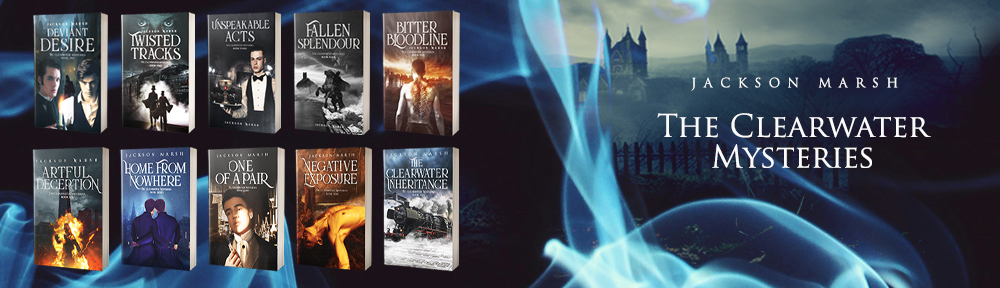
Finding a Way is the first of a new series of Victorian mysteries. Following on from the highly successful Clearwater Mysteries and Larkspur Mysteries, the series starts in London in 1892, and involves some of the original Clearwater characters in supporting roles. There is no need to have read the preceding two series, though it would be a shame to miss them.

Still to do

I still have a few pieces of the process to complete before I can announce the book as released, but you can expect it in around 10 days (roughly). I have still to:

  • Finish checking the proofs now it’s back from the proofreader.
  • Receive the full cover from Andjela V.
  • Have the guys at Other World Ink see to the layout, which will include a drawing of one of the main characters, as that’s something I am keen to continue in this series. (I have the illustration already.)
  • Sort the Amazon stuff like ISBN, and upload the files.

A Fall From Grace

Meanwhile, ‘A Fall from Grace’, the second book in the series, is now at 65,000 words and is doing well. This story continues the one begun in book one, because ‘Finding a Way’ resolves only one of the two plots; the action plot, while the emotional, love interest story is ongoing. I envision the series will include a slow-burn romance which will develop over time, and yes, there will be some sexy parts in it, though they won’t be overly graphic in nature.

‘A Fall From Grace’ is a detective story, as the series is a detective series, with a new mystery each time, and one to be solved by my three main characters, a new band of investigators. However, they come to their new jobs thanks to existing characters from the Clearwater world, and, I hope, you will have some nice ‘Ah ah!’ moments as you read both books. I’ll say no more on that and will leave it for you to discover what lies ahead when you start on the series, hopefully in a couple of weeks.

And now, it’s back to the typowriter and my proofing of book one, while book two waits in the wings to be taken up again once I have ‘Finding a Way’ ready to go. Not long now.

Cover Reveal: Finding a Way

Finding a Way is the first book in the new Delamere Files series, and today, you can see the full cover for the first time.

This series begins in June 1892, six months after the Larkspur Mysteries ended. It is set in the Clearwater world of late Victorian England, and some characters from the Clearwater and Larkspur mysteries appear or are mentioned, but they are not the main cast.

If you have read the Clearwater collection, you will know that Delamere House is the property next door to Clearwater House in London. It is where Lady Marshall used to live, and the building is owned by Lord Clearwater. In the early 1890s, it became the headquarters for the Clearwater Detective Agency under James Wright and is also the house where Joe Tanner and Dalston Blaze live. The house appears later in ‘Finding a Way’, and will feature more as the series continues.

However, ‘Finding a Way’ is not about Delamere House, it is about Jack Merrit, a young London cabbie with a heap of challenges who finds himself unwittingly involved in the solving of a crime. Around this central story is a story of self-acceptance, coming out (as we’d call it these days), and a very slow-burn love story that will develop through several of the books to come.

‘Finding a Way’ will be available in August, and I will let you know when it is published. Meanwhile, here is the blurb as it stands now, and below that, the title. Click on the title to see the cover and meet two of the cast.


Finding a Way

The Delamere Files book one

It began with a man sobbing in the night.

Twenty-five-year-old Jack Merrit struggles to make a living as a London cabbie, and when he is robbed by a fare, he can see no future for himself and his beloved younger brother, Will.

Enter Larkin Chase. A dashing writer of social observations and a man in search of love. After learning Jack’s story, Larkin sees the chance for him to earn a twenty-pound reward. All he has to do is identify the pair of crooks that robbed him.

The crooks, however, are at the top of the heap of a notorious East End gang who know no boundaries when it comes to silencing a witness. With Jack’s world crumbling around him, he is drawn to Larkin by an unnatural desire which he must either fight or allow if he is to see justice done and win his reward. When an equally dashing young detective arrives on the scene, Jack’s life becomes even more complicated, and when the criminal gang exact their revenge, he is set on a life-or-death quest that will forever change his life. Or end it.


Cover Reveal

Click the image to open the full front cover.

Two at Once. WIP 6:12

Finding a Way

The two-at-once scenario persists. I am giving ‘Finding a Way’ my almost final read-through before sending it to be proofed. After that, I will do another read before setting a release date. Andjela has provided me with several cover ideas, and I have chosen one. By the look of the cover, I have invented a new TV detective series set in the late 1800s, which is (almost) what I intended. Dazzling, who does my illustrations, is working on a character drawing of one of the MCs, because I like dropping them at the front of the books these days, and I am still fussing about whether the book is any good or not, but that’s par for the course. (It is good, but because it gives us new characters, I always worry about what’s going to happen to them.)

Fall From Grace

Meanwhile, book two in the new series has a title and 45,000 words of a slowly evolving mystery, during which my main character starts to find his feet as a Clearwater detective and as a recently able-to-be-out gay man in 1892.

Where book one is more of an introduction/prequel than a mystery, book two starts off with a case. A client charges my new detective with finding a missing man. My newbie, Jack Merrit, is being tutored by old hand, Jimmy Wright, and is finding the transition… Well, I’m not saying too much right now as I’m not even halfway through, but I know where I am going – though the characters don’t yet know what’s in store (insert an evil laugh), and I know how things are going to work out in the end.

The end will, of course, lead to book three… But that’s a way down the line right now.

The Series

I was going to keep details of the new series quiet for as long as possible, but I’m getting to the stage where I have to start dropping teasers and hints. So, I can now give you the title, font and subtitle that will accompany the new books, and the first one will look like this:

The Delamere Files, eh? Uh huh. Each one (after book one) will be a case for my trainee detective. I intend to keep my three main characters and build them and their relationships as they find their way through this new world of being investigators of one sort or another, and around them, I’ll build more traditional mysteries than the sometimes-outlandish ones we have in Clearwater and Larkspur. (All of which were perfectly feasible, and some of which actually happened.) While all that is going on, favourites from Clearwater and Larkspur will give us guest appearances, and the main characters of Jack Merrit, Will Merrit, and Larkin Chase will develop, fall in and fall out, and… who knows what else.

So, that’s where I am right now. I am heading back to book two, chapter 11, somewhere in West Kent in July 1892, and a graveyard…

Work In Progress: 6.07

Hi, and welcome to WIP Wednesday. Today’s news is that I am having a crisis. Well, not me, but my new main character, Jack Merrit, a London cabbie in 1892. I’m not going to tell you why, because that would give away spoilers and reveal the plot and twists in this, the first book of a new series, but I can tell you that Jack’s crisis happens at around 75,000 words in. That’s where I left the first draft yesterday, and I’ll be getting back to it after I have posted this.

I’m still without a title, and currently, I have a choice of two directions in which the story can go. They both lead to the same finale, which will lead to the second book, which I will start on as soon as I’ve finished this one, but before I’ve published it.

Yes, sounds like a lot of work, and it is, but my plan is to be at least halfway through part two before I release part one. By doing that, I can ensure I have a viable series and not a standalone, so don’t expect ‘Untitled 1892’ anytime soon.

Cannon Street Railway Bridge and Southwark Bridge, London, 1892.

What you can expect before too long, though, is a re-release of ‘The Mentor of Barrenmoor Ridge.’ I’m just about to send the MS off to be professionally laid out, and, as that never takes very long, I should be able to do a re-release in a couple of weeks.

Meanwhile, back in 1892, I have a crisis to deal with…

Pop back on Saturday for more of The Clearwater Companion.

Work In Progress: 6.06

The new novel progresses…

Bit by bit, chapter by chapter, the start of a new series is making its way from imagination to keyboard. The characters are developing to the extent that I now don’t like one of them, and the story has just taken an unexpected twist. This twist was of my devising, not one of those where, at the end of a chapter, a character says something out of the blue and I think, ‘Oh! Okay, let’s see where that leads.’ That’s happened to me in the past, but I am more in control these days.

I also know where we are going to be at the end of the book, and that this story needs to lead into the second in the series, and so on. My three main characters, including the one I’m not sure about, know themselves, and I know them, but soon, we’re to have a fourth enter the stage, and he’s going to throw the proverbial cat among the pigeons as we race towards the crisis point.

So, the work-in-progress news this week is that it’s all back to work and going well, and I am aiming to finish a first draft in a couple of weeks.

The Mentor of Barrenmoor Ridge

Meanwhile, The Mentor of Barrenmoor Ridge re-working is also coming along at the rate of a couple of chapters per day. I have been through the MS once to improve it, and am now doing a line edit and making more improvements to the writing, not to the story, as that’s staying the same. I only hope that by editing I am not adding in the kind of typos I seek to remove. All being well, Barrenmoor Ridge (the improved recipe) will be re-released in June.

 Queer Romance Ink

Queer Romance Ink

Recently, I was featured on QRI, a place where I list all my books; it’s a kind of ‘gay Goodreads’ you might say, though I never bother with Goodreads, I do bother with QRI, so it was good to get a feature. If you’ve not found this resource yet, you should take a look. Thousands of titles to check out, and loads of new romance authors to meet. They also have a Facebook page to follow. You can see my profile here.

https://www.queeromanceink.com/mbm-book-author/jackson-marsh/

Work in Progress: 6.05

The First of a New Series

After three weeks away from the new book with the working title of ‘471 Kingsland Road’, I am now back to putting down words. Progress is slow but I have managed a couple of chapters this week, and have all day today to press on with another. It’s coming together slowly, though I am still aware that what I am writing now might actually be a prequel to the start of the series, in the way ‘Banyak & Fecks’ was a prequel to the Clearwater Mysteries. What ‘471’ is turning out to be is character creation, an exploration of ideas, and the putting together of possibilities. It is still telling a story and a good one, and it is a valuable exercise.

It’s proving interesting to start something new, and difficult to leave behind the characters and themes that I’ve lived with since starting Clearwater late in 2018. Five years in the same world is hard to leave behind, so I have an inkling that I won’t actually be leaving it behind entirely.

‘471’ started off as an idea to write something that took place at the same time as Deviant Desire, but now I am thinking it might take place just after the last of the Larkspur series, starting in 1892 (instead of 1888). There’s a reason for this, and, if all goes according to the latest plan, there will be a twist just over halfway through the story which, I hope, will delight readers of Clearwater and Larkspur. That’s the current thinking, and the idea is taking shape and appealing more than my original idea, which was to have a completely separate series set around the same time.

I’ll say no more about that, but will leave it vague because I am still developing ‘471’ and what it might lead to. You’ll hear my thoughts on it as it progresses, so keep calling back to the Wednesday WIP to follow progress. Meanwhile, the Saturday blogs from now on will be a development of The Clearwater Companion, with interviews, images, unpublished sections, chapters and other background things to accompany Clearwater and Larkspur. This, I hope, will see me through the Saturday blogs of summer, and in the winter, when we have more time, we’ll return to interviews with other authors and blogs about research.

The Mentor of Barrenmoor Ridge

While all this is going on, I am continuing to revise The Mentor of Barrenmoor Ridge for its second edition and I have to say, I’m enjoying the process immensely. I am on the final edit of all 21 chapters and saving up to have the book professionally laid out ahead of a re-release in a few weeks’ time.

I’ll be back on Saturday with another page of The Clearwater Companion.

Photo: A hackney carriage waits at the end of a long row of horse-drawn hansom cabs facing the striking round portico and spire of All Soul’s Anglican Church on Langham Place at the north end of Regent Street. https://www.presbyterian.org.nz/

Work in Progress: 6.03

471 Kingsland Road.

That may not end up being the title, but it’s an idea. It’s also a place where I once lived, but that’s by the by.

There’s not much to report today because we currently have guests, so I am not writing as much as usual. What I am doing, though, is rereading what I have already written, improving it, and saying to myself, ‘Where is this going, and is it any good?’

Yesterday, I was looking around for some advice, and putting in search strings such as, ‘How to start on a new series,’ and ‘Ending one series and starting another.’ I was doing this because I can’t help feeling I am writing another Clearwater or Larkspur, only with different characters. I’m not. What’s coming out now has a completely different feel, yet I can’t help feeling I am doing the same as I did before. So, I was hoping to find some advice from experienced writers of series that said, ‘Take a month off,’ or, ‘Write in a different time or genre,’ or, ‘If you can’t let the last series go, then maybe you should go back to it.’

I didn’t find anything of use, only lots of very similar articles on how to start and finish a chapter. What was nice about that was that they were all saying you should try to do this, this and that, and I already do this, this and that. But it wasn’t what I was looking for.

What I decided, in the end, was that I’d carry on writing ‘471’ when I could, see what I have at the end of it, and go from there. If nothing else, I would have created a character or two, hopefully more, and put them into a story I could then improve. As I won’t be able to do much concentrated work for a couple of weeks, it will take some time, but during those weeks, I will be able to distance myself from what I have written, and then, who knows how ‘471’ will progress? Meanwhile, I am still learning a lot about hansom cabs and the way of Victorian cabmen.

More chat on Saturday…

Imagination is more important than Knowledge: Discuss.

“Imagination is more important than Knowledge.”

So said Albert Einstein, thus inspiring today’s blog, a continuation from last week’s blog, which was about researching the taxi driver’s ‘knowledge.’

In that case, ‘knowledge’ was the thing London cabbies need before they can start transporting passengers around the metropolis. In Einstein’s case,

‘knowledge’ meant learning, what facts we have accumulated and, literally, what we know.

So, what he’s saying is pretty clear:

it’s more important to imagine than it is to know.

Thinking that, reminded me of the old adage, ‘Write about what you know.’ How many times have I heard that? I remember being told it at school when we had to write essays and short stories for English classes. However, I also remember when I was first inspired to write creatively, and here’s a little story that, unless I lose my train of thought, will point up the idea of creativity and imagination being more important than knowledge.

Soon to be Twelve, Never Been to Egypt

Picture it…

I am sitting in the library of an independent school in Folkestone, Kent. The wall opposite is filled with books, my best friend is sharing the table with me, and there’s a man with a beard facing us and the rest of the small class of uniformed pupils. It’s March 1975, and I am a few days away from being twelve years old. A few days ago, the television news carried the appalling story of a tube strain disaster at Moorgate station in London, where 43 people died because the train failed to stop and drove into a wall at speed. Not exactly the subject for a discussion during an English lesson with Mr Whitney, housemaster, historian and all-round inspirer of pupils. After a discussion about the train crash, our homework was to write a short story inspired by the event, which you might think was a little unusual or bad taste, but that’s the British public school system for you.

So, off I went after school, walking up the road to the bus stop with John (the best friend), discussing not English homework, but Hammer Horror films, because he collected the magazines, and we both liked the films, and having said goodbye, I continued to the bus stop and went home to write my short story.

Flashback: 1972, I am nine years old and in a long queue, eventually entering a huge building, walking through echoing halls and into dark chambers to wonder at the gold funeral mask of a pharaoh, Tutankhamun, and other treasures. Flash forward a couple of years, and I am watching one of the Universal ‘Mummy’ films, Boris Karloff or Lon Chaney Jr., it doesn’t matter which, I am fascinated by pyramids, Egyptian tombs and things buried underground.

Flash back to the story, and I am sitting down to write my homework based on the tube disaster. Of course, I didn’t know what it was like to be involved, I’m not even sure I’d been on a tube train by then, so all I had to go on were the images I’d seen on TV and my imagination. Oh, and my interest in Egyptology, such as it was at 11 years old.

My story, presented at the next English lesson, concerned a team of archaeologists investigating a pyramid, when that pyramid collapsed. All I remember of it were limbs sticking out from beneath rocks, dust, darkness, screams and other horror elements, and the ending; a man in a hospital bed where instead of flowers in the vase, there were the same dead arms and legs. I also remember the praise I received after its presentation in class. Mr Whitney singled it out because it had a beginning, a middle and an end, and told the whole class he’d chosen it for singular praise because I ‘Didn’t once mention a blessed train, like the rest of you. Imagination! It is far more useful than knowledge.’ Or something very similar. He then, rather annoyingly for an 11-year-old, told me it needed improvement, and I was to write it out again in my best handwriting, but not to copy it. What he did was tell me to write a second draft, thus teaching me the pain and value of editing.

The point of that story was simply to highlight the title of this piece, that you don’t always need knowledge to write creatively, and to be truly creative, imagination is more important than knowledge.

Now hang on a minute We can take the opposite view with no hassle whatsoever and be perfectly pedantic by saying: You need to know how to write. Ah ha! See, that’s knowledge. Yes, and quite right. Except, as far as we know, Homer never wrote a word, he spoke his stories, as that was the only way to pass them down back then. He didn’t need to know how to write, he needed to know how to tell a story, but storytelling is in all of us, whether it comes out in the written word or spoken, in art, journalism, comic books or gossip; we all have the ability to tell a story.

Yes, but… I know what you’re going to say. How can you write about something you know nothing about? How can you write a story set somewhere you have never been, or about something you have never experienced, or have no knowledge of?

Yeah, yeah, blah-di-blah… Tell me, dear sceptic, how many times did Shakespeare visit Italy to research his Merchant of Venice or any of the other 13 plays he set in the country? Did Bernard Cornwell OBE fight against Napoleon, or live among the Anglo Saxons of the Dark Ages? I think not. Yes, writers research, and some who write historical novels are learned historians, but they’ve still never been back in time, and let’s not mention Azimov or Arthur C Clarke, and others who write science fiction, fantasy or steampunk. Come to that, Bram Stoker never went to Transylvania or, as far as anyone knows, got bitten by a vampire or had his head chopped off.

Write about what you know, and if you don’t know about it, research. That would be a better maxim, in my book.

Ideas are the Seed of all Achievement

I found that delicious quote, from journalist, Anastasia Haralabidou, in an article titled ‘Great Ideas: Is imagination more important than knowledge?’ (2015, you can find it here.)  In her article, she points out how imagination has inspired knowledge. Example: an apple falling from a tree and narrowly missing Isaac Newton… Why did it do that? How come it fell and didn’t float away? And there we have gravity.

It’s a case of saying ‘What if?’ and then following the what if to a conclusion, and to do that, you need to use imagination, not knowledge. If you don’t have the knowledge, you can gain it, if you don’t have the imagination, well, frankly, you’re scuppered. As Haralabidou also says in her article,

“Imagination is the highest freedom of all and the one that no one can deprive us of.”

How good is that? We all have an imagination, it is as inherent as storytelling, and you don’t need knowledge to release it, you only need to know that you can, and we all can. Some with more success than others, I grant you, but it is within us all to tell stories, and if those stories are set in a time or place about which we know nothing, then, like a soon to be 12-year-old transposing what he’d seen on the news to the pyramids of Giza, we research what we must, and imagine the rest.

This all reminds me of another saying I heard once many years ago which has always stuck with me. Prevention is better than knowing who did it. That, I fancy, might be the title of a future blog.

Work in Progress: 6.02

The Unnamed

‘The Unnamed’ sounds like the original title of ‘Dracula,’ The Undead. My new story is definitely ‘undead’ because it’s very much alive and kicking. I am up to 24,000 words and the end of act one. The main characters have their initial setup, time and place have been established, and now, there is a quest for the main character, a dilemma, a fair amount of pressure and a big decision to be made. I think Jack Merrit is to be something of a reluctant hero, because he doesn’t want to do what he has to do, and there is both an external reason for that and an internal one.

By external, I mean an action-driven reason for him to react, and by internal, I mean he has a personal dilemma to deal with, and it’s a big one.

What I haven’t yet convinced myself of is the action spine; the events that will drive the physical action through to the end. Initially, what I had in mind sounded interesting and is based on an actual event. However, it strikes me it might be flimsy when transformed into a novel because it is basically a search for a location, and we can’t have 50,000 words of a man driving up and down London streets looking for a particular place. Well, we can, but other things will have to happen along the way, otherwise the reader will soon be asking, ‘Are we there yet?’

Once I’ve finished other work this morning, I will continue with chapter eight and see where that leads me. We have visitors arriving on Sunday for two and three weeks, and I’m not sure how much I will be able to get done during that time, but I will carry on carrying on, and I’ll let you know how it all goes in my regular blog posts.

From ‘Street Life in London’, 1877, by John Thompson and Adolphe Smith (Wikimedia Commons)

Learning the Knowledge for a New Series

If you read my Wednesday work-in-progress blog, you will know I have embarked on a new series, currently titled ‘New Series’ in one folder, and ‘Victorian Series’ in another. So far, I have written four chapters in draft one, a rough outline, some character notes, and some research notes.

Part of my research has been around cab drivers because one of the two main characters is a young cabman, and that led me to a couple of books, a few websites, and a coincidence.

The Knowledge

When London cabbies train for the job, they spend on average two years learning ‘the knowledge.’ That’s the layout of all 25,000 or more London streets in a six-mile radius from central London, roughly.

If you’ve ever taken a black cab, as we call them nowadays (though they are not always black), you’ll feel assured that once you step in and say, ‘471 Kingsland Road,’ the driver will say, ‘Righty-o, Guv,’ and off you go. You can give as obscure an address as you fancy and, the chances are, your driver will know where it is because he’s got ‘the knowledge.’

When this term came into use, I am not sure, but then, I’ve not completed my research yet.

My ordered book has arrived, ‘The History of the London Horse Cab’, and I’ve read the introduction, but there’s a long way to go yet, so my knowledge of cab work and ‘the knowledge’ currently equates to knowing only about five streets out of the 25,000 or more.

I’ve also been looking at various collections of writings from Victorian times that I’ve found on websites, including my favourite, The Dictionary of Victorian London, compiled by Lee Jackson.

A Coincidence

While looking around for various resources, I came across a Facebook page dedicated to a book, ‘Carter the Cabman.’ After a little investigation, I discovered that this book was available on Kindle, so I downloaded a copy and set to reading, out of interest.

It turns out to be a novel, presenting in a nicely clever way, a collection of papers discovered in an antique shop in 1988, and those papers were written by a cabman called Carter in 1888, at the time of Jack the Ripper. That’s as far as I have got with my reading as I only bought it yesterday, but already, I feel a weird sense of coincidence. My Clearwater Mysteries series begins in 1888 at the time of the Ripper (though it’s not Jack), and my new series is not only about a cab driver, but is also set in 1888, though the Ripper murders are not part of the plot this time. I’m looking forward to reading the rest of ‘Carter’ and perhaps asking the author if he’d like to appear here in a guest post. (Though I’m not sure how to tell him that the word ‘weekend’ didn’t come into usage until after 1912, so his cabman author of 1888 would not have used it… but that’s me being pedantic.)

More About ‘New Victorian Series’

My notes are vague in places, and detailed in others. I have in mind a set of investigations that my two main characters will undertake, but unlike the Clearwater and Larkspur mysteries, these will involve a different investigative style. Clearwater and Larkspur use a lot of unlikely but not impossible scenarios, and inventions of the time or just before the time, such as vanishing and reappearing ink, telegraph printers, and glow-in-the-dark paint. The new series will, if all goes according to plan, focus on real issues of the time and how my two MCs put things right. A little like ‘Guardians of the Poor’, where our heroes uncover corruption at the Hackney workhouse. I have in my list of ideas notes such as:

  • Slum landlords Vs paupers,
  • The Thames Murders (cold case),
  • Mediums,
  • Quacks,
  • Lunatic asylum, and
  • ‘gay’ cases.

The latter one is also a hark back to Larkspur, where the initial idea was to base characters and stories on actual events, which I did all the way through: Dalston Blaze and the workhouse scandal, for example, or Edward Hyde’s incident on the train and the court case with that nasty Tory MP. But don’t think this new series is going to be all special investigation and doing the right thing, and don’t think it will be a repeat of issues and events from the other two series.

So far, I know that it is going to involve the following:

  • Clues
  • villains
  • adventure
  • A slow-burn romance over a couple of books
  • A character with an undefined ‘problem’ who will turn out to be a genius (at something)
  • Brotherly love
  • Bromance and MM romance (of course)
  • Falling in love, falling out of love, blah-di-blah
  • Humour
  • Real places and events

That’s where I am with ‘New Victorian Series’ right now, researching and learning more knowledge about life in Victorian Britain, especially London, around the end of the 19th century. It all starts with a journalist discovering a handsome young cabman in tears late at night on August 17th 1888. Why is he crying? That’s what you will one day find out.