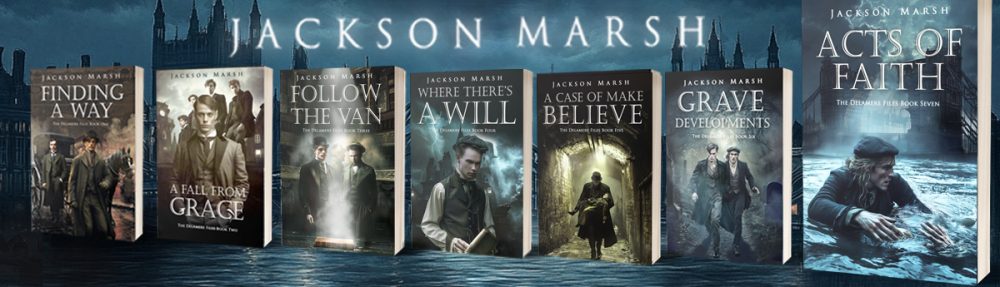
Work In Progress 3.11

Speaking in Silence

You may remember my to-do list last week looked like this:

  •     Finish the fine editing
  •     Reread for a final check
  •     Create the blurb
  •     Find images suitable to make a cover and open negotiations with Andjela
  •     Proofreading
  •     Layout
  •     Check everything and reread
  •     Upload to Amazon
  •     Hope for the best

I’m happy to tell you, I have completed the first four things on the list ✔✔✔✔, though I haven’t finalised the blurb yet. Neil has read my edited draft, and I have a little editing to do on the last chapter, which I will do in a moment. Andjela and I have the licence for a photo to be adapted for the front cover, and there will be a reveal of that nearer the release date, which is still estimated at the first week of August.

Check in next week for an update. Meanwhile, here’s the draft blurb.

Speaking in Silence

The Larkspur Mysteries Book Five

Jackson Marsh

“The quiet ones have the loudest voice. Them as say most by speaking in silence.”

Fiona Hawkins, 1881

March 1891. A parliamentary committee arrives at Larkspur Hall to assess Lord Clearwater’s suitability to become the Earl of Cornwall. Prince Albert Victor will announce their decision at a society dinner on Archer’s thirty-second birthday.

However, the MP with the authority to advance Archer to the title is the same man who caused Edward Hyde never to speak again. When the parliamentarians arrive to inspect the Larkspur Academy, Edward comes face to face with the man he had arrested for making unnatural advances. A man who was never tried for his crime.

Silas Hawkins and the academy men band together to ensure Edward sees justice done while protecting Lord Clearwater’s reputation and each other. Using their skills in chemistry, physics and deception, they embark on a game of secrets and subterfuge where the unspoken causes the loudest outcry.


Speaking in Silence is the fifth book in the Larkspur Mysteries series, and touches on themes of victimisation and suicide. Like all books in the series, it is inspired by actual events from the late 1800s. With themes of friendship, bromance, male love and revenge, the story is more of a ‘how dunnit?’ than a ‘who dunnit?’ and like all of Jackson’s mysteries, contains humour, while mixing fact with fiction.

Disability Pride Month: Joe Tanner

Disability Pride Month occurs in July “to listen to what the voices of disabled people have to say about their rights and what they need“.

The month was chosen to recognise that, the then President of the United States, George H.W. Bush signed the Americans with Disabilities Act (ADA) into law on July 26, 1990. (Wiki)

As this month is Disability Pride Month, I thought I’d write a short piece about my “disabled” character, Joe Tanner. I put the disabled in “ ” because Joe wouldn’t have seen himself as disabled. He’s deaf and has been since birth, and yes, that’s a disability, but all the same, he wouldn’t (or doesn’t) consider himself disabled.

These days, it’s difficult to write about how Joe was treated because the language of that time is now considered offensive, but we shouldn’t take offence at history, because there’s nothing we can do to change it; it is how it was. Being deaf in the late 19th century wasn’t easy, and although there had been schools for the deaf since the 18th century, they were small, private and expensive. Also, sign language was outlawed in 1880 and was discouraged as taught communication for 100 years. When Joe Tanner was born in 1871, his parents didn’t know what to make of him. Although his father was a vicar, he had a very short fuse, and Joe’s early life wasn’t pleasant. Frustrated that their son couldn’t communicate, Joe’s parents left him at the Hackney Workhouse and buggered off to America. Joe was about seven at this time, and was immediately put on the ‘idiots ward.’

This is where you mustn’t take offence to the language.

According to the glossary on Peter Higginbotham’s marvellous site www.workhouses.org:

Idiots and Imbeciles were two commonly used categories of mental subnormality.

Definitions varied over the years, but in broad terms:

Idiots, the most deficient, were unable to protect themselves against basic physical dangers.

Imbeciles, a less severely deficient group, were unable to protect themselves against moral and mental dangers.

It’s also likely that many deaf people entering a workhouse would have ended up in the hospital wards or sent to an asylum. In Joe’s case, he should have been sent to a school, which probably would have done him no good anyway, but he was lucky. Not only did he have an understanding workhouse matron, but he also met Dalston Blaze.

Here are some extracts from the chapter in ‘Guardians of the Poor’ where Dalston meets Joe for the first time. Joe was seven, Dalston six, and Mrs Lee was the workhouse matron.

The matron demanded to know what was happening, and a grubber said the boy had refused to stay on the idiots’ ward, and they were trying to get him back there. Dalston knew of the idiots’ ward, and of the one on the floor above, which was for the imbeciles, but he wasn’t allowed up there. Even if he was, he wouldn’t have gone, the noises and screaming were too frightening.

As the matron tore the grubbers down a peg, Dalston crept closer and stood facing the boy. Without knowing why, he knew that what was happening was wrong. If a boy misbehaved, he missed a meal, everyone knew that, and perhaps, he thought, this lad has been naughty. It wasn’t uncommon for the schoolteacher to whack a boy’s arse for misbehaving, but if this lad had just suffered that, he wouldn’t have been able to sit.

Mrs Lee tried to talk to him, but he balled himself tighter, and in the end, she told the grubbers to go about their business, and leave the lad alone.

Dalston, intrigued by the boy, stays with him when the staff give up, and the two start to communicate. Their language begins with drawings and moves on to finger and hand signs. In the story, Dalston (who is hearing) and Joe do what many deaf people did; they invented their own language. Although British Sign Language (BSL), as we now call it, was abandoned in schools in 1880, many deaf people continued to use it in their own groups, homes and meeting places. That’s why there are now so many regional variations in BSL.

Dalston and Joe go on to appear in all of the Larkspur Mysteries either as main characters or supporting cast, so I have been able to explore Joe’s character more as the series goes on. I thought it was important that Joe didn’t end up as a ‘feel sorry for’ character; I didn’t want him to be the one being looked after or treated in any way differently to the other characters. He’s a gay, young man in Victorian times like all the others around him, except he can’t hear. He can communicate, but not everyone can return the communication, not with sign language at any rate. However, other characters are learning some of it, they can always write things down, and none of them treats Joe as inferior. He is, after all, an excellent and natural horseman, he drives the carriages, and he studies archaeology while solving old murder cases.

With Joe, I wanted to show a disabled character in the same way as I show my others. Therefore, he’s not always fun and happiness, he has flaws, he gets frustrated, and he has a temper. He and Dalston’s first year together out of the workhouse (aged 19 and 18 by then) was not always an easy one, and like any young couple, they had relationship problems – none of which were due to Joe’s deafness. Joe’s also got a naughty sense of humour, and uses his sign language to his advantage, talking about people without them knowing what he is saying.

Book five of the Larkspur series, ‘Speaking in Silence’ also concerns a young man with a disability, though it’s not a physical one. Because of something that happened in his past, Edward Hyde has chosen not to speak more than one or two words to anyone (apart from his one friend). It’s his way of withdrawing from the world because of an incident that left him contemplating suicide. So, his disability is, you might say, an emotional one, but it is one he can be ‘cured’ of. That’s what the book is about, getting Edward’s voice back – although emotional recovery from his trauma will continue long after the story has finished.

For both these characters, Joe Tanner and Edward Hyde, I wanted to present my differently-abled characters as positive, non-victims (although Edward was) and to make them as good/bad, nice/nasty, grateful/churlish as all the others. Hopefully, they both present positive images of deaf or emotionally scarred people, and we see them do heroic things that we all wish we had the courage to do.

However readers take them, what they do in the books makes me proud, and that’s my way of wrapping up this post about my ‘disabled’ characters for Disability Pride Month.

Speaking in Silence is due out at the beginning of August

The Larkspur Series begins with Guardians of the Poor’ and it’s Joe you see on the cover signing the word ‘deaf.’

Work In Progress 3.10

Speaking in Silence

We’re into week ten of the writing of this new Larkspur Mystery and I am pleased to tell you, I have only eight chapters left to edit before I can say I have a draft for my beta readers, Neil and Jenine. The MS is booked in for proofreading on the 20th of July, and I am still aiming for the end of July/start of August to have the finished novel ready for you.

My to-do list now looks like this:

  • Finish the fine editing
  • Reread for a final check
  • Create the blurb
  • Find images suitable to make a cover and open negotiations with Andjela
  • Proofreading
  • Layout
  • Check everything and reread
  • Upload to Amazon
  • Hope for the best

While all that is going on, you won’t be surprised to learn that I have started thinking about the next book. The next two books, actually, because I am planning a two-book finale to this series along the lines of ‘The Clearwater Inheritance.’ I am teeming with ideas, and have already outlined various scenes in my head, but I must find a way to connect them. All I can tell you right now is that I am planning to incorporate many of the characters from both Clearwater and Larkspur, have three or four storylines running at once all leading to the same end, so all will be connected, take my characters to some wild and exciting places, and tie up many threads. Some of these threads were started in Deviant Desire, and before that, Banyak & Fecks, so I have lots of rereading and remembering to do (thankfully, I keep my ‘bible’ and notebooks). There is also a special ending to consider, and all being well, you’ll be able to read the second book of the two at or by Christmas.

Watch this space.

Thank goodness for my author notebooks and ‘bible’!

This Author’s Summer

Summer is well underway on our little island. Temperatures are in the low 30s but don’t stop me from working. I’m used to the temperature outside being up to 45 degrees in the middle of summer, and I spend a lot of time avoiding the great outdoors. When I do, I stay in the shade. While inside, I work at my desk with my shirt off, a towel between my arm and my mouse, and a large, noisy fan blasting at me from the side. I also do most of my work in the morning, getting up at 4.00 and working through until 11.00, then taking a break, and returning around 13.30 for another couple of hours before taking a siesta.

A summer’s view from our balcony

While all that’s going on inside, there’s a lot going on outside. As you might know, I live on Symi, an island in the Aegean not far from the larger island of Rhodes. We have day-trip boats coming in every day during the summer, sometimes up to five of them. They come from Rhodes bringing interested visitors on a day out who meander around the harbour or are herded in groups by tour guides with little flags. The backstreets can become busy down there between certain hours, and I don’t very often get down unless it’s for bank, post office or ferry business. We have a bus and taxis, but as I don’t own a car, I prefer to walk even though it’s about 400 steps down and 400 back up again. Needless to say, I don’t do that when it’s 45 degrees.

Living on a Greek island isn’t always as idyllic as you might think. Recently, our water pump was playing up, and we had to get another one installed. I should explain that we are not on a constant mains water supply. We can fill up our tank three times a week, and if it runs dry, then that’s it until the next filling-up day. Because the main water cistern beneath the house was invaded by tree roots and is unusable, we have a large plastic one on our flat roof. This holds 500 litres, and that’s usually enough for two of us, but without a pump to pump the water from the tank to where it’s needed, we’re ‘dry.’ Anyway, we had to replace the water pump this week because the old one sounded like it was about to blow, and I’d rather pre-empt a ‘dry’ spell, particularly as we had Neil’s brother visiting.

One of our local restaurants that we visited when Neil’s brother was here. The ‘Kali Strata’ offers a new, modern twist on traditional Greek dishes…and a great view!

Another thing about living here is that it’s not always convenient to travel. We were aware of this when we decided to settle here, so I’m not complaining, just pointing out what it takes to get from A to B. We and Neil’s brother have been invited to a wedding in Inverness later this year. James (the bother-in-law) lives in Vienna, so for him, it’s a train to the airport, a flight, a wedding, a couple of nights in a hotel and a flight home. For us… Well, that’s a different matter. I’ve done my research and made a spreadsheet, and the cheapest way for us to do this trip in November involves this: An overnight boat from Symi to Athens. Night at the airport hotel (very costly but the flight is an early one). Flight to Edinburgh, couple of nights there, train to Inverness, hotel, wedding, hotel, train to Edinburgh, hotel, flight to Amsterdam, flight to Athens, hotel for two nights, overnight boat home. James will be away from his home for three days, but we will be away for 12, and that’s without taking a holiday (although we are seeing grandchildren and visiting family).

This will be us in November lol

But enough rambling from me. I must get back to my fine editing of ‘Speaking in Silence’ and racking my brains for a cover idea. You can discover how the next Larkspur Novel is coming along by looking at my regular Wednesday WIP blogs.

Work In Progress 3.09

Speaking in Silence

It’s done! The first draft, that is, and we have arrived at Bodmin station at 95,000 words. Now, after a brief stop, we must make the return journey to London as we embark on the rewrites and editing.

A view of Bodmin Road Station, Cornwall in c.1895

This novel turned out to be slightly different to the others, and that made the journey an interesting one. Speaking in Silence is a mystery. It takes place in Cornwall and London, it brings in two characters who have, until now, been in the background, and it is based on a newspaper report from 1891. There, the similarities with the other Larkspur Mysteries end. Don’t worry, it still contains your favourite elements, but in a different way.

The content is darker than I’ve previously dabbled with because the protagonist is a victim. He’s also the one who hardly speaks, which presented another challenge when writing. Also, the mystery isn’t written as: This is strange, how are we going to solve this? It is written so the reader asks, ‘What are they doing?’ We know ‘they’ are up to something, and we know what they want to achieve, but, hopefully, you won’t work out what it is they are doing and how they achieve it until the end. Then, in the denouement, you’re told exactly how it happened.

I expect that makes little sense, but it will all become clear in the end, and the end of the journey, I hope, will be sometimes in July. Meanwhile, here’s an unedited taster from draft one.

Outside, foxes and owls scoured the grounds for their prey, while inside, a dim light burned in the drawing room until well past two in the morning. Figures paced before the window, apparently speaking in silence as no sound escaped the casements, and they disturbed nothing and no-one. At two fifteen, a light in an upstairs bedroom came on, and three silhouettes sat at a desk with paper and pen. Another discussion began, and one wrote while the others offered ideas. A little later, one sat in a chair while another busied himself around his head with scissors and a razor, until all three were satisfied with the results of their labours.

If that wasn’t strange enough, at the back of the house, another two men came from the kitchen and crossed the yard. At two twenty-five, they lit lamps in an ancient building that had once been a barn and set to work. There was no speaking, but there were sounds; the hissing and bubbling of liquids in jars, the clank of crucibles on iron stands, and the opening and closing of heavy books. All this took place beside a light which grew increasingly discoloured, once being orange, and then red, to glow purple just before the stable clock chimed half-past three.

Speaking In Silence
JACKSON MARSH
I love this watercolour of Victoria College’s first chemistry lab, I can imagine our young men working in here

Work In Progress 3.08

Speaking in Silence is now at Plymouth

On our imaginary train journey from London to Larkspur, Speaking in Silence is now on platform one at Plymouth station. We have two legs to go, from Plymouth to Liskeard, and from there to Bodmin. Or, in writing terms, we have the remainder of the climax to write followed by the denouement, the ‘how it was done’ section.

https://www.historichotels.org/hotels-resorts/the-savoy-london/media-gallery.php

I am at 85,000 words with approximately another 10,000 to go (plus all the rewriting and editing), and last night, I left my characters at the Savoy Hotel’s French dining room, in London, on March 26th 1891. They were among good company, being in the presence of Prince Albert Victor, Sir Arthur Sullivan, WS Gilbert, Gladstone and other notables of the time. The Clearwater crew are represented by Archer, Silas, Jasper, Mrs Norwood and some of the Larkspur Academy men, and on the journey, we have met several others from the large cast of both Clearwater and Larkspur mysteries.

There’s a reason for the cast being so large, and that will become clear in the next novel, as yet untitled, and the one after that which will finish the series, The Larkspur Legacy. But those are other journeys for other days.

Right now, I am dealing with an unusual mystery novel, because the mystery is for the reader (I hope), who should be asking, ‘What are they up to?’ It’s one of those where the characters and I know more than the reader does until the reveal at the climax. When I rewrite, I will need to check I haven’t given too much away while also making sure what clues I do drop are sufficient to hold the reader’s intrigue. I am sure I will find out when husband Neil reads the second draft for me, but that will be on the return journey to London.

Ah, we are now pulling out of Plymouth, and I must get back to the Savoy Hotel and the great reveal…

Work In Progress 3.07

Speaking in Silence is now arriving at Exeter.

If you have been following the ‘Speaking in Silence’ journey from London Paddington to Bodmin, you will know that it’s been an interesting train ride so far. In the word count scheme of things, I’d say I was now at Exeter, being at roughly 72,000 words, with the destination being 100,000 or thereabouts. After some shunting around in a yard several miles back, I have had a clear run from Bristol, and am now approaching the final reel. The final ‘act’ as they say in film terms.

I started the ‘Speaking in Silence’ journey knowing that I wanted it to be about two characters who appeared in the last book, but who we don’t yet know; Henry Hope and Edward Hyde. In this story, Edward is the protagonist, and yet, not only does he hardly speak, he also hardly communicates. That poses a few challenges for the author. Unlike Joe Tanner, who is deaf and communicates through sign language, Edward has taken a vow of semi-silence. The only person he speaks to is Henry, and Henry knows why. We, the reader, come to learn why Edward chose to do this, and we come to understand there is only one thing that will enable him to feel able to speak again. Justice. Therein lies the plot of the novel.

That was what I started with 72,000 words ago, and the rest I have, quite literally, made up as I have gone along, including the characters of Henry and Edward and a hell of a lot of backstory, which trickles out over time. I have used the flashback technique, and it was only while writing those scenes that I came to know the characters. They introduced themselves to me while Henry was telling me his and Edward’s story if you like, and that didn’t happen until I was quite a way into the story. That’s why we had the shunting around a few miles back, and I had to backtrack and change the point of view of some of the earlier chapters. If there’s a lesson there, it’s ‘know your characters before you start’. (A note to fellow authors, if you would like to stretch your character’s bio then you can always drop in for a ‘character interview’. Contact my PA for more details jeninesymi@gmail.com).

To give you a flavour of the novel, and without giving anything away, here’s a short excerpt from the first draft – unedited so excuse any errors. The skeleton is a character who will remain nameless for now, and I have changed the name of the second character to ‘John’ so as not to spoil things for you. John, the villain, is going to see the other villain at his new lodgings in Greychurch:  


The skeleton’s previous lodgings above the ‘Princess Alice‘ had, John thought, been about as low as a man could go, but when he took a deep breath and entered the ‘Hops and…’ as the broken sign described it, he realised he had been wrong.

His foot fell on a rat, but it didn’t squeal because it was dead, but the child playing with it gave him a mouth of abuse, which he ignored. Dishevelled heaps, rather than people, sat at the few tables, some sucking on pipes whose fumes hardly disguised the stench of damp clothes, sweat and something else he didn’t like to think about, while across the room, no more than ten feet from the door, two men stood at a trestle table that served as a bar, while three rested against it on the floor, either drunk or dead. The most unnerving thing about the place, however, wasn’t the landlord with wooden teeth, only one eye and one hand, nor even the miasma of fire, pipe and opium smoke, but the silence. No-one even looked at him, no-one jereed at a well-dressed man from the west of the city entering their destitute realm, and nobody, apart from the child, made a sound.

These people, if he could call them that, might still be able to hear, he thought, and so he prepared to whisper to the disfigured landlord. As he leant over one of those asleep at his feet a movement to his right caught his eye. One of the heaps unwound itself from the table it had been slumped across and dragged itself to its feet. It said nothing, but a skeletal hand emerged from the sleeve of its black gown and beckoned to John like death, before gliding towards a door beside the makeshift bar.

Pleased to be with someone he knew, albeit vaguely and nefariously, John followed the skeleton through to a passage, and down a set of steps to a cellar. Ahead, the scurry of clawed feet suggested their path was clear, but still, when they arrived below ground, several pairs of pink eyes glinted in the candlelight, watching from the crevices for the time they could reclaim their dominion.


The Princess Alice pub was one of the pubs frequented by prostitutes in the East End of London at the time of the Ripper crimes

More on my WIP blog next Wednesday, but don’t forget to be here on Saturday for my other weekly post.

The Old Nichol and a Dirty Old Man

How Research and Detail Improve your Novel

A notorious slum and a dirty old man have led me to write a new book, ‘Speaking in Silence.’ To follow the progress of this novel, the fifth in the Larkspur Mystery series, tune into my Wednesday WIP blog, but to know how research and detail improve your novel, read on.

The Old Nichol was an infamous slum area of Bethnal Green in East London, and I’ll get onto that part of my research later. First, though, I want to tell you what inspired me to write ‘Speaking in Silence’, and it starts with a man on a train.

One night in April 1891

On the night of April 20th 1891, a young man by the name of Christopher Richmond was travelling by train from Horsham in Sussex to East Croydon in Surrey. He was followed into an empty compartment by a man called Charles Fyffe, later described in the newspapers as ‘elderly.’ This man, it seems, had a penchant for young lads. Christopher was 16, worked for the railway as a goods clerk, and had a disability. During the first part of the journey, Christpher said, the man carried out various acts of indecent assault upon him. The precise details are not mentioned in the newspapers of the time, as they considered these things not palatable for the Victorian reader, but despite Christopher’s objects, Fyffe continued his advances even after the pair changed trains at Three Bridges. When they reached East Croydon, Christopher made a complaint to the authorities, and Fyffe was arrested. The young man did the right thing, and was prepared to testify in court, which he later did. You’d think that would have been the end of the matter.

Far from it.

Here’s an extract from a newspaper I found in the British Newspaper Archive, dated 29th April 1891.

Mr C.A. Fyffe, the accepted Liberal candidate for East Wilts, who was summoned to Croydon Police Court yesterday, charged with a serious assault in a railway carriage between Horsham and Croydon, on Monday week, did not appear.

Who was willing to appear, however, was a heap of character witnesses prepared to speak to the high literary and social character of the accused, viz., the Dean of Westminster, Professor Jowett, Sir Horace Davey, Sir George Grove, Mr Benson, London Stipendiary Magistrate, Mr Robinson, editor of the Daily News, and others…

A little more research made it clear to me that there was more to this case than a well-to-do older man pulling out the big guns to save his reputation, and more reading uncovered a few more facts. Fyffe had worked for a newspaper. When arrested, he gave a false name to the police (three times), and later, tried to kill himself.

Right, I thought, this is a case that needs looking into.

I spent some time in the online newspaper archive, and looked around elsewhere for mentions of this case. I found a very detailed presentation of it on Rictor Norton’s wonderful website where he lists incidents such as this as reported in the newspapers of the time, and he’d found more information than I could track down. I have taken inspiration for other stories from this site (the idea for ‘Guardians of the Poor’ came from here), and I suggest anyone writing gay fiction set in the 19th century bookmarks his site as essential reading. Click the link in the citation to lose yourself in historical fact.

Rictor Norton (Ed.), “Prosecution and Suicide of Eminent Historian, 1891”,

Homosexuality in Nineteenth-Century England: A Sourcebook, 10 September 2021 http://rictornorton.co.uk/eighteen/1891fyff.htm 

If you head there and read the full reports, you will get all the details of the case, but what attracted me to this story was my own outrage. More facts come out as you read the history, and it becomes very clear that Fyffe pulled in the ‘old boy’ network to protect himself. You can, in my opinion, see the bias in newspaper reports, such as one that came out in the Western Chronicle which uses phrases such as Mr. Fyffe was made the subject of a terrible charge by a lad… Unnerved at his frightful position… a moment of the direst confusion… the deep sympathy of his political friends and foes are with him… No-one who knows him believes him for one moment to be guilty.

There is no such sympathy towards young Christopher, whose testimony was called into question. Why didn’t he get out of the carriage at the next stop? (His disability meant it would have taken time, and he might have missed the train.) Why didn’t he report it before East Croydon as there were several stops along the way? (Because East Croydon was his final destination, and to report it elsewhere would have meant he didn’t get home that night.) Maybe he was complicit or tried to blackmail Fyffe? Christopher swore he was not and did not. From his testimony, he sounds like a very upright young man, after all, he was in a decent clerical job at the age of sixteen.

Outrageous newspaper bias in favour of a man who wrote for the Daily News, I decided. I would have written a strongly worded letter to the Western Chronicle had I not been 131 years too late.

The intrigue continues…

It turned out that the ‘elderly’ Mr Fyffe was 42 (another report puts him at 45, either way, hardly ‘elderly’), and the reason he didn’t appear at the first hearing was because he’d tried to cut his own throat. Later, when he was able to appear, he was brought in on a stretcher. (Drama queen?) His old cronies testified to his good character, and when the case came before the grand jury to decide if it should go to trial, even the judge said something like, ‘Well, we know this kind of thing goes on…’ as if it were nothing.

In charging the grand jury, Mr. Justice Mathew said that what first struck one about the case was that the acts were improbable, seeing that the charge was made against a man of mature years. [Croydon Advertiser and East Surrey Reporter. 18 July 1891]

Not only were the newspaper reports biased in favour of Fyffe, so was the Justice. It was improbable that a respected, mature man, standing to be elected as an MP might fancy a lone 16-year-old trapped in a railway carriage by his disability at night and try and touch him up…? Improbable my arse.

In the end, the case never went to trial. Not only was Christopher pilloried in the press and his good name called into question (he was counter-accused of being complicit by asking for ‘a present’ in return for sex, an allegation he denied) but he never got his justice, and that’s what’s at the heart of ‘Speaking in Silence.’

There’s a lot more to this case, and for my novel, I have used it as inspiration, mixing in some facts, but bending the truth in places for dramatic and fictional effect. If you were wondering, Christopher had lost a foot (not sure how, possibly an accident on the railways as his father worked for the company and they lived in railway dwellings in Brighton). Living away from home in a decent job aged only 16, he presented a very reasonable case in court, but because Fyffe know all those important people and was (later) an MP, an Oxford Fellow and an author, the chances were clearly weighted on the side of the villain.

You are Allowed to Fictionalise Facts

To be honest, reading the case makes my blood boil. Happily, though, I found out that Christopher eventually married, and emigrated to Australia, where he may well still have descendants. As for Fyffe… He died the following year ‘from the effects of his self-inflicted wounds.’ We may celebrate at that, but it still left Christopher with no justice.

For ‘Speaking in Silence’, I have moved the incident back a few years, so it forms part of the backstory of my mainly silent character, Edward Hyde (the Christopher Richmond of the story). It was, I thought, about time we found out about him and his constant companion, Henry Hope. Henry and Edward are 18 and 20 respectively and have a genius for science. How, I wondered, is that going to be useful in getting justice for Edward? That is one of the mysteries the reader will, I hope, enjoy as the story progresses.

The other part of the novel is the backstory of Edward and Henry, and for that, I turned to a copy of ‘The Blackest Streets’ by renowned author, Sarah Wise.

The Old Nichol

Even if you have never lived in London, or even England, you may well have heard the nursery rhyme, ‘Oranges and Lemons.’ This rhyme was first published in the ‘Pretty Song Book’ by Tommy Thumb in 1744, and it seems to have appeared simply as what it is: a rhyme that lists several London churches. One theory is that the song was written to help strangers find their way around the city, but whatever it was created for, it mentions Shoreditch.

When will you pay me? Say the bells of Old Bailey.

When I grow rich, Say the bells of Shoreditch

The bells in question are those of Saint Leonard’s church, a grade one listed building built in 1740, and a good friend of mine used to live right next door. As I only lived a mile away up the Kingsland Road, and as Julian’s flat was on the way to our regular drinking haunts around Shoreditch and Old Street, I was forever in the area. I didn’t know it at the time, but I was visiting the part of London once known as the Old Nichol, one of the worst slums in the city up until it was demolished and replaced by the Boundary Estate in 1900.

If you look on Google maps and search for Shoreditch or St Leonard’s church, you’ll see the A10 road running south to meet with Commercial Street, and to the east of the church, Arnold Circus, making a wheel-like pattern on the map. That was just about the centre of the Old Nichol, and some of the original roads still exist, namely Old Nichol Street to the south of Arnold Circus, and Boundary Street which runs parallel to the A10. You can find a map of the Old Nichol as it was in 1889 at Horrible Hackney, also there is a plan of the Boundary Estate in 1890. Shoreditch is on the western edge of the imagined ‘Greychurch’ of my Clearwater novels, and on the eastern side of it, I have Limedock (Limehouse). ‘Greychurch’ is a location for several Clearwater stories, and now, part of the backstory of Henry Hope and Edward Hyde. You were wondering when they were going to come back in, weren’t you?

First-Hand Accounts

Henry and Edward lived for a while in a room in the Old Nichol, and when I first started thinking about how that would have been, I turned to my usual resources for first-hand research. In this case, VictorianLondon.org and a copy of Low-Life Deeps, by James Greenwood, 1881 [first published 1875] – Curiosities of “Alley” Life. Those of you who were paying attention a couple of years ago when I was writing ‘Banyak & Fecks’ might remember James Greenwood. He was, allegedly, one of the first investigative reporters, and spent a night in the casual ward of the Lambeth workhouse to experience and report on what casual paupers had to endure. I used that piece of writing to inform a scene in ‘Banyak & Fecks’ and Greenwood and other sources to inform the workhouse scenes in ‘Guardians of the Poor.’ Here, Greenwood writes a report of his findings after a visit to Devonshire Place, one of the worst courts in the heart of the Old Nichol.

There was but one bedstead in the room — a mite of a place; I measured it with my walking stick and found that it was three and a half one way and four sticks the other, and yet it was made to accommodate mother, father, and eight children.

… a tiny room above and below, with broken floors and blackened walls and ceilings so shattered that every step overhead causes the rotten plaster to crumble and fall…

Reading a first-hand account is probably the best place to start your historical fiction writing. Your job is to help a reader imagine where your characters are, as well as who they are and what they do, and with a little research, you can add facts into your story that will help it ‘pop.’ Such facts come from people like James Greenwood and Sarah Wise, and the book I mentioned, ‘The Blackest Streets.’

That book is deeply researched and so well written I’ve found it a bit un-put-down-able, and I’ve learnt much from it. Not only about Poor Laws and government boards, the rather useless legal framework in place to force landlords to repair homes, and the work of officials and charitable bodies in helping the poor, but also a great deal about the people my characters would have lived among. Not everyone was a ragged, starving pauper withering away on a death bed and devoid of hope, as today’s films might have us believe (although there were plenty of unfortunates like that, of course). What comes from reading reminiscences of the place is the ‘get on with it and make do’ attitude of many residents. The way neighbours looked after each other (when they weren’t beating up each other or their families), the ‘honour among thieves’ mentality if you like, and the way the criminal gangs worked, and the police kept a distant eye.

The book explains the housing conditions, and in one section, describes how, in some dwellings, the lavatory was in the back ‘yard.’ To get to it, the residents had to descend to the windowless cellar, and bent double beneath the ground floor floorboards, walk through the cellar to the back door. This they would do as quietly as they could so as not to disturb the family who lived in the cellar.

From Charles Booth’s poverty map

It’s that kind of detail that I like to put into my novels: real and detailed, and in this case, almost unthinkable. This kind of research pays off, and these kinds of details really bring your story to life.

As I work my way through ‘Speaking in Silence’, I find myself putting in such things as the factual times of trains my characters take. For this, I refer to my railways’ guru who sends me the times and changes necessary for a fictional character to get from A to B on March 22nd 1891, as taken from the timetables of the day. Or, as another example, I find a character standing on Blackfriars Bridge contemplating how far away the railway bridge is, and how high above the Thames he is standing. The old railway bridge isn’t there anymore, just its pillars, but the road bridge was roughly 14 meters above river level.

Research Leads to Detail

Research leads to detail, and detail leads to a more fulfilling read for your reader. It also leads to the author doing a lot of reading and learning a lot of facts along the way. As a final example: Did you know that when someone talks in their sleep, they are giving you a somniloquy, or, I suppose, somniloquising? Well, you do now, and you never know when that snippet will come in handy.


Sources:

The British Newspaper Archive
https://www.britishnewspaperarchive.co.uk/

Rictor Norton, “Prosecution and Suicide of Eminent Historian, 1891”,

Homosexuality in Nineteenth-Century England: A Sourcebook, 10 September 2021 http://rictornorton.co.uk/eighteen/1891fyff.htm 

Horrid Hackney

https://horridhackney.com/f/the-appalling-victorian-slums-of-the-old-nichol-shoreditch

Victorian London org

https://www.victorianlondon.org/publications4/low-11.htm

Work In Progress 3.06

Speaking in Silence

The WIP news this week is that I am up to 55,000 words and chapter fifteen of the Larkspur Mysteries book five, Speaking in Silence. On our train journey from London to Cornwall, we have reached somewhere around Bath or Bristol, and that’s appropriate because it means I’ve just met the villain of the piece coming the other way. Chapters 14 and 15 are set on a train journey from Cornwall to Devizes, in Wiltshire, and in the story, the train has recently left the city of Bath.

You know when you get halfway through a draft and suddenly think to yourself, ‘Something’s not right’? Well, I had that twice during the last week, so some of my workload has been fixing a couple of things, or rather, fixing one, and thinking about how to fix the second.

In the first instance, I’d left what they call a plot hole and needed to go back and fill it in. This meant adding an extra chapter so that what a character did next would make sense.

In the second instance, I realised I have started the story from too many points of view. Simply put, it opens with the villain, cuts to Silas’ POV, then to Frank’s, then back to Silas’, and then there’s a backstory section from Henry and Edward’s points of view. The story was originally to be about Frank and his involvement with someone else’s story, but now I am further in, I realise it’s not about Frank at all. So, the earlier scenes that are from his POV need to be from someone else’s, Henry in this case, and so they need rewriting.

Hey ho! That’s how it goes. Now, having told you this, I am going to get on with chapter 16 and move the story into its second half.

What’s On Your First Page?

The importance of the first few lines

In showbiz, they say, ‘It’s not how you start, it’s how you finish.’ When writing a novel, I say, it’s how you start and finish.

While standing in the bookshop or browsing through Amazon, many people will pick up a book and look at the cover first. If the cover and title grab them, they will then read the back blurb. If that intrigues them, they will read the first line, and if that appeals, they may read the first page. After your cover, title and blurb, your first page is the most important part of your book, so today’s blog is about what a first page should do. You can expand that to the first couple of pages or the first chapter, but really, what the first page should do is grab the reader and drag them into the story.

Opening Lines

Before we get into an examination of what’s on your first page, I wanted to have a look at some opening sentences, just to make a point:

It is a truth universally acknowledged, that a single man in possession of a good fortune, must be in want of a wife.

Jane Austen, Pride and Prejudice (1813)


It was the best of times, it was the worst of times…

Charles Dickens, A Tale of Two Cities (1859)


There was a boy called Eustace Clarence Scrubb, and he almost deserved it.

C. S. Lewis, The Voyage of the Dawn Treader (1952)

And the point is, it’s not only the first chapter or page which should engage, the very first line should too. When I wrote the first line of The Mentor of Barrenmoor Ridge, I wanted to sum up the entire story, set the background and inspire the reader to look forward. This is what I came up with:

John Hamilton was refusing a job at Everest base camp when he caught sight of the youth who would change his life.

Barrenmoor Ridge is about a mountaineer coming to terms with the death of his lover while rescuing a younger man from a mountain and falling back in love. The first page opens halfway through a scene, as all good scenes should, they say. Having just written that, I thought I’d examine some of my other opening lines to see whether I followed my own advice.

Andrej waited until the darkest hour before he untied his wrists with his teeth, and freed his feet from the knots.

[Banyak & Fecks]


Jasper Blackwood’s life changed beyond recognition on the morning of 27th July 1889.

[Home from Nowhere]


Liam Dent was wondering if the time was right to come out to his best friend when the man who would nearly kill them stepped on his foot.

[The Students of Barrenmoor Ridge.]

You can see, there’s something of a formula, but not always. The opening for ‘Other People’s Dreams’, my first novel, is an advertisement:

Do you want to live out my dream?

One yacht, a thousand islands and all the time in the world.

36-year-old guy with the money and the fantasy seeks four fit, young, gay lads to crew his boat in the Greek islands. (No experience necessary)

You must be trustworthy, attractive, loyal, adventurous, uninhibited and free from June through to September with no ties.

All expenses and living allowance paid in return.

Certain strings attached.

Write with photo to Jake, Box No. 2006

The first sentence in your novel is as important as all the others, but is usually the first one someone will read before deciding whether to buy a book. Grab ’em from the start and hold ’em until the end. But before they even reach the end of chapter one, they need to get past the first page…

Meanwhile, on the First Page

One Stop For Writers (OSFW) released a guide, ‘How to Craft a Winning First Page’ (see the image), and I am using that as a guide while I examine the openings of two of my novels. The details of each section are on the image, but below, I’m comparing what OSFA suggests against what I did. Bear in mind, I hadn’t read this advice or any like it when I wrote the two novels I’m going to look at, The Mentor of Barrenmoor Ridge (2018), and Deviant Desire (2019).

The notes on the image expand the OSFW advice, but in summary, it suggests five things a first page should do:

  1. Start in the right spot – begin just before a major event in the main character’s life
  2. Show – basically, don’t start with too much backstory (plenty of time for that later)
  3. Tighten up – don’t be wordy, don’t drag it out (plenty of time for that later too)
  4. Raise a question – create intrigue
  5. Build empathy – make the reader like the MC

How do my two examples compare?

The Mentor of Barrenmoor Ridge

The Mentor of Barrenmoor Ridge

Here’s the opening line:

John Hamilton was refusing a job at Everest base camp when he caught sight of the youth who would change his life.

Start in the right spot. Catching sight of the impact character (Gary) is the catalyst for the love story that follows. We also enter the story halfway through a discussion. That’s a common trick used by Shakespeare among many others. Other good ways to open are on a journey in progress, with an argument, with a bang, or right in the middle of some action. When I wrote Banyak & Fecks, I originally started with Andrej (Fecks) standing over the ruins of his burnt-out home and remembering his childhood. That section is still in the first chapter, but it was too slow for an opening. Now we start with him escaping from a camp, stealing back his knife, and running from certain death. A little more grabbing than a character feeling sorry for himself.

But I digress…

Show. I.e., trimming down the backstory. My Barrenmoor Ridge first page contains lines such as, ‘You were talking about another base camp season,’ he said, showing us that John has worked at Everest base camp before, he’s got something to do with mountaineering, and a discussion has happened before we arrived. Showing, not telling, is something that confuses many aspiring authors, and it can be a hard one to get your head around. I tell plot and action all the time, because sometimes you have to, but I always aim to show things like emotion and feeling. Rather than saying ‘he felt sad’, or ‘John was angry,’ show John crying or kicking over a chair and shouting. The reader will imagine more and thus, be drawn further into the story and character. In Barrenmoor Ridge, John is distracted and not concentrating, and he’s shaking because of something or someone he’s just seen.

Tighten up. There are two paragraphs on my first page that tell us where we are, what’s going on, and give us some atmosphere. We are in the climbers’ café in Inglestone, where cigarette smoke hung in the clammy air mixed with the blue fog of over-fried food. That’s enough to set the scene. We don’t need too many other details of the café beyond the tablecloths and plastic bottles of sauce.

Raise a question. Hopefully, the opening line, John’s trembling hand and a couple of other things raise questions. Who did he just see? Why is he trembling? Why is he refusing a job? How will his life change?

Build empathy. In the opening scene/page, John is doing what most of us have done: meeting with someone in a café and having breakfast. It’s what in screenwriting terms they call ‘the normal world.’ However, the second character tells him, ‘Not just any season,’ she said. ‘Possibly your last. You’re not getting any younger.’ So, we now know he’s getting on a bit, it’s a special opportunity, and he’s done it before. Over the page, we learn that John is getting over the death of his lover, so hopefully, that builds more empathy.

Having just reread that opening, I know I could have done better for a variety of reasons, but, in my defence, it was only my second novel as Jackson, and I was still building my style. A year later, I wrote what was to be a standalone novel based around the Jack the Ripper murders (although in an area of London called ‘Greychurch’ where the Ripper was killing rent boys). Deviant Desire then became the first in an ongoing series of Victorian mysteries, but that wasn’t my original intention. Had it been, I probably would have begun the story in exactly the same way.

Deviant Desire

Opens with:

Silas Hawkins was searching for coins in an East End gutter when a man four miles distant and ten years older sealed his fate.

Can you see the similarities between that and Barrenmoor? Yeah, well, if it ain’t broke don’t fix it.

Start in the right spot. That opening line tells us that the catalyst is on its way; Silas’ life is about to change because of what someone else is doing off stage. The first paragraph goes on to say that even if Silas knew what was to become of him, he wouldn’t have been bothered, because Silas wasn’t the kind of youth to shy from a challenge, not even one that might threaten his life. (Ooh, something dangerous is coming…)

Show. This is about cutting out too much backstory, remember? Well, there isn’t any on the first page, but there is plenty in later chapters. Although this opening is ‘wordy’ in that it is descriptive, that is to set the atmosphere of an October night in London’s East End in 1888. You can’t write about the Ripper and not have atmosphere. Thus, I get a bit Dickensian while making the reader want to know more about Silas’ past:

In these times, hunger was a keener motivator than sense. It drove need, need drove experience, and in the four years since he had turned his first trick, experience had prepared him for the dangers of life.”

There is some backstory there, four years since he had turned his first trick, but I didn’t really go into detail about those four years until nine books later when I wrote the prequel, Banyak & Fecks, and the story in which those four years come back to haunt Silas, Negative Exposure.

Tighten up. I refer you to the section above about atmosphere. However, the story starts with a bold statement that tells us something major is about to happen to this man who is searching through rubbish leftover at a market hoping to find food. He’s hungry, cold, and he ‘turns tricks.’ We also learn a bit about his character while reading what I hope is suitable and descriptive prose.

Raise a question. As with Barrenmoor, the questions arise from the opening sentence. Who is Silas Hawkins? Why is he searching for coins? Who is the man four miles distant? Why should he change someone’s life? Is the ‘ten years older’ relevant? Will we get an older/younger romance? Later on the page, we learn he’s been turning tricks and we might wonder why, how, and will we get to know more about that?

Build empathy. If you don’t feel sorry for a gamin (street urchin) rooting through trash so he can live, shivering, prostituting himself even during the time of the Ripper and generally not having a pleasant life, then you need to work on your empathy skills. Joking aside, it’s the writer’s job to make the reader feel empathy. Hence, phrases on this page such as Every night on the grimy, gaslit streets was dangerous, and every unlit customer a potential killer, but the threat of starvation gnawed harder than the fear of violence.

A Few Last Words About the First Words

There is a practise in the film script writing world to do with how you introduce a character and how you say goodbye to them. It’s a case of first impressions count, but so do last ones, and the same applies to novel writing. I’m not necessarily talking about the main character here; the rule applies to all characters and to the novel itself. How you meet an entire story is as important as how you meet the MC and others, but so is how you leave it.

Take from the attached advice from One Stop For Writers what you will, but I am going to end with an ending.

In Deviant Desire, we meet Silas on that grimy street, and we leave him 300 pages and one adventure later somewhere entirely different. As for the story, it starts thus:

Silas Hawkins was searching for coins in an East End gutter when a man four miles distant and ten years older sealed his fate.

By the time I got to the end, I decided it was to be an ongoing series, thus, it ends with a different character whose name I have omitted so as not to spoil the story for you.

Revenge was not something [he] thought he would ever contemplate, but he found the idea of it suited him and, as he ordered an ale, he turned his mind to a variety of ways it might be exacted.

Continued in part two, Twisted Tracks

Remember, it’s about how you start and how you finish. It’s about how you introduce your reader to your story, how they leave the story and how the story leaves them. The mark of good storytelling comes when a reader finishes a book wanting to know what happens next to the people in it. This means they have connected with the characters and their world and don’t want the journey to end. The mark of a good first page is to do the same in reverse: to make your reader want to take the journey in the first place.

You can join me on my writer’s journey by tuning into my regular Wednesday work in progress blog. Currently, we’re journeying through Speaking In Silence, the Larkspur Mysteries book five.