A Writer Writes (but not always)
I have just read a blog post by author KJ Charles in which she warns against the guilt authors feel when they are not writing.
But hurling yourself into a book before you’re ready can be at best a waste of time, probably disheartening, and sometimes a project killer,
she writes at KJ Charles, When Not to Write. She also warns against writing when you’re not interested in writing, because then the reader won’t be interested either; and not forcing an idea, because forcing an idea can kill it. Knowing when not to write is important, she says, and I agree.
Here’s my take about not writing.
A Writer Writes
Remember ‘Throw Momma From The Train?’ that film about a frustrated author teaching creative writing? Well, Larry, played by Billy Crystal, tells his class just that; a writer writes.
But Not Always.
You know how it is when you meet someone new and they ask, ‘So, what do you do?’ and you want to say, ‘None of your business,’ but you don’t because you were well brought up. These days, I reply, ‘I’m a writer,’ because I am. I am also an author because I write novels, but a writer because I also hire myself out to write copy for websites and others when I need income. Which is all the time. I write just about every day, even if it’s only in my head, but there are some days when I simply don’t bother. Why?
I’ll explain.
Flowing
Sometimes a novel flows. I start with an idea for an opening and a climax, a theme and a device which, in the mysteries, is the key to unlocking the mystery, or the shroud that wraps the mystery and must be solved. (* Examples below.) With those in my head, or occasionally on paper, I set off on the adventure. From then on, the characters lead me down a path I have vaguely outlined in my head, and before I know it, six weeks have passed, and I am at the end of the first draft. Several of the Clearwater Mysteries happened like this because, after books one and two, I had a cast of formed characters, so I didn’t have to think about creating them, only developing them.
When I am flowing like this, I can write upwards of 6,000 words a day. Editing them later, of course, is another matter.
Slowing
On some occasions, I progress slowly, and accepting when that is necessary is a question of experience. ‘The Clearwater Inheritance’, for example, was always going to be an end of series book. Therefore, I had loose ends to tie up, events from ‘Banyak & Fecks’ which took place several years before had to come back into play, I had to revisit characters from the past and plot where they were now, put it all in the context of a legal complication and the influenza pandemic of 1889/90, and have it progress through a timeline. However, it was also a novel that started something else, the Larkspur Academy, and the follow-on series of books, the Larkspur Mysteries. That thread had to be plotted in, and those foundations laid. (They actually began in book nine, ‘Negative Exposure.’)
Thus, if a novel needs technical plotting rather than running free, I tend to write more slowly. I will imagine a scene while on a walk or watching a dull TV show, and will write it up the next day once it has fermented.
Writing like this, I can write up to 3,000 words a day, but they are more thought out and will take less editing later.
Knowing
When not to write is another matter again. Some day I know that whatever I write will be crap, yet I still make myself write something. There’s nothing more inspiring than a blank piece of paper, and each empty Word doc is a challenge. Even if the words are no good, at least you got some practise, right?
Yes, well, not always. Sometimes, as KJ Charles says, forcing an idea can kill it. So, leave it alone and go and do something else. In my case, on days like this, I go and research. I find that is not only useful for my general knowledge and world-building, but it can set off creative ideas I’d not thought of.
Knowing when not to write is as important as ‘A writer writes’, and again, comes with experience. If you’re new to writing and have the feeling of ‘Now’s not the time to write’ because you are scared to, or worse, couldn’t be bothered, be careful not to make that an excuse for not working. Sometimes writing when you’re not in the mood can work, just don’t push it, or let the poor results put you off. I know when I am writing poorly, but I also know when I am page-filling (**see below), and I know when I am writing well.
So…
Flowing, Slowing and Knowing (when to hold back and fill your time with something more positive) are my three aspects of knowing when not to write.
A writer writes, Mr Crystal, just not all the time.
* The mystery device.
An example of a device, a key that unlocks the mystery, would be the painting in Clearwater six, ‘Artful Deception.’ This is different to the ‘smoking gun’, which, to my mind, is the ‘ah-ha!’ moment of cracking the case; when a character says, ‘Oh my God! Why didn’t I think of that?’ Or finds that vital clue which has evaded him all this time.
An example of a shroud that wraps the mystery would be the poem by Tennyson in Clearwater four, ‘Fallen Splendour.’
** Page filling
I was doing it yesterday, describing the interior of the British Museum Reading Room in 1890 in great detail. What I was actually doing was familiarising myself with a location and developing an idea. A lot of what I wrote won’t make it to the book, and I’ve done that many times before. In fact, as a treat, I will let you see a chapter which never made it to a book. This was going to be ‘Men of a Similar Heart’, a Clearwater Mystery about a death at a public school when Clearwater was young. I wrote the first five chapters, and had a thoroughly fun time doing so, and had the entire plot worked out. But then… it didn’t feel right, went so slowly I knew I didn’t want to be there. I knew something wasn’t right, so I put it aside for later. I still have the draft chapters though, and I’ll put part of one up now.
Remember, this is draft one, unedited, not proofed, and may come into use later.
Men of a Similar Heart, A Clearwater Mystery, Chapter Two in part, first draft. Copyrighted.
02
Witheringly thin and pale, the man clung to the back of his chair for support. His eyes hung in his face as two dark circles above prominent cheekbones, themselves overhangs of hollow cheeks. Silas didn’t know the man, but he was immediately concerned. Falconbridge was Archer’s age, but looked twenty years older, his eyes were tinted yellow, and his lips nearly non-existent. The only thing that suggested his thirty years was his hair, cut in a younger man’s fashion and thick, the temples, however, showing streaks of grey against black. Silas assumed he needed help discovering who was behind his poisoning; it was the only reason he could think of for an ill man to consider a private investigator.
He was soon to be proved wrong.
‘Clearwater,’ Falconbridge said, a smile on his skeletal face. ‘How the devil are you?’
Barely contained by skin, his Adam’s apple rose and fell like the puck of Silas’ imagined high striker, and the hand he offered was more bone than flesh.
‘Better than you by my first examination,’ Archer replied. ‘Freddie, are you ill?’
‘No, Archer, I am quite healthy.’ Hands were shaken and withdrawn. ‘I am suffering no disease or disability, but I am gravely concerned. Sit. Dine. I shall explain all.’
‘My secretary and friend, Silas Hawkins.’ For obvious reasons, it was as close to a personal introduction as Archer ever made about Silas, and in this instance came with the added, ‘Hawkins is also one of our two lead investigators.’
Introductions made, and seats taken, Archer switched the conversation to a less dramatic topic than Falconbridge’s appearance, the menu.
On cue, a waiter appeared from a door hidden among the cartoon representations of London characters that ladened the panelled walls, and slithered to the table to serve water. As he did so, an unexpected beam of sunlight streamed through the tall windows, one of which was partially open allowing the sound of the street to invade, and the waiter asked if Their Lordships would rather have it closed. As Falconbridge was the host, Archer left the decision to him, and, to Silas’ horror, did the same with the meal. Falconbridge chose the most uninspiring of dishes accompanied by a German wine, and told the waiter to leave the window open but to stoke the fire.
‘An excellent choice,’ the waiter fawned, unconvinced, before putting logs in the grate and slipping from the room as greasily as he had entered.
‘Terribly sorry to have been so blunt,’ Archer said once they were alone. ‘I didn’t mean to be rude, Freddie, but you don’t look at all well.’
‘The matter is forgotten.’ Falconbridge waved away the faux pas with spindly fingers. ‘I have become accustomed to the reaction of late.’
‘What has gone wrong?’
‘Nothing is amiss with me,’ Falconbridge said, adjusting his napkin. ‘But I fear something has gone terribly wrong with a dear friend of mine.’
‘I would suggest he’s a very dear friend,’ Silas said, his mind already filtering information.
‘Why do you say that?’
To his credit, Falconbridge didn’t take umbrage at a mere secretary joining the conversation as if they were well acquainted, and his manner was civil. His tone suggested he had already accepted Silas as an investigator of worth, a sign, perhaps that he was desperate. Either that, or Archer had sold the agency’s talents to him in a private correspondence. Whatever the reason for the viscount’s acceptance, Silas needed to live up to the part, and thought like James would have done while applying Thomas’ impeccable manners.
Silas had spent enough time working with Dr Markland at the mission to have picked up a few technical words and some knowledge of illness, and employed his experience in the manner Markland used when at work.
‘A man,’ he began once he was sure of his words, ‘that orders a light lunch because he has no appetite. Excuse the forwardness, but I suggest you have not eaten well for two or three weeks at least. I am no doctor, Sir, but the description His Lordship gave of you bears little resemblance to what I see, and as the two of you last met six months ago, the change is dramatic.’
Falconbridge gawped from Silas to Archer, himself wide-eyed at the sudden change in his secretary.
‘Go on,’ Falconbridge said, more interested than affronted at the familiarity.
‘Again, forgive my boldness,’ Silas continued. ‘But as you say you are physically fit and well, I have to conclude that you are suffering from nervous exhaustion. You suggest a problem with a friend, but this person must mean more to you than the average chum, else why worry yourself to starvation?’
‘I agree,’ Archer said. ‘Either that, Freddie, or you have transformed through some curse, which, in this day and age, and for a man so well educated, I find unlikely.’ Leaning on his elbows with a wicked glint in his eye, he enthused, ‘Or you are lovesick. Who is she?’
Falconbridge also leant forward, but his eyes were neither wicked nor glinting. They were wide with wonder.
‘I knew I’d come to the right men,’ he said, cracking a smile of pale gums. ‘You’re right, of course, Clearwater, but the friend is not a lady.’
‘Oh?’
‘Before I say more…’
Falconbridge paused as the waiter slunk back to the table, presented the wine, opened it, had it approved, and poured. The moment the bottle was in the ice bucket, another waiter appeared, this one crookbacked with a face set in a permanent leer, and set down the first course; a depressing salad served with a suspicion of sardines.
Once the hidden door had thudded gently back into place, Falconbridge resumed his sentence.
‘I wanted to ask how your new venture is coming along.’
‘The electricity company, the Henwood stud farm or the detective agency?’ Archer enquired.
‘The agency. Are your men experienced?’
‘We are,’ Archer replied. ‘And I say we because I count myself among the number. Mr Hawkins has handled several successful cases. Our director, James Wright, you may have heard of as it was he who cracked The Case of the Poisonous Parakeet, as the more sensational press titled it. We also have among our number Doctor Philip Markland who devised the cure for the unfortunate victim, a Russian speaking man of action, another who specialises in firearms, and we have a range of experts on whom we can rely. Together, we have extensive knowledge of codes, mysteries, the law and other foul deeds.’
‘Most excellent,’ Falconbridge nodded. ‘But who are these men? Where did you find them?’
‘At home,’ Archer said, calmly investigating his salad.
Silas couldn’t start eating until the viscounts did, and Falconbridge showed no interest in his meal. Growing tired of the politeness and formality, he decided to move things along.
‘Aye,’ he said. ‘Jimmy was His Lordship’s valet, Andrej’s the coachman. The butler looks after the weapons in his cellar, and we’ve got an assistant housekeeper with a memory like a camera. Oh, and our man of all works knows a bit about mechanics. Our disguise man lives next door. You don’t need to worry about credentials, Your Lordship.’
‘I see that you come with the brevity of the Irish, Mr Hawkins,’ Falconbridge said, unfazed by what he had been told. ‘But I can’t quite place the accent.’
‘Dublin, My Lord, though raised in Westerpool.’
‘Ah, then that will be it. Please, do start.’
Silas did, but soon wished he hadn’t. Spoiled of late by Lucy’s overindulgence in the kitchen, a weak salad that smelt of Billingsgate leftovers was not exactly his cup of tea. A cup of tea would have gone down better than the insipid wine, and Archer’s barely concealed gasp of dismay when he took a sip, suggested he was of the same opinion.
And so it wittered on to the end of 3,700 words. I took from it the name Falconbridge (‘Negative Exposure’), and rather liked the descriptions of the waiters, but that was about it.
And so… To work. I hope to see you on Wednesday for the Work In Progress blog.
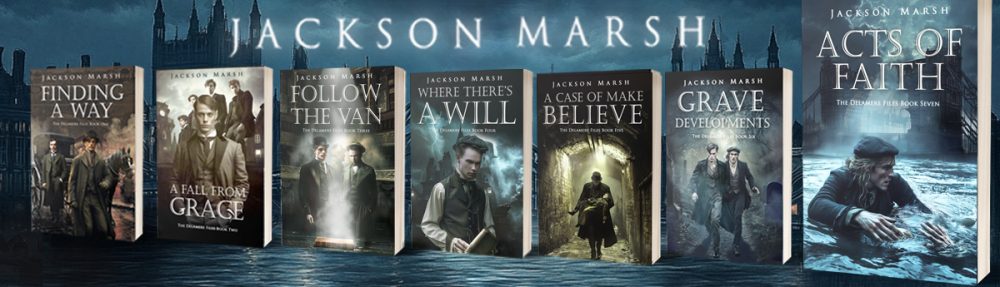

 On Friday you can catch another preview on fellow author, Ofelia Grand’s website. I will be her guest blogger, hope to see you there!


 As I write, I am doing my final read-through having completed the various drafts and used ProWritingAid to conduct a line edit. The final draft goes to my proofreader next week, and once it is back, I will have one last read before uploading it all to Amazon. I have the front cover and will reveal it soon. My designer is working on the full cover for the paperback, and I have two illustrations ready to use at the front of the book. Everything is in place, and, with luck, we’re looking at a release date towards the end of the first week of November. I’ll let you know.
 For me, the second draft is often a read-through of the first with an eye to consistency of story. Have I said something early on that doesn’t tie up later? Does a character’s eye colour accidentally change? Particularly important to me is the timeline, and because I use dates as chapter headings, I need to ensure these remain accurate. (They are accurate to the calendar from the year in which the story is set, and I check this with publications in the online newspaper archive because not all online date calculators are accurate.) Another thing to look out for is repetition. I often put some piece of vital information early in the story, and then repeat it later, which is unnecessary. What I’m doing is reminding myself to make sure the info is in there, because after putting it in chapter one, by the time I get to chapter ten, I can’t remember if I’ve written in it the story. Therefore, draft two is often about removing repetition. A reader should only need to read something once, and if I find myself saying aloud, ‘Yes, I know this,’ I delete it.


