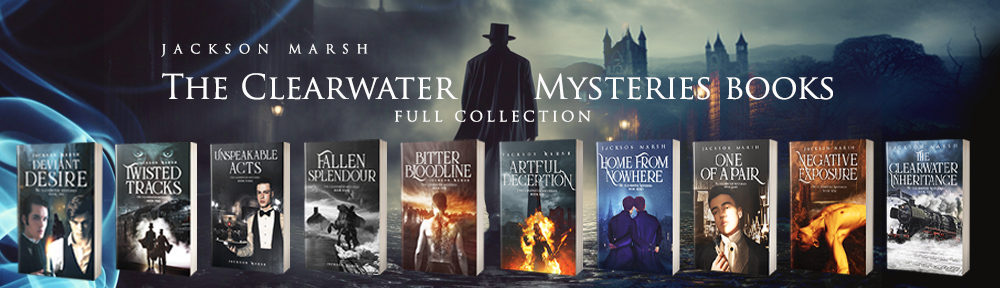
How Many Voices Tell Your Story?

As you might know, I’m currently working on ‘The Larkspur Legacy’, the last in the Larkspur Mystery series.

If you have read ‘Starting with Secrets’, you will know that book comes before ‘Legacy’ and concerns a treasure hunt in four pieces based on the four points of a compass. In ‘Secrets’, the characters chased three out of four clues because I thought having four story-lines running simultaneously might be complicated, and now, writing ‘Legacy’ with all four stories in action, I find I was right.

It’s not the weaving of the four plots that needs careful handling and consideration, but the way the stories are told. I love a good, interwoven plot line or four, where each thread has to be tied off neatly so my story doesn’t get knotted. What I am having to be aware of is who is telling the story, and in ‘Legacy’, I have four main characters seeing the story from four points of view (POV). So, the question is, how do you handle that?

One Character POV

Many stories are told with one main character (MC) as the central character. We follow his/her path from a normal world, through a series of trials and a character-development arc, to a twist, a change, a crisis and a climax. (Use the search box for earlier posts about story and character development.) That’s the classic hero’s journey kind of storytelling, but in ‘Legacy’, I am not telling one person’s story. What I am doing, is bringing to an end a series of 17 books through a device that uses characters and information from as long ago as the Clearwater prequel, Banyak & Fecks, and taking us right up to date and the previous Larkspur mystery, ‘Starting with Secrets.’

I decided I couldn’t write a four-story epic like ‘Legacy’ with one main character involved in each one of the four through-lines, simply because no-one can be in four places at the same time. However, what I could do, was have one of my main characters ‘lead’ each storyline and write it from his point of view, keeping one protagonist (in this case, Archer, Lord Clearwater), and one antagonist who has a band of other villains under his command.

Thus, what we have are four stories woven together, all playing their part in the success or failure of one overarching story (the treasure hunt), and all coming about because of one protagonist. Easy right?

Actually, yes. I’m loving it, but I have to keep my eye on the ball, particularly when it comes to who is experiencing the story, and as I just explained, that is not one character, but four.

Five actually, or maybe it’s six…

Know Your Throughlines

Without giving anything away, I can tell you that the action plot of ‘Legacy’ looks something like this:

  1. Overarching plot of discovering the secret and finding the treasure based on four points of the compass.
  2. South: a team chasing down the answer to the south clue
  3. North: a team chasing down the answer to the north clue
  4. East: Ditto but the east clue
  5. West: you get the picture
  6. The villain’s story, because we need to know that side of things too

Within those six storylines, we must have the emotional side of the story, so that the reader is engaged emotionally and is not reading a Clive Cussler action-adventure story.*

So, among the six listed above, I also have:

  1. The ‘heart’ of the story; the friendship story if you like
  2. The tying up of previous loose ends, love stories, histories, etc.
  3. The villain’s motivation explained
  4. The tying up of other threads begun in earlier books in the series
  5. Giving those that deserve it a happy ending (or not)

(* I love Clive Cussler adventure stories, btw.)

With those charted on my map that will lead me through ‘The Larkspur Legacy’, I set about writing the story… stories… while keeping everything and everyone focused on the final outcome: success for Lord Clearwater, and happiness (or not) for his band of friends, crew and academy men.

This is where, when you are writing from more than one character’s point of view, you need to remember who is seeing the story unfold.

General Narrator VS Character POV

Many authors write with their own voice as the narrator, and that’s fine. The narrator is an omnipresent observer relaying the events back to you, the reader. I always wonder, though, how this narrator knows what’s inside the characters’ heads and hearts, and I often find the telling of the emotional side of stories is muted because of this approach. That, like everything else I write here, is only my opinion.

Some authors, and I am thinking of John Steinbeck here, take on the voice of a character who lives in the world of the story but is not actually in the story. That works better for me, and I find my writing flows best when I am writing in the first person, as I do in one of the stories within ‘Legacy.’

Some of my books have taken two characters’ points of view, and others have taken more, but only now and then. ‘Banyak & Fecks’ for example, is told in four parts: Andrej, from his POV, Silas, from his, then the Andrej & Silas, and Banyak & Fecks sections which are variously from both points of view. In other books, we might find a chapter from a minor character’s point of view, as we do at the start of ‘Artful Deception’ which opens with a man called Henry Beddington, the concierge of the National Gallery. That’s fine too; we need to keep our readers informed and entertained, and if we have to change from one place to another, we might need to change from one character’s POV to another.

Beware: it’s not a good idea to have a new lead character and point of view in every single chapter or section thereof.

For ‘Legacy’, I have gone down the multi-character point-of-view narration style. It’s still my voice overall, but even though we read from a 3rd person, omnipresent narration in all but the 1st person sections, I am aware that I am describing things from a character’s POV and not my own.

Say what?

I am trying to say, when making more than one character your main character, always be aware of who that character is, and make sure his/her reactions to and observations of what happens are character appropriate. Fine, but there’s more. I also try and ensure my style of narration reflects the main character of the chapter.

Let me try and illustrate what I am saying.

Voices

Again, without giving anything away, here is how I am approaching this multi-character point-of-view style in ‘Legacy.’ Here are a few examples of how I am trying to change my narrator’s voice to reflect the attitudes of the main characters of each of my storylines. These are first-draft, unedited sections, so please forgive any clumsiness.

1) Action at Larkspur Hall is seen from Silas’ point of view, therefore the first thing we get is a cosey scene of two lovers in bed. The writing style is mostly straightforward, to reflect Silas’ character, and when writing, I find myself ‘thinking Irish.’

‘This is an outrage!’

Silas rolled over to find his lover sitting up in bed, his reading spectacles teetering on the end of his nose and his face red with rage. Archer’s knuckles were white as he gripped a newspaper, and his coffee sat steamless on the bed tray. Silas hadn’t heard Nancarrow come in, deliver the coffee and pour, nor had he woken when the butler drew the curtains revealing a grey sky…

2) Action pertaining to the ‘heart’ of the story (the good fortune of the academy men, friendship, the changes Clearwater has enabled in his men, the more emotional side of things). This is mainly seen from Dalston Blaze’s point of view, he being the first Larkspur Academy man we met in ‘Guardians of the Poor.’

The workhouse. A previous life of tedium, cold and hunger. An existence he wouldn’t wish on anyone, and yet, had it not been for a house fire and an unknowing public, he wouldn’t have been taken to the Hackney spike. There, if it hadn’t been for a kind matron and his ability to draw, he would never have met Joe, but if he hadn’t met Joe, he may not have fallen prey to Skaggot. His life had been shaped by a chain of coincidences, and the only one among them that felt inevitable was meeting Joe.

3) 1st person narrative is written by Bertie Tucker in diary form. He’s a pretty rough character underneath, been at sea since he was seven, and not greatly educated, but he’s been asked to keep a diary. In this brief section, he’s trying on clothes with an Italian sailor called Mario. The style is completely different to a) give readers a rest and a smile, and b) bring them into the action, because 1st person is more direct.

I got me boots and trousers off, and was in my drawers going through the shirts when I found one I thought might fit him. So, I turned back to hand it over and he’s standing there naked as the day he was born. Or, more like, the day he was carved out of marble, because his body (darker skin than me) showed me every single muscle.

‘What you doing naked?’ I said, and should have looked away, but being me, I couldn’t resist a gander. Just a quick one, you understand, but enough for him to see what I were doing.

‘No underwear,’ he said. ‘Lost it in a bet.’

Bloody hell. This great big peg dangling about dark as you like, and a couple of buoys you could hitch a few lobster pots to and never lose them in a storm, and… I mean, where’s a man to look?

4) The descriptive, darker side of villains. When we switch to the baddies and what they are up to, I have, as I have done before, slipped into Tripp’s mind, but in some cases, as in the example below, I have become a general narrator as if I and the reader were floating around in the fetid atmosphere of the villain’s lair.

To Tripp’s left stood the letter table, a relic of a fortunate past once lived, where industrious staff had placed the box for posting, and the deliveries from cheerful men wishing Fareham’s household a good day. Now, it was nothing but another shape in the gloom, whose usefulness had faded like the writing on the envelopes that once might have waited there. What remained was an opener. A long, steel blade which, unlike Tripp, had meaning. It was within his reach, and it would do its work with speed, but it was not work Tripp could currently allow. No matter how vile his master, he needed the earl. Perhaps, once Clearwater was dead, so could the earl be, for Tripp had nothing to live for after his revenge was done.

5) Others, and so on. Other parts of the story are seen through the eyes of other characters, such as Frank Andino, and when he’s on stage as the MC, I am aware that he’s a blunt speaker. Not only is this reflected in the dialogue, but it’s also shown in the ‘black stuff’, the narration, as if we were in his mind.

The sauntering young Greek became a confident Englishman as Frank entered the foyer, hands out of pockets, guidebook under his arm. His hat doffed to the sleepy old lady behind the counter, he mounted the stairs with grace until the turn, and then bolted the rest of the way to their room. Two open suitcases, Jimmy’s spare jacket on a hanger, Frank’s trousers off the floor, two bottles from the table, one bloody boot? Where’s the other one, malaka…? Both in the case, case shut, other case shut, quick check. All there. Fuck off out of here.

How Many Voices Tell Your Story?

To bring this to a close, I repeat: How Many Voices Tell Your Story? I answer my own question by saying, as many as it takes, but be careful. Ensure your narration fits the main character as well as your characters’ dialogue suits them, and don’t be afraid to transport your reader from one place to another at the turn of a page. However, remember your overarching through-line, your character arcs and your plot.

Hey, this writing thing is meant to be fun, isn’t it?

Have a good weekend, Jackson

Christmas Parties & Celebrations

Hello, everyone

Today’s blog is all about celebrations, parties, freebies and award nominations. There is a lot taking place in the run up to Christmas, all of it exciting, and I’ve set out all the details below. It starts with an online party in a popular Facebook group…

This Sunday there is a massive party over on the MM Fiction Addiction Cafe Facebook page. Over 100 authors will be dropping in throughout the day introducing themselves and holding quizzes and games. It promises to be a riot of freebies and festive frivolity. I will be joining in the celebrations and it would be great to see you there! The party will take place between 9am and 9pm Eastern Time, which is 4pm – 4am in Greece, 2pm – 2am in the UK (I think?!).

Followed by…..

The Small But Mighty MM Romance Group are halfway through their 12 Tropes of Christmas Celebrations. On Tuesday look out for #AgeGap where yours truly will be dropping in to showcase my Mentor Series. Come along and join the fun for a chance to win two books of your choice from the series.

Meanwhile, on my own Facebook page I am still running my advent ‘name the book’ competition.

Every day a new question and all correct answers will be put into my husband’s steampunk hat on Boxing Day and my godson will draw the winner. And now I can reveal that the grand prize will be…wait for it

ddrrrrrrrrrrrrr……..

your choice of a mousemat or mug featuring The Clearwater Book covers. Yes, I thought it was time we try out some merchandising so we have been playing on various websites and trying out some mock-ups. Whoever wins we will personally create your prize and ship it off to you in the New Year.


And if you still have some free time after all those shenanigans please head over to Goodreads where you can vote for your favourite MM Romance authors of 2022. I have been nominated for a number of awards, a huge thank you to those who voted so far! I am listed amongst some of the top names which in itself is a great honour.

BEST COVER ART

First up we have ‘Best Cover Art’…it is fantastic to see Andjela K nominated, without her my books would just not have the same visual impact. Click the link to place your vote https://www.goodreads.com/…/258430-best-cover-art-you…

BEST ESTABLISHED COUPLE

Joe and Dalston are nominated in this category. This gives me great joy, I absolutely loved creating these two characters and their relationship really did bring out pure emotion in my writing. I couldn’t have done it without learning British Sign Language, I feel that took my journey with these two young men to a different level. Here’s the link to vote https://www.goodreads.com/…/258374-best-established…

BEST BOOK OF THE YEAR

This nomination is a big WOW, ‘Speaking In Silence’ is up there amongst some big names, a great honour. To place your vote follow the link https://www.goodreads.com/…/258367-best-book-of-the…

ALL-TIME FAVOURITE M/M SERIES

Both The Clearwater and The Larkspur Series have been nominated for The Best Series Category (I suggest we all vote for Clearwater to gain more collective votes)

Click the link to vote https://www.goodreads.com/…/258336-all-time-favorite-m…

ALL-TIME FAVOURITE MM ROMANCE

Deviant Desire remains my best-selling book to date, it is so good to see it here as a nominee. Silas and Archer’s relationship started as an ‘insta-love’ but their lives together continue to be exciting and passionate, I have loved telling their story. If you would like to vote for them hit the link https://www.goodreads.com/…/258377-all-time-favorite-m…

ALL-TIME FAVOURITE M/M AUTHOR

Yes! I have made the nominee list, thank you, thank you! Here’s the link to vote fave author

You need to be a group member of the MM Romance group, if you need the link to sign up, here it is

https://www.goodreads.com/group/show/20149-m-m-romance

It takes 24 hours to approve your request and be sure to put your date of birth on the sign-up.

Thank you everyone!

After all this excitement, I could do with a lie down, but the truth is, I have left my Larkspur Academy men in something of a predicament, so I had better go and write another chapter of ‘The Larkspur Legacy’ before they get tired of waiting. A proper update will be on Wednesday’s blog.

Unfinished Beginnings. Why you Should Never Throw Anything Away.

This morning, while wondering what I might blog about today, I turned my attention to my collection of Clearwater notes, and a folder titled ‘Other ideas and texts.’ In it, I found the first 16 draft chapters of a book that never was. (That, by the way, was 60,000, but I decided I could do better, so I started again.) The story was titled ‘Original Part 6’, meaning I’d not yet found a name for it, but I had been playing with the idea of a novel called ‘Men of a Similar Heart’, a title I may, one day, still use. As this draft was never published, I looked at it to remind myself of the story which would have come after ‘Bitter Bloodline’ and before ‘Artful Deception.’ Sure enough, chapter one begins:

Henry Beddington had been the concierge at the National Gallery since it opened in 1865, and took great pride in the fact that, despite the large number of visitors passing through its doors each day, there had never been any trouble in his foyer. Keeping watch over the entrance from his counter on the morning of July 8th he had no reason to suspect that today would be any different.

That paragraph ended up being the opening of ‘Artful Deception’, but what came later in ‘Original Part 6’ differed wildly from the rest of the final book.

I also found two chapters where Archer and Silas take lunch at a dubious club, meet with an old friend of Archer’s who is in serious decline, and take on a new case. That idea was also shelved (though it’s quite a funny scene, so I may rehash it at another time).

Then, there were a few chapters of another version of ‘Men of a Similar Heart’ that never made it into any of the other books. In one version of the story that never was, James, by then a detective (1889) takes on a mysterious case where one man is searching for another before his missing friend ‘does something stupid.’ I have the outline of that mystery/adventure, and it’s a good plot with a few nice twists, so I might return to that one day too.

Then, I found notes for ‘Part 09’, which ended up becoming ‘Negative Exposure.’ After bringing the Jasper and Billy story to a reasonable conclusion in ‘One of a Pair’, I turned my attention to the backstory of Silas and Andrej and came up with ‘Banyak & Fecks’, so by the time I returned to the Clearwater world, other ideas had come to the fore. Much of what underpins ‘Negative Exposure’ comes from events that happened years before in ‘Banyak & Fecks’, which is why I advise reading the prequel between books eight and nine.

While going through some of these notes, wincing at some of my clunky writing (they are first drafts), and also thinking, ‘Hm, now that would be fun to resurrect’, I found a few other starts and ends of chapters I’d like to share. I am always conscious of ending a chapter in a way that leads to another unless that chapter is the first part of a longer scene. There are a few in the collection of never-used which I may well reuse elsewhere. Here is the original opening for another version of ‘Men of a Similar Heart’ that never was; the end of chapter one.

[Archer, Silas, James, Fecks and Tom are swimming in a pond near Larkspur Hall one summer, when Barnaby Nancarrow, then still a footman, comes charging over the hill. He reports that while Archer has been out, someone has broken into the Hall. Nothing has been taken, but something has been left behind.]

Barnaby had started shaking with shock, and Archer was certain it wasn’t from the exertion of running a mile from the Hall to the edge of the estate. Thomas appeared, immaculately dressed and calm, and seeing the state of his footman, stood directly in his line of sight.

‘Barnaby. You must answer His Lordship,’ he said, employing an authoritative but gentle tone. ‘You have done exactly as I would have wished, and there will be no recriminations if you speak plainly and honestly. If nothing has been taken, what has been left behind?’

Hearing his butler address him so naturally gave Barnaby strength. Being more accustomed to talking to the butler than his master, he was able to break the news to Mr Payne, and he cleared his throat before squaring his shoulders.

‘Very sorry to report, Mr Payne,’ he said, ‘but whoever it was, has left behind a corpse.’

Cue mysterious music…

Another opening chapter: In this one, set in December 1889, a new client visits James at the detective agency at Larkspur House and asks him to take on a case. The first chapter ends with:

‘Mr Wright, only you can take my case for three reasons. Firstly, it is not a matter for the police because a crime has not been committed. Secondly, it is a delicate and personal matter, and as I expect you know, the police are neither delicate nor personal. But, most importantly, it must be you who takes my case because it is one that can only be understood by…’ What had been a confident flow of words dried with apprehension, and Norton swallowed. His Adam’s apple rose and fell like the puck on a fairground hammer blow, and James expected to hear a bell ring.

‘Can only be understood?’ he prompted when Norton had hesitated long enough.

Norton cleared his throat and regained his composure. ‘By men like us,’ he said, and when James shook his head in bewilderment, clarified. ‘It is a case that concerns men of a similar heart.’

And that’s where the idea for the title came from.

Another file in my folder is titled ‘Another opening idea’ (I am not very original when naming files), and this time, it’s the start of a chapter and book which I set aside for later use:

[Larkspur Hall, December 11th, 1889. A letter from Mrs Baker to Thomas Payne in London.]

Dear Mr Payne,

I write for your advice because I fear for the safety of Lady Clearwater and do not wish to unduly alarm His Lordship.

Where was that leading?

(It eventually became the sub-plot of ‘Negative Exposure’ and led to the story of ‘The Clearwater Inheritance.’)

Here’s the end of chapter one of another story that never was. It’s the one I mentioned where Archer and Silas take lunch at a club and are there to meet an old friend of Archer’s, Freddie Falconbridge, who Archer has described as fit and strong, an athlete and a statue of manliness.

Silas followed, picturing Lord Falconbridge as a tall, wide wall of muscles, someone he might see smashing a hammer onto a fairground’s high striker to ring an impossibly high bell, or lifting weights in a show of physical strength before singing bawdy ballads with his manly teammates after a hellish game of football.

When he entered the room, however, the man who struggled from his chair to greet them, could not have been more different.

‘Good Lord, Freddie,’ Archer exclaimed. ‘Will you live through lunch?’

I never used the scene or the chapter ending, though Falconbridge turns up in another guise in ‘Negative Exposure’ because I liked the name.

Finally, another opening that never found an ending, though I have the plot of this story and several draft chapters. I rather liked this one because it gives us the crime to be solved as reported in a newspaper, and we all know how much I like to employ newspaper articles, letters, telegrams and such devices.

Exeter and Plymouth Gazette

Monday, November 26th, 1877

Tragedy At Sinford’s

A grim discovery was made on Friday last at Sinford’s School for Boys, Moorside. On rousing the men of Drake House, the Housemaster, Rev. D Spencer discovered a student absent from his bed, and soon after, when searching for the pupil, was confronted with a scene of great tragedy.

The body of Luc Verdier was discovered in the attic of the building hanging from a rafter by a rope fashioned into an ill-formed, but fatal noose about his neck. Verdier, we are told, was the son of a diplomat of the French Embassy and had attended Sinford’s since coming up from prep school…

And so it goes on, as could I, but I will leave you with the point of today’s blog, and that is to say to all aspiring authors, never throw anything away. If you have an idea, write it down and keep it. You can always reuse, as I have done, and even if you don’t, it’s fun to reflect on what you were thinking and where stories might have taken you. It’s also a useful exercise to look back and see how your writing has improved over time, and it will.

So, my thought for the day:

The Writers’ Museum, Edinburgh, Grave Robbers and Dracula

Hello! I’m not long back from our trip to Scotland, and it’s high time I gave you an update of what’s going on in the world of Jackson Marsh. There’s more about the next Larkspur book in a moment, but first…

On the way to our son’s wedding, I found myself alone in Edinburgh for a day, and there, wandered the old streets and the new, admired the buildings and visited the castle grounds. While on my walkabout, I stopped off at The White Hart, reputed to be the oldest inn in the city and a place where the grave-robbers Burke and Hare used to hang out.

Later, I was just thinking about heading back to my hotel when I stumbled upon the Writers’ Museum. This is a collection of artefacts and information pertaining to three Scottish writers; Robert Louis Stevenson, Robert Burns and Sir Walter Scott. It’s housed in Lady Stair’s House in the Lawnmarket area of the city, and the building is as interesting as the exhibits. I took a few (bad photos) which you can see below.

A few days later, I was in Inverness with my brother-in-law while waiting for Neil and his son to collect us and take us to the wedding. This was held in a castle by the river and was a splendid affair, and yes, I wore a kilt. The architecture of old Inverness along its riverbank was somewhat inspirational, so I’ve included a couple of shots I took there.

Now back at home, where the weather is glorious, I am back at work. I have a backlog of freelance typing to catch up on while I am also going through the final read of ‘Starting with Secrets’, the next Larkspur mystery. I am still aiming to have this ready for you in a week or so—probably more like two—and will send it off for its laying out next week. Andjela has done herself proud with another stunning cover and there will be a cover reveal soon. So, stay tuned to this channel for more information on my Wednesday work-in-progress blog, and prepare yourself for the first half of an epic Clearwater/Larkspur adventure that will conclude in the final book of the series. I am hoping to start on that as soon as ‘Starting with Secrets’ is published.

Meanwhile, here are a few of my dodgy shots of the Writer’s Museum, Edinburgh, and the riverside in Inverness.

The grand hall, now a gift shop.
Robert Louis Stevenson’s childhood rocking horse. Looks rather painful.
Robert Louis Stevenson’s pipe.
The three great men in art form.
It was Halloween, so I bought another copy of Dracula and read some of it back at the hotel.
Inverness
Inverness Castle.

Weak Words Vs Power Words

When do you write the blurb for your publication? I start it as the idea of the book is forming, because giving yourself a rough outline of the main points of the story is important. This, later, becomes the structure of the blurb, the write-up you see on the book’s back cover and/or on the sales pages. To my mind, these things need to be succinct while offering the potential reader an outline of what to expect.  

The Blake Inheritance

I’m going to give you a quote from one of my unusual romance stories, The Blake Inheritance, and here it is in sections:

An inheritance, a ring and a church organ; three clues to the Blake family mystery.
Twenty-five and fleeing a stale relationship, Ryan Blake returns home to find some answers. What he discovers is the impish twenty-two-year-old, Charlie Hatch, a homeless scamp who has a way with words, a love of mysteries, and a very cute arse.
As the two set about unlocking the Blake family secrets, Ryan finds himself falling for the younger guy. But is he ready to commit again? And can Charlie learn to accept that someone loves him?

What we have here is not a synopsis (never write a synopsis as your blurb) but it outlines the story in 91 words. It may not be the best blurb ever written, but it contains all the elements of the story while, I hope, enticing the reader to buy the book, which you can do here:

The Blake Inheritance

“Let us go then you and I, to the place where the wild thyme grows.”

The first line tells us it’s a mystery. The second paragraph tells us the main character, Ryan, is overcoming a problem, meets an impact character (one who will affect a change in the MC) and there’s a hint of something sexy. The last paragraph suggests the love story and the conflict, and that’s all we need to know. Combined with the cover that shows two young men and a lighthouse in a slightly twisted way should add a visual to the blurb. What this blurb doesn’t overdo, though, are the ‘power words.’ Then again, it doesn’t use weak words, and your blurb should be about power, not weakness.

Power Words

What do I mean by power words? Let’s move away from the blurb and look at fuller storytelling. Which sentence tells you more?

Edward went to look.

Edward forced himself to look.

Went is a weak word, forced is a power word; it tells us something about his state of mind and has a clearer meaning than ‘went.’ In this case, we can assume Edward didn’t want to look. Here’s another example taken from my upcoming ‘Starting with Secrets’:

… she said, moving to the stove

… she said, drifting to the stove

I don’t mind ‘moving’ too much because it’s vague and in this scene, ‘she’ is being vague, but ‘moving’ is an opportunity for something better. Here, she drifts to the stove because she is reminiscing as she’s talking, but were she angry, she might stomp, or if she was in a panic she might fly, she might ‘scream her way to’ or ‘bustle to’, ‘stagger in the manner of a drunk toward’ or, if you want to use ‘move’, ‘moved to the stove like a galleon in full sail’, but then, ‘sailed’ would be better, or ‘tacked’, ‘lurched’… In other words, ‘move’ is a weak word, and the others are power words.

Other weak verbs to be wary of include, stand, walk, look, feel, think, said, have, got, go. Example:

He knelt beneath the bell and looked inside.

He knelt beneath the bell and squinted inside.

Squinted suggests poor lighting or eyesight, so it adds more to the scene than looked.

Power Descriptions

As we can replace weak words with more powerful and descriptive ones, and we can improve our writing by looking out for other weak words which are easy to use but can always be bettered. I, for example, now look out for my use of the word ‘it’ because unless the ‘it’ is obviously the thing I am referring to, the word can confuse the reader. Sometimes, when editing, it confuses me, and I have to read back to remind myself what’s being talked about. So, look out for your use of the weak word, ‘it’ and see if it isn’t better replaced by something more specific. Other weak words used in this way include replacements for ‘it’ such as ‘one.’ For example:

Not as public as the one in the cathedral,

Not as public as the plaque in the cathedral,

That’s also from ‘Starting with Secrets’ and the ‘one’ we are referring to, the ‘it’ if you like, was mentioned a few sentences back, and because things have happened in between, ‘one’ might be too vague for the reader. Obviously, there are times when one, it, them, they etc., work, and you don’t want to repeat ‘plaque’ or whatever too many times.

She taught him how to make pastry and roll it.

Makes sense but there was that dreaded ‘it’, and something didn’t feel right. I changed it to:

She taught him how to make and roll pastry. It reads better and makes more sense; it’s not as clunky.

Here’s another way I try and improve my writing by swapping weak words for more powerful ones. This is an actual edit from my first draft to my second. Which do you think is more descriptive?

… but no light appeared at the window.

… but daylight refused to breach the window.

Okay, so I could have gone further: … but daylight refused to breach the grime-encrusted, leaded windowpane that stood as a barrier to the dawn… But let’s not go over the top.

‘Stood’, by the way, is another weak word. Always ask yourself how? How did he stand? How did she move?

Get/got is another one to avoid.

When he got to the junction…

When he arrived, reached, staggered to, fell upon, finally found… the junction. Much more descriptive.

However, when a character is speaking, always write as he or she would speak. Don’t put in unnecessary power words for the sake of it, not in dialogue. A character would be perfectly justified saying, ‘When you get to the junction.’

Word Order

A slight aside, but while editing the next book, I came across this sentence:

… and enjoyed standing beside her drying plates.

There’s nothing better than watching plates dry is there? Why was he standing beside plates that were drying? Why was he enjoying such a dull spectacle?

I changed the line to:

and enjoyed drying plates beside her, which is what I actually meant to say.

I could have improved the initial sentence with a comma, I suppose, but it still felt clunky. … and enjoyed standing beside her, drying plates.

Finally

I was trying to think of a way to end this post, and came across another short piece on Before You Publish that included a list of strong, mild and weak words. It’s not that easy to read unless you enlarge it, but I’ve added it to my bookmarks as a resource. You might find it interesting when you are editing. I’ll be back on Wednesday with more news on ‘Starting with Secrets’ my current work in progress.

Starting with Secrets: First Look at the Blurb

I have almost finished Starting, by which I mean ‘Starting with Secrets’, the sixth Larkspur Mystery, is nearing completion. Neil is beta reading it as I write, and Andjela is working on the cover. Meanwhile, I am working on the author’s notes and the blurb ahead of sending it all to be proofread on the 28th.

Because I don’t yet have a cover, I’m including some photos that are relevant to the story to give you a taster of what’s coming.

These are not necessarily shots for the cover. We’ll do a cover reveal nearer the publication date, which should be around the middle of November. That gives you plenty of time to catch up on the rest of the series if you haven’t already started it. You can find all Larkspur Novels on the Amazon Larkspur Mystery series page, and the adventures, which follow the Clearwater Mysteries, begin with ‘Guardians of the Poor.’

What is Starting with Secrets about?

I’m not about to give away the plot, but if you want keywords, then this collection will do:

Mystery (of course), Treasure hunt, Misplaced affection, Twists, Revenge, Childhood memories, Drama, Adventure, History, Humour, Compass, Maps, Clues, and, as usual, Bromance.

The story continues a couple of months after Speaking in Silence.’ There is a new man at the Larkspur Academy, Bertie Trucker, and he’s feeling out of place. Up at Larkspur Hall, Archer, now the Earl of Clearwater, receives a message and a gift; a compass. This sets him and his crew off on an adventure — a treasure hunt of sorts, which can only be completed with the help of the friends and men he has gathered around him since the first Clearwater Mystery began in ‘Deviant Desire.’

This means everyone who has read either series can catch up with their favourite characters, because throughout this book and the next, all main characters from both series will have a role to play. Whether you’re a Fecker fan or a James junkie, an Archer admirer or a Dalston devotee, you will find your man (and woman, for those of us nuts about Mrs Norwood or loopy about Lucy) playing an active role in ‘Starting with Secrets’ and the follow-on book, ‘The Larkspur Legacy’—which I’ve not started writing yet, but will begin very soon.

You see, ‘Starting with Secrets’ is the start of a two-parter, and it starts with a secret, as you might have guessed. I suppose it’s a little Dan Brown-esque in its mixing of fact and fiction, and like one of his great adventure/fact/fiction novels, there is an evil villain keeping pace with and sometimes overtaking the heroes. There is more than one villain, actually, because where Archer has built a solid crew of loyal friends and experts, so the villain needs others to help him realise his evil aims.

Starting with Secrets Blurb

That’s more than enough advanced warning about the story. Here is the first draft of the blurb, the text that will go on the back of the book, and on its Amazon page and other publicity. Bear in mind this is only a draft, and the wording may change, although the story outline won’t.

Starting with Secrets

The Larkspur Mysteries

Book six

“The greatest reward lies at the end of the stoniest path.”

Lady Dorothy Marshall, March 1891

When Lord Clearwater inherits a set of enigmatic clues and a compass, it becomes clear he has the means to uncover a momentous secret. He calls upon the men of the Larkspur Academy to help with the hunt, including the latest recruit, the bewildered ex-sailor, Bertie Tucker.

The academy men investigate follies, national monuments and ancient churches, using their diverse skills to unlock a series of random messages. The men must work together to find Clearwater’s secret and ‘treasure’, but relationships threaten the status quo. Edward Hyde has turned his affections from Henry and aimed them at Bertie Tucker, opening a rift which must be mended if the hunt is to succeed.

And when two of Clearwater’s adversaries conspire to beat him to the secret, what begins as an adventure becomes a game of cat and mouse that leads to a fight for survival.

What Next?

Next come the beta reading, cover design, author’s notes, final blurb, proofreading, proof accepting, internal layout and finally, in about a month, publication.

So, that is where ‘Starting with Secrets’ is starting. The question is, where will it all end?

Why I Ignore Emails from Book Promotion Companies

I want to tell you about the thing that made me write this article.

The ‘thing’ was an email from a company purporting to offer a book promotion service, something I always ignore. Why? Well, have a look at the following. All I have done is taken out the name of the company; the rest is copied word for word and symbol for symbol. Bear in mind, this email came from people who want me to believe they deal with literature.


*Hey- Jackson Marsh,*
*I hope that you have been enjoying your recent book "Bitter Bloodline" 

**This mail is to introduce you to our "services" of “company name” which can be used to enhance the reach of your book all over the globe.* just upload your book at *company name.*  

*We have 1 Slots  left for the next promotion in the Featured Book Category (High demanding).* *Hurry!!!! Grab your slot now.*

Eek!

Let me go through the ‘thing’ line by line *starting with* the unnecessary use of ***.

Why? What are they meant to do? Make me think, ‘Oh, that’s pretty, I’ll sign up with this lot right away.’ ? They sent me in the opposite direction before I’d read a line.

*Hey- Jackson Marsh,*
Why the dash?

*I hope that you have been enjoying your recent book “Bitter Bloodline”.*
I published Bitter Bloodline in November 2019, and why should I be enjoying it? Yes, it’s a good read, but I don’t sit around reading my own work three years after I wrote it.
(note from PA, it is a great read but please start with Deviant Desire and work your way through the series to get the very best out of Jackson’s writing)

*This mail is to introduce you to our “services” of “company name

which can be used to enhance the reach of your book all over the globe.*

What are these “services”? Putting any word in quotes that isn’t a quote makes me feel the word doesn’t represent the thing it actually is. For want of a better way of putting it, wrapping a word in quotes makes the word feel pretend. So, “Services” aren’t really services, they’re a sham because this email (not mail btw) is a scam. I’m not sure about enhance the reach of either. My books have heart, but they don’t have arms.

*If You like to register your book on our web portal for more than one year
just upload your book at *company name.*

A few pedantic points here:

If You… why the capital letter? If You like… Where’s the would? … upload your book at… TO. Upload my book TO your spurious web ‘portal’ which, I assume, will send it whizzing off through time and space to land on another planet. Or, more likely, on a pirate website where twats steal authors’ work and give them away, or worse, sell them and make money from other people’s hard graft.

*We have 1 Slots…

See above regarding unnecessary asterixis and inappropriate capital letters, and while you’re about it, take note that we always write numbers from one to ten as words, with ten/10 being optional. One slot, by the way, is singular. 1 Slots, or even one slots is just plain wrong.

…for the next promotion in the Featured Book Category (High demanding).*

You certainly are. What does High demanding mean? Why the stray capital letter? Why is it in brackets?

*Hurry!!!!

Don’t get me started on the use of the exclamation mark, let alone four.

Four!

Grab your slot now.*

Don’t be so personal.

I mean, honestly. Are we supposed to take this kind of thing seriously? It’s as if I received a letter from the child-catcher from Chitty-Chitty Bang-Bang offering to look after my offspring for a day. Or, worse, an email from the UK Tory party asking me to trust them and promising to improve my quality of life.

The message here is simple:

Ignore Emails from Book Promotion Companies

unless it’s a company you know, one that someone you trust has recommended, or one you have researched and found for yourself. Otherwise, offers such as these will only lead to your work being pirated and sold with no income coming to you.

Trustworthy Book Promotion Companies

I use two and have no qualms about using them.

The first is All Author, where you can list your books, grab promotional tools, make memes and gifs, have an interview, pay a little extra for a front-page promotion and other handy things. It’s also a good place for readers to find authors.

As is the second place I use, Queer Romance Ink which is run by the same guys as Other World Ink. OWI does my book layouts for me, and they offer many other author services at affordable prices such as blog tours and reviews.

If you are going to promote your books, I highly recommend those sites, and even more highly recommend you never consider replying to an email from a company offering *“Services!!!!”* Especially those that tell you to grab your slot.

The Clearwater and Larkspur Character Illustrations

This week, I took delivery of the illustration that will go at the beginning of ‘Starting with Secrets.’ Since beginning the Larkspur Mysteries series, I have added an illustration at the start of each book because… Well, I’m not sure. When I published ‘The Clearwater Inheritance’ I had someone draw me a map of Europe showing the route of the Orient Express, because I thought it would be fun for readers to follow the journey. Previously, I’d engaged an artist to draw some of my characters from photos and add some Victoriana, such as the correct costume. I was doing this for a book I am still considering, ‘The Clearwater Companion, and I’ll tell you about that another time.

What I thought I would do today is put up the collection so far: the collection of illustrations which have been drawn by an artist who lives in India and has a company called DazzlingDezigns. If you click on that link, you will see her page on Fiverr, which is where I was lucky enough to find her. I’ve not been able to commission every main character (and let’s face it, there are a lot of them!), but here, in no particular order, are those who have so far made it into the gallery. There are also a couple of other illustrations which have been used in the Larkspur books and for the cover of ‘Banyak & Fecks.’

You can find all my books on my Amazon page

The Clearwater Mysteries start here

The Larkspur Mysteries start here

I’ll be back on Wednesday with an exciting update about ‘Starting with Secrets.’

Reader Reviews and What to Make of Them

Every self-published and trad-published author wants and needs reviews. Every author also dreads them. Some don’t read them, while others learn from them. I bet some say they never read them, but they do, and some read them and say they are not affected by them when they are. Today, I wanted to write a few words about how I deal with reviews and give my opinion on the subject of reader reviews and what to make of them.

Books are Like Hotels

Reviews of anything help buyers decide whether to buy the product or not. I’m not just talking about novels here, but anything. Yesterday, I was looking for a hotel to stay in on a forthcoming trip, and went to one of the popular booking sites to see what was available. In a way that a reader will first be attracted to a cover, I was first attracted to the location of the hotel. Next, as a reader will then read the blurb/description, I read the hotel’s details to see if it had the right kind of room, WiFi, a bar, restaurant etc. Is this the right hotel for me? It’s the same as asking, is this the right kind of story for me?  Then, as most potential readers do, I looked at the price, and finally, out of interest, I looked at the reviews.

Reviews, therefore, come pretty low on my list of things to check before committing to a purchase, and that applies to books as much as it does to hotels or any product. The thing is, I only read the first couple of reviews, or I choose to read only the five-star ones. I also look at the chart of how many five, four, three etc., stars a product has, because if the balance is tipped towards one end of the scale, I get a pretty good impression of the overall suitability of the product according to the majority of previous customers. I get a benchmark. That process can take two minutes, or it can take ten. Either way, other people’s views are low on my list of things to check, but that’s just me, and reviews remain an important factor in a buyer’s decision-making process.

Why are Reviews Important to Authors?

So, if I am saying that reviews are a low priority, why do I then say they are so important for authors? There are several reasons:

  • The more reviews a book has, the more the book has been read, and that suggests to the potential buyer that the product is worth buying. People have bothered to buy it, so it must be popular, right?
  • Reviews give the author the chance to hear feedback from their readers.
  • Reviews can be used as quotes for publicity. They can provide impartial publicity from a third party.

Not everyone leaves a review, but many readers give a star rating. The higher the rating, the better the book. In theory. There are firms out there who hire people to leave good rates and stars even on books that are dreadful, and the aim of these firms is simply to make money. That, to my mind, is crass and damaging, but it happens.

How to Handle a Bad Review

There is a difference between a bad review and a review of a bad book. When authors say, ‘I had a bad review,’ they usually mean someone slagged off their great work. When I say, I had a bad review,’ I mean the review was badly written. We should say, ‘I received a low-star rating,’ or, ‘A reviewer didn’t like my book,’ but, because it’s what most of us mean, I’ll take a ‘bad review’ as meaning someone gave a negative opinion of my work. An opinion, after all, is all a review is.

You may know that I have written a very successful series of novels, The Clearwater Mysteries. (Successful for me, at any rate, because the series now pays my rent.) That series started with my first attempt at an historical, mystery-romance mashup, ‘Deviant Desire.’ I wrote it, published it and waited for my first review.

It was dreadful. A one-star rave about how awful the book was, and on first reading, I was saddened. Then I read it again, and realised that it wasn’t a bad review, it was an appallingly written, vindictive review that not only gave away some spoilers (thus ruining the read for many others), but was also inaccurate. I concluded that the review had been written either by someone with a general hatred of self-published novels, or by someone who wished they’d written thought of writing the book first. A disgruntled would-be author bitter because they couldn’t do any better. Whoever wrote it, and for whatever reasons, the book remains my most popular publication, and the stream of five and four-star ratings, and the wealth of positive reviews, more than outweighs one person’s negative opinion.

Reviews are Nothing More Than one Person’s Opinion

And that’s the point. Reviews are nothing more than one person’s opinion. Take them to heart, learn from them, agree or disagree with them, or consign them to history and forget about them, they are always only what one person thought of your work. That goes for whether it’s a badly written spiteful attack, or a glowing accolade of effusive adjectives and love. It’s what someone else thinks, and there’s nothing you can do about that because everyone is entitled to an opinion, and an opinion, according to the dictionary is simply: a view or judgment formed about something, not necessarily based on fact or knowledge.

I’ll just repeat part of that to make you feel better: not necessarily based on fact or knowledge.

Reviews are Your Connection to Your Readers

Good or bad, positive or negative, reviews are your connection to your Readers. This morning, I read a post on a Facebook group where the receiver of a negative review reacted with an excellent attitude. She understood that her writing wouldn’t connect with everyone, and that everyone has the right to an opinion. It was the word connect that resonated with me and made me think. Having thought, I came up with this advice.

No matter whether a reader writes good things about your work or bad, they wrote something. Your work connected with them. It made them react, and isn’t that what us writers are meant to do? Aren’t we here to cause a reaction in others? Beit joy, sadness, thought, anger, pride, outrage, hatred, or laughter… Beit anything, it is a reaction. By writing a review, the reader has proved that the story moved them enough to pause in their day, not to move straight onto their next Kindle purchase, or go back to the housework, but to stop, think, and put virtual pen to paper.

So, the next time you receive a negative review, be happy that your work moved someone enough to make them pen a reaction. No matter what that reaction is, you did your job. As an author, you made someone care. Bravo! Now get back to work.

From Dreams to Secrets

What I did then Vs what I’d do now.

Times have changed, and we’ve often rewound the clock…’

The opening lines of ‘Anything Goes’, and the starting place for today’s blog.

Not only have times changed, but so has my writing. It has changed greatly from when I wrote ‘Other People’s Dreams’ in 1996 to now, when I am writing ‘Starting with Secrets’, my 35th novel. I thought it would be interesting to look at how I write 26 years after beginning my career. Reading what I have already published is not something I do very often, because I always think ‘I wish I’d written that better,’ and that causes regret. However, it is a useful exercise as long as you turn the ‘I wish I had…’ into ‘The next time, I will…’ and learn from your own naïveté.

The more I have written, the more I have learnt to write better.

Let’s start by improving that.

The more I write, the better I get.

I don’t like the word ‘better’ or ‘get’ come to that, and ‘come to that’ is not necessary.

The more accurate I become? The more literary? The more I improve?

The more I write, the more improved my writing becomes…

You know what I am trying to say. Like a fine wine, a writer improves with age, as long as he continues to write, criticize his own work, and learn from his experience. The first novel I wrote is called ‘Other People’s Dreams,’ a line from a song by Janis Ian that has always resonated with me.

Other People’s Dreams

I began writing this novel while on holiday on Symi, Greece in 1996. When I returned home, I read parts of it to my flatmate and, as all new writers do, I thought it was the best thing since The Catcher in the Rye. It wasn’t, but my flatmate was encouraging, offered positive advice (he was a published journalist), and most of all, encouraged me to finish it, and then rewrite it. I rewrote it several times, and then put it away, and it didn’t see the publishing light of day until some years later.

The story opens with an advertisement. A thirty-six-year-old man is looking for four handsome young men to crew his yacht in the Greek islands. It’s a perfect summer job opportunity, but there are ‘Certain strings attached.’ That’s the hook, and I liked the way it set up the premise and a little mystery.

Then, we have a section of a screenplay in which there is an accident at sea. That’s unexplained, and we have another hook.

Then we have a flashback which sets up a third hook as we wonder what that story is all about, and it’s not until after that’s done that the present-day story starts.

Blimey. These days, I wouldn’t write so many introductions.

In the next chapter, we meet one of the four young men who will form the crew. This scene sets up people’s reactions to the advertisement, the ‘present day’ to separate the action from the flashback, and a character called John. Fine.

Then, we jump to a swimming pool, and we meet Mick, another of the four, and a character who doesn’t know where he’s going or what he’s doing. He will become the impact character when we finally meet the anti-hero.

Which we do in chapter four. Yippee! We finally feel the story is settling down, and then we’re hit with the job applications. These are presented as snippets of letters, and the chapter gives us more of an insight into our anti-hero, Jake, and another of the boys who will be the third to join the crew. It’s a neat device, and I still use letters in my novels as they make the stories feel more real. Letter writing is also a good way of putting across a character’s inner thoughts. I am using the device in ‘Starting with Secrets.’

As ‘Other People’s Dreams’ progresses, we meet the fourth character, and the first act comes to an end when Jake has selected his four men, and they are about to set off to Greece. Meanwhile, the flashback story has also reached its act one ending as the man in the past meets the object of his lust, a Greek lad called Andreas.

Looking back at the book now, it’s interesting to see that I must have had a natural feel for the four-act structure even though I knew nothing about it. There’s a turning point halfway through both stories (the flashback and the present day), and both lead to a crisis and then a climax and resolution. It’s at the climax that we know for sure how the two stories and the screenplay relate, though most readers would have worked that out along the way.

When I sent OPD to a publisher, and they sent it to their readers for an opinion, I received some positive criticism with the rejection. Although the readers found the characters ‘well drawn, especially the Greek man, Nikos, their final decision was ‘Almost but not quite’, which I think should be the title of my autobiography. I wasn’t disappointed, but took the critique on board and was actually quite buoyed by it. So much so, that I looked for an agent and found one. She took OPD to read, and I was so thrilled, I immediately began a second book.

This was a dreadful thing full of dodgy sex and a murder mystery. Set in the street in which I lived in Brighton, it was titled ‘Neighbourhood Watch.’ Although it was never published, it did turn up on some gay adult sites, because I licenced it as filler content along with some erotic short stories. This, by the way, was years later, and as far as I know, it might still be out there. I sent ‘Neighbourhood Watch’ to the agent, she read it, had a heart attack, and emigrated to Spain.

Almost but not quite…

Dreams Vs Secrets

Looking back at OPD and the way it is written, I can see plenty of things I would not do now, and I don’t just mean the structure of the opening. When examining your own past work, it’s important to look at everything from characterisation to the old ‘show and tell’ mystery, to the sentences themselves. I do this on every rewrite of every book, and there are now particular things I look out for and try to avoid.

Here are some examples of what I did in older novels that I try not to do in the newer ones. Some are necessary, some are unavoidable, but the fewer I have of them, the better I feel. (The more satisfied I feel, damn it!)

Starting a sentence with ‘He…’

At some point in my writing past, I noticed I often started sentences with He. He heard no engine, no unnatural noise, just the animals. That’s telling not showing. We know who we are reading about, we’re in his point of view, so why not write, The silence of a dead engine was the canvas on which goats and sheep painted their bleating. Well, it’s a bit naff, but I am thinking off the top of my head. Starting a sentence with He is fine now and then, but in some passages of my early books, I do it all the time. It’s a cop-out. He saw… He knew… He felt… These, to my mind, are all telling and thus, robbing the reader of the chance to experience the atmosphere.

Punctuation

This is why I have a proof reader. My punctuation, I notice, is based on how I speak, and is not always grammatically correct. I have to admit, now I use a proof reader, I don’t bother dithering over whether my punctuation is 100% accurate, because I know someone else will sort it out. However, I do know what to avoid. The other day, someone showed me the first proof of their first book, and with great excitement, asked me what I thought. I opened it at random and leapt in shock. The whole thing was in a sans serif font, Ariel or something. That’s a no-no, because serif fonts like Times New Roman are much easier on the eye when reading large blocks of text. Sans serif is fine on web pages like the one you are reading now, but, in my opinion, they should be kept out of print books.

Another thing this chap had done was hammer out exclamation marks as if they were the three-million rivets on the Titanic! I mean, one or two in a novel is fine, but eight or nine on each page! I mean, that’s overkill! Exclamation marks add emphasis for sure! But they also add an upturn in your reading voice! And if every sentence is exclaimed, the reading suffers from hiccups! And repetition! You see what I mean?!

?! is even worse, and try to avoid starting sentences with And and But. Although it can be argued it’s a style thing, there’s always a better way to start a sentence than with a conjunction.

Similar words

Again, my proof reader comes into play when I write discreet but mean discrete. The same applies to practice and practise, and several others. However, thanks to her notes, I now know to check certain words to ensure I have the verb rather than the noun, or the adjective rather than the verb. I also know what my most common typos are, and I keep a list of them so I can run a search/find on the full manuscript and change form to from and fro to for, etc.

Repetition reminders

Something I do a great deal of when writing a first draft is remind myself that I have already said that. I will state a fact the reader needs to know, and then I’ll state it again from someone else’s point of view later, and probably, do it a third time. This is a subconscious thing in the first draft, and I do it because I am unsure if I’ve mentioned the fact before. Either that, or I repeat it so the reader knows a different character knows the fact. I reckon a reader only needs to be told once, so, in the second draft, I consciously look for such repetitions and ask myself, ‘Do we know this already?’ Very often the answer is yes, so I take it out. An exception might be if a vital fact or clue is mentioned in chapter one and comes into play again in chapter thirty; then, it’s acceptable to remind the reader, but it must be done subtly.

Shoe Leather

Every chapter must have a point, and I keep a list I call POC. Point Of Chapter. As long as the plot or character details I want known come across, then the chapter has a point. That’s one thing, but another is the shoe leather scene, as they call it in screenplay writing. These are scenes to be avoided and, in some screenplays, they are there because the writer needs to present 90 pages and only has 87. A chapter only needs to be as long as it needs to be, you don’t have to aim for 3,000 or 4,000 words. In fact, it is better to vary the length of chapters as it is to vary the length of sentences. If your chapter feels too short, don’t bung in any old description or, worse, repetition just to make it longer. I used to do this, but now as I reread, I think to myself, ‘Do we need this?’ ‘What’s the point of this paragraph?’ ‘We’ve been here before.’ ‘We’ve done this…’ Ad infinitum

And Finally, Cyril

I am in danger of wittering on ad infinitum, so I will stop there. The point of this post has been to highlight how a writer can, and must, learn from his or her own writing. The above is simply an early morning reflection on what I have to say about the subject, and I hope you found it of use. To finish with, and just for fun, I want to give a few lines from both ‘Other People’s Dreams’ (1996) and ‘Starting with Secrets’ (2022, first draft). Both sections are from towards the beginning of the novels. See if you can spot the differences.

Other People’s Dreams

There was no doubt about it, the older man in the red trunks was flirting. This was the second time he had walked slowly past the lifeguard station, staring up and looking for a moment too long. Mick caught his eye again and immediately looked away, tiring of the attention. Not only was he working, he was simply not interested.

He had become used to the admiring glances of the men and women whose lives he guarded for six hours a day; there was no more novelty to it.

Starting with Secrets

[Character name]* tore the page from the newspaper, and threw the rest into the coal scuttle to use as kindling. Beyond the window, a sickly glow of yellow light coloured the overhanging fug, through which came the sound of clatter-carts and costermongers calling their wares, the sharp cackle of the prostitute and the crash and roar of warring couples. A policeman’s whistle pierced the night, and boots thudded on the cobbled street, chased by others and accompanied by shouts. Slops cascaded from the room above to catch a child unawares, resulting in screams and foul language, and soon after, came the threatening tread of a father mounting the stairs to seek revenge.

* I removed the name because it might have been a spoiler

Other People’s Dreams is on sale here.

Starting with Secrets should be ready for publication by the end of October. It will be the sixth book in the Larkspur Mystery series.