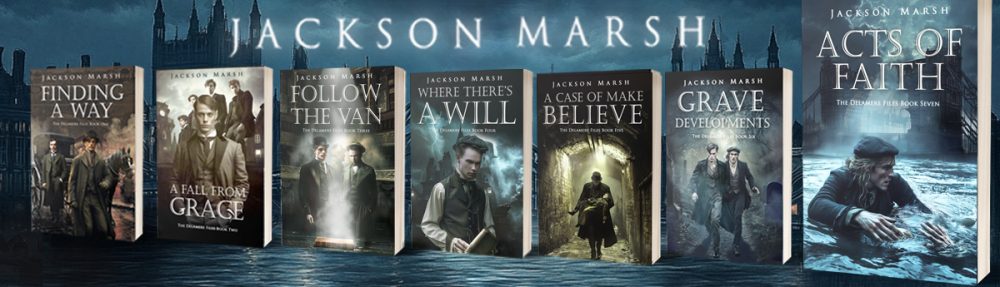
The update news today is the first draft of the first book in the next series is complete, except for a short chapter at the end to move us forward to book two, lots of editing and some rewriting, the proofing, cover, layout and, most importantly, the title.
Titles
I’ve spoken about titles before and how they sometimes come out of the text, other times from a flash of inspiration in an unlikely moment, and sometimes, even before I start work on draft one. In this case, the title isn’t coming at all, though I have a list of ideas noted down as I have been writing; none of which have yet struck me as being ideal. They include:
471 471 Kingsland Road The Cabman’s Adventure The Cabman’s Knowledge The Knowledge The Driver and the Fare The Cabbie and the Fare Merrit & Chase Something That’s a Play on Words about Cabbies Having the Knowledge of London Streets and Self Knowledge, or Street Names, or Roads, or…
And Onwards…
The current word count is 103,000, and that’s without the sections I have cut; two chapters of backstory, an introduction written by one of the main characters, half of chapter 21, and the complete first draft of the final chapter which I have completely rewritten. I am still editing out repetition and sections that are in the wrong place, and those I read back and think, ‘What on earth was I trying to say here?’
Today, I will be continuing my reread from where I left off yesterday at chapter eight (out of 26), and will continue to agonise over the title. What’s not changed, however, is the original idea, that the story is based on a piece from the 1870s by James Greenwood, though the novel is set in 1892, and the images of my two main characters. Rather, my main character, Jack Merrit, and the impact character, Larkin Chase. The impact character (IC) is who the main character comes up against and the one who doesn’t change, thus, he has an impact on the MC who has to change for us to have an emotionally driven story.
Larkin Chase is my IC, and Jack is the MC. In this novel, we have archetypal characters in the classic storytelling, hero’s journey tradition. Jack, the reluctant hero, has a sidekick, his brother Will, who also acts as the mentor character. Larkin Chase is the protagonist and IC. We have an antagonist in the form of a gang of East End criminals, shapeshifters (not the fantasy story kind) in the varying shapes of waterboys, servants and cabbies, and we have the voice of reason character in the form of someone you will recognise if you have read the Clearwater and Larkspur series. I will say no more…
What we don’t yet have is a title or cover idea, but that will come later. Meanwhile, as I return to the typo-writer, I’ll leave you with images of the MC and the IC, one or both of whom may end up on the cover beneath the title…. Whatever.
Jack Merrit, a young cab driverLarkin Chase, an investigator of social injustices
Happy Pride Month everyone. I know Pride Day is celebrated on 28th June, but I’m getting in an early celebration and announcing The Mentor of Barrenmoor Ridge is free today, 24th. That’s given me an excuse to write a little about how the Mentor books came about and to tell you a little about each one, in the order they were written. (Click the covers or links to go directly to each book’s Amazon page.)
Free today
The Mentor of Wildhill Farm
Apart from ‘Other People’s Dreams’ which I wrote years ago, The Mentor of Wildhill Farm was my first foray into writing novels as Jackson Marsh. I had previously written several novels as James Collins, and all but one has a gay character or characters, but none of them were specifically ‘gay novels.’ You can check them out on my other Amazon page here. I had been writing gay erotica for a few websites and magazines and thought, ‘Why not make a novel out of it?’ Being me, there had to be more of a story, so I invented a situation which will appeal to anyone who likes a bit of older/younger, age-gap romance and heat, and made it something of a fantasy. A sexual one rather than one with mythical creatures.
An older man has carte blanche to mentor four (18+) younger guys in their creative and sexual skills. That’s the story, and there’s a little romance in there too. It’s the hottest of the four Mentor books for sure, and a crossover from my writing of erotica to more mainstream gay lit.
The Mentor of Barrenmoor Ridge
This came next, and for inspiration, I drew on a place and activity I knew well in my younger days. A remote Yorkshire Fell, and mountaineering. This book is more romance mixed with adventure, which is something I do a lot, and although there is a slow build to the heat, the heat is not a major part of the book. It’s about dealing with loss, accepting someone new, and there’s a fair amount of mountain rescue, enforced isolation, and a little bit of a villain Vs hero thrill line.
For a reason I’ve never discovered, Barrenmoor Ridge really took off when first published. Its success boosted me to carry on as Jackson and write more, and from that initial publicity came my proofreader, with whom I still work today. Barrenmoor is on my list of top-ten best-selling books, only surpassed by the first four Clearwater books and the first Larkspur novel.
The Mentor of Lonemarsh House
Again, using a location known to me, I set the third book down in Kent, near where I used to live. I was back in the village a couple of years ago, catching up with an old school friend (and illicit teen affair way back when), and not much had changed. The pub, the local church, the farming community, it was all still there and reminded me of my lonely days on the marsh wandering the lanes hoping Mr Right would appear around the next corner. Lonemarsh explores the idea of the younger person being trapped in a small world and needing an escape. When the love interest arrives, though, Jason, the younger of the pair, finds it hard to accept that love with another man is possible.
You might have noticed the similarity in titles. I’ll break them down to make it obvious: Wild Hill Farm. Barren Moor Ridge. Lone Marsh House. Lost Wood Hall.
Adjective suggesting isolation; remote landscape; a setting. All the Mentor books are set in such surroundings.
The Mentor of Lostwood Hall
By now, I was running out of ideas for titles and situations and thought that a fourth book would be the last. You can have too much of a good thing after all. Lostwood is set in Wales, there’s a storm, a lonely man, an isolated old hall, a younger lad on the run from villains, an accident… It has all the classic hallmarks of a Mentor novel, including other characters of dubious sexuality, some humour, and a slow burn to the heat sections, of which, if I remember correctly, there are a couple. I like to think my writing skills and experience had developed, though I am sure there are still many edits I could make if I returned to this novel for a re-edit, as I have recently done with Barrenmoor.
It’s interesting to note that here we have: a rich man and a down and out, villains, a remote castle, a mystery… All aspects which would later form the basis of the Clearwater Mysteries, undoubtedly my best-selling series. Perhaps this is where it all began?
The Students of Barrenmoor Ridge
Two years after The Mentor of Barrenmoor Ridge, when I was halfway through writing the Clearwater series, I suddenly had this idea to do a follow-on from Barrenmoor; to return and see how Gary and John were doing a few years later. Along came the Students… Two 18-year-old best friends are away to celebrate a birthday with a camping trip, and one intends to come out to his friend. Disaster ensues, and who should rescue them but John Hamilton and Gary from the earlier book? Back at Barrenmoor Ridge, Gary and John then end up mentoring the younger couple as they deal with their coming out and change in friendship.
This book has one of my favourite lines made comedic by the situation. It’s something like: ‘We’re hanging eighty feet off the edge of a cliff, and you ask me this now?’
You’ll have to read it to understand why.
Free for Pride – The Mentor of Barrenmoor Ridge
So, just a reminder that the Kindle is free for today only. I have recently re-edited it to make minor improvements, so if you’ve already bought a copy, you can have this updated version for free, on me. So, follow the link, and look out for the giveaway. If you feel like it, please also share this page, the book’s page, and this news in any social media group you might belong to. Thanks!
Back on Wednesday with an update on the next novel.
First: The Mentor of Barrenmoor Ridge will be free all day on Saturday 24th June to celebrate Pride Weekend (somewhere in the world) and Pride month. Also, to celebrate its new, tidier edition, with enhanced readability.
I have learnt so much over the last few years, I have a new mission. When I can, to go back and tidy up earlier novels, and Barrenmoor is the first to receive the treatment. Here’s its Amazon.com page, but it will be FREE everywhere for 24 hours on Saturday (Amazon time.) https://www.amazon.com/dp/B078TFPQ89
Merrit & Chase
I am nearing the end of the first draft of ‘As Yet Untitled. A new Mystery Series, Book One.’ This may end up being titled, ‘Merrit & Chase’ as that’s one of the ideas I am playing with. Others include a play on words around ‘Knowledge’ because Jack Merrit is a London hansom cab driver in 1892. Other ideas include something to do with the word Two, or Streets, a street address (not very punchy), or a phase that lurks somewhere in the draft that’s not yet leapt out at me but might do when I start on draft two.
I am nearing the end of the first draft now and am at 90,000 words (with two chapters of backstory already cut), and have about another 10,000 words to go. Then, I will edit, cut, rewrite, check and dither, before repeating the process and moving on to book two. I can’t say when this one will be ready for publication, but I can tell you I have a title for the series.
Yes, I have made up my mind. On hearing my decision, my husband said, ‘You just can’t leave them alone, can you?’ which made me laugh. No. And why should I? Astute readers of mine will understand what he meant when I give you the series title, and tell you it is to be…
The Delamere Mysteries
At least, that’s the plan for now. More to follow in due course.
Starting with the prequel, Andrej is the first character we meet in the Clearwater series, and ending with The Larkspur Legacy, he is the last to leave the stage. You could say that the entire series of 18 books charts his life because he appears in or is mentioned in every book. Although he rented when he had to, Andrej is one of the few straight characters in the series, and I have to admit, he is one of my favourites.
He started out as a lad from the East End called Andrew or Andy, and was to be Silas Hawkins’ sidekick, but as soon as he appeared in the first chapter of Deviant Desire, I knew he had to be more interesting than an Oliver Twist to Silas’ Artful Dodger. As there were so many immigrants in London at that time, particularly the East End, I decided to make him German, then Russian… then thought, no, something nobler and with more history, so Ukrainian. I wanted a big, strapping, everybody-loves-him straight man to be Silas’ unlikely best friend, and thus, Andrej was born.
I gave him such a long and complicated name because I wanted to make a comedy moment out of it (when Thomas or Tripp has to announce him to Archer), but also, so I could show how much Silas thinks of him because he can pronounce it perfectly.
One of the books I am particularly proud of is ‘Fallen Splendour’, in which Fecker features prominently. In one scene, he is telling Archer of the tragedy of his family back in Ukraine, and it’s a levelling moment for Archer and an important one for Fecks. I had a few tears as I wrote it, and I had different tears at the end of the book too, and all because of this hulking but very fit, loveable, plain-talking straight man.
Clearwater Companion Notes
Here are my initial notes about Andrej, one of the mainstay characters of the Clearwater Mysteries. Some of these facts changed over time, particularly Fecks’ year of birth, because he doesn’t know it. He only knows the family celebrated it around Easter time.
Born in March 1867 (?)
He thinks he is about 19, as does Silas, but he is actually 21 in 1888, and doesn’t know his exact birthday. He thinks it is around Easter as he remembers celebrations near his birthday and thought they were for him.
The boundless fields of Pobuzhzhya and Ingul River region, green vineyards and wonderful flowering gardens under the bottomless blue sky is Mykolayiv land.
Agriculture is the leading industry of the regional economy. Mykolayiv Region makes significant payments in strengthening the country, producing almost seven per cent of cereals and sunflowers, and three per cent of gross milk production.
Family
Parents Father Borysko 1840 to 1878 (Turkish War)
Mother 1842 to 1869 (childbirth)
Poor farmers with five children:
Danylo 1859 possibly still alive Vladsylav 1861 to 1879 Alina 1864 to 1876 Andrej 1866 (?) Daria 1869 possibly still alive
Year
Age
Real age
Events
1867
0
Fecker born Andrej Borysko Yakiv Kolisnychenko Danylo aged 8 (1859), Vladyslav aged 6 (1861) Alina aged 3 (1864)
1868
1
1869
0
2
Daria born – mother died in childbirth Compulsory education introduced in Russia
1870
1
3
Father remarried a much younger girl, Fecks considers her mother
1871
2
4
1872
3
5
1873
4
6
Fecker compulsory schooling. Farm working. Horses a particular love
1874
5
7
Poverty
1875
6
8
Danylo general conscription
1876
7
9
One sister died (Alina, aged 12 at hands of Russian soldiers)
1877
8
10
Vlad general conscription
1878
9
11
Fecker taught fencing by older brother Danylo and other military roles – tough life, local land skirmishes, learnt to look after himself. Father died, mother left with younger sister Daria, brother away so Fecker left alone to cope with farm.
1879
10
12
Vlad killed in a battle in Turkish War/Balkans; dad dead, step-mum and sister gone, other sister dead and then Danylo goes missing after Turkish War. (Possibly to turn up later in a story?)
1880
11
13
Fled Ukraine made his own way across Europe, through Austria-Hungary (Moldova, Romania) Working where he could, fighting off abuse and mistreatment when he joined a travelling group of circus horsemen. Killed a man who was trying to rape him and fled towards Hungary
1881
12
14
Across Hungary and Slovenia, working, looking after horses, taken in by an older woman and family Left there when woman’s husband returned from war, mad and angry.
1882
13
15
Arrived Italy. Crossing towards Med coast, had first experience of sex for sale. Stowed away on a ship not knowing where it was bound. He probably caught the ship in Genoa, but can’t remember the name of the place. Was discovered at sea and able to stay thanks to sexual favours; learnt his trade. Arrived in London in the autumn
1883
14
16
Met Silas (book one) Renting
1884
15
17
Renting/dock work
1885
16
18
Renting/dock work
1886
17
19
Renting/dock work
1887
18
20
Renting/dock work
1888
19
21
Deviant Desire – moves to Clearwater House
Banyak & Fecks
I wrote the prequel to the Clearwater series after publishing One of a Pair, and some of the events that occur have a bearing on book nine, Negative Exposure. You can read the prequel at any time; it’s not a mystery, but it’s a book about friendship, and it’s structured in four parts. Andrej | Silas | Andrej & Silas | Banyak & Fecks. The story leads up to a couple of days before the start of Deviant Desire, and it has moments of comedy, love, eroticism, drama and sadness.
Here’s a drawing I commissioned. It was meant to show Silas and Andrej aged about 16/17 and it’s meant to be a photo. I wasn’t totally impressed by the work, so I never used it, and I think this is the first time I’ve shown it.
Here’s a short extract from chapter one. Andrej has decided to make his own way in the world and is escaping his war-torn village.
His movements controlled, his fear tempered by resolve, he slithered away as silently as he had come. Once deep among the shadowy ferns, he stood, a sapling in a forest of fools, and left them to their fate. Gradually, the camp faded into darkness, and the hillside gave way to the fields beyond which the ruins of his village smouldered in the approaching dawn.
The land was a vast basin of streams and farmland, bordered to the south by the Black Sea, to the east, the broad river Dnieper, and to the north, plains that stretched further than anyone could walk. It was a barren place in winter when the snow buried the crops, and the Balai froze. In summer, when the sun beat relentlessly on his back, it was a place of hard work, scything and baling. Autumn brought misty days for ploughing, and softer earth from which to pull the harvest, and the spring, a promise of regrowth and rain when the butts filled, and he picked flowers for his stepmother.
   His ancestors had worked the land for more generations than his father could make him understand. Their bones rested in the ossuary, while those more recently lost lay with his grandparents beside the church. Once white, it was now scarred with burn-black, half its dome destroyed, its walls pitted by firing squads. Nearby, Jewish and Christian bodies lay together in a mass grave of sadness and anonymity that also held his father, but he wouldn’t look there.
   The first pink rays of the sun tinted his grandmother’s grave her favourite colour, and remembering her voice and wise words, he smiled. Babusya was always with him along with his grandfather’s knife, and straightening himself with pride as they had taught him to do, he spoke to the gravestone.
   ‘I am Andrej Borysko Yakiv Kolisnychenko,’ he stated. ‘And no-one can rob me of my name.’
Here’s my weekly update on where I am at with my latest WIP, currently with the working title of ‘471 Kingsland Road.’
Never start with a backstory
Yesterday, I worked on chapter twenty-one, which was chapter twenty-four, but I had a ‘moment’ a few days ago, and now, three chapters have gone. I was pondering away from the typing machine and wondered if I needed the first three chapters, the first of which was a short introduction. Having had a think, I decided that these chapters were all backstory and probably only me setting up the MC in my head. They’re fine as they are, and decent storytelling, but they shouldn’t be right at the start of the book. Never start with a backstory, as this delays the action. So, they have gone to the Cuts folder, and the info may come out in future books, or as an aside on the blog once the book is published.
The word count (without them) is 82,580, and I am about to embark on the climax. That, I’m guessing, will take me up to 92,000, and the denouement should bring us to 100,000, which is about what I am aiming for in the first draft.
471 Kingsland Road
That’s the working title (471 Kingsland Road), as that’s where some of the action is set, and as the main character is a London cabbie, I was tinkering with the idea of using a street name for the title. I was rereading a chapter the other day when I read something and thought, ‘That might do as a title.’ I didn’t write it down, and now, I’ve forgotten it, so it probably wasn’t that good as a title after all. Something will come. It took me several goes to get ‘Deviant Desire’, currently my bestseller, so it’s worth waiting for the right phrase to fall into place.
London Maps of 1888
Another tool in my arsenal arrived the other day via a delivery from a friend in the UK visiting Symi for her holiday. I’d ordered this book from Amazon, but thanks to Brexit, would have had to pay exorbitant postal and import rates to have it sent. My friend arrived with it on Wednesday, and it’s a boon. It’s actually a book, so it’s a boon-book, or book-boon, and it comes with some coincidences.
It’s a collection of maps of London streets in 1888, perfect for the time in which I am writing. It’s an A to Z, but not as we now know them, and it has clear printing, street names, an index and info, and as my MC, Jack Merrit, is a London cabman… Well, I couldn’t have asked for anything better. I took a couple of photos this morning, trying to highlight the area of London used in the story, and if you look closely, you may be able to see Kingsland Road and Dalston Junction. This is where I lived for about 10 years back in the day, at 471 Kingsland, actually.
Dalston Junction, 1888
Coincidences
Just as an aside, I noticed, when the book arrived, that it was published by Harry Margary of Lympne Castle, in Kent. The castle overlooks the Romney Marshes where I was born and brought up, and I used to cycle up there during my teen years. Not only that but there is a crest on the book cover, the motto of which reads, ‘Domine Dirige Nos’, which I believe, when translated, means ‘God guide us.’ My family crest (yes, apparently we have one) has the motto, ‘Domine Dirige Me’, God Guide Me. Well, who’d have thought it?
Anyway, I must get back to chapter twenty-two now, or I will when I have been for a short walk to wake me up and set the chapter in my head. I’ll be back on Saturday with more for the Clearwater Companion, which is taking shape gradually over the course of the coming year.
In this week’s blog, you can get to know the main character from the Clearwater Mysteries, Archer, Lord Clearwater. Here’s a little background, and Archer’s answers to five questions.
This interview with Archer took place before January 1890 and the events depicted in ‘The Clearwater Inheritance.’
Lord Clearwater is Archer to his friends and the 19th Viscount Clearwater of Riverside and Larkspur to everyone else. He was the second son of the 18th viscount, Mathias Riddington and Lady Emily Hapsburg-Bran. He was educated at Millfield prep school from 1868 to 1872 when he was sent to Dartmouth to begin his naval education and training.
In 1877, he became a lieutenant on The Britannia, where he served under his brother, Crispin, during conflicts on the Black Sea. Archer was honourably discharged from the Navy in 1886 following a near-fatal injury inflicted by his own brother.
When Crispin was declared incurably insane, the 18th viscount reluctantly gave into Lady Emily’s wishes and arranged for Archer to succeed the title on his death. Mathias, Lord Clearwater died suddenly from heart failure in 1888, and the title passed to Archer. The inheritance, however, did not.
You have unusual Christian names. Can you explain them, and do you have any nicknames?
I suppose my forenames might be considered unusual, but they are perfectly explainable. My father, you see, was a devotee of the Hundred Years War and the Battle of Agincourt in particular. It was something to do with his sense of hating everything and everyone that was not British. My elder brother was named Crispin because Agincourt was fought on St Crispin’s day, and I was Christened Archer because it was the archers, they say, who won the battle for the British. Camoys, my second name, comes from Baron Thomas Camoys, who led the left flank of the soldiers on that day. I am lucky I was not named after the commander of the archers; otherwise, I would have Erpingham as my second name. Why he could not have just called me Thomas and had done… But there we are. My father never liked me.
As for pet names, my elder brother had various unsavoury words for me, which I shall not repeat here. My mother and some of my close friends call me Archie, which I quite like. My Horse Master, Mr Kolisnychenko, calls me ‘Geroy.’ Apparently, in his village in Ukraine, that was the word they used for someone noble. The Geroys, in his mythology, were fierce warriors and very noble men. Mr Kolisnychenko has such names for everyone, including my friend Tom whom he calls ‘Bolshoidick.’ Bolshoi, of course, means ‘big’, so I rather got off lightly.
The Illustrated Times from the day Archer was born, Saturday, March 26th, 1859. The illustration shows “The Prince of Wales’ balcony on the Corso, Rome, during the carnival.”
Where and when were you born?
I was born on the 26th of March 1859 in Clearwater House, Riverside, in London. What is now the London Borough of Riverside (south and north) was originally family land, my family being Riddington. We… I still own much property and land within what is now the borough and I keep my London house there. *
My mother kept a copy of The Illustrated London News from the day of my birth. You would rather think she had more pressing matters that day, but she was something of a collector. It was a Saturday, and the news was about the threat of war in Europe. Not much has changed.
*The area is now what we know as Knightsbridge, Belgravia, South Kensington and Chelsea. Ed.
How would you describe your childhood?
My first recollection is of being put in a tub of cold water by a large lady in black. This, I later discovered, was our nanny, and it was she who brought me up until the age of eight. My father was often away, managing to be at Larkspur when the family was in London, and in London when my mother took me to Larkspur. At the edge of eight, I was sent to a preparatory school in Kent and only saw my parents on rare occasions. I saw my brother, Crispin, more often, and there were some happy times between us. That changed as he grew older until, when I was twenty-seven, he was incarcerated because he was, by then, a lunatic. I suppose his tendencies had manifested themselves in our childhood, but had gone unnoticed. Because he was also my father’s favourite, they went unpunished. Where I was often birched for things Crispin had done, Crispin was allowed to get away with murder. He very nearly murdered me when he attacked me during a land skirmish when we were both fighting for the Odessians by the Black Sea.
My point here is, my upbringing was traditional; boarding school, elocution lessons, Latin, the classics, a little music, but only because my grandfather encouraged it, and the usual rounds of what the Honourable Master Archer was supposed to do. However, Crispin was the eldest and the heir, while I was just the spare and never meant to take the title. Whereas Crispin’s education leant towards country pursuits, estate management, and so on, I am very pleased to say mine was more towards academia and the arts. My father, of course, put a stop to that with the military academy, and I attended Dartmouth and Greenwich naval training college from the age of thirteen to seventeen when I received my first commission.
Life as the second son of a man with a title is not as pleasant as you might think. When my mother arrived to collect me for my first year at prep school, I didn’t know who she was.
Any particular childhood memories that stand out?
Apart from constant bullying by my deranged brother, whippings from my father, fierce nannies and cold dormitories, you mean?
Yes, actually, and it was something that happened when I was about thirteen and preparing to be shipped off to the military academy. I was at Larkspur, it was summer, and involved my, then, one and only friend, Tom Payne, who was then a hall boy. When my father was absent, my mother encouraged me to go below stairs. This was for two reasons. I firmly believe she wanted me to understand the servants’ lives so I would appreciate how lucky I was. I also think she knew I was a lonely child who craved to be loved, but she was unable to provide that love. As a result, I was able to spend much time with Tom, and we got ourselves into all manner of scrapes, much to the annoyance of Mr Tripp, my father’s butler, and to the amusement of the housekeeper, Mrs Baker.
One summer afternoon, there was some function or other taking place in the Hall and Tom and I escaped the clutches of Nanny and Tripp and set off on an adventure on the moors. (Larkspur Hall is on Bodmin Moor.) I can’t remember how it came about, but we ended up near what we called the Frog Pond, rolling down a hill and ending up on top of each other, me pressing down on him. I shan’t say more for fear of embarrassing Tom, who is now the Larkspur Steward, but I will drop a clue and say that was my first kiss. The joy and consequent confusion of that afternoon are offset by the horror and fear of an incident that had happened a few years earlier. Again, I had extracted Tom from below stairs (we were nine and eleven then) and persuaded him to slide down the marble bannisters on the grand staircase. It’s a horseshoe, you see, so we had one bannister each and would race from top to bottom. On this day, Mr Tripp caught us, and Tom fell. He could have died, but luckily, he only broke his arm. I was more scared that I’d hurt my friend than I was at the whipping I knew would come when Tripp told Father.
With good, there is always bad.
Thomas Payne, Archer’s lifelong friend, later his butler and estate steward. Through his life, Tom has gone from being the son of a dairy farmer to a hall boy, footman, butler, steward and gentleman. There has been something between Tom and Archer since book one of the mysteries, ‘Deviant Desire’, and we’re never too sure if they have or haven’t… you know. Then, there is that thing that happened in Paris in ‘Negative Exposure’ which can only set us wondering…
What do you measure success in? (Money, career, husband/wife, children, happiness, etc.)
I measure my success by the happiness and well-being of others. In other words, by the success of my charities and businesses. I don’t mean that to sound overly grand; as far as I am concerned, I do not do enough to help those who cannot help themselves, but I do what I can. Sometimes that’s in the Lords, lobbying parliament members to amend bills favouring the poor. Sometimes, and for me, principally, it is in the administration of my charities: A women’s refuge, St Mary’s Hospital, a relief fund for the out of work, and one for sailors unable to work because of injury while in service. Now, I also have the Cheap Street Mission for young men who, rather than prostitute themselves, want to better themselves. We give them the chance to start again. My secretary and lover, Silas Hawkins and I set it up following the Ripper incidents in 1888. Silas still oversees it from a distance, but it is now run by a young man who, like Silas, was a renter, thereby proving that my ‘system’ works.
As we speak, I am in the process of establishing what we must call an ‘Academy.’ It’s called that so we can secure funding and permission, my legal man tells me, but learning is only part of what we will do. The ‘House’ as I call it, is on the Larkspur estate and will be a place where young men (and one day, women, I hope), will be able to come to develop their talents in… Well, in anything. My aim is to find a man to be the overseer, bring in mentors for the young men as and when required, and have a place where they can simply be and develop themselves. These young men will be from disadvantaged backgrounds, such as those we help at Cheap Street. Mainly, I hope, they will be men who have fallen foul of the hideous Labouchere amendment. Men who have been deemed criminals because of their ‘unspeakable acts’, their ‘deviant desire’ to love other men, or who have in some other way fallen foul of laws that forbid men from loving men. I believe the German doctor of the mind, Richard von Krafft-Ebing, coined the word ‘Homosexual’, but that sounds far too clinical for me. I refer to such men as ‘members of the crew’, mainly for their own protection.
So, to finally answer your question, I measure my success in the happiness of others. After all, there is no greater gift than to bestow joy.
You can start the adventure with ‘Deviant Desire’ and follow the lives of Archer, Silas (pictured with him on the cover), Tom and the rest of the Clearwater Crew right through 10 Clearwater Mysteries (and the prequel, ‘Banyak & Fecks’), and on into the seven Larkspur Mysteries. Who knows, soon, there may be another series featuring these popular characters.
Hi, and welcome to WIP Wednesday. Today’s news is that I am having a crisis. Well, not me, but my new main character, Jack Merrit, a London cabbie in 1892. I’m not going to tell you why, because that would give away spoilers and reveal the plot and twists in this, the first book of a new series, but I can tell you that Jack’s crisis happens at around 75,000 words in. That’s where I left the first draft yesterday, and I’ll be getting back to it after I have posted this.
I’m still without a title, and currently, I have a choice of two directions in which the story can go. They both lead to the same finale, which will lead to the second book, which I will start on as soon as I’ve finished this one, but before I’ve published it.
Yes, sounds like a lot of work, and it is, but my plan is to be at least halfway through part two before I release part one. By doing that, I can ensure I have a viable series and not a standalone, so don’t expect ‘Untitled 1892’ anytime soon.
Cannon Street Railway Bridge and Southwark Bridge, London, 1892.
What you can expect before too long, though, is a re-release of ‘The Mentor of Barrenmoor Ridge.’ I’m just about to send the MS off to be professionally laid out, and, as that never takes very long, I should be able to do a re-release in a couple of weeks.
Meanwhile, back in 1892, I have a crisis to deal with…
Pop back on Saturday for more of The Clearwater Companion.
As soon as I realised I was to write a series, I began what writers call a ‘bible.’ This, in my case, is a leather-bound notebook in which I record basic details of characters and places, various notes, maps and other information which I can refer to later. Doing this helps avoid errors further on in the series, so, for example, a character’s eyes don’t change their colour, or he isn’t suddenly a year older than he should be.
Some characters have more notes than others. Archer’s entry, for example, covers two pages, and some of the notes make little sense. However, over time, I will add these notes to the Clearwater Companion and include everything I have in my bible per character, and some other snippets that might be of interest. Most of the dates and ages in these notes relate to 1888, particularly for the characters of Archer, Silas, Thomas, Fecker and James.
[By the way: I have started building a Companion page for this website. It will be an index of all the ‘Clearwater Companion’ posts that I have and will put up over the next year or so. As soon as there is enough in the index, I’ll make the page public.]
Bible Notebook
This is it in the image:
These are some of my notes from my leather-bound Clearwater bible, my main depository of notes that keep me on track as the series grows. Apart from the locations section, I put these notes in the order they appear in my books, so they jump around a little, but I later, for the companion, I will arrange them under the series book number and title. Where a character has a whole page or two for their own notes, I will put them in a separate section.
Locations
Throughout the two series, I have used real and imaginary locations, or real locations to which I have given imaginary names. My original idea was to set Deviant Desire in a parallel London, so as not to upset Ripperologists. However, later, I realised that there was nothing wrong with using real places, as long as my descriptions were as accurate as I could make them. In the location sections, I make notes about whether the places are real or not, and mention those where the name is changed.
The city London
Greychurch The area/borough of Whitechapel
Limedock The area bordering the river, Limehouse
The Crown and Anchor Archer’s nearest pub in North Riverside
Riverside North and South (Kensington and Chelsea)
Cleaver St Cleveland Street
Five Dials Seven Dials near Covent Garden
The Grapevine restaurant The Ivy, near Seven Dials
Prince’s Bridge The Albert Bridge
St Matthew’s Park Hyde Park
Clearwater House, Bucks Avenue, London, W.
A very rough plan of the ground floor of Clearwater House. You should be able to enlarge it. Ps, I am not an architect!
Clearwater House borders St Matthew’s Park, and although made up, would have been to the west of Knightsbridge underground station, somewhere around what’s now Prince’s Gate. I named the street Bucks Avenue after the location of what’s commonly thought to be the first Jack the Ripper murder. On August 31st 1888, Mary Ann Nichols was found dead in Bucks Row, Whitechapel. Bucks Row is now called Durward Street.
Places In Greychurch
Saddle Square
The Ten Bells Real pup in Spitalfields
The Lamb and Compass Pub in Limedock
Cheap Lane Invented
Leather Lane An ally leading to The Ten Bells
City Street, main road Whitechapel Road
Tanner’s Yard Invented
The rope house (Molly’s) is in Tanner’s Yard
Taking the rope, or sleeping upright while hanging over a taut rope, cost 2d per night in 1888. It is thought that this is where the term ‘hangover’ came from because a night trying to sleep in a crowded room while hanging your upper body over a rope left you feeling pretty rough the next day.
You could also ‘take a coffin’ and rent an undertaker’s coffin for 4d per night. Some casual wards of workhouses and other hostels also had ‘coffins’, rough beds that resembled wooden coffins.
Other streets and places:
East Street with Cutpurse Lane off it
Cheap Street Market
Iron Bridge, at Limedock
Lane End Hospital (Mile End Hospital)
St Mary’s Hospital, Lady Clearwater’s project
Lessening Lane, Limedock
Christ Church, near the Ten Bells (real)
Bible Notes Random
It’s the nature of my book that I jot ideas and notes as I go through, so there will be some random notes that are not in chronological order. I might go back and add a character note to their page when they have one, but otherwise, I find whole pages dedicated to random jottings.
Bit by bit, chapter by chapter, the start of a new series is making its way from imagination to keyboard. The characters are developing to the extent that I now don’t like one of them, and the story has just taken an unexpected twist. This twist was of my devising, not one of those where, at the end of a chapter, a character says something out of the blue and I think, ‘Oh! Okay, let’s see where that leads.’ That’s happened to me in the past, but I am more in control these days.
I also know where we are going to be at the end of the book, and that this story needs to lead into the second in the series, and so on. My three main characters, including the one I’m not sure about, know themselves, and I know them, but soon, we’re to have a fourth enter the stage, and he’s going to throw the proverbial cat among the pigeons as we race towards the crisis point.
So, the work-in-progress news this week is that it’s all back to work and going well, and I am aiming to finish a first draft in a couple of weeks.
The Mentor of Barrenmoor Ridge
Meanwhile, The Mentor of Barrenmoor Ridge re-working is also coming along at the rate of a couple of chapters per day. I have been through the MS once to improve it, and am now doing a line edit and making more improvements to the writing, not to the story, as that’s staying the same. I only hope that by editing I am not adding in the kind of typos I seek to remove. All being well, Barrenmoor Ridge (the improved recipe) will be re-released in June.
Queer Romance Ink
Queer Romance Ink
Recently, I was featured on QRI, a place where I list all my books; it’s a kind of ‘gay Goodreads’ you might say, though I never bother with Goodreads, I do bother with QRI, so it was good to get a feature. If you’ve not found this resource yet, you should take a look. Thousands of titles to check out, and loads of new romance authors to meet. They also have a Facebook page to follow. You can see my profile here.
Continuing my theme of publishing never-before-seen sections of the Clearwater and Larkspur mysteries, here is the original draft of Chapter 42 of The Larkspur Legacy. If you’ve read the book, you will know when this section was meant to go; if you haven’t, it comes after a storm and before the climax.
Realising the book was running at over 175,000 words, I had to make cuts, and this scene, although fun to imagine, didn’t serve much of a purpose. There’s a fair amount of internal thought/exposition in it which I later took out and placed in pieces elsewhere, and the adventure could quite easily happen off-stage. In other words, it wasn’t necessary and was something of a filler, so it had to go.
As with the other cuts and unused parts of my novels I present here, this is a first draft and hasn’t been proofread. Let’s call it An Earl, a Cart, and a Midnight Journey…
Archer was woken from a fitful sleep by someone shaking his arm. Opening bleary eyes, it took him a moment to remember where he was and the name of the pink-cheeked, blond man crouching at his side.
‘It is dark, Sir,’ Clem said. ‘We can leave as soon as you be ready. It be a fair way, so the sooner we’re on the road, the better it be.’
‘I am at your command, Mr Carter. Give me five minutes.’
‘I’ve loaded the cart with some straw and some blankets,’ Clem said, standing and stretching his back. ‘You be best with your coat. It be dried by the fire now. If ye be hungry, there be bread and such beneath the canvas.’
‘Canvas? Are we to sail to Bodmin?’
‘Would it were that easy,’ Clem said, and took a rain cape from a peg. ‘Mr Hawkins said plain there were a chance of you being followed or watched, and them as might be doing it weren’t a be trusted. I made arrangements to get you there without being seen, but it ain’t a be pleasant. Only other way be to risk the night train and the chance of a cab at the other end, but that won’t be safe enough. Be quick now, Sir, we’ve many miles a cover tonight.’
Archer gathered what few things he had, and when they were both ready, Clem extinguished the lanterns bar one and led the way outside. The wind had dropped, but the night air remained cold, and was penetrated by an overriding smell of damp grass. There were few stars between the mottled clouds, themselves fading to black as the last of the dusk withered behind hills, and to the south, there were only a few lights from passing ships.
‘You best be in the back, Sir,’ Clem said, lifting his lantern to show Archer where he was to travel.
It was a cart drawn by two horses that were merely shapes in the gloom. Archer regarded the rough boards, the crates and boxes, and the canvas, secured at the sides but open at the back.
‘It’ll cover you, but you’ll have a be laying down.’
‘I see.’
It was not the way the earl was accustomed to travelling, and for the first time on his journey, he silently cursed Lady Marshall for setting him the challenge. Being at sea had, at first, revived his passion for being aboard ship, but later, once boredom and the storm set in, his enthusiasm had waned. Now, clambering into the back of a delivery man’s cart and taking up a position he was to keep for several hours, he wondered why the old ladies couldn’t have come up with something less tiresome.
‘Just bang the backboard if ye needs anything,’ Clem said. ‘I’ll tie this lose so it won’t blow about, and you can undo it if ye must. I got a change the horses outside Truro and agin at Lanivet, but everything be in order fur that.’
‘How long?’
‘Will have to see what the livery gives us, but I be reckoning on six or seven hours, Sir. I’ll take them as fast as I can, but don’t want a draw no attention. Mr Hawkins wrote there be someone watching Larkspur, so we’ll not be coming up the drive when we get there.’
‘Oh?’
‘You’ll see, Sir. Right, head down. Get back to sleep if ye can.’
Surprisingly, Archer could. He’d dozed during the afternoon, warmed by the fire until his insides no longer felt like ice, but after three days weathering the storm, his body was more tired than he realised.
Waking when the cart stopped, he had no idea where they were until he heard Clem’s voice on the other side of the canvas.
‘They’s not as sturdy as this team. They be the best you got, Denzel?’
‘Aye, me ’ansome, that’s the best I can be giving ye.’
‘I seen more meat on dead dog. Ah, well if this be it, then this be it.’
The cart dropped, and Archer became squashed against the backboard, until, grunting and swearing, Clem and his livery man lifted the stocks, and another pair of horses shuffled into place with their brasses clanking.
‘Be off, then, I will,’ Clem said at length. ‘I’ll have them back in a day or so.’
‘Aye.’
The journey began again, and when Archer judged they were away from the stable, he kicked the crates away, and resumed his position. There was no chance of sleep after that. Not only were the new horses slow, but they were also cumbersome, and he could tell Clem was having difficulty keeping them straight. It would have been much easier to take a train, or even ride home, but Silas’ warning had been clear. At least, it had been clear to Archer. To anyone else, the prose printed in the Egyptian newspaper would read as nonsense.
Vanished be the one who once wore ‘Amore Salvat’ like a dream, the message said. It was a reference to the ring Simon Harrington had given Archer when they were lovers, and the same as the one he had gifted Silas. For what’s left behind may not here come with thee. A hidden legacy was what his mother had left behind, and thus, the ship could not land with Archer aboard. The part about dust to dust meant that Archer could pretend to be lost at sea if that was necessary, and Silas would tell the others it was a pretence. But know this: the crew has oiled the wheels, and those wheels are turning. Silas had put in place a plan, and everyone knew, including Clem, now singing to himself as though happy to be driving through the night in December.
The rest of the strange publication suggested Silas intended to put a stop to Kingsclere before Archer returned, and that was the part that concerned him most. There was no way of telling what Kingsclere would do to steal the treasure, and as that was not yet found, there was no way of knowing how desperate or frustrated the earl had become. With madmen like Tripp and who knew who else working against them, Silas might put himself in danger without thinking of the consequences.
‘No might about it,’ Archer said, his mind now turning to what he would find when he was home.
The crew would have reached Larkspur by the early evening, and Mario Ricci would now be back aboard the Legacy with Captain Kent. There was work to do, and he would be with Bertie Tucker again, for a short while at least. What happened when the ship was ready to sail, and Kent had decided what to do with her, was an unknown, but the Legacy probably wouldn’t put to sea again until after winter.
Silas, meanwhile, would be waiting at Larkspur, ready to bring Archer up to date on events. Where was Jimmy? He and Andino had had plenty of time to get to Athens and back, and what of Tom?
There was much to contemplate, and by doing so, he hoped he might again induce sleep. It was creeping towards him some hours later when the cart turned and stopped.
‘I hope you know what time it is,’ a disgruntled voice said.
‘Aye, be coming on three. You’ll get your money.’
‘But I won’t get me sleep, will I?’
‘You know what me grandfader use a say, Mr Nance?’
‘No, and I don’t care to, neither.’
‘He used to say you can sleep when you be dead. Now, help me get this tack off, and I hope you got a better team than these two scragabouts. Taken hours here from Denzel’s.’
‘That ain’t surprising. What you want a be using him fur?’
The discussion about horses, liveries and midnight journeys continued as the harnesses clattered, the cart tipped, Archer suffered laying in a silent heap while Clem went off and, by the sound of it, relieved himself. The smell of wet canvas started to get the better of him, and he was on the verge of giving himself away with a sneeze, when the cart tipped back, and the men tethered the next team. The noise gave him a cover, but it still wasn’t a quiet a sneeze as he would have liked.
‘What were that?’
‘One of your nags letting air,’ Clem said. ‘I be back wi’e, in a few days, like I said.’
‘Aye, and make sure it ain’t three o’clock in the fucking morning, Carter. Be on yer way, and don’t give them too much feed. These two blow chronic.’
‘Wouldn’t expect nothing better, Mr Nance. God be with’e.’
The trundling, clattering and repetitive clomping began again, and Archer tried to think of things other than what he might find at home.
It proved an impossible task. Andrej should now be with Lucy, but there had been no news of her condition. There was a wedding coming up, assuming the poor woman had recovered from whatever ailment she suffered, and there would be a child in the house, assuming it had survived. As Mr Tanner had confirmed his translation while abord the Legacy, there should be three new leads on the chalkboard, but still the fourth clue to understand, unless Silas or Tom had had any luck. Silas might not be there. Jimmy might have taken on Kingsclere hand-to-hand and been…
Sleep overcame him, and when he woke, he was grateful for it, because his thoughts had been straying to the worst, but once more awake, he directed them to the point of his godmother’s quest.
‘To give you the grand tour you never took,’ someone had said, and it might have been Tom.
‘Because she and your mother liked puzzles and knew you do too,’ had been another suggestion, but there was a deeper reason, and it had something to do with Lady Marshall’s original letter.
To distract himself from the numbing in his legs and the pain in his back, the stink of canvas and flatulent horses, he though back and strained his memory.
The letter had called it his mother’s ‘hidden treasure’, but his godmother had not told him what it was, even though she could have done so in five words.
‘A stash of Romanian gold,’ he mused counting the words on his fingers. ‘The crown jewels of Hungary.’ Unlikely. ‘Complete ownership of Rasnov Castle.’ What would he want with that, and why keep it a secret?
No, it had to be something darker than that, and, being transported in darkness like a tea chest had not put him in the mood for dark thoughts. They could stay at the back of his mind, but they were hammering to be released.
There was too much to think about, too many unknowns, and pondering them would do him no good.
Without a lamp, he was unable to see the time, and not wanting to annoy Clem, he daren’t ask, but he wasn’t even sure what day it was, let alone how far they were from Larkspur.
‘Well, this is a fine kettle of fish,’ he whispered, because talking kept him amused. ‘The Earl of Clearwater discovered packed in with crates, being delivered to his home in style… There is a good reason.’
There was. His safety, and it was not only at the front of Silas’ mind when he wrote his coded prose, but also in the minds of the academy men and his friends. Even cherishing what his crew of young, loyal men, and Mrs Norwood, had done for him was not enough to keep the dark thoughts from escaping their metaphorical cage.
Hard though it was to imagine one of Kingsclere’s men lying in wait for him at the Hall, it was easier to imagine Adelaide. Discovering Archer ‘lost at sea’ or in some other way not aboard the ship that was no longer his, the inspector would have flown into a rage of frustration. Hopefully, Andrej had taken the advice and blustered as Archer had shown him how, and Kent had stood his ground. Even if not, Adelaide would still be after Archer’s blood. What little news had made it to the Egyptian papers had suggested as much, and the inspector’s desire for arrest had been compounded, no doubt, by Kingsclere’s determination to destroy Archer’s good name.
That was another dark thought to be shoved in the cage at the edge of his mind. The bars were bulging, and the lock in danger of cracking when the sound of the cartwheels changed, the horses slowed, and he heard Clem call them to a halt, before he said, ‘What you doing here?’
‘Morning, Mr Carter,’ was the reply, and it was a voice Archer recognised. ‘We thought it better if I showed him the way. Besides, Trevik has to get to his fields.’
‘Aye. Been some damage. You be lucky you missed the worst of it.’
‘I didn’t. I be fair freezing, Trevik. Be there a chance of cocoa from your mother’s stove.’
A laugh was followed by. ‘Always fur you, Carter. Get unloaded, and I’ll take ye inside. Art can do the rest. You brought your delivery, have’e?’
Archer was starting to think he’d been forgotten, but the canvas was whipped away revealing a sky glittering with a million stars, and, when he struggled to sit up and looked over the edge, Clem, Trevik Pascoe and his second footman, Art, were gawping at him by lanternlight.
‘Good morning, gentlemen,’ he said, trying to summon a sense of normality. ‘I assume I am at Far Farm.’
‘Aye, here you be, My Lord,’ Pascoe said. ‘And glad we are a see ye. I’ve hot water on if you be in need.’
‘Let me help you, Your Lordship.’
Art, to his credit, said nothing about Archer’s scraggy appearance, his crumpled overcoat, straggly beard and smell, as he helped him from the back of the cart, but he did suggest Mr Holt was already up and about and would have a hot bath ready.
‘That is kind of you,’ Archer said, his feet stinging when they hit the ground and his legs weak from lack of blood. ‘I assume we are to walk?’
‘After you’ve had a cup of tea,’ the young footman replied.
‘Aye, Sir, come inside and be warm a while. It’s a fair clamber through them tunnels to your cellar.’
‘Ah yes,’ Archer said, remembering how Pascoe used to take them to visit Art in secret. ‘You really are following in your ancestors’ footsteps, Mr Carter. Smuggling me into my own home.’
‘Best be safe, Sir,’ Pascoe said. ‘There’s been a stranger on the moor many nights, and Art says he means you harm. Quick. Inside now.’
‘I’ll have you home before dawn, Sir,’ Art said, taking Archer’s arm to guide him. ‘There’s lot to tell you.’